Cylinder Liner Lexus OEM Supplier Sourcing Guide
Sourcing cylinder liners for Lexus engine applications is not a bore-size lookup exercise. Importers, wholesalers, engine remanufacturers, and sourcing engineers need proof that a factory can control material structure, bore geometry, surface finish, cleanliness, packaging, documentation, and repeat supply at batch level. A cylinder liner Lexus OEM supplier search may involve dry sleeves, wet liners, and semi-finished liners for petrol and hybrid powertrain service programs, with RFQs ranging from catalog replenishment to drawing-controlled projects requiring sample approval. The procurement issue is simple: can the supplier hold engine-specific tolerances—often in the 0.01–0.05 mm range for critical machined features—and trace each lot from material receipt through machining, inspection, packing, and export shipment? Driventus manufactures engine and powertrain components in Taizhou, Zhejiang, including cylinder liners, pistons, gaskets, water pumps, turbochargers, crankshafts, and related assemblies. The company exports to 60+ countries and operates under IATF 16949:2016 and ISO 9001:2015 quality-management systems. Driventus is an independent aftermarket manufacturer; Lexus and other brand names are referenced for fitment identification only.
First Decision: Catalog Sleeve, Modified Part, or Drawing-Controlled Program?
Before comparing prices, decide what you are actually buying. A Lexus-compatible liner program usually falls into one of three lanes: catalog replacement coverage, a modified sleeve based on an existing blank, or a new drawing-controlled item. Each lane changes the quotation, sample plan, MOQ, tooling risk, and approval route.
For distributors, the best lane is often catalog coverage: stable SKU references, dependable interchange data, and low mixed-SKU order risk. For engine remanufacturers, Tier-1 service programs, or private-label buyers, the lane often shifts toward process capability, measurement discipline, and control-plan execution. A catalog sleeve may use an existing machining route. A modified sleeve may need a new honing program, fixture, or inspection setup. A new drawing-controlled liner may require foundry review, tooling, first-article inspection, and PPAP-style documentation.
Use this decision framework before issuing the RFQ:
- If the part is a direct catalog reference, confirm application list, engine code, displacement, nominal bore, liner type, and model-year range where available
- If the part is modified, identify which dimensions change and whether the change affects honing, OD grinding, flange height, grooves, chamfers, or packaging
- If the part is drawing-controlled, mark critical-to-quality characteristics, datum structure, inspection frequency, and approval authority
- If the application is high volume, request capability evidence for critical dimensions rather than relying on sample appearance
- If the order is mixed-SKU, clarify whether MOQ is driven by casting batch, machine setup, packaging print run, or export consolidation
- If storage time is long, define anti-rust life, typically 6–12 months under normal indoor warehouse conditions
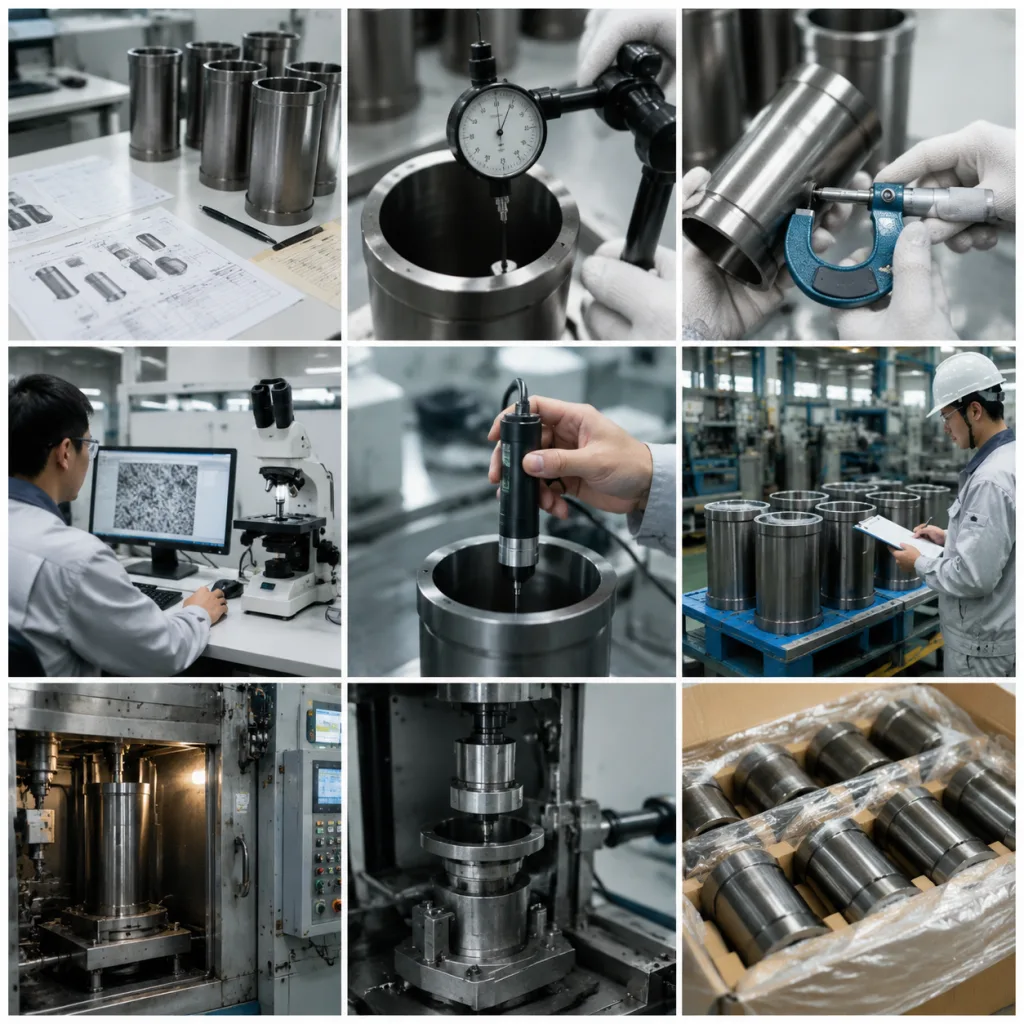
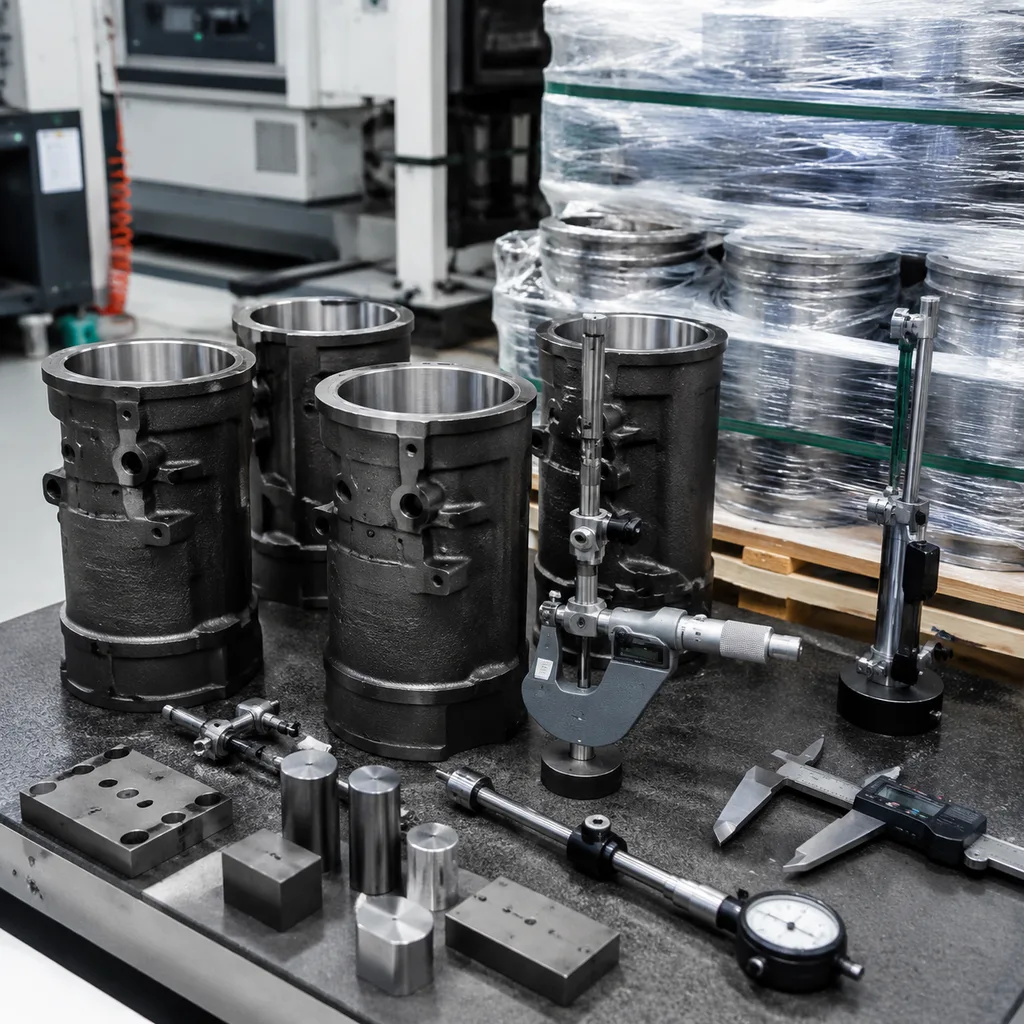
Technical checks should cover material specification, hardness range, casting method, chemical limits, and metallographic requirements such as graphite form or carbide control. Dimension checks should include bore ID, OD, flange height, wall thickness, seating face, groove width, chamfer, and radius tolerance capability. For many machined features, critical diameters may require ±0.01–0.03 mm control, while noncritical lengths may sit around ±0.05–0.10 mm depending on the drawing.
Surface finish should not be left to guesswork. State whether Ra-only reporting is acceptable or whether Rz, Rpk, Rk, and Rvk data is required. Define plateau honing, cross-hatch expectation, oil-retention profile, and inspection location.
Buyers can review standard engine-component coverage in our catalog and use custom manufacturing when the sourcing file requires drawing-based production rather than catalog selection.
Spec Deep-Dive: What Actually Makes a Lexus-Compatible Liner Work
A cylinder liner is judged by what happens after installation: ring sealing, oil control, heat transfer, block interface stability, and wear life. Nominal dimensions matter, but they are not enough. Small errors in cylindricity, wall thickness, hardness, flange geometry, or honing finish can lead to oil consumption, noise, ring seating problems, or premature wear.
Risk shifts by liner type. For press-fit dry sleeves, OD size, roundness, wall thickness, and distortion after installation are often as important as the finished bore. For wet liners, flange height, sealing land condition, groove geometry, corrosion resistance, and cavitation resistance become higher-risk characteristics.
Avoid RFQ language such as “OEM quality liner” or “same as original.” Ask for measurable values, test methods, inspection points, and sampling rules. Final values must come from the controlled drawing, approved sample, or customer-specific standard for the engine family.
| Specification item | Typical procurement requirement | Why it matters |
|---|---|---|
| Material | Centrifugal cast iron or alloy cast iron, drawing-defined; chemistry report per melt or batch | Controls wear resistance, machinability, and thermal stability |
| Hardness | Declared range, commonly about 180–260 HB depending on grade, with batch test report | Helps reduce bore wear, scuffing, and inconsistent machining response |
| Bore cylindricity | Drawing-defined tolerance, often checked at top/middle/bottom and in two axes | Supports ring sealing, compression stability, and oil control |
| Wall thickness variation | Controlled around circumference and along liner height; commonly monitored to avoid local thin spots above 0.10–0.20 mm variation where design is sensitive | Helps prevent distortion during press fit, clamping, or thermal cycling |
| Surface finish | Ra, Rz, and honing cross-hatch defined where required; typical plateau-honed bores may target Ra 0.3–0.8 µm and 35–55° cross-hatch when specified | Influences break-in, oil retention, ring life, and oil consumption |
| Chamfer and edge condition | Burr-free, specified entry angles such as 15–45° and radius limits per drawing | Reduces assembly damage and handling-related rejection |
| Seating and flange features | Flatness, flange height, parallelism, and contact-face finish controlled; flange height may require 0.01–0.03 mm class control on critical designs | Supports correct installation and combustion-load transfer |
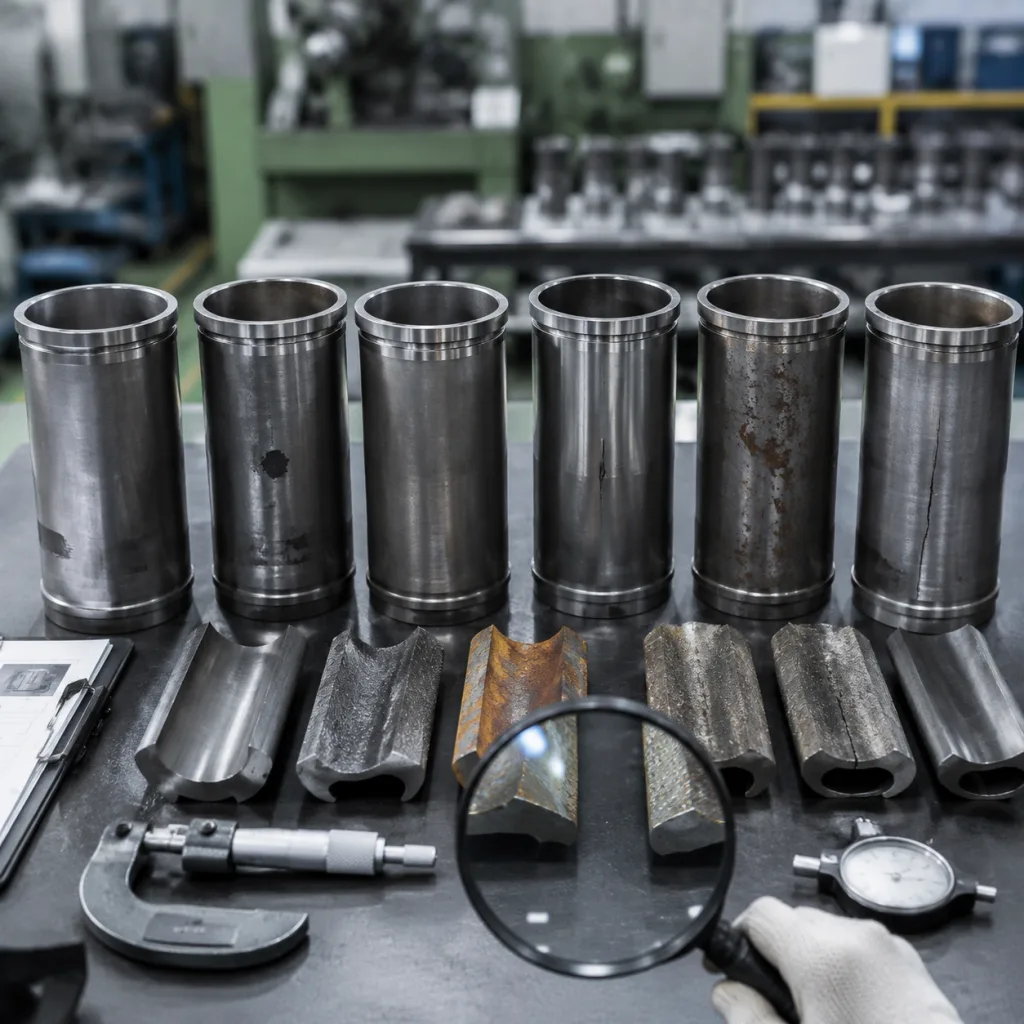
| Visual inspection | No cracks, blowholes, rust, machining burns, dents, dropped-part marks, or honing chatter | Prevents early rejection during receiving inspection |
| Cleanliness | Parts protected from chips, abrasive residue, and corrosion; washing and drying process defined | Reduces assembly contamination and storage risk |
| Traceability | Heat, batch, machining lot, operator/shift, inspection-lot, and packing-lot records | Supports containment, investigation, and corrective action |
| Procurement item | Standard catalog supply | Drawing-based or custom supply |
|---|---|---|
| MOQ | Lower by existing SKU; often 50–200 pcs per reference or mixed orders by carton/pallet where available | Higher due to setup, tooling, fixture, or validation requirements; commonly 300–1,000 pcs per reference or one casting batch |
| Sample lead time | Commonly 2–4 weeks if tooling and blanks exist | Commonly 6–10 weeks depending on drawing review, tooling, foundry schedule, and fixture needs |
| Mass production lead time | Commonly 30–60 days after order confirmation and deposit/LC arrangement | Commonly 45–90 days after PPAP-style or customer approval, longer if new casting tooling is required |
| Price logic | Based on current SKU cost, material weight, machining time, inspection level, packing, and order quantity | Adds tooling amortization, engineering review, sample runs, custom gauges, special inspection, and launch scrap risk |
| Documentation | Inspection report, packing list, export documents | Drawing review, material report, dimensional report, control plan, process flow, and approval records on request |
| Packaging | Neutral export cartons or customer label | Customer-defined label, anti-rust oil/VCI, carton, pallet, barcode, and warehouse specification |
| Stocking plan | Suitable for repeat catalog demand and mixed-container replenishment | Usually tied to forecast, launch order, buffer stock, and agreed replenishment schedule |