Connecting Rod for Ford Escape OE Equivalent: Sourcing Guide
Procurement teams sourcing a connecting rod for Ford Escape OE equivalent need a fitment strategy, not just a part name. The critical variables are engine code, centre distance, big-end and small-end geometry, weight window, and bearing interface. Miss one of those, and a rod that looks correct on paper can create noise, uneven loading, or early wear after installation. Driventus supports B2B sourcing for aftermarket distributors, repair chains, and engine rebuilders that need stable dimensions, documented material control, and repeatable packaging. Driventus is an independent aftermarket manufacturer; brand names are referenced for fitment only. We manufacture to controlled processes under IATF 16949:2016 and ISO 9001:2015, and we can align production with OE-style requirements when the buyer supplies the engine code, sample, or cross-reference data.
Start With Fitment, Not the Badge
For a connecting rod for Ford Escape OE equivalent, the right question is not “does it fit a Ford Escape?” It is “which engine, which rod geometry, and which bearing system?”
That distinction matters because the platform uses different engine families, and the rod must match the target engine variant, piston pin size, crank journal size, and bearing shell arrangement.
A buyer-ready OE-equivalent spec normally includes:
Centre-to-centre length held to the OE drawing tolerance, commonly within ±0.02 mm to ±0.05 mm depending on engine family
Big-end bore diameter controlled to the bearing shell crush spec, typically within 0.01 mm to 0.03 mm on final hone size
Small-end bore or bushing ID matched to wrist-pin clearance, often 0.005 mm to 0.015 mm running clearance
Beam offset, twist, and bend controlled to engine-builder limits, commonly under 0.10 mm twist and 0.10 mm bend on inspection fixtures
Weight class and end-to-end balance matched within the engine set, often within 2 g to 5 g for passenger-vehicle programmes
Bolt specification, torque angle, and stretch target verified if the rod uses torque-to-yield fasteners
If the buyer can provide the OE number, VIN decode, or engine code, Driventus can map the part to fitment and confirm whether the design is cast, cracked-cap forged, or conventional forged steel.
Spec Checks That Actually Catch Failures
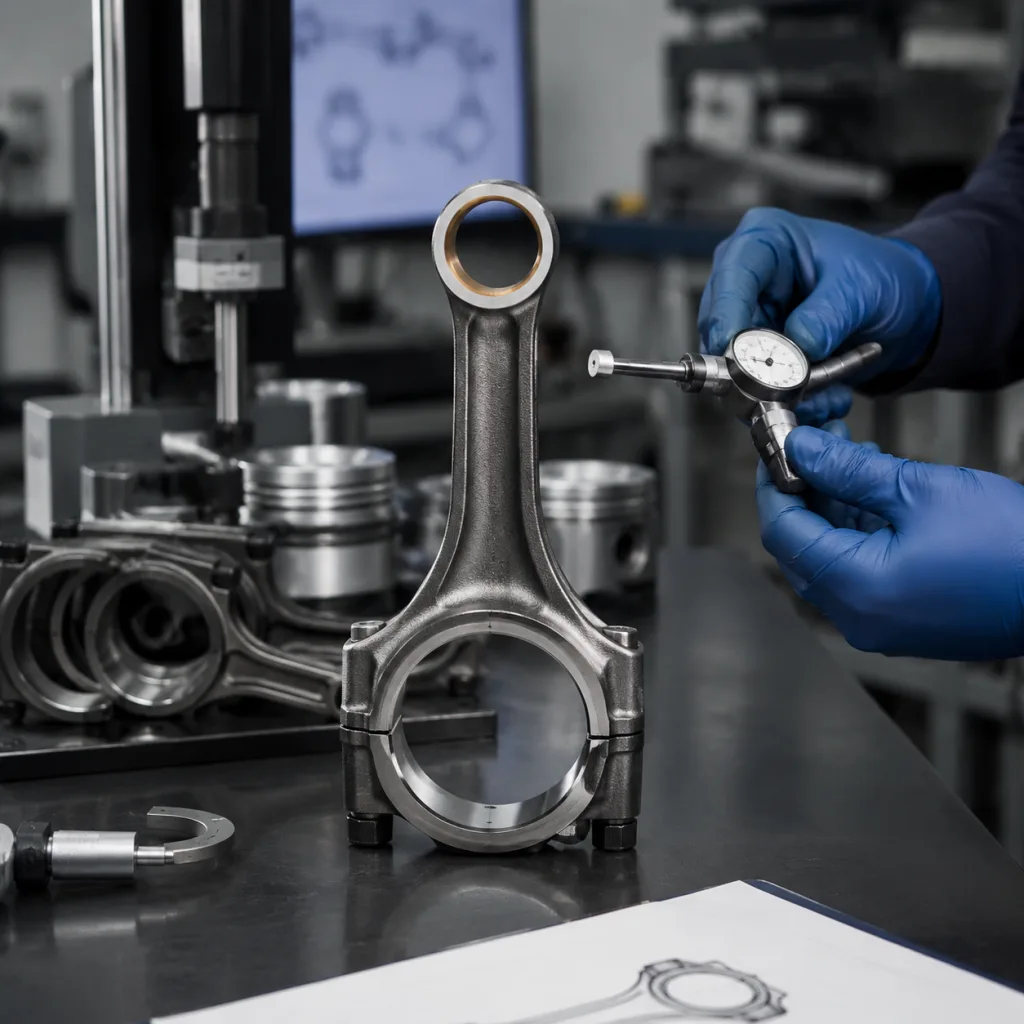
Replacement rods should be validated with metrology, not only catalogue images. The common failure mode is subtle: a slight bore mismatch, a cap fit issue, or a width variation that only shows up after installation.
Check item
Typical procurement requirement
Centre length
Match OE sample or drawing; record nominal and tolerance
Big-end bore
Final hone size within specified tolerance, with roundness and taper controlled
Small-end bore
Match pin diameter and bushing type; confirm surface finish
Rod bolt
Verified grade, thread class, and clamp-load method
Mass
Weight-matched within the engine set, usually 2 g to 5 g
Material
Forged steel or PM steel as specified by application
Surface quality
No cracks, laps, burrs, cap mismatch, or heat-tint marks
</tr></thead><tbody> </tbody></table>Where available, buyers should request a first article report with nominal dimensions, actual measurements, and a sampling plan. A practical purchase package includes:
Material declaration with steel grade or alloy family
Hardness range, often measured in the mid-20s to low-30s HRC for many forged applications, or per drawing requirement
Big-end and small-end bore reports with CMM or bore-gauge readings
Shot-peen or surface-treatment confirmation if specified
Traceability to heat, lot, and production date
For European and UK import programmes, chemical compliance should be checked against REACH (EC) No 1907/2006 when required by the customer’s documentation pack. Buyers who operate private-label or remanufacturing programmes should also ask for packaging specs, corrosion protection, and carton count per master case so inbound handling does not damage machined faces.
Validation Before You Approve the Lot
A rod can pass a visual check and still fail in service. Before first shipment, procurement teams should ask for validation on a sample lot and confirm that the rod passes both fit and durability checks.
Recommended validation steps: 1. Verify engine code, OE number, and application list against the sample. 2. Measure centre length, bore diameters, twist, bend, and width at multiple points; record actual values against the buyer’s tolerance sheet. 3. Confirm cap interchangeability, bearing crush, and fastener seating before torque. 4. Check crack-free condition with magnetic particle or dye penetrant inspection if specified. 5. Review hardness, microstructure, and coating or shot-peen data from the supplier. 6. Fit one sample with bearings and check side clearance, oil film behaviour, and interference to adjacent components. 7. If the rod uses stretch fasteners, validate clamp load by stretch measurement, not torque alone.
A practical approval lot is usually 3 to 10 pieces for dimensional review plus 1 to 2 pieces for teardown or bench fitment, depending on programme risk. Driventus can support this process with inspection records, lot traceability, and control samples. Buyers who need tighter control for private label or rebuild programmes can use custom manufacturing to align the rod to their drawing, packaging, and labelling needs.
How Driventus Structures Replacement Supply
Our production model suits distributors and rebuilders that need repeatable supply, not one-off warehouse shopping. We run controlled processes for forged engine components and maintain documented quality checks under our quality system.
Typical support items include:
OE number cross-reference confirmation when provided by the buyer
Sample approval and dimensional reporting with actual measured values
MOQ planning by engine family, finish state, and packaging format
Pricing logic tied to volume tiers, annual forecast, and tooling scope
Lead-time planning for sample, pilot, and production lots
Packaging for wholesale and export distribution
Batch traceability and inspection records
Multi-market documentation for customs and warehouse intake
Commercially, buyers should expect MOQ to vary by product status: sample lots are often 3 to 10 units, pilot runs 20 to 50 units, and production MOQs may start at 100 to 300 units depending on machining complexity and boxing requirements. Lead time is typically shortest for in-stock or existing-tooling parts, often 2 to 4 weeks for samples and 4 to 8 weeks for production once the order is released; new tooling or engineering changes add time. Price is normally structured by quantity breaks, with the best unit cost at full carton or pallet multiples and separate charges for custom label work, corrosion protection, or documentary packs.
If the project extends beyond one rod number, buyers can review our catalog and the wider engine components range for related parts such as pistons, bearings, and gaskets in the same platform family.
When the Buy Looks Safe—and When It Is Not
A reliable OE-equivalent purchase normally shows four signals: clear fitment data, stable geometry, controlled material source, and a supplier that can document the process. If any of these are missing, the part may still be serviceable, but the sourcing risk rises.
Look for:
Published dimensional controls rather than only application text
OE cross-reference support in the format buyers can audit
Material, hardness, and finish records on request
Evidence of process control under IATF 16949:2016 and ISO 9001:2015
Export packaging that protects machined surfaces during transit
A clear escalation path for mismatch claims, including photo review, retained samples, and corrective-action response time
For buyers building a long-term programme, the main commercial advantage is not a low spot price. It is stable fitment across repeat orders, fewer returns, and easier consolidation across regional warehouses. The best sourcing decision is the one that balances unit cost with dimensional consistency, sampling discipline, and predictable replenishment lead time.
Frequently asked questions
No. Driventus is an independent aftermarket manufacturer; brand names are referenced for fitment only. We supply OE-equivalent replacement parts based on sample, drawing, or cross-reference data.
The best inputs are the engine code, OE number, sample rod, or verified dimensions. Centre length, big-end bore, small-end bore, twist, bend, and bolt type are the most important checks.
Yes. We offer custom manufacturing, packaging, and label control for distributors and rebuilders that need a repeatable B2B supply programme.
If you need a validated connecting rod for Ford Escape OE equivalent, send the engine code, OE reference, or sample photos through our team at /contact.html.