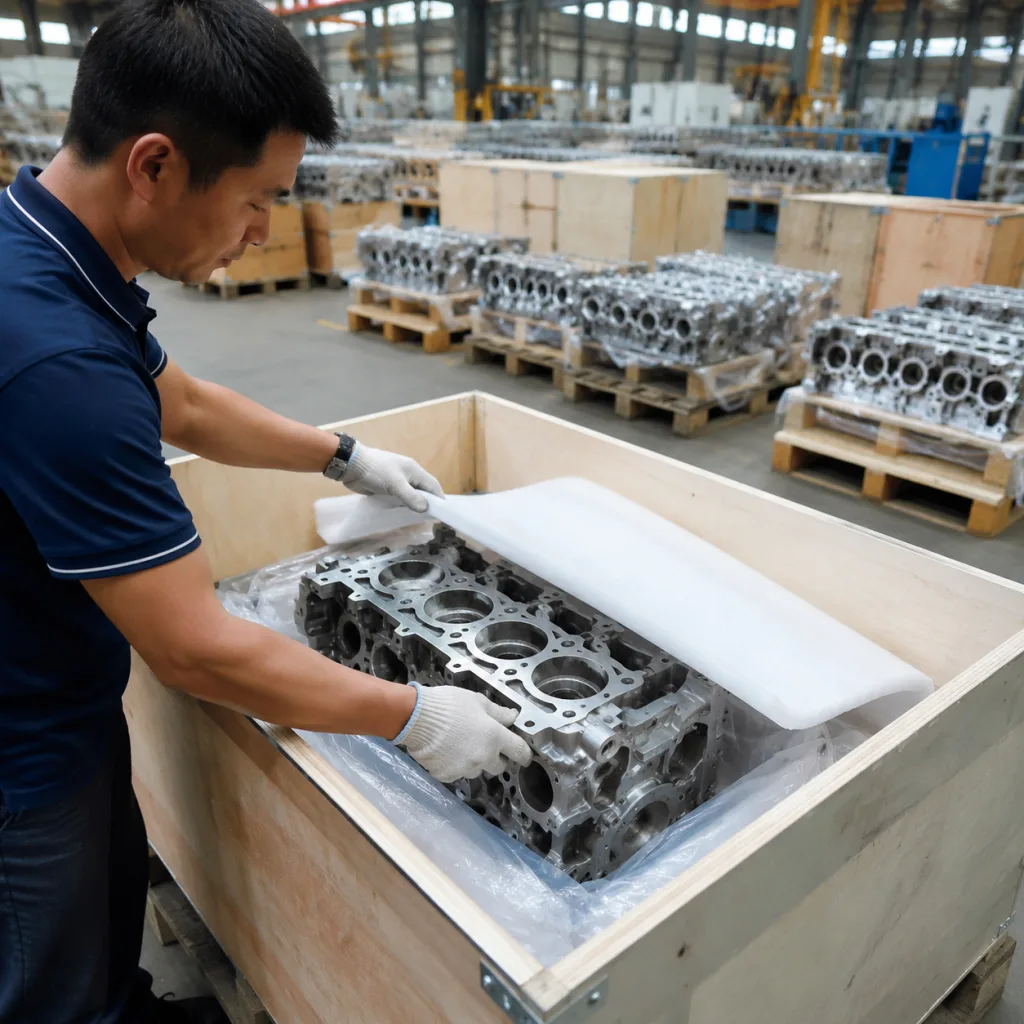
Export packaging for cylinder heads is not just a warehouse task. It affects corrosion control, dimensional protection, customs handling, and complaint rates after arrival. A cylinder head has machined decks, valve seats, threaded ports, and gasket faces that can be damaged by impact or contamination during transit. For procurement teams, the right specification should define the packing method, inner protection, palletisation, moisture control, labelling, and inspection records before shipment leaves the factory. Driventus is an independent aftermarket manufacturer; brand names are referenced for fitment only. This article explains what to verify for cylinder head packaging requirements export, using practical checkpoints that support container shipping, mixed-pallet consolidation, and long-distance transport to the EU, UK, US, Canada, Australia, and Brazil.
Why export packaging matters for cylinder heads
Cylinder heads are heavier and more sensitive than many buyers expect. A typical casting can be distorted by poor stacking, while machined faces can corrode if the pack does not control humidity. For export, packaging must protect the part through warehouse handling, trucking, port transfer, ocean freight, and destination receiving.
Key risks to control:
Deck-face contact and abrasion
Thread damage on coolant and oil ports
Broken studs, plugs, or dowels
Corrosion on bare cast iron or aluminium surfaces
Carton collapse under pallet compression
For buyers, the packaging spec should be written as part of the purchase order or supplier agreement, not left to informal practice. That is especially important when sourcing mixed programmes, OE-cross-reference items, or low-volume lines with variable order frequency.
Minimum packaging specification to request
A clear export pack standard should define each layer of protection. At minimum, ask the supplier to document the following:
Item
What to verify
Surface protection
Anti-rust oil, VCI film, or desiccant-based moisture control for the full transit period
Part restraint
Foam, corrugated inserts, or moulded separators that prevent face-to-face contact
Primary pack
Individual carton or tray sized to stop movement inside the box
Secondary pack
Master carton or crate with stated compression strength
Pallet unit
ISPM 15-compliant wooden pallet or approved export pallet design
Labelling
Part number, quantity, batch traceability, gross/net weight, country of origin
Documents
Packing list, commercial invoice, and photos of packed goods before dispatch
</tr></thead><tbody> </tbody></table>For aluminium heads, the pack must also prevent galvanic staining and scratching. For cast iron heads, the focus is usually oxidation control and impact resistance. If the programme includes an OE 06A107065-style cross-reference, confirm that the pack identifies the supplier part number as well as the customer reference.
How to confirm packaging before shipment
Use a simple approval process before first delivery and after any pack change.
1. Review the packing drawing or work instruction. 2. Check whether the head is individually protected or packed in pairs. 3. Confirm all machined surfaces are separated from hard contact points. 4. Verify desiccant quantity, VCI coverage, or oil specification for the expected transit time. 5. Inspect pallet height, overhang, and banding method. 6. Request pre-shipment photos showing internal and external pack condition. 7. Record the approved pack version in your supplier file.
If the supplier offers custom manufacturing, ask whether packaging can be adapted for regional freight conditions, such as humid sea lanes, bonded warehouse storage, or drop-ship distribution. That reduces the chance of having one universal pack that is too weak for export or too expensive for domestic routes.
Testing and quality controls buyers should ask for
Packaging claims are only useful when they are tested. Procurement teams should ask whether the supplier validates export packs under defined methods and internal release checks.
Relevant controls include:
Drop or shock testing for carton integrity
Compression checks for stacked pallets
Moisture exposure checks for rust-sensitive surfaces
Visual inspection for casting damage after transit simulation
Traceability checks against batch and packing records
A supplier working under an quality system aligned with IATF 16949:2016 and ISO 9001:2015 should be able to show standard work for packing inspection, nonconformance handling, and corrective action. For export into regulated markets, material and chemical compliance may also need review against REACH (EC) No 1907/2006. If the project includes vehicle-specific fitment claims, buyers should still validate dimensions, port layout, and gasket face geometry against the approved drawing set.
Common export pack mistakes
Most packaging failures are repeatable and preventable. The most common issues are:
Mixing heavy heads with lighter parts in the same carton
Leaving machined faces exposed to cardboard dust or metal contact
Using weak tape or low-grade strapping that fails in humid conditions
Packing without desiccant for sea freight routes
Omitting clear part identification on inner packs
Building pallets that overhang the footprint and crush corners
A practical rule is that the packaging should survive normal freight handling without needing repacking at destination. If your network includes regional distribution or multi-location repair chains, standardised pack dimensions help with shelf storage, barcode scanning, and receiving checks. Buyers sourcing related engine parts may also want to review our catalog and the broader engine components range so packaging rules stay consistent across families.
What to include in a purchase order pack note
A purchase order note should be specific enough that the factory can execute without interpretation. Keep it short and measurable.
Suggested pack note fields:
Part number and revision
Individual or bulk pack quantity
Rust-prevention method
Carton type and pallet type
Maximum pallet height and weight
Labelling language and barcode format
Photo release required before dispatch
Any country-specific import marking
This is also the right place to state whether the buyer requires mixed-SKU pallets or single-SKU pallets. Single-SKU pallets are easier to count and inspect. Mixed pallets may improve freight efficiency, but they raise the risk of mis-picks and label errors. If the sourcing team wants a packaging standard tailored to a project, use request a quote after aligning the technical pack note with the commercial terms.
Frequently asked questions
Yes, in most cases. Individual protection reduces face contact, scratching, and part-mix risk. For bulk projects, ask the supplier to show how separators and restraint prevent movement inside the master carton.
It depends on the route and base material. Cast iron generally needs corrosion protection; aluminium still needs contamination control and surface protection. Desiccant, VCI film, or oil can be used if the transit time is long or humid.
At minimum, use a packing list, commercial invoice, and pallet or carton label set matching the part number and quantity. Photos of the packed goods are also useful for claims handling and receiving checks.
If you need export-ready cylinder head packaging aligned with your route, quantity, and inspection requirements, contact the team through /contact.html for a reviewed pack specification.