Procurement teams sourcing a cylinder head Lexus supplier need more than a catalogue match. The critical questions are dimensional compatibility, alloy and casting quality, machining repeatability, packaging, traceability, and whether the supplier can support stable replenishment across model years and engine variants. For Lexus applications, the part must align with the correct OE reference, valve seat geometry, cam journal alignment, coolant passage integrity, and head bolt clamp characteristics. Driventus supplies cylinder heads to aftermarket distributors, OEM and Tier-1 buyers, and repair-chain networks. Our production is supported by IATF 16949:2016 and ISO 9001:2015 processes, with export documentation for EU, UK, US, Canada, Australia, and Brazil. Driventus is an independent aftermarket manufacturer; brand names are referenced for fitment only.
What procurement teams should verify before sourcing
When evaluating a cylinder head Lexus supplier, start with the exact engine code and OE cross-reference, then confirm the machining specification against the target application. A correct part number is not enough on its own.
Minimum verification points
OE cross-reference and engine family, for example OE 06A107065 only when the reference is already known from the buyer’s catalogue
Casting material, typically aluminium alloy for many modern applications
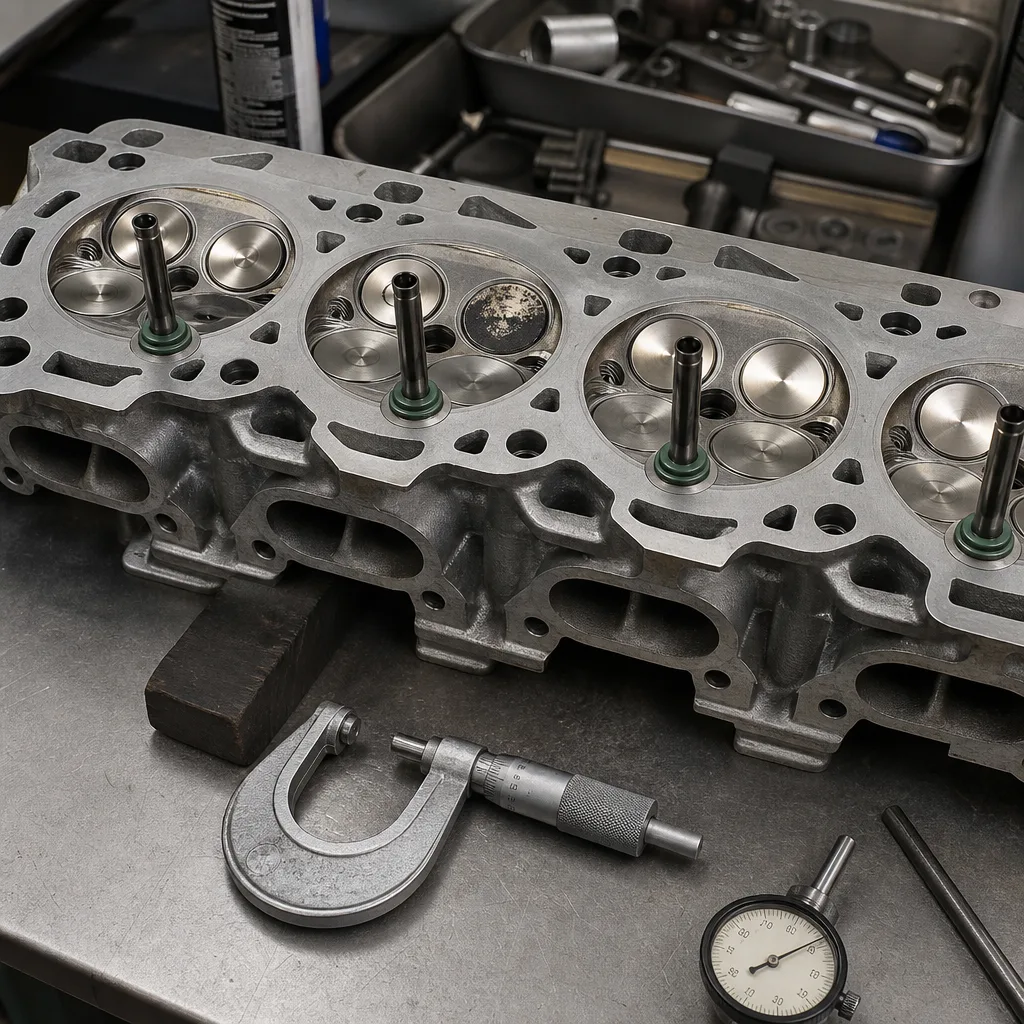
Valve seat and guide fitment, including interference fit control
Deck flatness, combustion chamber volume, and port geometry
Pressure testing for coolant jackets and oil galleries
Packing method to prevent flange damage during ocean or air freight
For mixed fleets, buyers should also verify whether the head is supplied bare, with valves and springs, or as a complete assembly. This affects landed cost, inventory turns, and workshop labour. Our catalog supports part-number screening before sample release, and our engineering team can review fitment data against drawings or sample parts.
Factory capability and certification data buyers request
A supplier should be able to show how production is controlled from incoming material through final inspection. For cylinder heads, that usually includes casting inspection, CNC machining control, torque-critical face checks, and leak testing.
Buyer checkpoint
What to ask for
Why it matters
Management system
IATF 16949:2016, ISO 9001:2015 certificates
Confirms documented process control
Material traceability
Heat number or batch traceability
Supports recall management and warranty claims
Dimensional control
Flatness, valve seat concentricity, guide bore data
Affects sealing and valvetrain life
Leak testing
Pressure or submerged leak test records
Screens coolant and oil passage defects
Compliance
REACH (EC) No 1907/2006 declaration where applicable
Supports EU chemical compliance files
</tr></thead><tbody> </tbody></table>Procurement teams in the UK, EU, and Australia often request a factory audit pack before placing volume orders. Driventus can provide process summaries, inspection checkpoints, and sample documentation for supplier onboarding. Our quality system page explains the control flow from raw casting to packed shipment.
Fitment control for Lexus applications
Lexus engines often share architecture with Toyota passenger and light-commercial platforms, but fitment should still be validated by engine code, head type, and emissions-era differences. Small changes in coolant port layout, cam cover bolt pattern, or sensor bosses can create installation issues.
Use the following checks before approving a replacement:
1. Confirm the engine code, not only the model badge. 2. Match the OE number, casting revision, and valve count. 3. Verify whether the part is for VVT-i or non-VVT-i applications. 4. Check compression ratio and chamber volume against the original. 5. Confirm gasket interface and head bolt pattern.
If the buyer is replacing damaged stock across multiple branches, one validated sample should be retained for comparison against incoming lots. That reduces dispute risk and supports consistent claims handling. For broader powertrain sourcing, see our catalog and engine components for related items.
Lead times, MOQ, and packaging for export orders
B2B buyers usually compare unit price against fill rate, not price alone. A cylinder head supplier should be able to quote MOQ, sample lead time, production lead time, and packing density clearly.
Typical commercial points to confirm
Sample lead time: usually shorter than batch production, subject to pattern and machining status
MOQ: depends on casting set-up and machining line allocation
Carton and pallet specification: important for sea-freight stability
Coating or corrosion protection: especially for humid routes and warehouse storage
Label data: part number, batch code, country of origin, and carton count
For distributors, the ideal programme is a stable reorder schedule with controlled inventory cover. For repair-chain groups, the priority is fewer part-number errors and better box-level traceability. Driventus can align supply schedules to customer forecast windows and can support custom manufacturing where buyers need application-specific machining or packaging.
Validation, warranty, and aftermarket risk control
Cylinder head failures after installation are expensive because they can affect labour, gaskets, coolant systems, and sometimes pistons or valves. Procurement teams reduce risk by requiring pre-shipment validation and documented inspection records.
Common validation items include:
Visual inspection for porosity, cracks, and machining chatter
Flatness measurement on the deck surface
Thread and boss inspection for stripped or incomplete machining
Pressure testing of water jackets and oil galleries
Random sample teardown on first article and pilot batches
Buyers should also define warranty terms by defect type, claim window, and evidence requirements. The most useful supplier response is a clear nonconformance workflow, not a vague promise. Driventus supports documented corrective action and batch traceability through its quality system.
How Driventus supports sourcing teams
Driventus is a vertically integrated manufacturer in Taizhou, Zhejiang, with export experience in more than 60 countries. For procurement teams, the main value is control: casting, machining, inspection, packing, and export paperwork are managed within one supply chain.
What buyers can expect:
Technical screening of fitment data before quotation
Batch traceability and inspection records
Support for sample approval and production release
Stable communication for reorder planning
Export documentation suited to customs and distribution networks
We work with aftermarket distributors, OEM and Tier-1 supply chains, and multi-location repair groups. If you are building a sourcing programme for Lexus-related engine programmes, please request a quote with engine code, OE reference, target quantity, and destination market. Driventus is an independent aftermarket manufacturer; brand names are referenced for fitment only.
Frequently asked questions
Yes. OE reference and engine code are the preferred starting points. Model names alone can hide mid-cycle changes in head design, valve train layout, or emissions-spec differences.
Yes. Buyers can request samples, dimensional checks, and validation records before release. This is standard for new programmes and cross-market fitment verification.
Typical documents include commercial invoice, packing list, batch identification, and inspection records. We can also support quality documentation aligned to customer onboarding requirements.
If you are sourcing for distribution, repair networks, or programme replacement, send your engine code and target quantity and we will review fitment and availability. [Request a quote](/contact.html).