Camshaft for Honda Pilot OE Equivalent: Buyer Guide
Procurement teams sourcing a camshaft for Honda Pilot OE equivalent need more than a part that fits the bore. They need matching lobe geometry, journal diameters, surface finish, and hardness that align with the engine build and service interval. For replacement programmes, the focus is dimensional consistency, correct phasing, and predictable wear performance across batches. Driventus supplies engine components for B2B programmes and supports buyers who need stable production data, traceability, and export documentation. Driventus is an independent aftermarket manufacturer; brand names are referenced for fitment only. For buyers comparing suppliers, the practical questions are whether the camshaft matches OE installation dimensions, whether the heat treatment is controlled, and whether validation testing covers the duty cycle required by the application. This article outlines what to verify before placing a purchase order and how to reduce mismatch risk on Honda Pilot replacement projects.
What OE-equivalent means for a Honda Pilot camshaft
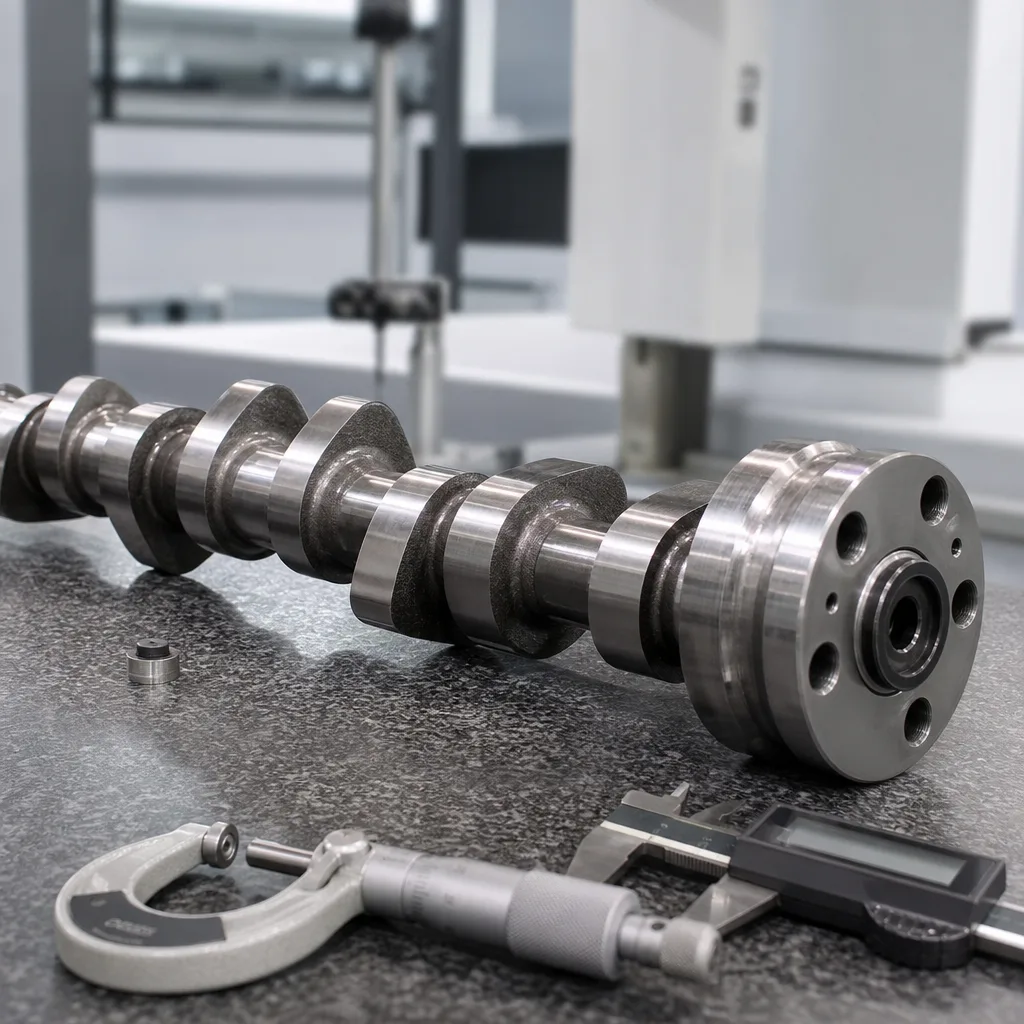
For procurement, OE-equivalent means the camshaft must match the functional and installation characteristics of the original part, even if it is not an original branded component. That includes:
Journal diameter and roundness
Overall length and thrust face location
Lobe lift, base circle, and lobe separation
Timing index and sprocket interface geometry
Material grade and heat-treatment profile
Surface hardness and finish on journals and lobes
A replacement programme should not rely on appearance alone. Two camshafts can share the same external outline and still differ in timing or lobe profile enough to affect idle quality, emissions, and valvetrain wear. For this reason, dimensional inspection and runout control are central to OE-equivalent sourcing.
Driventus is an independent aftermarket manufacturer; brand names are referenced for fitment only.
Key checks before you approve a purchase order
Use a sample-based validation plan before full release. A practical buyer checklist is below.
Check item
What to verify
Why it matters
OE cross-reference
OE 06A107065 or the applicable catalogue reference
Confirms fitment target
Journal size
Measured to drawing tolerance
Prevents oil clearance issues
Lobe profile
Lift, duration, and phase alignment
Maintains valve timing
Hardness
Confirmed by test report
Reduces premature wear
Runout
Measured on V-block or centre fixture
Prevents vibration and noise
Surface condition
No scoring, pitting, or burrs
Protects lifter and bearing surfaces
</tr></thead><tbody> </tbody></table>If your programme covers multiple trim levels or engine codes, lock the approved part number to the vehicle VIN, engine family, and production year range. A single listing can still cover multiple variants only when the timing and sensor interfaces are identical.
Materials, heat treatment, and durability expectations
A camshaft is a wear component, so metallurgical control matters. Buyers should ask for the material specification and the heat-treatment method used on the working surfaces. For replacement use, common expectations include induction-hardened lobes, controlled journal hardness, and stable core toughness to resist fracture under cyclic loading.
Published standards may be used as reference points in purchasing specifications and quality agreements, including IATF 16949:2016 and ISO 9001:2015 for quality management, and REACH (EC) No 1907/2006 for chemical compliance in the EU. Where validation is required, buyers often request bench endurance testing, dimensional inspection records, and surface integrity checks.
For multi-market distribution, ask for the following documents:
Material certificate or internal test summary
Hardness test report
First article inspection record
Packaging and traceability record
Country-of-origin documentation
If the part is intended for a repair network, consistency between batches is usually more important than achieving unusually tight cosmetic appearance.
How Driventus supports replacement programmes
For B2B buyers, supply continuity depends on technical alignment and process control. Driventus manufactures engine and powertrain components in Taizhou, Zhejiang, and exports to 60+ countries. The company supports catalogue sales, private label programmes, and custom manufacturing when a customer needs a specific OE-equivalent target.
Relevant internal resources:
Browse our catalog for engine components and related part families.
Review our quality system for certification and inspection approach.
Use custom manufacturing when your programme needs a drawing-based solution or special packaging.
For buyers handling broader engine programmes, the engine components overview is useful when a camshaft purchase is bundled with gaskets, pumps, or valvetrain parts.
A replacement project is normally approved after sample fitment, dimensional comparison, and sign-off on packaging, labelling, and lead time.
Validation testing that reduces field returns
A replacement camshaft should be validated under conditions that reflect real service, not only static measurement. At minimum, ask for evidence of the following:
1. Dimensional inspection against the reference drawing or master sample. 2. Hardness verification on lobes and journals. 3. Concentricity and runout measurement. 4. Fitment trial in the target cylinder head or test fixture. 5. Functional run test where applicable.
If your purchasing specification includes durability targets, you may also request testing aligned with customer-defined duty cycles or recognised test methods such as SAE J2527 where relevant to component durability validation, or application-specific internal standards. For emission-sensitive programmes, confirm that the replacement part does not alter the calibrated valve event timing beyond the permitted window.
The most common sourcing failure is a part that fits mechanically but changes engine behaviour because the lobe profile or indexing is wrong. That is why OE-equivalence must be proven, not assumed.
Frequently asked questions
No. OE-equivalent means the camshaft matches the required fit, function, and key dimensions for the application. It is not an OEM-branded part, and it should be verified by measurement and fitment testing.
Request a drawing or dimensional summary, material and hardness data, sample photos, traceability details, and a fitment confirmation against the engine code and OE reference.
Yes. Driventus supports custom manufacturing for drawing-based or programme-specific requirements, including packaging and documentation for export markets. Use the contact page to discuss your specification.
If you are qualifying a camshaft for Honda Pilot OE equivalent, share your target engine code, sample, and annual volume so we can review the match and production plan. Request a quote at /contact.html