Cylinder Head Isuzu Supplier: Sourcing Guide
If you are sourcing a cylinder head Isuzu supplier for aftermarket distribution, fleet service, or OEM programmes, the useful questions are practical, not promotional. Buyers need fitment, machining consistency, material control, delivery reliability, and traceable quality records before they place an order. A cylinder head is a precision casting and machining assembly, so small variation in deck flatness, valve-seat geometry, or coolant passage finish can affect compression, sealing, and durability. Driventus is an independent aftermarket manufacturer; brand names are referenced for fitment only. For procurement teams, the real task is comparing suppliers on documented process control, test coverage, and commercial terms such as MOQ, pack format, and lead time. This guide focuses on what to verify, how to compare offers, and where cylinder head supply programs usually fail.
Step 1: Confirm fitment before price
For cylinder head sourcing, start with fitment and traceability rather than price. Confirm the engine family, OE cross-reference, combustion chamber volume, valve layout, port configuration, and gasket face dimensions. If the listing uses an OE reference, record it exactly, for example OE 897074-1230 or OE 8-97317-123-0 when provided by the programme owner.
Key checks:
- Casting material: aluminium alloy or cast iron, depending on application
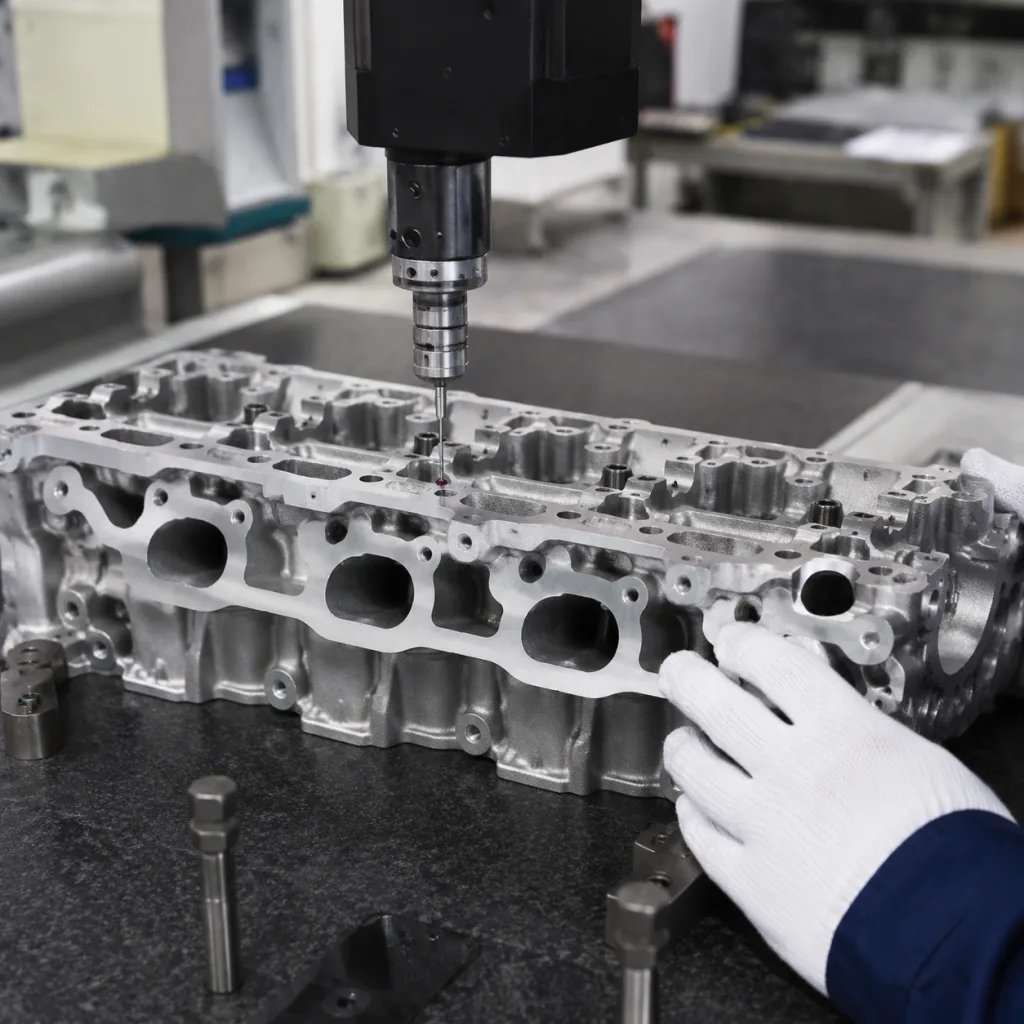
- Machining tolerance: deck flatness within 0.05 mm over the sealing face, seat concentricity within 0.03 mm TIR, and valve guide clearance typically 0.015-0.040 mm depending on valve size
- Valve train configuration: number of valves, valve stem diameter, spring pack, and installed height
- Surface finish: gasket face roughness target Ra 1.6-3.2 μm and port deburr control
- Traceability: heat number, batch code, casting cavity code, and inspection record
If a supplier cannot confirm these items quickly, the quote is not yet usable. For mixed sourcing, compare not only the finished part but also incoming material control and in-process gauging. Those two controls usually explain most field variation and are often the difference between a stable programme and recurring claims. Ask whether the supplier maintains control plans by part number and whether critical dimensions are recorded on first-off and patrol inspection sheets rather than only at final inspection.
Where suppliers usually fail
The most common cylinder head failures are predictable, which makes them useful as a screening tool. A strong supplier should be able to explain how it prevents each one, not just promise that defects are rare.
Typical failure modes:
- Porosity in the casting that later shows up as coolant seepage or pressure-test leakage
- Distortion after machining, especially on the deck face and combustion chamber side
- Valve-seat mismatch from inconsistent interference, seat depth, or concentricity
- Thread damage from poor tool control or weak deburring
- Mixed revisions when programme changes are not locked by part number and batch code
If a quotation looks cheap but the supplier cannot show in-process controls, expect cost to return later as claims, sorting, and replacement freight. The better question is whether the supplier can show how it prevents repeat defects across batches. Request sample inspection reports with actual measured values, not only pass/fail marks, so your quality team can compare the supplier’s process capability against your internal acceptance standard.
What a credible supplier must show
A credible Isuzu cylinder head supplier should be able to show a documented quality system, process flow, and test method summary. At minimum, ask for certification to IATF 16949:2016 and ISO 9001:2015, plus evidence of controlled inspection equipment and calibration records. For export markets, ask for material compliance statements relevant to the destination, including REACH (EC) No 1907/2006 where applicable.
Driventus supports procurement reviews with a structured document pack. Our quality system covers process control, dimensional inspection, and final release checks. If you need application-specific development, our custom manufacturing page explains how we handle drawing review, sample approval, and production planning.
A factory audit should cover:
- Incoming alloy or casting verification, including chemistry certificate review and heat traceability
- CNC programme control, tool life tracking, and revision management
- Pressure testing for coolant and oil circuits, with test pressure and hold time recorded
- Valve seat and guide inspection frequency, plus measured results for sample pieces
- Final visual criteria for porosity, cracks, thread damage, and machining burrs
Do not accept a generic capability statement without method details. Buyers need repeatable evidence, not broad claims, and the strongest suppliers will show how their controls are applied in production, not only in a brochure.
How to compare offers fairly
Procurement teams often compare suppliers on unit price only, but cylinder head programmes are sensitive to total landed cost. Packing, palletisation, inland freight, sampling lead time, and corrective action response all affect supply continuity. Ask each supplier to quote the same commercial basis and the same pack quantity.
| Commercial item | What to confirm |
|---|---|
| MOQ | Minimum order per part number and per shipment; many programmes start at 50-100 pieces for trial orders and 200-500 pieces for regular production, depending on tooling and packaging |
| Lead time | Sample lead time, usually 2-4 weeks for stock tooling or 4-8 weeks for new machining setup, and production lead time, often 30-45 days after order confirmation |
| Warranty terms | Coverage period, claim evidence required, and whether the supplier replaces or credits parts after validation |
| Packaging | Inner protection, carton strength, pallet type, moisture protection, and whether gaskets or plugs are pre-installed |
| Documentation | Invoice, packing list, COO, inspection report, and any batch-level traceability files |
| Incoterms | EXW, FOB, CIF, or destination terms, including who pays inland freight and export handling |
| Price breaks | Tiered pricing by volume, sample fee policy, and whether tooling or fixture amortisation is separate |