A cylinder head Hyundai supplier should not be chosen by unit price alone. The part sits at the intersection of combustion sealing, coolant flow, oil control, valve-train geometry, and installation reliability. If casting porosity, deck finish, guide clearance, thread quality, or cleanliness drifts after approval, the buyer pays later through leakage claims, overheating complaints, compression loss, rework, and vehicle downtime.
Driventus Auto Parts manufactures engine and powertrain components in Taizhou, Zhejiang, and exports to more than 60 countries. Our Hyundai-fit cylinder head programs support aftermarket distributors, OEM and Tier-1 sourcing teams, and multi-location repair chains that need repeatable fitment, documented inspection, and clear commercial terms. Supply options typically include aluminium alloy bare castings, machined bare heads, and assembled heads with valves, guides, seats, springs, seals, plugs, and other hardware defined by the buyer’s bill of material.
This article is structured as a sourcing decision file rather than a general overview. It covers the approval logic, the failure modes to prevent, the commercial variables that change price, the documents worth requesting, and the audit checks that separate a capable factory from a sample-only supplier. Driventus is an independent aftermarket manufacturer; vehicle brand names are used for fitment reference only.
Start With the Approval Decision, Not the Sample
The first question is not “Can the supplier send a cylinder head?” It is “Can this supplier repeat the approved condition for the next 500, 5,000, or 20,000 pieces?” A single clean sample proves very little if later batches shift in porosity, CNC location, surface roughness, valve-seat quality, or washing discipline.
A qualified cylinder head Hyundai supplier should be judged against a short approval framework:
1. Define the supply condition. Is the RFQ for an unfinished casting, semi-machined casting, machined bare head, or fully assembled head? 2. Lock the technical baseline. Confirm drawings, samples, critical-to-quality dimensions, alloy requirement, gasket-face finish, pressure-test scope, and buyer acceptance standards. 3. Verify the process path. Review casting control, heat treatment where applicable, CNC machining, valve-seat and guide operations, washing, assembly, final inspection, and packing. 4. Check repeatability evidence. Ask for batch traceability, in-process inspection records, pressure-test results, calibration records, and nonconformance handling. 5. Compare quotes only after scope is equal. A lower price may exclude plugs, assembly components, 100% pressure testing, special packing, or required inspection reports.
For B2B sourcing, supplier evidence should cover:
Manufacturing scope: casting management, CNC machining, valve-seat and valve-guide operations, washing, assembly where required, and final inspection.
Quality certification: current IATF 16949:2016 and ISO 9001:2015 certificates available for review, with a scope relevant to engine or machined automotive components.
Traceability: batch codes linked to raw material, casting lots, heat treatment where applicable, machining records, pressure-test data, and final inspection results.
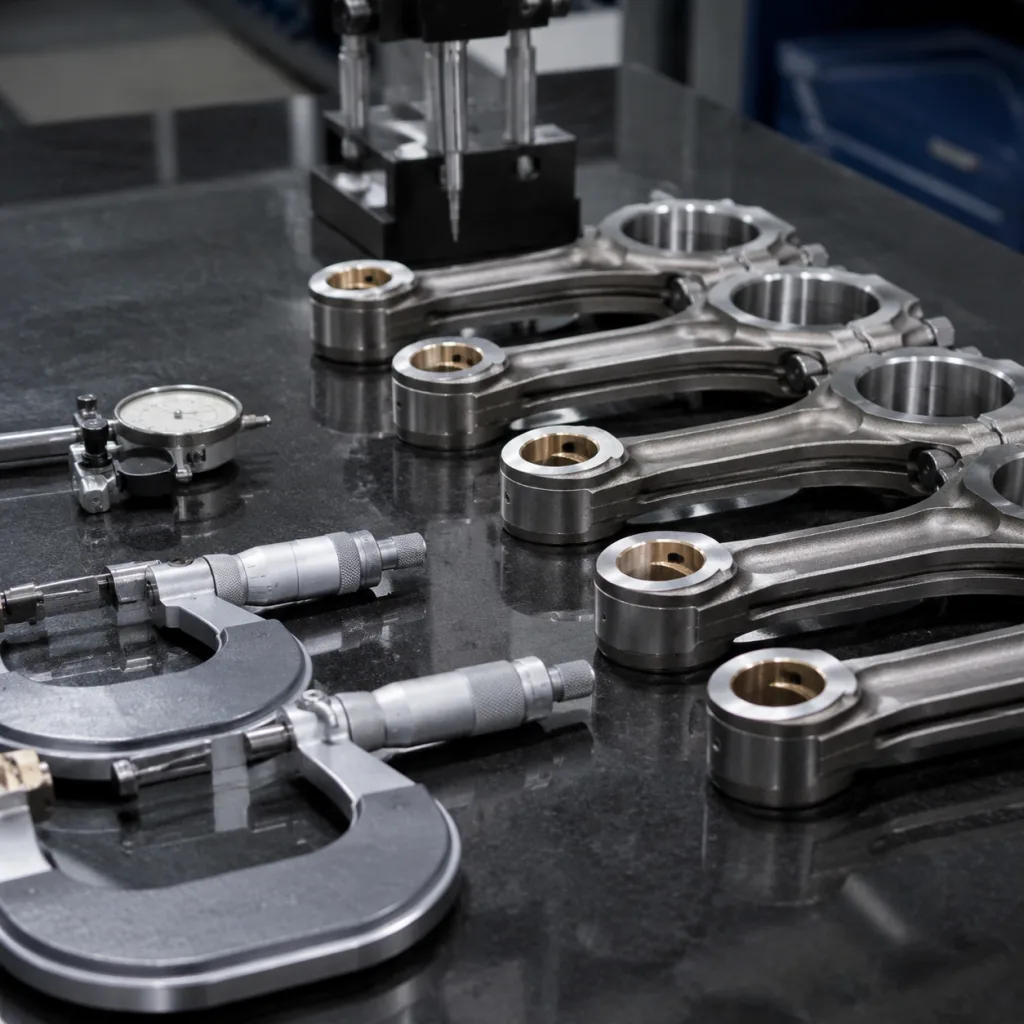
Dimensional control: CMM checks, deck flatness inspection, thread gauging, valve-guide bore measurement, valve-seat position checks, and camshaft bearing alignment verification where relevant.
Process capability: first-off approval at shift start, tool-life limits for critical cutters, in-process checks for key machined features, and reaction plans when dimensions trend toward tolerance limits.
Export readiness: packing list, commercial invoice, certificate of origin where required, and destination-market compliance declarations requested by the buyer.
Engineering communication: ability to review drawings, samples, fitment data, and customer-specific acceptance standards before production.
A machined bare head should normally include finished gasket faces, combustion chambers, ports, valve-seat and guide bores, cam journal or bearing areas where applicable, threaded holes, plug installation if specified, washing, pressure testing, and final inspection. An assembled head needs more definition: valve material, seat insert material, guide material, spring load, installed height, seals, keepers, plugs, and any torque or leak-test checks.
Driventus supplies aftermarket cylinder heads for Hyundai-fit applications according to customer specifications, sample benchmarks, or drawings. For related sourcing programs, buyers can review our catalog and the engine component range at /products/engine-components.html.
Failure Modes to Prevent in a Hyundai-Fit Cylinder Head Program
Most field problems begin as small process escapes. A gasket face is slightly too rough. A coolant passage has hidden porosity. A guide bore runs loose. A threaded hole passes visual inspection but fails under torque. None of these issues looks dramatic in a carton. All can become expensive after installation.
Failure mode to control
Why it matters to procurement
Typical verification method
Alloy mismatch or unstable chemistry
Affects strength, thermal conductivity, corrosion resistance, and machinability
Spectrometer report by batch; aluminium alloy grade confirmed against drawing or buyer standard
Can affect dimensional stability and mechanical properties
Furnace record, hardness check, process log, retained time/temperature chart by lot
Deck flatness error
Risks head gasket failure and compression loss
Precision straightedge, surface plate, or CMM; typical target often within 0.03–0.05 mm depending on head length and drawing
Wrong gasket-face roughness
Can conflict with MLS or composite gasket requirements
Roughness tester and recorded Ra values; common MLS range is about Ra 0.4–1.2 µm unless otherwise specified
Valve-seat runout
Reduces sealing, combustion efficiency, and valve life
Dial indicator or dedicated seat gauge; common runout target is 0.03–0.05 mm where specified
Incorrect guide clearance
Causes oil consumption, valve instability, or noise
Bore gauge, plug gauge, stem clearance check; clearance tied to valve stem diameter and engine specification
Camshaft bore misalignment
Can lead to abnormal wear, seizure, or valvetrain noise
Line-bore inspection, CMM, dedicated gauge; alignment and bore size recorded for OHC heads
Weak or damaged threads
Creates installation failure during engine repair
Go/no-go gauges and torque sample checks; 100% gauging often used on head bolt, manifold, and plug threads
Residual chips or contamination
Can introduce debris into oil or coolant circuits
Washing validation, visual inspection, compressed-air blowdown, residue checks where required
</tr></thead><tbody> </tbody></table>Pressure testing deserves precise language. “Leak tested” is not enough. Buyers should request the test medium, pressure, hold time, sealing fixture, acceptance limit, and record format. Common aftermarket practice is to test coolant and oil circuits separately where design allows, often around 0.3–0.6 MPa for 30–90 seconds. The correct value, however, must follow the drawing, application requirement, or customer standard.
A practical control plan separates 100% checks from sampling checks. Pressure testing and visual casting inspection are often full-lot controls. CMM layout, roughness, hardness, and destructive checks are usually scheduled by lot, shift, or agreed AQL. Any repair welding, impregnation, thread repair, or rework policy should be disclosed before approval, not discovered during a warranty dispute.
For export programs, Driventus normally defines the control plan before mass production. Depending on part family and customer requirements, it can include incoming material checks, first-article inspection, in-process machining checks, pressure testing, cleaning validation, final inspection, and packing verification.
Buyers can review our quality system for the structure of certification and process control. IATF 16949:2016 and ISO 9001:2015 do not replace part validation, but they provide a recognized framework for document control, corrective action, supplier management, calibration, risk review, and monitoring after release.
Compare Quotes by Scope: MOQ, Lead Time, Packing, and Test Level
Two cylinder head quotations can look similar and still describe different products. One may include plugs, 100% pressure testing, protected gasket faces, and assembled valve-train components. Another may cover only a machined bare head with basic export packing. Procurement teams should normalize the scope before negotiating price.
Use this comparison logic:
MOQ: model-dependent. Active machined-head programs may support trial ranges of 20–50 pcs. Low-volume or new-development items may require 100–300 pcs to cover casting, fixture, and setup economics.
Sample lead time: commonly 20–45 days, depending on tooling, machining fixtures, sample availability, and whether the item is already in production.
Mass production lead time: commonly 45–75 days after deposit and confirmed specification, subject to order size, material availability, casting queue, heat treatment, machining capacity, and packing material availability.
Price structure: unit price should be separated from tooling or fixture cost, sample cost, assembly component cost, inspection surcharge, special packing, and freight basis.
Packaging: neutral export cartons, palletised packing, customer label formats, carton marks, barcode requirements, VCI bag or moisture barrier where required, and foam or molded protection for gasket faces and ports.
Incoterms: FOB Ningbo/Shanghai, CIF, or other terms by agreement.
Payment terms: based on order value, customer history, and credit review. New programs commonly use deposit plus balance before shipment or against inspection approval.
Audit access: remote document review, video process review, third-party inspection, or on-site audit by appointment.
Change control: written notification requirements for material, process, fixture, supplier, or packaging changes after approval.
Price moves for identifiable reasons. Aluminium alloy cost affects casting price. Machining cycle time affects unit cost. Assembled heads add valves, seats, guides, springs, seals, plugs, and assembly inspection. Low MOQ increases the per-piece allocation of setup, fixture, CMM layout, and pressure-test labor.
Before comparing suppliers, require the same configuration, same gasket-face roughness requirement, same pressure-test scope, same packing method, and same warranty or inspection standard. Otherwise the cheaper quote may simply be incomplete.
For new part development, set the approval path before issuing the purchase order. A common sequence is RFQ, drawing or sample review, feasibility confirmation, tooling or fixture plan if required, prototype sample, inspection report, buyer approval, pilot order, and mass production release. A new or modified casting needs extra time for pattern or die work, fixture design, trial casting, machining program validation, and first-article correction. An existing active part number usually moves faster because machining programs, pressure-test fixtures, and packing methods are already established.
Where standard catalogue coverage is not enough, Driventus can support custom manufacturing based on drawings, samples, performance requirements, fitment data, and packaging specifications.
Build the Approval File: Documents That Actually Reduce Risk
Good documentation is not paperwork decoration. It tells a buyer whether the factory can explain the process, repeat the process, and correct the process when something moves out of range. For distributor warranty programs, regulated export channels, and OEM-style purchasing files, the document package should be requested before approval, not after a claim.
Recommended approval-file contents:
Company profile and manufacturing scope.
Current IATF 16949:2016 and ISO 9001:2015 certificates.
Process flow chart and control plan for the selected cylinder head.
Material specification and alloy test report, including chemical composition by lot.
First-article inspection report with agreed key dimensions, nominal sizes, tolerances, actual readings, measuring equipment, inspector, and date.
Pressure test record for coolant and oil passages where applicable, showing pressure, hold time, fixture number, result, and batch quantity.
Surface roughness and flatness records for gasket mating faces, including Ra value and flatness method.
Valve-seat, valve-guide, and camshaft bore inspection results if relevant to the configuration.
Gauge calibration records for critical inspection equipment, including CMM, micrometers, bore gauges, thread gauges, roughness tester, hardness tester, and pressure-test gauges.
Packing specification with carton strength, pallet layout, label format, gross/net weight, quantity per carton, gasket-face protection, and moisture-protection method where required.
Corrective action process and warranty return handling procedure.
REACH (EC) No 1907/2006 declaration where required for EU import compliance.
For higher-value programs, buyers can request a PPAP-style file even when formal automotive PPAP is not contractually required. Useful elements include dimensional layout, material report, process flow, PFMEA, control plan, measurement system evidence, sample approval record, packaging approval, and a signed change-control agreement.
The purpose is simple: lock the approved condition. Future lots should be checked against the same baseline, with the same drawing revision, same part configuration, same inspection logic, and same packaging standard.
Buyers should also confirm the data source. Is the supplier working from customer drawings, benchmark samples, original buyer specifications, or reverse-engineered reference data? OE part-number cross-references may appear in RFQ files in generic form, such as OE 06A… or OE 11251…, when supplied by the buyer for identification. Driventus does not claim approval, authorization, or endorsement by any vehicle manufacturer.
Audit the Factory Like a Batch Is Already at Risk
A useful audit follows the part, not the showroom. Start with the casting source or casting-control records. Move through machining, washing, inspection, warehouse, and packing. Then pick real parts and trace them backward.
Questions to ask on the floor
1. Are critical dimensions identified on drawings or inspection plans, including gasket-face flatness, surface roughness, chamber dimensions, valve-seat position, guide bore, cam bore, dowel holes, oil galleries, coolant passages, and threaded holes? 2. Are gauges calibrated, labelled, and traceable to a defined schedule, with overdue or damaged gauges locked out? 3. Are pressure-test methods documented, and are results linked to production batches, fixture numbers, operators, and dates? 4. Are nonconforming parts segregated, labelled, and reviewed before disposition, with rework limits defined for machining defects, porosity, thread repair, or plug leakage? 5. Can operators explain process parameters for CNC machining, valve-seat work, washing, drying, plug installation, and pressure testing? 6. Are inspection records connected to batch numbers, shift records, or production dates, and can one finished head be traced backward to casting lot and machining records within minutes? 7. Is packing specified for export handling, stacking load, port protection, gasket-face protection, and humidity exposure? 8. Are customer complaints recorded with root-cause analysis, corrective action, and effectiveness checks, such as 8D reports or equivalent corrective-action records?
Red flags during supplier review
No current quality management certificate or unclear certification scope.
Inspection equipment present but no calibration records.
Sample parts produced outside normal production flow.
Uncontrolled mixed inventory of similar cylinder head variants.
No written procedure for customer complaints, warranty analysis, or corrective action.
Inconsistent answers on material grade, pressure test method, machining sequence, or cleaning standard.
No clear method for separating revised parts from earlier versions.
No evidence of tool wear control for reamers, seat cutters, taps, or milling inserts used on critical features.
Pressure test performed only after visual defects appear, rather than as a defined lot or 100% control.
A simple sampling method works well: select 3–5 finished parts from stock, 3–5 parts in machining, and one packed carton ready for shipment. Verify the drawing revision, batch code, inspection record, packing label, and test result for each. If the supplier cannot connect the physical cylinder head to the record, the traceability system is not ready for warranty-sensitive channels.
Driventus welcomes structured supplier evaluations from distributors, sourcing engineers, and repair-chain procurement teams. Audit preparation can include process documents, photos, video calls, sample reports, and agreed inspection criteria so technical and commercial teams review the same evidence before approval.
Three Buying Scenarios and How Driventus Supports Each One
Long-term supply rarely fails because one purchase order was difficult. It fails when fitment data, packaging rules, inspection levels, forecasts, and reorder files are not controlled. Driventus works with B2B customers to define these variables before the program scales.
The distributor usually needs fitment breadth, stable packing, repeatable product data, and manageable MOQ. Driventus can support fitment review against customer application data, including engine code, displacement, fuel type, cam layout, valve count, emission version, and regional vehicle variant. Private-label or neutral packaging can be discussed by agreement.
Scenario 2: OEM or Tier-style buyer qualifying a process
The priority shifts to feasibility review, process control, traceability, and audit readiness. Driventus can provide pre-shipment inspection reports for agreed critical dimensions, photo evidence and measurement data when requested, batch traceability, and documentation aligned with the buyer’s approval file.
Repair chains care about fitment reliability, stable availability, and fast return analysis when a field issue occurs. For these programs, reorder file management matters. Approved drawings, samples, packing marks, labels, and inspection criteria should not be renegotiated at every purchase order.
Program support can include:
Fitment review against buyer application data.
Cross-reference mapping using buyer-provided OE references.
Private-label or neutral packaging by agreement.
Pre-shipment inspection reports for agreed critical dimensions.
Batch traceability to support warranty analysis.
Consolidated shipments with related engine components such as gaskets, pistons, water pumps, timing parts, valves, valve seals, head bolts, plugs, and other repair items.
Technical discussion for assembled heads, machined bare heads, or bare casting configurations.
Forecast review to support capacity planning and reorder timing.
Reorder file management for drawings, samples, labels, packing marks, and inspection criteria.
Rolling forecasts help. A 3–6 month forecast supports casting and machining capacity planning. A 12-month annual estimate helps with MOQ planning, pallet configuration, and component purchasing for assembled heads. When demand is uncertain, Driventus can discuss staged releases: sample approval, pilot batch, first container or LCL shipment, then scheduled repeat orders based on sales velocity and warranty feedback.
Driventus is an independent aftermarket manufacturer; brand names are referenced for fitment only.
Frequently asked questions
Provide the engine code, vehicle application, required configuration, annual volume, destination market, packaging requirements, and any OE cross-reference supplied in your sourcing file. Drawings, samples, photos of critical faces, pressure-test requirements, and inspection tolerances help confirm feasibility, price, MOQ, and lead time.
Yes, depending on the application and specification. Buyers should state whether they require a bare casting, machined bare head, or assembled head with valves, springs, seats, guides, seals, plugs, and other hardware. Inspection criteria and component materials should be agreed before sampling.
No. Driventus is an independent aftermarket manufacturer; brand names are referenced for fitment only. We supply parts according to customer specifications and do not claim approval, authorization, or endorsement by any vehicle manufacturer.
If you are qualifying a cylinder head Hyundai supplier for distribution, repair-chain supply, or OEM-style sourcing, share your RFQ file, drawings, samples, annual forecast, target MOQ, destination market, and inspection standard. Our team will review feasibility, documentation needs, price structure, and lead time when you [request a quote](/contact.html).