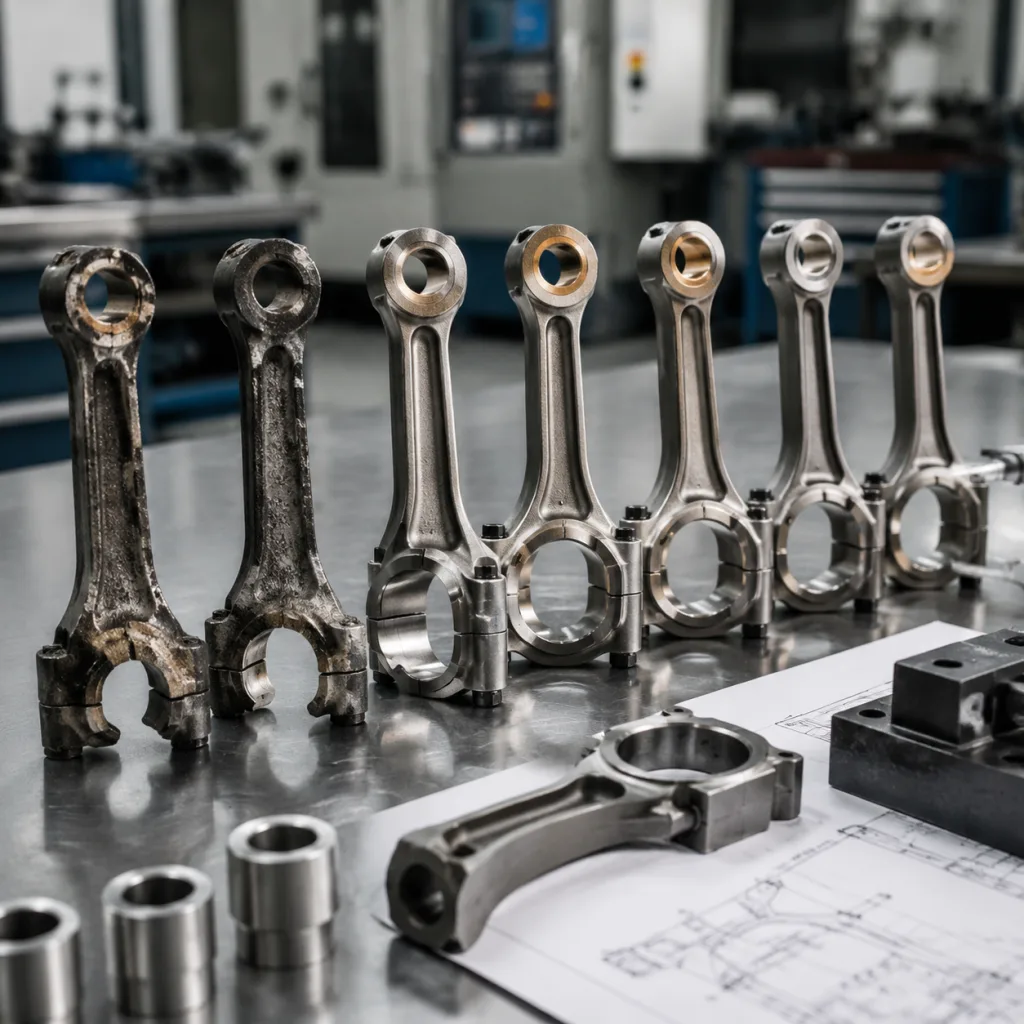
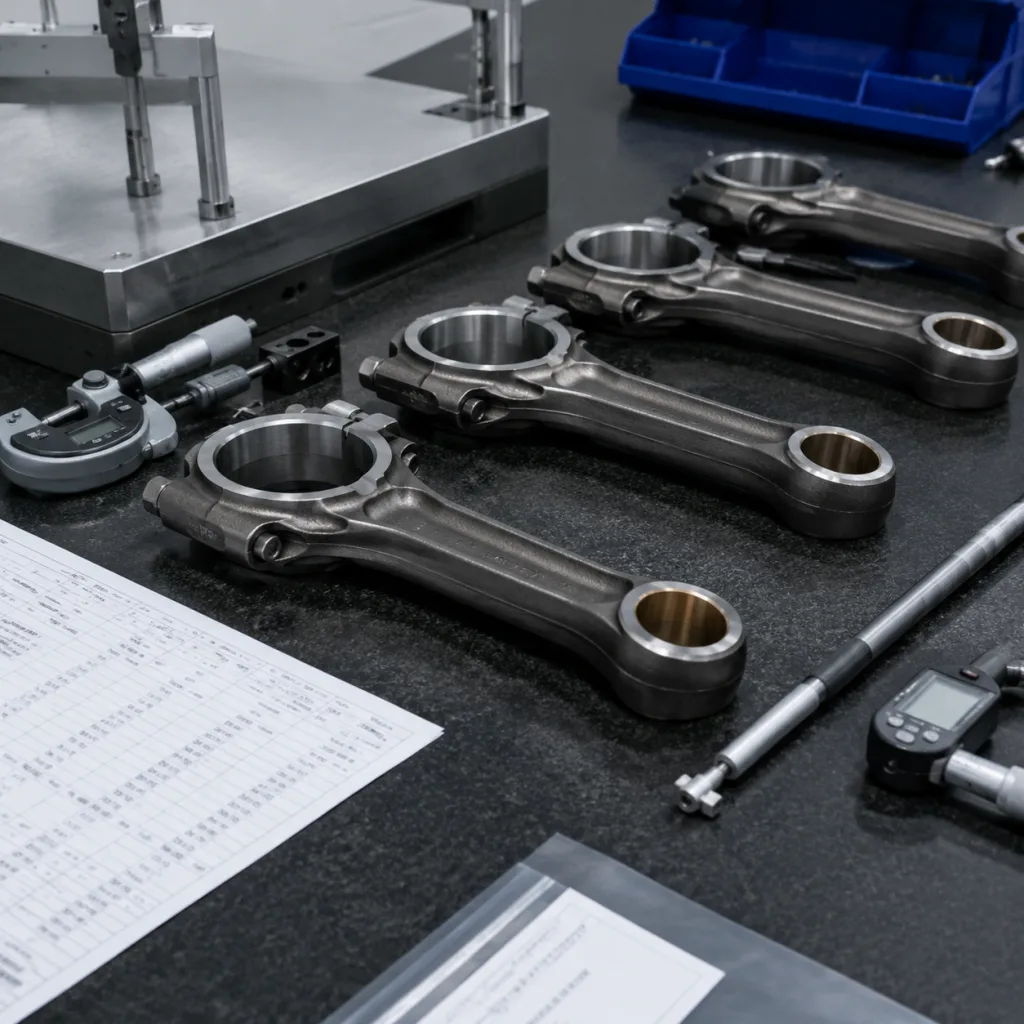
Sourcing a connecting rod Acura OE equivalent is a risk-control decision, not a catalogue exercise. The rod has to preserve piston position, bearing crush, cap stability, pin movement, oil clearance, and rotating balance across the approved engine population. One wrong bore, bolt process, or weight group can turn a low-cost line into repeat claims. Driventus manufactures engine and powertrain components in Taizhou, Zhejiang for B2B export markets, including North America, Europe, Australia, and Brazil. We support replacement programs with controlled forging or precision machining, production inspection, and batch documentation aligned with IATF 16949:2016 and ISO 9001:2015. Driventus is an independent aftermarket manufacturer; brand names are referenced for fitment only.
Decision rule: match the OE design envelope, not just the shape
OE-equivalence means the replacement rod is engineered to fit and function within the original engine architecture without implying vehicle-manufacturer approval. Treat it as a measurable technical benchmark.
For Acura applications, buyers should compare the proposed rod with an original sample, controlled drawing, or approved aftermarket specification. Visual similarity is weak evidence. Two rods can look interchangeable while differing in pin diameter, cap joint, big-end width, or beam mass. Those differences affect piston height, bearing crush, oil film, side clearance, noise, and balance.
Use the design envelope as the release gate:
Centre-to-centre length: controls piston deck position and compression relationship.
Big-end bore diameter and roundness: protects bearing fit, oil clearance, and cap alignment.
Small-end bore and bush specification: controls wrist-pin movement and lubrication film.
Rod width: affects crankshaft side clearance and oil flow.
Bolt grade and clamp load: keeps the cap joint stable under cyclic tensile load.
Weight grouping: limits imbalance across multi-cylinder engine sets.
Approve a connecting rod Acura OE equivalent as a set, not only as one loose part. Mixed weights, drifting bore sizes, or inconsistent pin fit can create vibration, bearing distress, abnormal noise, and early wear. For B2B supply, the target is repeatable interchangeability across the approved application list, backed by inspection records rather than a visual match.
Spec deep-dive: the controls worth writing into the RFQ
Connecting rods see compressive combustion load and tensile inertia load every cycle. A small machining or process error can become a bearing failure, piston contact issue, or cap movement event after installation. The RFQ should define the inspection standard before price is locked.
Control item
Procurement requirement
Why it matters
Centre-to-centre length
Drawing-controlled with tight production tolerance
Maintains piston travel and compression consistency
Big-end bore roundness
100% or batch inspection after cap assembly
Supports bearing crush and oil-film stability
Small-end bore finish
Controlled roughness after bush machining or honing
Reduces pin wear and start-up noise
Parallelism and twist
Checked with rod alignment fixtures
Prevents uneven piston and bearing loading
Mass variation per set
Weight grouped by batch
Reduces rotating and reciprocating imbalance
Bolt torque or angle method
Defined assembly process and verification
Controls cap joint separation risk
</tr></thead><tbody> </tbody></table>Material is not a box to tick. It must fit the OE design route, target duty cycle, application range, and price position. Forged steel may be needed where cyclic strength is critical. Powder metal or cast designs may be appropriate where the original architecture supports that route. Do not change the material route without reviewing fatigue behaviour, machining stability, cap-joint performance, and compatibility with the original bearing and crankshaft interface.
Add heat treatment, surface finish, corrosion protection, and cleanliness to the specification. Residual abrasive particles or storage corrosion can cause claims even when the dimensions are correct. Driventus can support standard replacement programs through our catalog and application-specific development through custom manufacturing.
Failure modes that validation should catch before shipment
Validation should answer two questions: does the rod fit, and will it survive the load environment? Dimensional checks answer the first. Material, bolt, and fatigue controls answer the second. For importers and stocking distributors, this work belongs before volume shipment, not after field returns.
A practical validation file includes:
Incoming material certificate review and chemical composition check.
Hardness testing after heat treatment.
Metallographic inspection for grain flow, inclusions, or heat-treatment defects where applicable.
Big-end bore inspection before and after bolt assembly.
Bolt proof-load or clamp-load verification.
Fatigue testing on representative samples for high-volume programs.
Salt-spray or corrosion checks where storage or packaging risk is high.
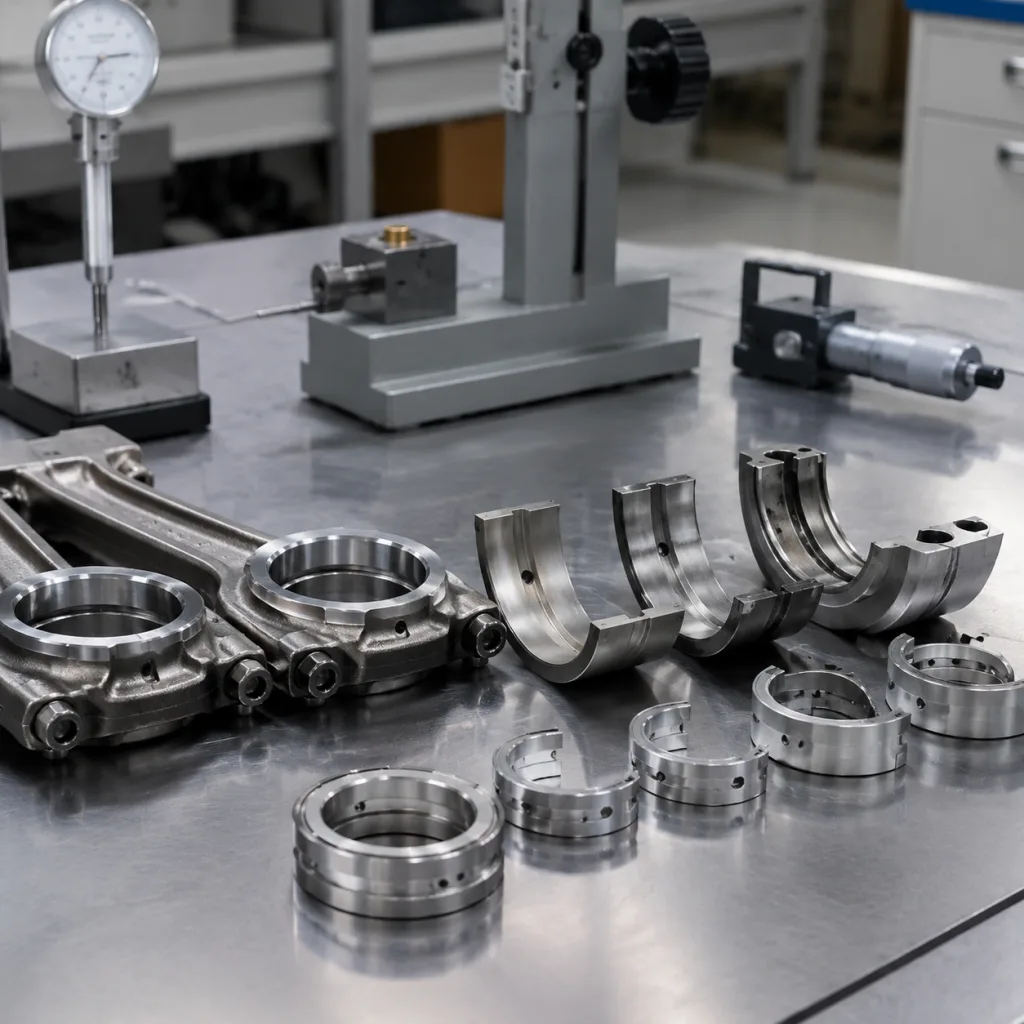
Trial assembly with bearings, crankshaft journal reference, piston pin, and cap bolts.
The main failure modes are predictable: cap separation from weak clamp control, bearing distress from bore error, pin noise from small-end finish problems, imbalance from mixed weights, and corrosion or debris damage from poor packaging and cleaning. Each one can be linked to a measurable control.
Quality systems such as IATF 16949:2016 and ISO 9001:2015 do not define the rod geometry, but they help structure traceability, nonconforming product handling, corrective action, and process repeatability. EU supply chains may also require declarations aligned with REACH (EC) No 1907/2006. When comparing suppliers, ask whether the approved sample and routine production lot are controlled by the same inspection plan. A single clean report is useful; repeatability is what protects the program.
Catalogue trap: when the cross-reference looks right but the rod is wrong
Replacement engine catalogues often hide risk. One engine family can use different rod designs by displacement, production year, market region, crankshaft journal size, piston pin diameter, bearing width, or cap style. A part can be visually close and still fail interchangeability.
This matters for buyers building multi-market catalogues across North America, Europe, Australia, Brazil, or other regions. Regional application lists may share a model name while using different detail specifications.
Require a fitment file that states:
Engine code or engine family where available.
Model year range and market region.
Big-end journal reference dimensions.
Pin diameter and small-end configuration.
Rod length and width.
Bearing type and cap style.
Notes on fracture-split, machined cap, or bushed small-end design.
OE part-number cross-references should be treated as fitment references only. If a buyer provides an OE-style reference, the supplier should verify it against dimensions and samples before production release. The catalogue should not replace engineering confirmation. Driventus is an independent aftermarket manufacturer; brand names are referenced for fitment only.
Before stocking, compare sample parts against the intended application list. Confirm packaging labels, barcode data, carton traceability, and installer notes. Clean fitment data speeds quoting, but its real value is preventing a workshop from receiving a rod that is close in appearance and wrong in a critical dimension.
Supplier comparison: what separates a stable program from a risky sample
A polished sample does not prove production control. Warranty exposure usually comes from variation: bore drift, mixed caps, inconsistent bolt lubrication, poor cleaning, weak packaging, or untracked heat-treatment lots. Audit the process that will make the thousandth rod, not only the first one.
Strong factory controls include:
Dedicated fixtures for big-end and small-end machining.
Cap and beam match marking to prevent mixed assemblies.
Controlled bolt lubrication and tightening method.
In-process bore gauging after cap installation.
Heat-treatment batch traceability for forged rods.
Final cleaning to remove abrasive residue from oil passages and bores.
Protective packaging against corrosion and impact during sea freight.
A reliable replacement program also defines acceptable quality limits, sample retention, and field-claim response time. Driventus maintains a documented quality system for inspection control, traceability, and corrective action. For large-volume buyers, production part approval-style documentation can be prepared where commercially agreed, including control plans, inspection records, and material reports.
Decide early whether rods will ship individually or as balanced sets. Engine rebuild channels often prefer set-level packaging because grouped weights reduce installer sorting and prevent mixed inventory. Distributor replenishment may need individual packaging, but carton labels and batch control must prevent rods from different weight groups or production lots being combined without review.
Purchase-order sequence: lock the technical file before the price
Do not issue a production PO for a connecting rod Acura OE equivalent line until the technical and commercial decisions are tied together. A low unit price has little value if the supplier has not confirmed the application list, validation route, packaging format, and documentation package.
Use this order of work:
1. Confirm application list, engine family, and regional fitment. 2. Provide sample, drawing, or verified OE-style cross-reference if available. 3. Approve material route, heat treatment, and surface protection. 4. Define critical dimensions and inspection frequency. 5. Confirm rod bolt specification and assembly method. 6. Require sample inspection report before mass production. 7. Confirm weight grouping and packaging format. 8. Review IATF 16949:2016 and ISO 9001:2015 certification status. 9. Clarify REACH (EC) No 1907/2006 declaration needs for EU shipments. 10. Agree lead time, MOQ, carton labelling, and claim-handling procedure.
For distributors carrying broader engine programs, related replacement components can be reviewed under engine components, including pistons, crankshafts, gaskets, and water pumps. Consolidating compatible parts can simplify supplier qualification and reduce inbound inspection work.
Keep the approved technical file for reorders. Future lots should be checked against the same dimensions, materials, fitment data, inspection rules, and packaging requirements instead of being renegotiated from zero.
Frequently asked questions
Yes, if it is positioned as an independent aftermarket replacement and verified against the required fitment and dimensions. It must not imply approval or endorsement by the vehicle manufacturer. Driventus is an independent aftermarket manufacturer; brand names are referenced for fitment only.
Request dimensional inspection reports, material certificates, hardness results, process control documents, packaging specification, and applicable quality certificates such as IATF 16949:2016 and ISO 9001:2015. For EU import, ask whether REACH (EC) No 1907/2006 declarations are available.
For repair chains and engine rebuilders, set supply is often preferred because rods can be weight grouped and packaged for one engine. Individual rods may suit distributor inventory, but buyers should control batch mixing and confirm the accepted weight range.
If you are qualifying Acura replacement connecting rods for distribution or repair-chain supply, Driventus can review samples, drawings, and fitment data. To discuss specifications and lead time, [request a quote](/contact.html).