Camshaft for Renault Captur Aftermarket Replacement
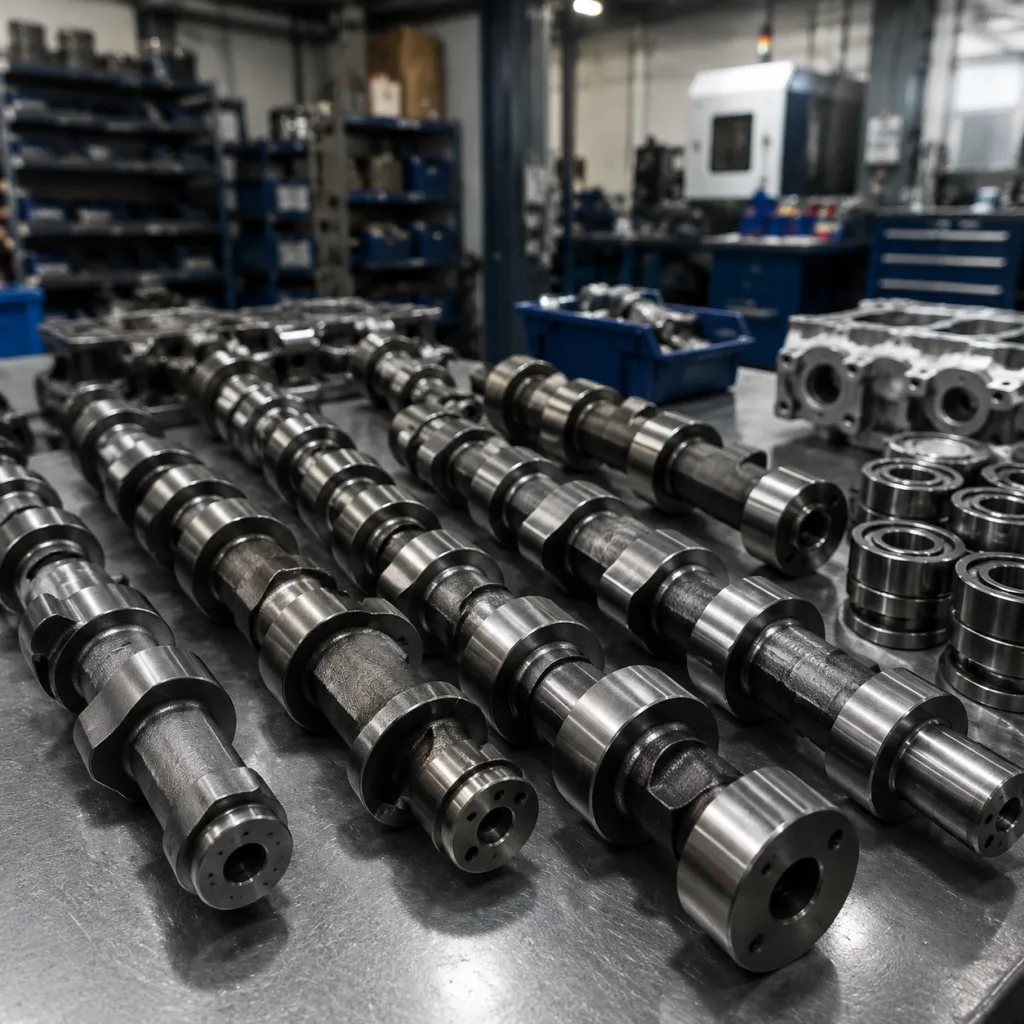
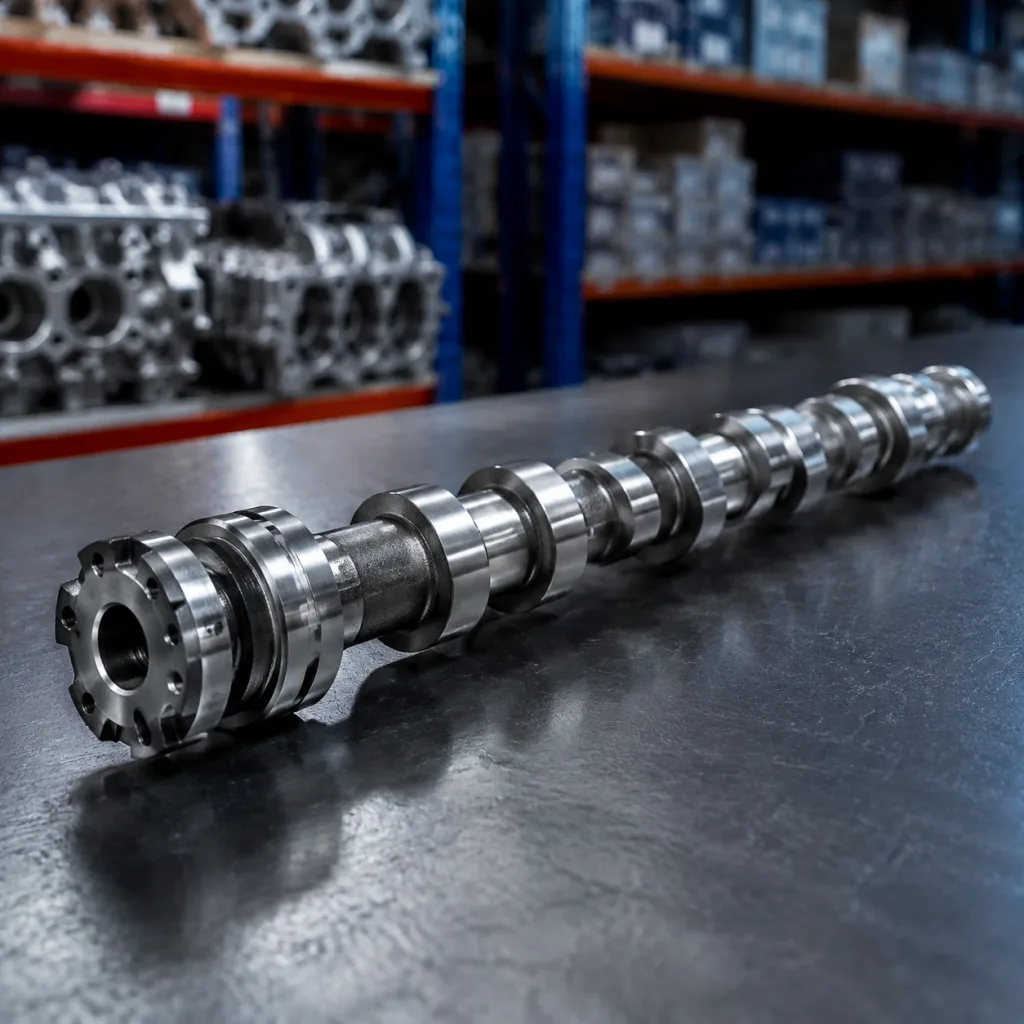
A camshaft for Renault Captur aftermarket replacement is not a catalogue-name purchase. The part has to reproduce valve timing, journal geometry, lobe hardness, oil-feed alignment, thrust control, drive-end features, and camshaft-position-sensor signals for the exact engine variant. If one of those details is wrong, the result is rarely just a returned box. Buyers can see cam/crank correlation faults, P0016-style synchronisation errors, valve train noise, follower wear, oil-pressure complaints, failed readiness checks, or repeat workshop comebacks.
Driventus manufactures engine and powertrain components in Taizhou, Zhejiang, and supplies B2B customers in more than 60 countries. For Renault Captur camshaft programmes, we build around OE-equivalent dimensional control, repeatable metallurgy, process traceability, and validation evidence suitable for aftermarket distribution. Typical quotations require a confirmed engine code, intake/exhaust position, approved sample or drawing, annual forecast, packaging format, and documentation level. Driventus is an independent aftermarket manufacturer; vehicle brand names are referenced for fitment identification only.
Start with the engine, not the badge: a fitment decision framework
The Renault Captur name covers different petrol, diesel, turbocharged, naturally aspirated, and hybrid-linked powertrains depending on generation, model year, market, and emissions package. That is why a sourcing programme should never approve a camshaft from the vehicle name alone.
Use the decision path below before sample approval:
1. Confirm the engine identity: engine code, displacement, fuel type, emissions level, model-year range, and target market. 2. Define the camshaft position: intake, exhaust, combined shaft, left/right, or bank reference where relevant. 3. Check timing-system interfaces: phaser bolt pattern, locating dowel, sprocket interface, keyway, taper, slot, or other drive-end feature. 4. Map lubrication and axial control: oil-feed holes, drilling angle, chamfers, thrust-face location, and required end-float target. 5. Verify sensor logic: trigger wheel or sensor-window count, angular datum, and relationship to the drive feature. 6. Decide what is sold together: camshaft only, intake/exhaust pair, or a kit with followers, tappets, seals, timing parts, gaskets, or hardware.
For a camshaft for Renault Captur aftermarket replacement, functional equivalence matters more than visual similarity. Procurement teams should verify:
Engine family, displacement, fuel type, emissions level, and model-year coverage
Intake, exhaust, or combined camshaft position, with left/right or bank references where relevant
Variable valve timing compatibility, including phaser bolt pattern, locating dowel, and oil-control feed path where fitted
Drive-end, phaser, keyway, taper, slot, or sprocket interface design
Number, width, spacing, and nominal diameter of journals
Lobe count, base circle, total lift, lobe separation, and phase relationship to the drive datum
Camshaft position sensor trigger pattern, tooth/window count, and angular datum
Oil-feed hole position, drilling angle, chamfering, and burr-free cleanliness
Thrust-face width, location, and end-float target against the mating cylinder head or carrier
Packaging protection for machined lobes, journals, trigger features, and thrust faces
The approval file should be practical, not theoretical: OE sample photos, 2D drawing or marked sample dimensions, engine-code list, target cross-reference list, and notes on parts that should be replaced together. If a typical failure mode damages followers or hydraulic tappets, for example, a distributor may stock a camshaft-only SKU while a repair chain uses a camshaft-plus-follower kit.
Buyers can review related engine part families in our catalog and the engine-components range at /products/engine-components.html. For private-label or regional range development, Driventus can also support custom manufacturing based on customer drawings, approved samples, and validated application data.
Specification deep-dive: the dimensions that decide whether the engine runs correctly
A replacement camshaft programme should be specified with measurable characteristics. “Suitable for Captur” is too broad for multi-market stocking, especially when different engines and emissions packages share the same vehicle platform.
The final tolerances must follow the approved drawing or master sample. The ranges below are useful quotation checkpoints when comparing suppliers.
Control point
Typical B2B specification target
Why it matters
Overall length
Drawing value, commonly controlled within ±0.10 mm
Helps prevent end-float and cover interference issues
Journal diameter
Drawing value, often ±0.010–0.020 mm depending on engine design
Maintains oil film, bearing clearance, and oil-pressure stability
Journal roundness
Usually ≤0.006–0.010 mm for functional bearing surfaces
Reduces oil leakage, hot spots, and uneven wear
Lobe lift
Profile-matched, commonly within ±0.03 mm of approved sample or drawing
Controls valve opening, combustion stability, and engine response
Lobe phase angle
Checked against drive datum, often within ±0.5° cam angle where specified
Prevents timing deviation and diagnostic correlation faults
Surface hardness
Application-specific, commonly 50–60 HRC for hardened lobes or equivalent HV case targets
Reduces lobe, tappet, rocker, and follower wear
Effective case depth
As specified, commonly 0.8–2.0 mm for induction-hardened steel designs
Ensures wear resistance beyond the surface reading
Runout
Checked across bearing journals, often ≤0.03–0.05 mm
Limits valve train noise and uneven loading
Surface roughness
Journals and lobes typically controlled around Ra 0.2–0.8 µm depending on design
Supports oil film formation and follower contact stability
Oil holes
Position, diameter, chamfer, and burr-free condition verified
Prevents lubrication restriction and localised wear
Sensor trigger
Pattern and angular position matched to application
Avoids camshaft correlation and synchronisation faults
Thrust faces
Width, finish, perpendicularity, and location controlled
Supports correct axial movement and timing alignment
Marking and traceability
Laser or stamped batch code plus application label
Supports warranty investigation, stock control, and recall isolation
</tr></thead><tbody> </tbody></table>Do not accept a product photo as proof of specification. A sourcing engineer should request a dimensional report against the approved drawing or master sample. The report should show actual measured values, gauge type, inspection quantity, inspector/date, and pass/fail criteria.
Launch lots usually justify 100% inspection of critical features: journal diameter, runout, oil-hole cleanliness, and trigger orientation. Once the programme is stable, buyers can move to an agreed AQL or control-plan frequency.
Where OE part-number cross-references appear in the customer’s internal data, they should be treated as fitment references only and confirmed against the exact engine application. Driventus does not claim approval, sponsorship, or endorsement by any vehicle manufacturer.
Where replacement camshafts fail: material, heat treatment, and machining controls
Most camshaft problems trace back to a short list of avoidable failure modes. The lobe surface wears because hardness or case depth is wrong. Journals mark because the diameter, roundness, finish, or lubrication path is unstable. The engine sets a correlation fault because the trigger feature or lobe phase is not aligned to the correct datum. Noise appears because runout, thrust control, base circle, or follower contact is out of range.
Process control has to target those risks from the beginning.
Cast iron, chilled cast iron, or forged steel selection according to application design and contact stress requirement
Controlled chemical composition with incoming material inspection and supplier batch records
Normalising, induction hardening, carburising, or nitriding where required by the specification
CNC turning of journals, thrust faces, drive-end features, phaser interfaces, and sensor trigger geometry
CNC lobe grinding or profile generation from the approved lift curve rather than simple shape copying
Intermediate straightness correction before finish grinding to control runout and grinding stock
Deburring of oil galleries, keyways, slots, drilled holes, and sensor features under magnification where required
Washing and air-blow cleaning of oil passages before rust-prevention treatment
Rust-prevention oil, VCI bag, foam sleeve, end-cap protection, and export carton control for sea freight
Practical tolerance focus
A small group of dimensions has a direct effect on field performance. Journal diameter and roundness influence oil film formation and bearing life. Lobe taper, base-circle consistency, lift profile, and surface finish affect follower rotation, contact pattern, and operating noise. Thrust-face geometry controls axial movement. Trigger-wheel or sensor-feature position influences engine synchronisation.
A typical process route for a steel camshaft is material cutting, rough turning, stress relief or normalising, CNC turning, heat treatment, straightening, rough grinding, finish grinding, oil-hole drilling or confirmation, deburring, washing, anti-rust treatment, final inspection, and protective packing. For cast designs, the route starts with controlled casting, shot blasting, normalising if specified, machining datum preparation, lobe and journal grinding, cleaning, inspection, and packaging.
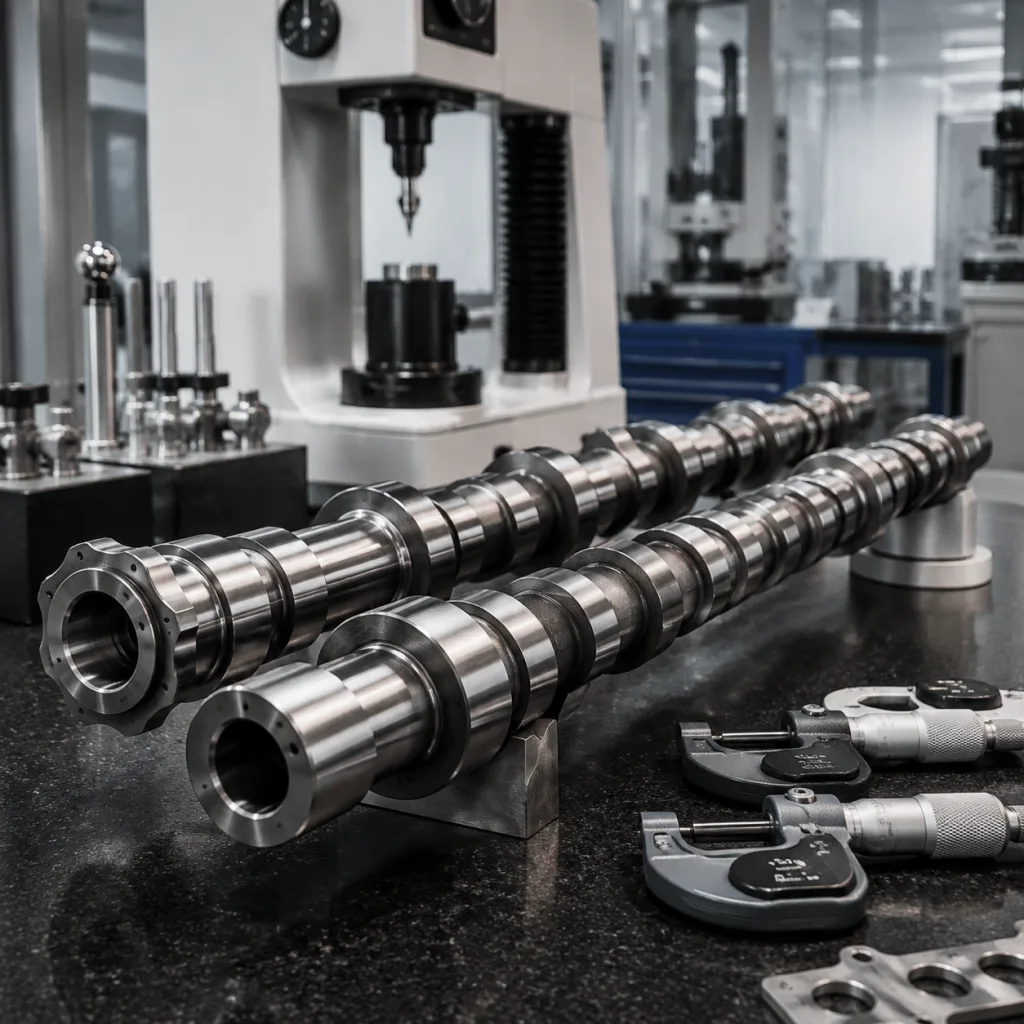
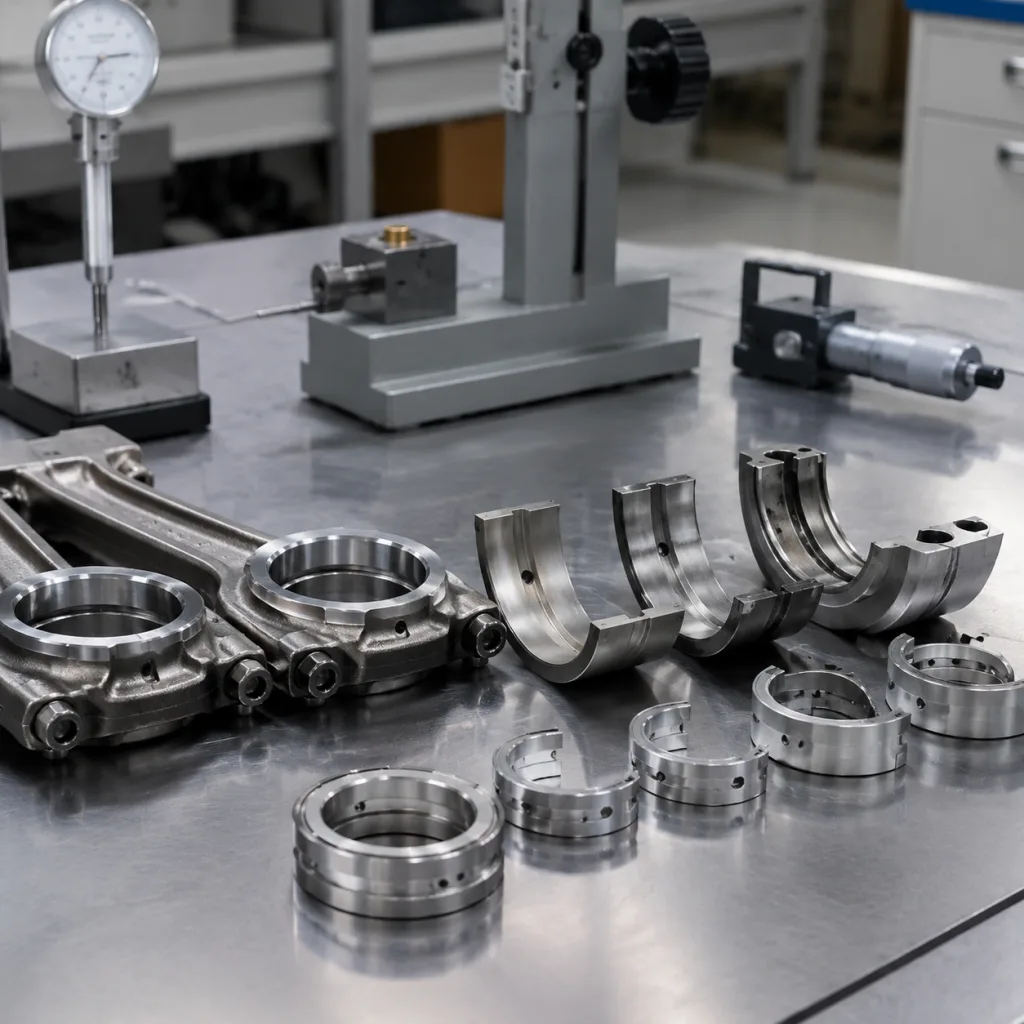
Driventus manages these characteristics through in-process gauging and final inspection. Depending on the part specification, critical dimensions are checked using micrometers, bore/journal gauges, height gauges, runout fixtures, contour measuring equipment, hardness testers, metallographic case-depth checks, surface roughness instruments, and visual inspection standards for oil holes and machined edges. Control plans can define 100% checks for launch batches and sampled checks for stable repeat orders.
Validation is more than a fitment trial: what evidence to ask for
Sample fitting matters. It confirms installation, clearance, and basic function in the intended engine. But it does not prove batch repeatability. It also cannot fully confirm hardness depth, lobe finish, straightness, oil-hole consistency, or trigger accuracy across production.
For a Renault Captur camshaft replacement programme, Driventus can provide validation evidence appropriate to the purchasing agreement, including:
First article inspection report for key dimensions, normally 3–5 pieces for new-tooling approval or as agreed by the buyer
Material certificate or chemical composition report linked to the material batch
Hardness inspection on journals and lobes where specified, including HRC or HV method and test location
Effective case-depth or hardened-layer confirmation when heat treatment is critical to the design
Lobe profile comparison against an approved sample, drawing, or lift table
Runout inspection across bearing journals using defined V-block or between-centre method
Surface roughness report for lobes, journals, and thrust faces when requested
Oil-hole position, chamfer, burr, and cleanliness checks before packing
Sensor trigger angular-position check against the drive datum or locating feature
Packaging drop, compression, label, and corrosion-protection checks for export cartons
Batch traceability records linked to material lot, heat treatment lot, production date, and inspection date
Quality planning is aligned with IATF 16949:2016 and ISO 9001:2015 principles. For buyers in the EU and UK, material and chemical compliance discussions may include REACH (EC) No 1907/2006 where applicable to supplied articles and packaging. Vehicle emissions standards such as ECE R-83 are not camshaft product approvals, but accurate valve timing can affect engine operation, diagnostic readiness, and post-repair drivability.
A practical incoming validation plan for importers is to inspect 5–10 pieces from the first shipment for journal diameter, runout, oil-hole condition, trigger orientation, packaging damage, label accuracy, and corrosion status. Repair-chain buyers can add an engine fitment trial with cold start, idle, oil-pressure observation, cam/crank synchronisation scan, road test, and post-run noise check before authorising full network release.
More detail on supplier controls, inspection flow, and traceability is available through our quality system.
Choose the buying model: distributor SKU, repair kit, or controlled service programme
The best commercial format depends on where the camshaft will be sold and who carries the warranty risk. A distributor may need a single camshaft SKU with broad but accurate application data. A repair chain may prefer a complete kit that reduces technician decisions. A service-part programme may need deeper documentation and long-term change control.
A camshaft for Renault Captur aftermarket replacement may therefore be purchased as:
A single intake or exhaust camshaft SKU
A paired intake-and-exhaust set
A repair bundle with followers, tappets, seals, timing components, gaskets, or installation hardware
A private-label range for a regional distributor
A documented service programme with PPAP-style records, change control, and repeat-order planning
Distributors usually prioritise application coverage, private-label packaging, barcoding, predictable carton dimensions, and stock segmentation by engine code. Repair chains focus on kit completeness, installation consistency, technical support, and lower comeback rates. OEM and Tier-1 service-part teams may require PPAP-style documentation, engineering change control, and long-term batch repeatability.
Before placing a production order, buyers should confirm:
Target engine codes, model years, body generation, fuel type, and markets
Required stocking unit: single camshaft, intake/exhaust pair, or repair kit
Intake/exhaust identification, part marking, label language, and anti-mix packaging method
Annual volume forecast, launch quantity, and repeat-order frequency
Packaging type: neutral, Driventus, or customer brand, with barcode and carton artwork rules
MOQ target by SKU, mixed-SKU carton policy, and whether tooling amortisation is required
Inspection documents required with each shipment and whether third-party inspection is needed
Warranty data format, return sample handling, and failure-analysis response time
Commercial logic depends heavily on tooling status and forecast certainty. For an already tooled application with standard Driventus packaging, buyers should normally plan MOQ around production batch efficiency rather than sample quantity; practical launch orders often start from several hundred pieces per SKU, while repeat orders can be scheduled against rolling forecasts. For new tooling, lower launch quantities may be possible, but unit price usually rises because engineering, fixture, sample, and validation costs are spread over fewer parts. Paired camshafts and kits should be forecast separately because an intake camshaft, exhaust camshaft, tappet set, and gasket pack may have different production lead times.
Price comparison should separate the camshaft unit price from tooling, sample freight, private-label carton setup, documentation, special inspection, and destination logistics. A small unit-price saving can be lost if the supplier does not control lobe hardness, trigger position, packaging corrosion risk, or fitment data. For stable programmes, buyers can improve cost by consolidating Captur-related engine parts into mixed container shipments and agreeing quarterly call-off schedules.
Driventus exports to customers in the EU, UK, US, Canada, Australia, Brazil, and other markets. If an application is already tooled and the customer’s specification matches existing controls, pre-production samples are commonly prepared faster than for a fully customised project. As a planning guide, buyers should allow about 2–4 weeks for sample preparation on available tooling, 6–10 weeks for new tooling or major specification changes, and 30–45 days for mass production after sample approval, subject to order quantity, documentation scope, packaging approval, and production schedule.
Approval workflow: eight steps before you release the bulk order
A controlled approval workflow reduces the risk of incorrect fitment data, unclear specifications, and batch inconsistency. It also gives both sides a technical file to use later when there are engineering changes, substitute materials, carton changes, or cross-reference updates.
For a replacement camshaft programme, Driventus recommends the following sequence:
1. Application confirmation: customer provides engine code, vehicle coverage, target OE-style references if available, required camshaft position, and market-specific fitment notes. 2. Drawing or sample review: Driventus compares supplied data against existing tooling or evaluates new tooling needs, checking journals, lobes, drive-end design, oil holes, and trigger features. 3. Quotation and documentation scope: buyer confirms volume, MOQ expectation, packaging, inspection reports, validation requirements, Incoterms, and commercial terms. 4. Pre-production sample: sample parts are produced or selected from controlled stock for dimensional, material, hardness, runout, and packaging review. 5. Fitment and function check: customer validates installation, sensor response, oiling, valve train noise, idle stability, scan-tool synchronisation data, and engine operation in the intended application. 6. Final specification freeze: approved dimensions, tolerances, marking, packaging, inspection scope, cross-reference data, and change-control rules are locked. 7. Mass production and shipment inspection: batch records and agreed reports are issued before export, with critical features inspected according to the control plan. 8. Post-launch feedback loop: buyer shares installation feedback, warranty returns, and sell-through data so repeat orders can adjust packaging, kit content, or forecast quantities.
A realistic approval timeline is usually 1–2 weeks for data review and quotation once the application file is complete, 2–4 weeks for samples when tooling exists, additional tooling time where required, 1–3 weeks for customer fitment testing, and 30–45 days for mass production after final approval. Urgent stock builds should be discussed before quotation because compressed timelines may limit private-label packaging, expanded inspection reports, or bundled-kit assembly.
This workflow is especially useful for multi-location repair networks and importers managing returns across several countries. It creates a shared basis for commercial release instead of relying on catalogue descriptions alone.
For Renault Captur-related camshaft sourcing, buyers can request a quote with target application details, expected annual volume, documentation needs, target price level if available, desired MOQ, shipment plan, and any existing sample or drawing information.
Frequently asked questions
Yes. Driventus can support neutral, Driventus, or customer-branded packaging for approved B2B programmes. Label content, barcode format, carton strength, application data, market language requirements, and mixed-SKU packing rules should be confirmed before mass production.
Please provide engine code, model-year range, intake or exhaust position, quantity forecast, destination market, packaging type, target documentation level, and any sample, drawing, or OE-style reference available. Fitment references are used for identification only and should be checked against the exact engine application.
No. Driventus is an independent aftermarket manufacturer; brand names are referenced for fitment identification only. Products are developed to meet agreed aftermarket specifications, buyer validation requirements, and approved application data.
If you are building a Renault Captur camshaft range or validating a replacement supplier, share your engine-code list, target annual volume, sample data, MOQ expectation, packaging format, lead-time target, and documentation requirements with Driventus. Start a sourcing discussion at /contact.html