Crankshaft vs Mahle Alternative: Sourcing Guide
When buyers compare a crankshaft vs Mahle alternative, the real question is not brand preference. It is whether the part matches the engine on geometry, balance, material condition, and supply reliability. For rebuilders, wholesalers, and procurement teams, a mismatch in journal size or fillet design can turn a low-cost buy into a costly return. Driventus is an independent aftermarket manufacturer; brand names are referenced for fitment only. Our crankshafts are produced under IATF 16949:2016 and ISO 9001:2015 controls, with material and inspection records available for B2B sourcing review. If you are validating a sample, cross-referencing OE data, or planning private-label supply, the safest decision comes from measured conformance, lead time, and total landed cost—not catalogue claims.
Start with the decision rule
A crankshaft vs Mahle alternative decision usually comes down to three checks: fit, durability, and supply continuity. If all three are strong, the choice is simple. If one is weak, the apparent savings can disappear quickly.
Use this order of review:
1. Confirm the OE cross-reference and engine code. 2. Check whether the journals, thrust face, seal diameter, and nose length match the target unit. 3. Review the material route, surface treatment, and inspection records. 4. Compare lead time, MOQ, and warranty exposure. 5. Decide whether the part is for emergency replacement, stocked resale, or programme supply.
That sequence helps buyers avoid a common mistake: choosing by brand familiarity before the technical fit is proven.
Where substitutions usually fail
Most sourcing problems show up after the purchase order, not before it. The part may look correct in the listing and still fail on one of a few repeatable points.
Common failure modes
- Journal diameters are nominally close but not within rebuild tolerance
- Fillet radius differs, affecting fatigue performance
- Balance spec is not documented or not repeatable across lots
- Oil holes, chamfers, or keyway positions do not match the target engine
- Surface hardening is inconsistent with the expected service duty
- Packing and traceability are too weak for incoming inspection
If a supplier cannot show measured data, the risk is hidden in the installation step. That is why a sample check should always happen before volume buying.
Spec deep-dive: what matters on the crankshaft
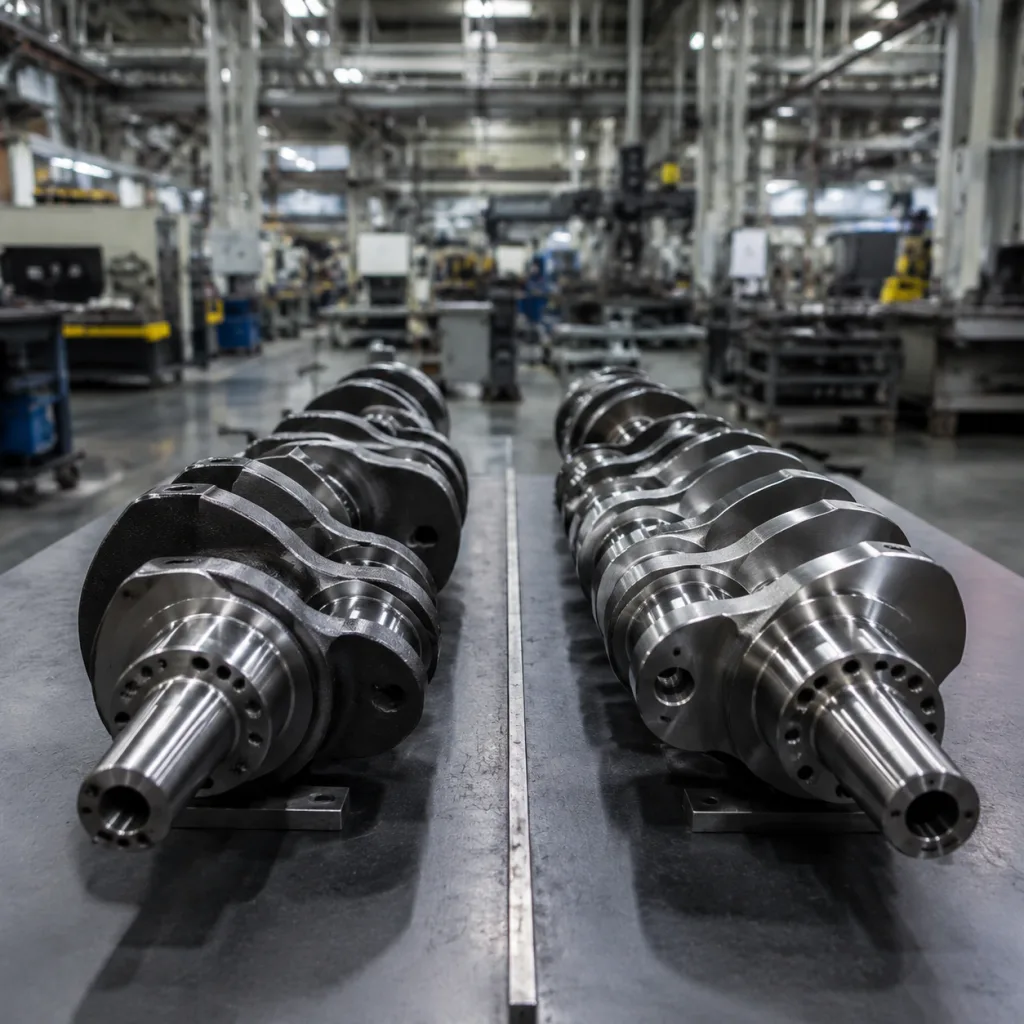
For crankshafts, the catalog description is less useful than the technical stack behind it. Material, processing, and finish all shape service life.
Key specifications to compare
- Steel grade, iron type, or forging route, with heat traceability
- Fillet rolling or other strengthening process on loaded journals
- Nitriding, induction hardening, or other surface treatment where applicable
- Main and rod journal finish, measured rather than assumed
- Runout, straightness, and balance state after final machining
- Crack detection method, such as magnetic particle inspection
A supplier working to IATF 16949:2016 and ISO 9001:2015 should be able to provide the inspection trail behind those points. For B2B sourcing, that documentation is often more valuable than a broad claim of equivalence.
How to validate a sample before you buy
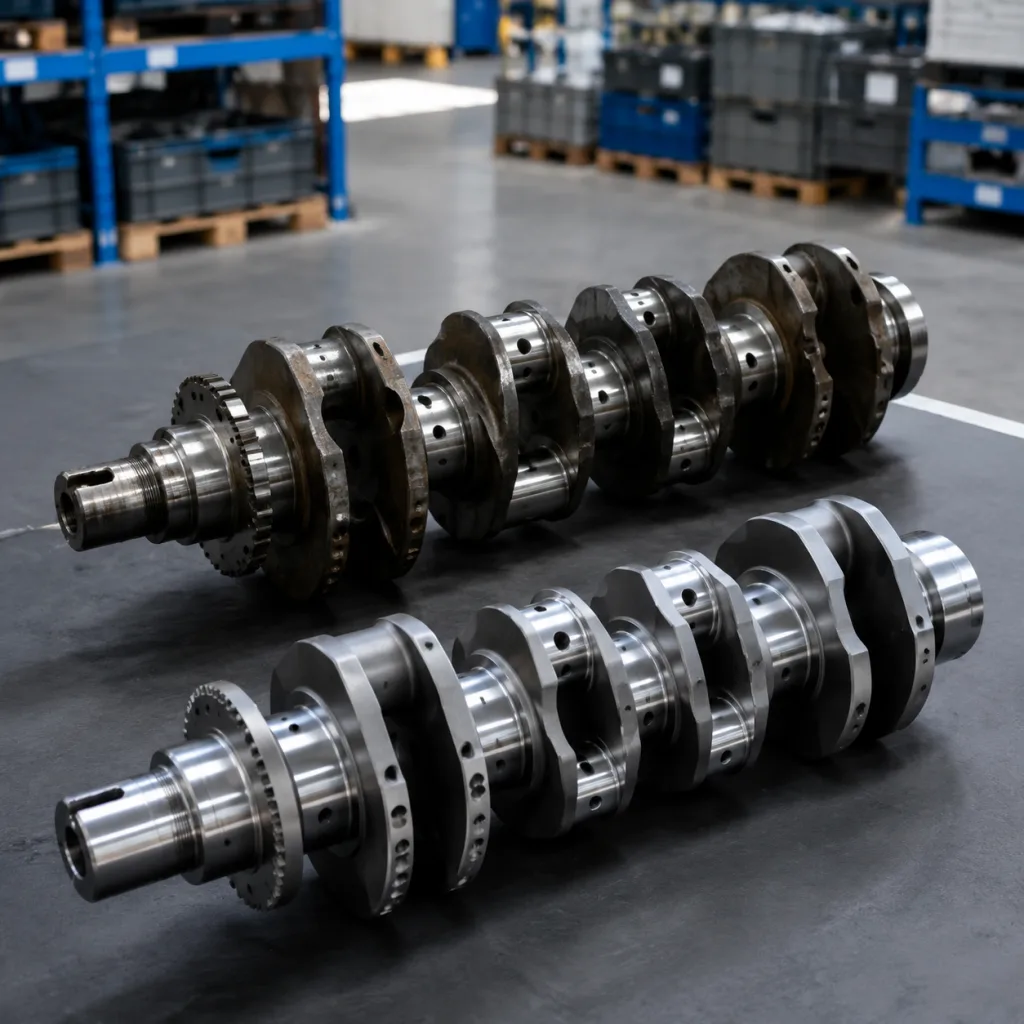
Treat the first sample like a gate, not a courtesy shipment.
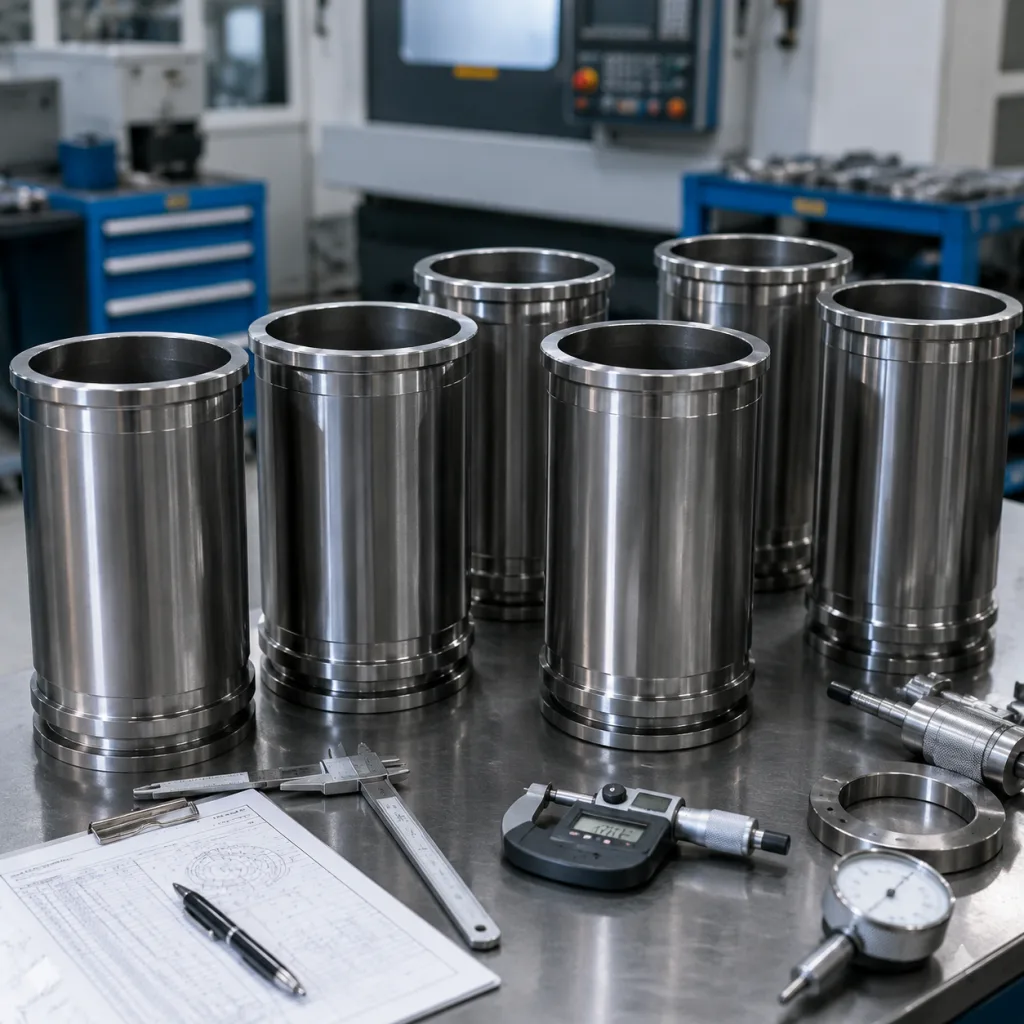
1. Match the OE reference, engine family, and application year. 2. Measure all critical journals with calibrated tools. 3. Check thrust width, seal diameter, nose length, and keyway location. 4. Inspect runout, straightness, and overall balance data. 5. Confirm oil hole position, chamfer quality, and fillet geometry. 6. Review the material certificate and any available inspection report.
If your programme serves European markets, you may also need internal durability or emissions-context testing depending on the end use. The exact plan should match the buyer’s risk level: one-off repair work, stocked aftermarket inventory, or a new sourcing programme.
Compare cost against sourcing risk
The cheapest unit price is not always the lowest-cost outcome. If rejection rates rise, freight is delayed, or documentation is weak, total cost climbs fast.
| Sourcing factor | Lower-risk choice | Higher-risk choice |
|---|---|---|
| Sample approval | Dimensional report plus photo set | Catalogue listing only |
| MOQ | Flexible production lot | Large fixed commitment |
| Lead time | Scheduled manufacturing window | Spot-market availability |
| Warranty exposure | Defined inspection criteria | Unclear acceptance terms |
| Documentation | COA, packing list, traceability | Minimal paperwork |