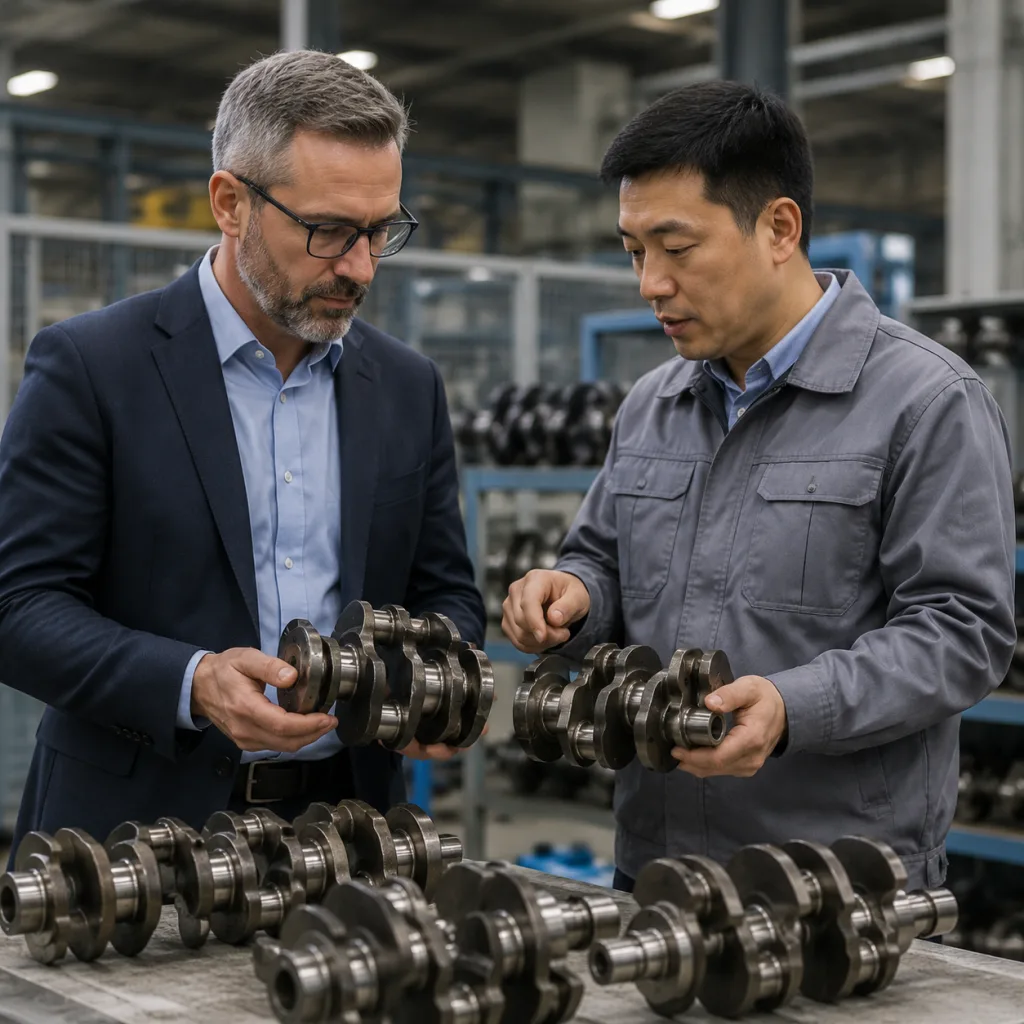
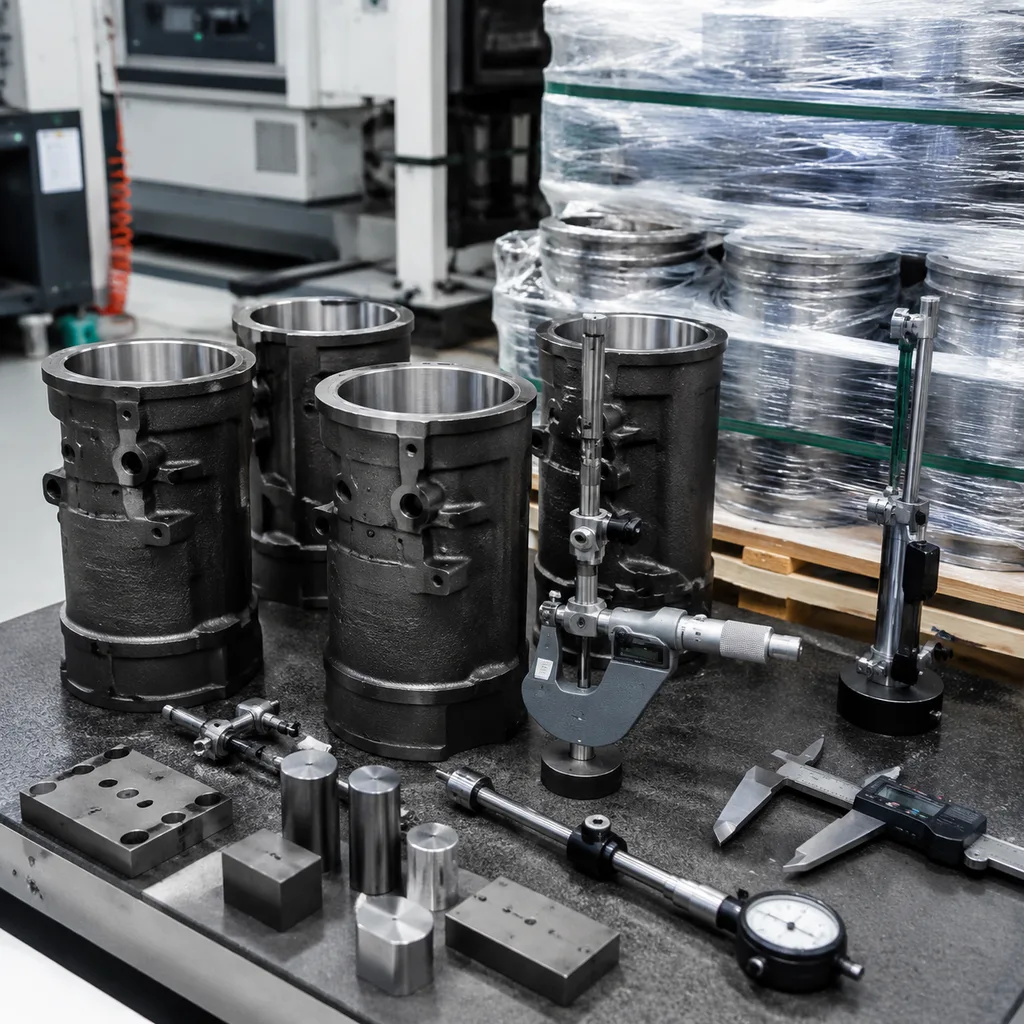
A procurement team looking for a crankshaft Volkswagen OEM supplier is usually trying to solve three problems at once: fitment accuracy, batch repeatability and landed-cost control. The lowest quote rarely answers those questions. A crankshaft programme only works when machining capacity, metallurgy, heat treatment, balancing, corrosion protection, export documentation and batch traceability hold steady after sample approval.
Driventus Auto Parts manufactures crankshafts and other engine components in Taizhou, Zhejiang, supplying aftermarket distributors, wholesalers, OEM projects and Tier-1 programmes in more than 60 countries. This article is written for buyers comparing Volkswagen-fit crankshaft sources from an independent Chinese manufacturer. It covers the decisions that affect real sourcing risk: certification, MOQ, lead time, inspection controls, audit evidence, cross-reference discipline and documentation.
Important note: Driventus is an independent aftermarket manufacturer. Vehicle brand names, engine descriptions and OE-style references are used only to identify fitment and interchange. We do not claim approval, endorsement or supply status from any vehicle manufacturer. The purchasing question is more practical: can each production shipment match the approved sample for journal diameter, runout, hardness, residual unbalance, anti-rust life, packing integrity and traceable records?
Decision framework: define the crankshaft before asking for price
A Volkswagen-fit crankshaft programme may cover petrol or diesel engine families, different strokes, main journal layouts, flange designs, reluctor or timing features, oil-hole positions and bearing interfaces. If those details are vague, the RFQ becomes a guessing exercise.
Start with the technical identity of the part. Use application data, engine code, drawings, approved samples and OE-style cross-references where available. OE references are useful for fitment mapping only. For example, a buyer may mention an OE 06A… family reference when discussing a petrol engine application, but the sourcing file still needs measurable dimensions, material requirements and inspection criteria. A brand name or OE-style number is not evidence of approval by a vehicle manufacturer.
A workable crankshaft definition should cover:
Forged or cast route, depending on application, load and duty cycle; common options include ductile iron casting, forged carbon steel or alloy steel, subject to drawing approval
Fully machined main journals, rod journals, flange, nose and oil passages, with journal finish commonly specified around Ra 0.2–0.4 μm where required by the application
Nitriding, induction hardening or another specified surface treatment where required, with hardness and case-depth targets agreed before sampling
Dynamic balancing to a stated residual unbalance limit, such as a gram-millimetre target per correction plane, not a generic “balanced” claim
Anti-corrosion protection suitable for sea freight and warehouse storage, typically VCI bag plus oil or inhibitor for 6–12 months of indoor storage
Neutral export packaging or distributor-specific packaging by agreement, with single-piece separation to prevent journal impact
Batch-level inspection report, material certificate and packing list tied to lot number, carton mark and production date
Price comparison should come later. A basic machined crankshaft is not equivalent to a part supplied with heat treatment records, balancing data, surface-finish control, full inspection reporting and export-grade preservation. A clear RFQ should identify each item by engine code, stroke, main journal count, timing or sensor feature, flange bolt pattern and known supersession.
Certification is the entry ticket, not the complete qualification. Driventus operates under IATF 16949:2016 and ISO 9001:2015, which support traceability, corrective action, process control and continual improvement. Buyers should still validate the specific crankshaft reference, drawing, process route and inspection plan.
The strongest audit method is simple: follow one live batch from raw material receipt to finished-goods release. Watch where the part can fail. Material mix-up. Heat treatment drift. Grinding variation. Burrs inside oil holes. Weak rust prevention. Carton labels that do not match the packing list.
Audit area
What to verify
Procurement relevance
Material traceability
Heat number, steel or casting grade, supplier certificate, incoming hardness or chemistry check
Reduces the risk of mixed or nonconforming material batches
Machine capability, tolerance target, correction method and retained records by serial or batch
Supports NVH performance and bearing life requirements
Cleanliness control
Oil-hole deburring, brushing, flushing, air blow-off and borescope or visual checks
Helps prevent bearing damage from residual debris
Packaging
VCI protection, impact control, carton or plywood crate strength, pallet height and moisture control
Reduces corrosion and transit damage
</tr></thead><tbody> </tbody></table>Ask which operations are in-house and which are outsourced. Subcontracted heat treatment, surface treatment or balancing can be acceptable, but only if approval, monitoring and traceability are controlled. Useful audit evidence includes calibration certificates, gauge labels, control plans, process flow charts, quarantine tags, scrap records, master sample storage, last-piece inspection records, 8D examples and pre-shipment inspection reports.
A credible crankshaft supplier should also explain the reaction plan. What happens if journal runout trends toward the limit? Who releases a reworked part? How are nonconforming pieces isolated? How is a drawing change communicated to production and packing teams? Driventus can share information on its quality system during supplier evaluation.
Commercial comparison: when MOQ and lead time are not quoting details
MOQ and lead time tell you how mature the part is. Existing Volkswagen-fit crankshafts usually carry lower MOQ because tooling, fixtures, gauges and process settings are already defined. A new development item needs engineering review, sample measurement, drawing conversion, fixture preparation, trial machining and first-article validation.
Use the following comparison points before ranking suppliers:
Catalogue crankshaft MOQ: usually 50–100 pieces per reference for active items, or one mixed pallet/container plan when combined with other engine components; smaller trial orders may be possible from stock.
New development MOQ: commonly 200–500 pieces after sample approval because engineering, fixture setup, trial machining, inspection programming and validation costs must be absorbed.
Lead time for existing items: typically 30–45 days after deposit and packaging confirmation, driven by the machining queue, heat treatment, final inspection and export packing schedule.
Lead time for new items: typically 60–75 days for first samples, plus approval time, then 45–60 days for mass production depending on material and treatment route.
Price basis: material grade, blank weight, machining complexity, oil-hole drilling, reluctor features, nitriding or induction hardening, balancing requirement, inspection level, packaging and annual volume.
Logistics basis: Incoterms, destination market, carton or crate design, palletisation, gross weight, CBM, and whether the order ships as LCL or a consolidated container.
Do not compare quotations until the scope is identical. One offer may include dynamic balancing, nitriding, batch inspection reports and VCI packing. Another may cover only a basic machined part with light oil. The second price may look attractive, then create corrosion claims, receiving-inspection delays or warranty exposure.
For annual contracts, define forecast mechanics early. A practical structure is a 3-month firm forecast, 6-month rolling forecast, agreed minimum call-off quantity and a documented price review trigger for steel or exchange-rate movement. If you need launch stock, seasonal replenishment or emergency supply, include it in the RFQ instead of negotiating after nomination.
For private-label or drawing-based projects, Driventus also supports custom manufacturing, including reverse engineering from samples where lawful and technically appropriate.
Failure modes: technical checks that prevent expensive engine damage
Crankshaft defects do not stay isolated. A poor journal finish can damage bearings. Runout can create vibration and uneven loading. A burr in an oil hole can move through the lubrication system. Incorrect hardness can shorten fatigue life. That is why procurement and engineering should agree critical characteristics before supplier nomination.
Check these items before approving production supply:
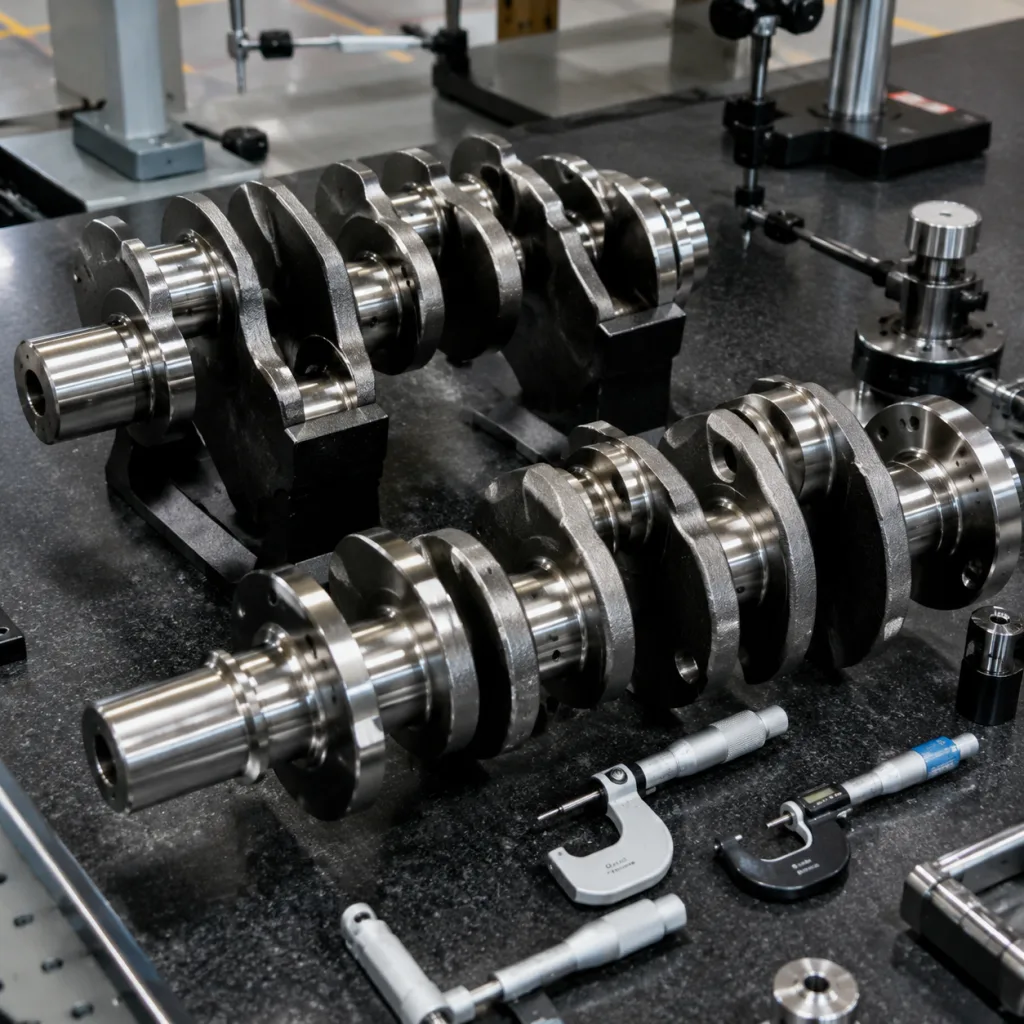
Main journal diameter, rod journal diameter and journal width, with tolerance taken from drawing or approved sample; many crankshaft journals require micron-level control rather than broad catalogue tolerances
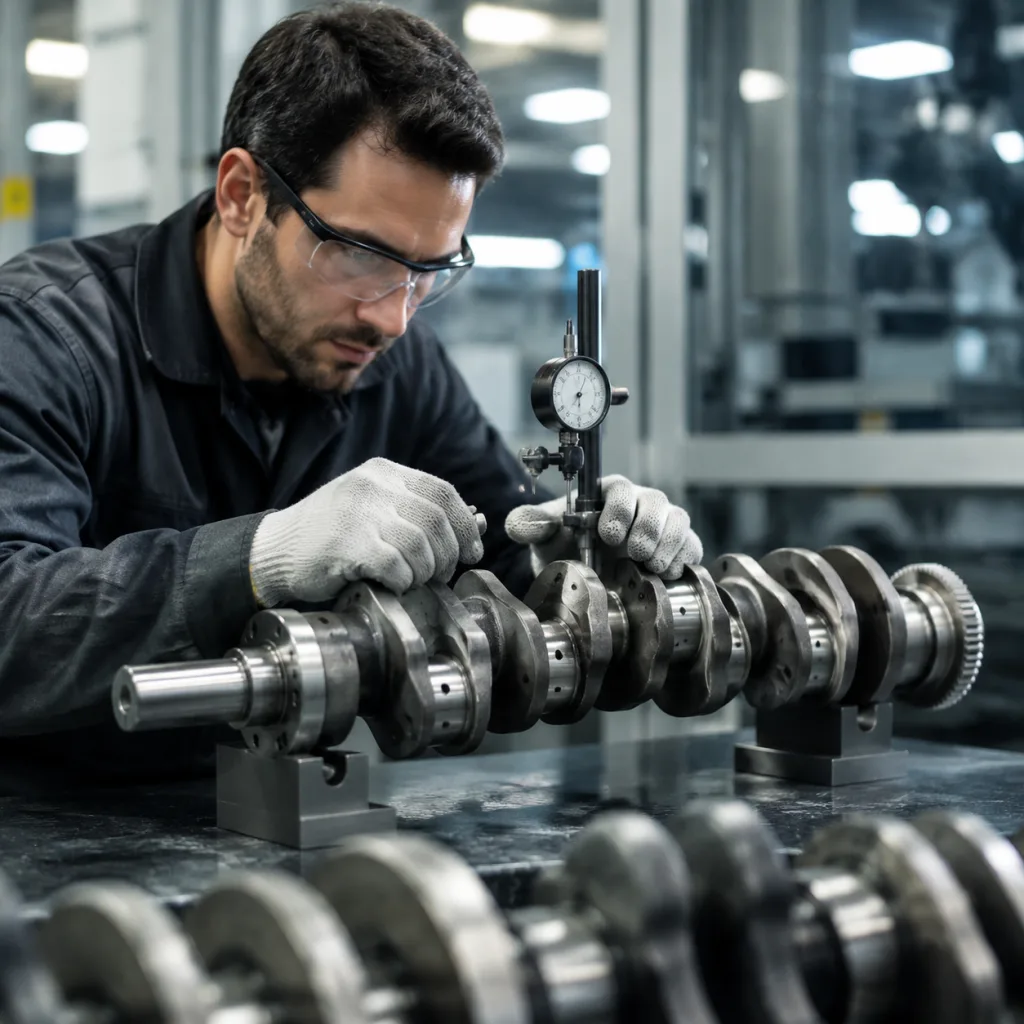
Journal roundness, cylindricity, taper and surface finish, verified with micrometers, roundness equipment and roughness tester where required
Stroke, crankpin indexing and runout, including centre-line runout at front and rear journals and angular position of crankpins
Thrust face width, flatness and surface condition to prevent axial play or bearing wear issues
Flange pattern, pilot diameter and timing feature position, checked against mating flywheel, pulley or sensor requirements
Nose dimensions, thread, keyway or gear interface where applicable, including chamfer and radius control
Oil-hole diameter, chamfering, deburring and internal cleanliness, with no loose burrs or abrasive residue after flushing
Hardness and effective case depth where specified, including surface hardness, core hardness and nitrided or induction-hardened layer depth
Dynamic balance requirement and residual unbalance record, with balancing plane and correction method stated in the report
Visual inspection for cracks, porosity, dents, corrosion, handling marks and grinding burns on journals and fillets
For higher-risk applications, request non-destructive testing. Magnetic particle inspection is commonly used for ferromagnetic crankshafts to detect surface and near-surface discontinuities around fillets, oil holes, flange transitions and keyways. Hardness and microstructure checks should match the agreed material and heat treatment route, not a generic pass/fail template.
Keep the reporting usable. A sample approval file can be broad; every batch report should focus on critical-to-function dimensions and records. A typical plan may require 100% visual and rust checks, retained balance records where balancing is specified, and dimensional inspection on a defined sample size such as 3–5 pieces per batch or per shift for critical journals. Batch traceability matters later if a distributor needs warranty analysis.
Environmental and chemical compliance may also apply. EU importers may need to consider REACH (EC) No 1907/2006 for coatings, preservatives or packaging materials. Where engine emissions-related service parts are involved, buyers should understand their own obligations under local rules such as ECE R-83 for vehicle emissions type approval. A crankshaft alone is not an emissions approval item, but fitment accuracy and engine repair quality can affect vehicle compliance.
Control point: stop cross-reference errors before they reach the warehouse
Many crankshaft disputes start as catalogue problems, not machining problems. The same Volkswagen-fit crankshaft may be ordered by internal SKU, distributor number, engine code, vehicle application or OE-style reference such as OE 06A…. If the interchange file is uncontrolled, the warehouse may receive a technically good part for the wrong variant.
Build a purchasing file that connects commercial references to one technical record:
Document
Supplied by
Purpose
Application list
Buyer and supplier
Confirms vehicle, engine code, displacement, year range and market coverage
OE cross-reference list
Buyer and supplier
Supports catalogue mapping, not brand approval
Drawing or critical dimensions
Buyer or agreed from sample
Defines acceptance criteria for journals, stroke, flange, nose, oil holes and timing features
Approved sample record
Buyer and supplier
Links production supply to the accepted technical reference, photos and measurement report
Control plan
Supplier
Shows production and inspection controls, frequency and reaction plan
Material certificate
Supplier
Confirms material batch traceability, heat number and grade
Final inspection report
Supplier
Records critical dimensions, hardness, balance and visual status before shipment
Packing specification
Buyer and supplier
Prevents corrosion, impact damage and label errors during sea freight and warehousing
Label and barcode rules
Buyer and supplier
Supports receiving, warehousing and distributor fulfilment
</tr></thead><tbody> </tbody></table>Version control is not administrative decoration. If a distributor sells in the EU, UK, US, Canada, Australia and Brazil, local catalogue teams may describe the same vehicle differently. Tie every sales reference to one internal technical file with dimensions, photos, packaging data and inspection requirements. Add version numbers, release dates and approver names so obsolete data cannot be reused.
Supersessions need the same discipline. If one SKU replaces another, confirm whether the change is a true interchange, a market-specific substitution or a packaging-only update. No supersession should be released until flange, nose, journal set, stroke, oil-hole layout and timing or sensor features are confirmed.
Driventus is an independent aftermarket manufacturer; brand names are referenced for fitment only. Any Volkswagen-related name, engine description or OE-style number is used only to identify compatibility and interchange.
RFQ scenario: how Driventus moves a crankshaft programme from list to shipment
A typical sourcing project starts with an application list and ends with a controlled shipment. The steps in between determine whether the programme becomes repeatable.
Driventus manufactures crankshafts as part of a broader engine and powertrain component range that includes pistons, gaskets, water pumps, turbochargers and related components. For buyers evaluating a crankshaft Volkswagen OEM supplier, our support is focused on feasibility review, stable production, documented inspection and export-ready packing rather than unsupported brand claims.
Procurement support can include:
Review of application lists, OE cross-references, engine codes, sample photos and buyer target specifications
Feasibility checks against existing tooling, fixtures, gauges, blank availability and machining capability
Quotation by MOQ, annual forecast, packaging standard and delivery term, including catalogue versus new-development lead-time logic
Sample production or pre-production samples from existing stock where available, with first-article measurement on agreed critical dimensions
Dimensional inspection report for approved samples, including journals, stroke, runout, flange, nose and oil-hole checks where applicable
Batch traceability and pre-shipment inspection records linked to lot number, carton label and packing list
Neutral, Driventus or customer-specified packaging subject to agreement, including VCI bag, oil protection, inner support, carton and palletisation
Consolidation with other engine components for container or LCL shipment to improve freight cost per unit
Support for distributor labelling, carton marks, barcodes and packing lists where agreed
For audits, buyers may request certification copies, process flow information, inspection equipment lists and sample quality records. Remote audits can be arranged when an on-site visit is not practical. For regulated, private-label or high-volume programmes, both sides should agree escalation routes for non-conformance, 8D expectations and replacement or rework procedures before the first shipment. The agreement should define who pays for sorting, rework, return freight or replacement if a confirmed batch issue occurs.
The fastest RFQs are specific. Send target annual volume, first order quantity, delivery market, required Incoterms, packaging preference, application list, OE 06A… cross-references if applicable, and buyer-specific quality clauses. Drawings, samples, photos of timing features and critical dimensions shorten the feasibility review. If target price is tight, share expected annual volume and acceptable inspection level instead of removing technical requirements.
To start the process, procurement teams can request a quote with drawings, samples or an interchange list.
Frequently asked questions
No. Driventus is an independent aftermarket manufacturer. Brand names and OE-style references are used only for fitment identification. We manufacture replacement crankshafts to agreed drawings, samples or technical specifications and do not claim vehicle manufacturer approval or endorsement.
Send the application list, engine details, OE-style cross-references such as OE 06A… if available, annual forecast, first order quantity, MOQ target, delivery country, Incoterms, packaging needs and any drawing or sample data. Critical dimensions, material grade, surface treatment, hardness, balance and inspection expectations should be confirmed before sample approval.
Yes. Driventus can support remote or on-site supplier evaluation with certification records for IATF 16949:2016 and ISO 9001:2015, process information, inspection controls, equipment lists and sample documentation, subject to confidentiality requirements.
If you are qualifying a Volkswagen-fit crankshaft source, send your application list, forecast volume, first order quantity and documentation requirements. Our team can review feasibility and respond with sourcing options at /contact.html