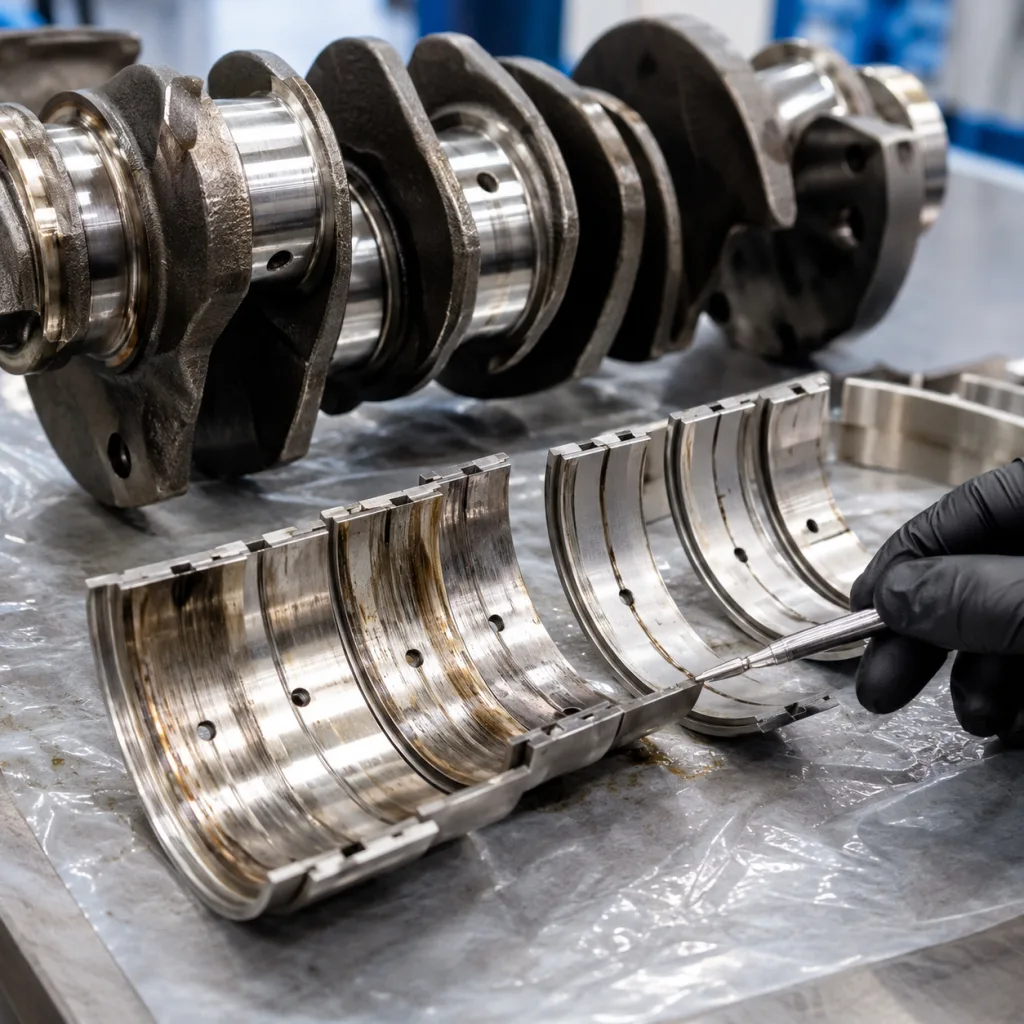
Buyers searching for a crankshaft Volkswagen manufacturer China need more than a supplier that can match an OE number in an aftermarket catalogue. The sourcing work has to confirm application fitment, engine code, metallurgy, forging or casting route, journal machining accuracy, surface hardening, oil-hole cleanliness, dynamic balance, traceability, corrosion protection, and repeat-order consistency. For Volkswagen-related engine families, small differences in stroke, main-journal diameter, crankpin geometry, trigger-wheel features, thrust-bearing position, flywheel flange pattern, or balance specification can turn into receiving rejects, warranty exposure, and assembly downtime.
Driventus supplies crankshafts for aftermarket, OEM, and Tier-1 programmes from Taizhou, Zhejiang, with export experience in 60+ countries. We operate under IATF 16949:2016 and ISO 9001:2015, and we build to customer drawing, OE cross-reference, or approved sample. Driventus is an independent aftermarket manufacturer; Volkswagen and other brand names are referenced for fitment identification only.
For procurement teams, the key questions go well beyond unit price and availability. Verify lead time, minimum order quantity, critical-to-quality dimensions, hardness range, effective case depth where applicable, journal surface roughness, runout, residual imbalance, cleaning method, anti-rust protection, carton compression strength, and the supplier’s ability to support PPAP-style documentation, magnetic particle inspection, salt-spray exposure checks, or fatigue testing when the customer specification requires them. This guide explains what to check before placing a purchase order, how to structure a technical RFQ, and how to compare Chinese crankshaft suppliers on engineering, quality, logistics, and commercial performance.
What procurement teams should verify first
A crankshaft purchase should begin with fitment, material route, and inspection scope, not price alone. For Volkswagen applications, the supplier should confirm OE cross-reference, engine code, displacement, fuel type, model-year range, journal count, stroke, overall length, main-journal and rod-journal diameters, flange bolt pattern, keyway or trigger-wheel features, thrust bearing location, oil-hole layout, and balance requirement. These details become especially important when one engine family has several regional variants, or when aftermarket catalogues show overlapping references.
Before issuing an RFQ, frame the project around three questions: Does the part fit the intended engine? Can the production route reproduce the required fatigue and wear performance? Can the supplier document each lot? A low-cost quotation without confirmed geometry, hardness, surface finish, and traceability can create hidden cost through rejected shipments, delayed launches, rework, and difficult warranty investigations.
Minimum data set for RFQ
OE reference, for example OE 06A107065 when applicable
Engine code, displacement, aspiration type, fuel type, and model-year range
Vehicle application and market region, such as EU, UK, North America, Latin America, Middle East, or Oceania
Existing sample photos showing main journals, crankpins, flange, keyway, oil holes, thrust faces, and trigger features
Customer drawing with tolerances, datum scheme, and revision level, if available
Forging or casting requirement, including whether the application requires forged steel, cast iron, or another specified route
Steel grade or material standard, if specified by the customer
Nitriding, induction hardening, fillet rolling, or other surface treatment requirement
Target surface hardness, effective case depth, and core hardness range
Journal diameter tolerances, roundness, cylindricity, taper, and surface roughness requirements
Permitted runout and residual imbalance limits
Cleaning, deburring, and oil-passage cleanliness requirements
Packaging, labelling, barcode, carton count, and palletisation requirements
Incoterm, destination port, and preferred shipping mode
Annual volume, order frequency, forecast split by part number, and launch date
If you buy for a warehouse network, repair-chain programme, engine remanufacturer, or export distributor, ask for batch traceability by heat number, forging or casting batch, machining lot, and final inspection lot. That traceability matters when you need to isolate one shipment after a field complaint, identify whether several cartons came from the same manufacturing batch, or compare a receiving inspection result against a specific material certificate.
It is also worth requesting a cross-reference confirmation sheet before sampling. This sheet should list the OE number, supplier part number, customer SKU, compatible engine codes, known exclusions, sample quantity, and inspection plan. For a crankshaft Volkswagen manufacturer China sourcing project, this early confirmation reduces the risk of ordering a visually similar crankshaft that differs in stroke, reluctor configuration, oil-hole chamfer, flange offset, or thrust face design.
Material and machining controls that affect service life
A crankshaft is a fatigue-loaded rotating component. It has to withstand bending load, torsional load, bearing contact stress, oil-film variation, cold starts, and repeated acceleration cycles. The supplier should control material grade, forging or casting quality, heat treatment, straightening, journal grinding, fillet rolling where specified, oil-hole drilling and chamfering, final cleaning, and dynamic balance. For passenger-car and light-commercial replacement parts, one attractive sample result is not enough. The real question is repeatability across production lots.
The material route should be clear from the quotation stage. A forged steel crankshaft is commonly specified where higher fatigue strength is required, while cast iron or another route may be acceptable for certain replacement markets if it meets the customer’s drawing, validation, and warranty requirements. Avoid vague wording such as “standard material” unless the supplier also provides a material grade, material certificate format, inspection criteria, and acceptance limits.
Control item
What buyers should request
Why it matters
Material
Mill certificate, chemical composition, mechanical properties where specified, and heat traceability
Confirms chemistry, source control, and batch identification
Forging or casting quality
Process route, visual criteria, magnetic particle inspection or other NDT when required
Reduces risk of laps, inclusions, cracks, shrinkage, and structural weakness
Heat treatment
Heat-treatment record, furnace batch, hardness map, and quench or nitriding parameters where applicable
Supports strength, wear resistance, and process consistency
Hardness
Surface and core hardness report with defined test points
Helps verify journal wear resistance and torsional durability
Case depth
Nitriding or induction-hardening depth report where applicable
Confirms that hardened surfaces meet functional depth, not only surface appearance
Journal geometry
Micrometer, air gauge, roundness tester, and CMM data as required
Protects bearing fit, oil-film stability, and assembly clearance
Surface finish
Roughness data for main and rod journals, typically reported as Ra and sometimes Rz
Reduces bearing wear and improves lubrication performance
Runout
Measurement on centres or V-block fixture with recorded values and datum definition
Reduces vibration, bearing distress, and premature wear
Dynamic balance
Balance report by part number, rotational speed, and residual imbalance tolerance
Lowers NVH risk and warranty exposure
Fillet treatment
Fillet rolling or equivalent process record when specified
Improves fatigue performance at high-stress transitions
Oil holes
Chamfering, deburring, washing, and cleanliness confirmation
Prevents abrasive contamination and lubrication restriction
Rust prevention
Anti-rust oil, VCI bag, desiccant, or protective packing specification
Protects machined surfaces during ocean freight and warehouse storage
</tr></thead><tbody> </tbody></table>Machining discipline matters as much as material selection. Main journals and rod journals should be ground to the agreed tolerance band, with controlled roundness, cylindricity, taper, and surface roughness. Many crankshaft drawings control journal diameters in hundredths or even thousandths of a millimetre, so the RFQ should state the actual drawing tolerance instead of relying on broad phrases such as “OE quality”. Oil holes should be chamfered, deburred, and cleaned because burrs or residual abrasive particles can damage bearings after assembly. Fillets should not be over-ground; the fillet radius is a critical fatigue area and must remain within the drawing profile.
For export supply, ask whether the plant uses calibrated micrometers, height gauges, CMMs, roundness instruments, hardness testers, roughness testers, and balancing machines, with calibration records managed under its ISO 9001:2015 or IATF 16949:2016 system. If you need a controlled approval process, request incoming material certificates, first article inspection data, process flow, control plan, inspection records, and pre-shipment reports. When the part is safety- or warranty-sensitive for your customer, include destructive or non-destructive checks in the approval plan, such as magnetic particle inspection, hardness mapping, metallographic review, retained sample inspection, or fatigue testing where required by the project specification.
Lead time, MOQ, and commercial planning
For B2B buyers, the right supplier can support launch volumes and replenishment without creating excess stock or missed delivery windows. Standard crankshaft programmes usually follow one of two commercial models: stock-supported part numbers for high runners, and build-to-order supply for lower-volume, revised, or market-specific applications. Each model affects MOQ, lead time, inspection timing, tooling status, and cash planning.
A stock-supported part number may be suitable when you need faster shipment for established applications. Even then, check the current revision, rust protection condition, label format, shelf time, and compatibility with your market catalogue. A build-to-order project gives more control over specifications, packing, marking, and documentation, but it requires a clearer forecast and earlier approval of samples or pilot lots.
Typical procurement questions:
What is the MOQ per OE cross-reference, per customer SKU, and per shipment?
Is the MOQ based on finished parts, raw forgings, castings, machining batch size, or packaging batch size?
What is the lead time for quotation confirmation, sample order, first article inspection, pilot lot, and repeat order?
Is tooling already available, and if not, what is the tooling charge and tooling lead time?
Can the factory hold finished-goods safety stock or semi-finished blanks for seasonal demand?
Are mixed-part shipments allowed under one carton plan or pallet plan?
Can cartons be labelled by customer SKU, OE reference, barcode, country of origin, and destination warehouse?
What is the packing method for sea freight to the EU, UK, US, Canada, Australia, Brazil, or other markets?
Which Incoterms are available, such as EXW, FOB Ningbo/Shanghai, CIF, or DAP where applicable?
What is the escalation process for urgent replenishment if your warehouse sells through faster than forecast?
A realistic timeline should include technical confirmation, quotation, sample production or sample retrieval, first article inspection, buyer approval, raw material or blank preparation, mass production, in-process inspection, final inspection, cleaning, rust prevention, packing, domestic transport, customs documents, and vessel booking. If private-label packaging is required, add time for artwork confirmation, label testing, carton approval, barcode verification, and any customer warehouse routing guide review.
Commercial planning should look at landed cost, not unit price alone. Crankshafts are heavy, precision-machined parts, so packaging density, pallet configuration, moisture protection, damage rate, and freight method can materially affect total cost. A slightly higher unit price from a supplier with stronger anti-rust protection, stable carton design, accurate labelling, and fewer receiving rejects may be more economical than a lower quotation that creates warehouse sorting, claims handling, or customer chargebacks.
If you need custom packaging, laser marking, carton labels, or a validation run against your own label standard, use our custom manufacturing. For a broader view of adjacent engine products, see our catalog and engine components.
Quality documents and standards to request
Procurement teams should ask for documents that support technical review, receiving inspection, customer approval, warranty investigation, and customs clearance. A credible crankshaft supplier should explain which documents are standard with every shipment and which are available only for project-specific approval. The aim is to create a document set your engineering, quality, purchasing, and logistics teams can actually use.
A typical document package may include:
IATF 16949:2016 certificate scope, including whether crankshaft or engine-component production is covered
ISO 9001:2015 certificate scope
Business licence or export qualification where required by your onboarding process
Material certificate by heat number or melt number
Chemical composition and mechanical property data where applicable
Forging, casting, heat-treatment, nitriding, or induction-hardening batch record where required
Dimensional inspection report for critical characteristics, including journal diameters, stroke, runout, flange features, and thrust faces
Surface roughness report for main and rod journals
Hardness test report and effective case depth report where applicable
Dynamic balance record with stated residual imbalance tolerance
Runout measurement data with fixture and datum method
Magnetic particle inspection, ultrasonic inspection, or other NDT report where specified
Process flow chart, control plan, PFMEA, and inspection plan for controlled projects
First article inspection report or PPAP-style submission where required
Packaging specification, carton dimensions, pallet plan, gross weight, net weight, and stacking limitation
Rust-prevention specification, anti-rust oil type or VCI method, and shelf-life guidance
REACH (EC) No 1907/2006 compliance statement where applicable
Country-of-origin, commercial invoice, packing list, and HS-code support for export shipments
For customer audits, review the supplier’s quality system and ask how non-conforming material is identified, segregated, dispositioned, and corrected. The corrective action process should show who identified the problem, which heat numbers or lots were affected, what containment was performed, how root cause was verified, and what process change prevents recurrence. For crankshafts, containment may include separating parts by heat number, rechecking main and rod journals, repeating balance verification, performing additional magnetic particle inspection, or reinspecting rust protection before shipment.
Clarify document language, file format, and retention time as well. If your receiving team requires inspection data in a specific spreadsheet, or if your customer requires certificates to reference both OE and internal SKU numbers, define that before production. This is especially important when one shipment contains multiple Volkswagen-related crankshaft references for different markets.
If the part is destined for a regulated vehicle programme or a customer programme with special approval requirements, clarify whether durability-related, emissions-related, or vehicle-level validation is required. Do not assume vehicle-maker approval unless it is documented by the customer programme. Driventus is an independent aftermarket manufacturer, and brand names are used only to identify fitment.
How Driventus supports Volkswagen crankshaft sourcing
Driventus manufactures and supplies powertrain components in Taizhou, Zhejiang, with exports to 60+ countries. In a crankshaft Volkswagen manufacturer China search, buyers usually want a factory partner that can manage technical cross-reference work, drawing review, document control, export packing, and production communication without long back-and-forth cycles. Our role is to help procurement teams turn an OE reference, drawing, or approved sample into a controlled sourcing plan.
We support procurement teams with:
Part matching by OE reference, customer drawing, or approved sample
Engine-code and application review where reliable data is available
Drawing and specification confirmation before sample or mass production
Batch traceability and lot coding
Material, heat-treatment, hardness, dimensional, surface roughness, runout, and balance records when required by the project
Production records, first article inspection, and pre-shipment inspection data
Export packing designed for palletised freight and long-distance ocean shipping
Custom labels, carton marks, barcodes, and private-label support subject to order requirements
Programme support for aftermarket, OEM, and Tier-1 channels
Communication support for repeat orders, forecast planning, shipment scheduling, and engineering change control
For parts that require dimensional confirmation before a mass order, we can align the production plan to sample approval and customer sign-off. This may include checking the sample against known OE references, confirming critical dimensions, reviewing surface treatment requirements, checking journal finish and runout, and agreeing on inspection points for the first batch. The goal is to reduce mismatch risk when the same engine family is sold across multiple markets with different catalogue, packaging, or label requirements.
Driventus can also help buyers organise a broader sourcing package when crankshafts are purchased alongside related engine components. For example, a distributor may need crankshafts, camshafts, connecting rods, bearings, pistons, timing components, oil pumps, or gasket-related items under one export shipment. Coordinating these items can improve container utilisation and simplify supplier management, provided the inspection, labelling, and packing requirements are clearly defined by product type.
Because crankshafts are high-value, heavy, precision-machined parts, we place strong emphasis on carton integrity, rust prevention, and pre-shipment checks. Export packing can be planned around individual surface protection, machined-journal wrapping, VCI or anti-rust treatment, carton strength, pallet stability, label visibility, and warehouse receiving requirements. For buyers serving the EU, UK, North America, Latin America, the Middle East, or Oceania, this packing discipline helps reduce transit damage, corrosion claims, and receiving disputes.
Validation checks before release to production
Before approving a crankshaft for volume purchase, verify the part through a pilot lot, first article inspection, or PPAP-style submission according to your customer’s requirements. The validation stage should confirm that the part is correct, the process is repeatable, the documentation is complete, and the packaging can protect the finished journals and thrust faces during shipment.
Recommended validation steps:
1. Confirm OE cross-reference, engine code, displacement, fuel type, aspiration type, and model-year applicability. 2. Compare sample or drawing details for flange pattern, keyway, trigger-wheel features, oil holes, thrust location, counterweight profile, and seal contact areas. 3. Check main journal diameters, rod journal diameters, stroke, overall length, flange runout, thrust face width, and crankshaft runout. 4. Review roundness, cylindricity, taper, and surface roughness results for all critical journals. 5. Review hardness, effective case depth where applicable, balance data, and heat-treatment, nitriding, or induction-hardening records. 6. Inspect oil-hole chamfering, deburring, cleanliness, edge condition, and fillet radius areas. 7. Validate assembly fit with bearings, seals, pulleys, timing gear, flywheel or flexplate interface, and related rotating parts. 8. Inspect packing, rust protection, machined-surface wrapping, carton label accuracy, barcode readability, and pallet stability. 9. Confirm that the inspection report references the same part number, OE reference, drawing revision, batch number, and shipment quantity. 10. Lock the agreed specification in writing before repeat orders, including tolerance ranges, inspection frequency, packaging standard, and document requirements.
A strong release process should define who approves deviations. For example, if one dimension is technically acceptable but outside the original drawing note, the supplier should not ship based on verbal approval alone. Record the deviation, affected quantity, engineering judgement, customer approval status, and whether the approval is one-time or permanent.
Plan receiving inspection before the shipment arrives. Your team may choose to check a sample size from each lot for journal diameter, thrust face condition, runout, visible damage, rust, packaging damage, and label accuracy. If the crankshaft will be assembled into a higher-level engine programme, add assembly checks for bearing clearance, seal contact, pulley alignment, flywheel interface, and rotating balance interaction.
Where your internal process requires it, align test methods with the customer drawing, PPAP submission requirements, or recognised automotive procedures. Environmental exposure, corrosion checks, fatigue testing, and durability testing should be specified by the customer programme rather than assumed. The exact validation plan depends on end use, customer specification, engine application, and market regulations. For repeat orders, keep the approved sample, inspection plan, deviation history, and packaging specification on file so each new batch can be compared against the original release conditions.
Frequently asked questions
Yes. We can quote against OE references, customer drawings, or approved samples. Brand names are used for fitment identification only, and final fitment must be confirmed by the buyer using the engine code, drawing, or approved sample.
Typical documents include certificate scope, material traceability, dimensional inspection, hardness data, balance records, runout data, and packing details. Project-specific reports such as case depth, NDT, first article inspection, or PPAP-style submissions can be aligned before order confirmation.
Yes. We support custom manufacturing requirements, including label format, carton marking, barcode information, anti-rust packing, and pallet plans, subject to the agreed specification and order volume.
If you are sourcing a crankshaft for Volkswagen applications or a related engine family, send your OE reference, engine code, drawing, or approved sample and we will review the production route, inspection scope, documentation package, packing plan, and lead time. Request a quote at /contact.html.