Camshaft Audi OEM Supplier: Sourcing Guide for Buyers
For procurement teams sourcing Audi camshafts, the key concerns are dimensional compatibility, metallurgical consistency, traceability, and supply stability. A camshaft is not a simple turned part; lobe profile, journal finish, runout, and heat treatment all influence valvetrain performance and engine durability. Buyers also need clear evidence of process control, especially when parts are supplied into aftermarket distribution, repair networks, or Tier-1 channels.
Driventus supplies engine and powertrain components from Taizhou, Zhejiang, with IATF 16949:2016 and ISO 9001:2015 systems in place. Driventus is an independent aftermarket manufacturer; brand names are referenced for fitment only. For Audi applications, sourcing should begin with OE cross-reference verification, then move to material, hardness, and inspection data. This article outlines the practical checks sourcing engineers use when evaluating a camshaft Audi OEM supplier, including MOQ, lead time, validation, and audit documentation.
Start with fitment risk, not price
For an Audi camshaft programme, the first question is whether the part will physically and functionally match the engine family. Price comes later. Confirm the engine code, valvetrain layout, number of lobes, sensor trigger features, and OE part-number cross-reference before discussing commercial terms. If the listing uses OE 06A107065 or a similar reference format, the supplier should confirm dimensional equivalence and application coverage in writing.
A procurement checklist should include:
Base material specification and heat-treatment route
Finished lobe hardness and journal hardness range
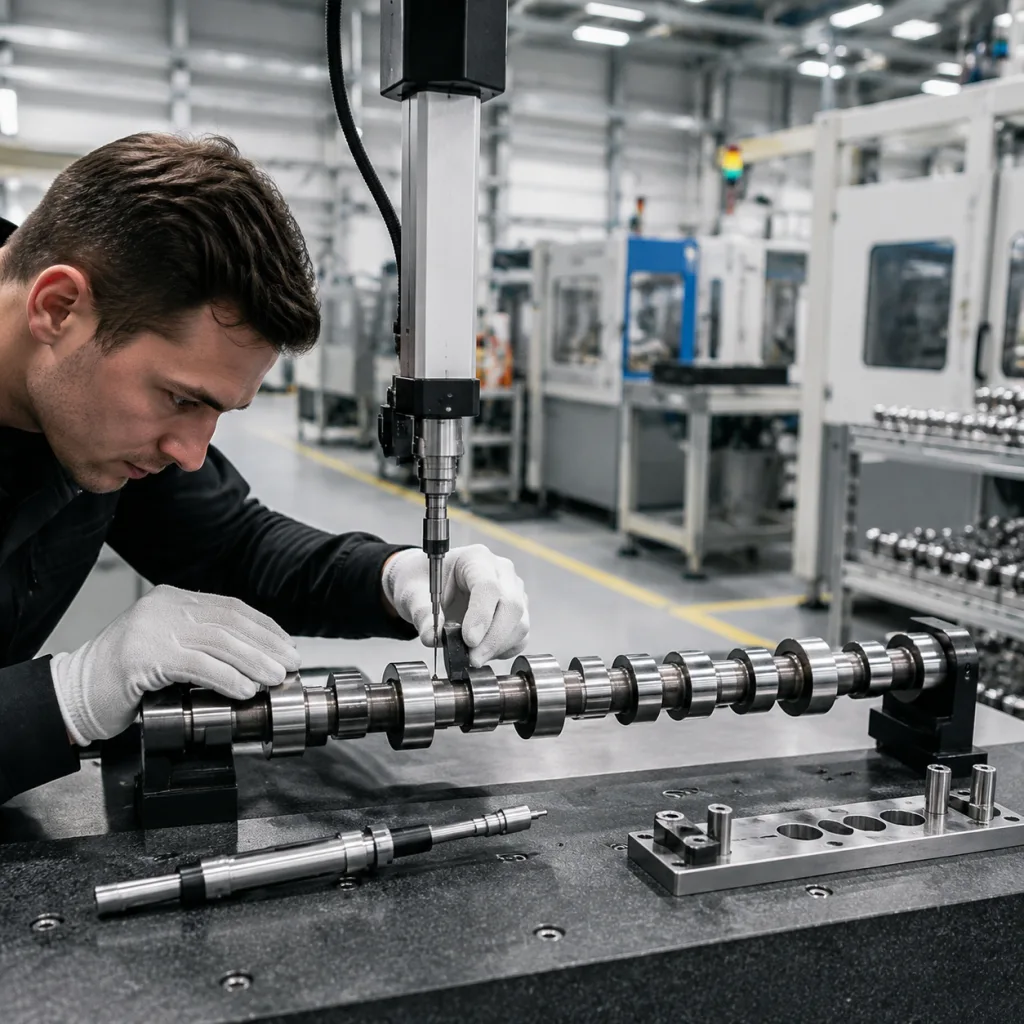
Camshaft total indicator runout and straightness limits
Journal diameter tolerance and surface finish
Nitriding, induction hardening, or other surface treatment details
Packaging standard for corrosion control and transit protection
Traceability to batch, furnace, and inspection lot
Sample quantity, PPAP-style documentation level, and revision status
Typical buyer acceptance targets for a replacement camshaft programme are runout at or below 0.03 mm TIR, journal diameter tolerance within ±0.01 mm to ±0.02 mm depending on the engine family, and straightness controlled within 0.03 mm per 100 mm unless the OE drawing specifies tighter limits. Surface roughness on journals is commonly requested at Ra 0.2 to 0.4 μm, with lobe finish controlled separately based on the follower design.
If these items are not documented, the risk is not only fitment returns but also inconsistent engine build performance across batches. For multi-location repair chains and distributors, that inconsistency is often more costly than the part price itself. A camshaft that is only 0.05 mm out on a critical journal can still assemble, but it may create oil film instability, noisy operation, or premature wear under load.
The specification sheet that actually matters
Camshaft specifications vary by engine family, but procurement teams usually compare the same control points. The table below shows the items that should appear on a supplier datasheet or PPAP-style submission.
Control item
What to request
Why it matters
Material
Alloy steel grade or chilled cast iron, stated by supplier; include EN/ASTM equivalent if available
Affects fatigue life, machinability, and hardening response
Hardness
Surface hardness and core hardness range; ask for HRC or HV values by zone
Impacts lobe wear, scuff resistance, and bearing life
Runout
Measured on journals or datum features; specify maximum TIR
Controls valvetrain timing stability and noise
Journal finish
Ra value or equivalent finish class
Reduces friction and oil film disruption
Lobe profile
CAD, master profile, or inspection method; request lift, base circle, and duration at check points
Ensures lift and duration match the application
Surface treatment
Nitriding, induction hardening, phosphate, or black oxide; define case depth where relevant
Improves wear resistance and corrosion protection
Traceability
Lot code, heat number, furnace record, and inspection lot
Supports warranty and root-cause analysis
Packing
VCI bag, end caps, tray or partition, carton strength, and label format
Prevents corrosion, nicks, and transit damage
</tr></thead><tbody> </tbody></table>Where the buyer requires more than catalogue replacement, compare the proposal against the engine build target and the intended duty cycle. A part supplied to a taxi fleet, for example, may need tighter process discipline than a low-volume repair programme. A fleet buyer may request 100% profile verification on the first 100 pieces, then AQL 0.65 sampling on steady-state production, while a distributor may accept routine 100% visual plus 1-in-20 dimensional checks if the supplier has stable capability indices. For most camshaft machining lines, buyers should ask for Cp/Cpk data on journal diameter and lobe lift; a Cpk of 1.33 or better on critical dimensions is a common approval benchmark.
How a supplier should control the process flow
A camshaft is only as good as the weakest step in its route. That is why the production sequence matters as much as the finished dimensions. Driventus operates as a vertically integrated manufacturer, which helps control process steps that are often outsourced in fragmented supply chains. For camshaft programmes, that means fewer handoffs between forging or casting, machining, heat treatment, and final inspection.
This structure supports three procurement needs:
1. Lead-time control — buyers can plan around stable production routing and batch scheduling. 2. MOQ alignment — smaller programmes can be discussed without forcing a full-container commitment if the specification is standardised. 3. Revision control — when an OE reference or engine family changes, engineering can track the effect through the process flow.
In commercial terms, standard replacement camshafts are typically quoted with MOQ ranges from 50 to 200 pieces per reference for stocked programmes, while special packaging or private-label requests may push MOQ to 300 to 500 pieces if tooling labels, cartons, or inserts must be customized. Lead time for standard catalogue parts is often 30 to 45 days after order confirmation when material is in house, and 45 to 60 days when heat treatment capacity is booked or the part requires a fresh production run. Buyers should ask whether the quotation is ex-works, FOB, or CIF, because freight and export handling can materially change landed cost on heavy engine components.
For suppliers serving the EU, UK, US, Canada, Australia, and Brazil, documentation matters as much as capacity. Buyers should expect material declarations where applicable, dimensional reports, and process certificates aligned to IATF 16949:2016 and ISO 9001:2015. If your sourcing file requires more than standard catalogue supply, see our custom manufacturing capability.
Proof of quality before you issue a PO
A camshaft programme should not move to PO stage without evidence of control at each major operation. Buyers commonly ask for the following:
Incoming material certificate with heat number
Hardness test report for a defined sample plan
Critical dimension inspection report
Runout and profile verification method
Surface treatment record, if applicable
Corrosion protection and packaging specification
Final visual inspection criteria
Process flow, control plan, and key gauge list
For a practical approval pack, request 3 to 5 pre-production samples from the same batch, plus one full dimensional report per sample and one retained master sample. If the supplier uses CMM or optical profile inspection, ask for the measurement uncertainty statement; for profile data, a repeatability target under 10 μm is usually expected for high-control features. Hardness checks are often requested on three points per lot: two lobes and one journal, with the acceptance band stated explicitly, for example 58 to 62 HRC at the treated surface and a softer ductile core where the design requires it.
For chemical compliance, ask for declarations aligned to REACH (EC) No 1907/2006 where applicable. If the part is used in a regulated emissions application, the supplier should also understand the documentation expectations around ECE R-83 and related market requirements, even when the part itself is an aftermarket replacement.
Review our quality system before you launch vendor qualification. If the supplier cannot show controlled records, traceability, and corrective-action handling, the procurement risk remains high even if the first samples measure correctly. A strong supplier file should also include an 8D response template, gauge calibration validity, and a clear nonconformance disposition process so buyers know whether suspect stock will be sorted, reworked, or replaced.
Commercial trade-offs buyers compare
For a camshaft Audi OEM supplier search, the commercial comparison is usually straightforward: can the supplier hold specification, repeat lead time, and support the channel model?
Common decision points:
MOQ: Is the minimum order suitable for distributor stocking or repair-chain replenishment?
Lead time: Can the factory support replenishment without long gaps?
Sampling: Are pre-production samples available for validation?
Packing: Is the part packed to avoid rust, edge damage, and transit movement?
Documentation: Are commercial invoice, packing list, and origin documents handled correctly for import?
Change control: Are material or tooling changes notified before shipment?
Price breaks: Does unit price step down at 100, 300, and 500-piece tiers?
A realistic sourcing comparison should not look only at unit price. A part quoted at $18.50 may be less attractive than a $20.10 part if the cheaper offer carries a 60-day lead time, lacks hardness records, or needs rework-level packaging at destination. Buyers often compare landed cost using three inputs: ex-works price, export packing, and freight. On heavier engine parts, ocean freight can add a meaningful per-unit cost when MOQ is small; if you buy 50 to 100 pieces, shipping can move unit cost by 8% to 20%, while a 300-piece consolidated order may reduce that impact to low single digits.
If you need a broader view of related engine parts, use our catalog and the engine-component range at /products/engine-components.html. This is useful when the camshaft order must be bundled with gaskets, timing parts, or water pump items for consolidated inbound freight. For channel buyers, ask whether the supplier can support mixed-SKU cartons, barcode labels, and palletization to your DC standard; those details often decide whether inbound receiving is efficient or costly.
When a standard part is not enough
Standard replacement parts are suitable for many catalogue programmes, but not all. Custom manufacturing becomes relevant when an engine variant has limited coverage, when the buyer needs private-label packaging, or when a specific surface treatment or inspection routine is required.
Typical triggers for a custom order:
Discontinued OE reference with ongoing fleet demand
Regional engine variant not covered in the standard line
Special packaging for export distribution
Higher inspection frequency for warranty-sensitive channels
Consolidated sourcing across multiple engine families
Need for tighter tolerance, such as journal roundness under 0.005 mm or lift variation under 0.02 mm versus the standard line
In these cases, the buyer should provide the engine code, target annual volume, required OE cross-reference, and the acceptance criteria. Include the target price band, desired MOQ, and requested launch date, because custom engineering cost is often recovered through volume commitment. A small private-label run may require a one-time tooling or packaging setup charge, while a recurring fleet programme may justify that cost if annual demand exceeds 1,000 units.
The normal workflow is: technical review, drawing or sample confirmation, quotation, sample build, dimensional validation, and then production approval. If the buyer can share old part samples, OEM service bulletins, or a written failure mode history, the supplier can align inspection to the real risk rather than guessing at the spec. That shortens the engineering review and reduces sampling delays. If you are building a supply plan around an Audi camshaft reference, use the project data to separate standard replacement demand from engineered supply demand. For the latter, request a quote after technical review.
Frequently asked questions
Yes. Driventus supplies camshafts as an independent aftermarket manufacturer. Brand names are referenced for fitment only, and we do not claim OEM approval or endorsement.
Request material certificates, hardness reports, dimensional inspection data, traceability records, and packaging details. For compliance workflows, ask for REACH declarations where applicable. For higher-risk programmes, also request process flow, control plan, and a sample measurement report with runout, journal diameter, and profile data.
Yes. Custom manufacturing is available for special packaging, non-standard engine coverage, and programme-specific inspection needs. Share your target volume, required MOQ, desired lead time, and OE cross-reference during enquiry so the quotation reflects both technical and commercial requirements.
If you are qualifying a camshaft Audi OEM supplier, send your OE reference, annual volume, target market, and required tolerance or packaging standard for review. We can confirm fitment, documentation, MOQ, and supply options via /contact.html.