Crankshaft Pulley Packaging Requirements for Export
Crankshaft pulleys are small, heavy parts with too many rejection points to treat packaging as an afterthought. Finished bores, keyways, belt grooves, timing marks, coated edges and rubber damping surfaces can all be damaged by one poor carton layout or a damp container route. For importers, the issue is commercial as much as technical: bad packing reduces incoming yield, slows warehouse receiving, increases warranty exposure and wastes container space. This guide sets out crankshaft pulley packaging requirements export buyers can put directly into RFQs, purchase orders and supplier quality agreements. It covers risk-based pack selection, part-level protection, carton limits, pallet loading, humidity control, traceability, documentation and shipment-release checks. Driventus manufactures engine and powertrain components in Taizhou, Zhejiang under IATF 16949:2016 and ISO 9001:2015 controls. Driventus is an independent aftermarket manufacturer; brand names are referenced for fitment only.
Decision Framework: Match the Pack to the Pulley Risk
Start with the part, not the carton. A pressed steel pulley, a solid machined pulley and a torsional vibration damper with bonded rubber do not need the same export pack. The right specification depends on geometry, weight, finish, transit route and how the part will be handled after import.
Use these risk points to choose the packing level and record the decision in the packing instruction:
Mass per unit: aftermarket crankshaft pulleys may weigh less than 1 kg or more than 8 kg; calculate carton limits using actual part weight plus inner-pack weight.
Critical surfaces: bore diameter, keyway, bolt holes, belt grooves, timing marks, mating face and damping ring; define “no burrs, dents, rust or coating chips on functional surfaces” as the receiving standard.
Surface treatment: phosphate, electrophoretic coating, zinc plating, paint, black oxide, anti-rust oil or bare machined areas; state whether oil is allowed on belt-contact surfaces.
Dimensional sensitivity: protect bores and hub faces where fit tolerances may be in the 0.01-0.05 mm range; a small dent can still trigger rejection.
Rubber elements: prevent compression set, solvent contact, ozone exposure and storage near heat; straps or inserts must not press directly on the damper ring.
Export route: sea freight, air freight, express parcel, LCL consolidation or domestic redistribution after import; sea shipments commonly require 60-90 days of corrosion protection.
Ask the supplier to price the approved pack separately where possible. A retail colour box, VCI bag and moulded insert can materially change cost and may require a higher MOQ than a plain export carton. Buyers comparing several part families should review our catalog and set requirements by product type rather than applying one generic carton rule to all rotating engine components.
Failure Modes at Part Level: What the First Layer Must Prevent
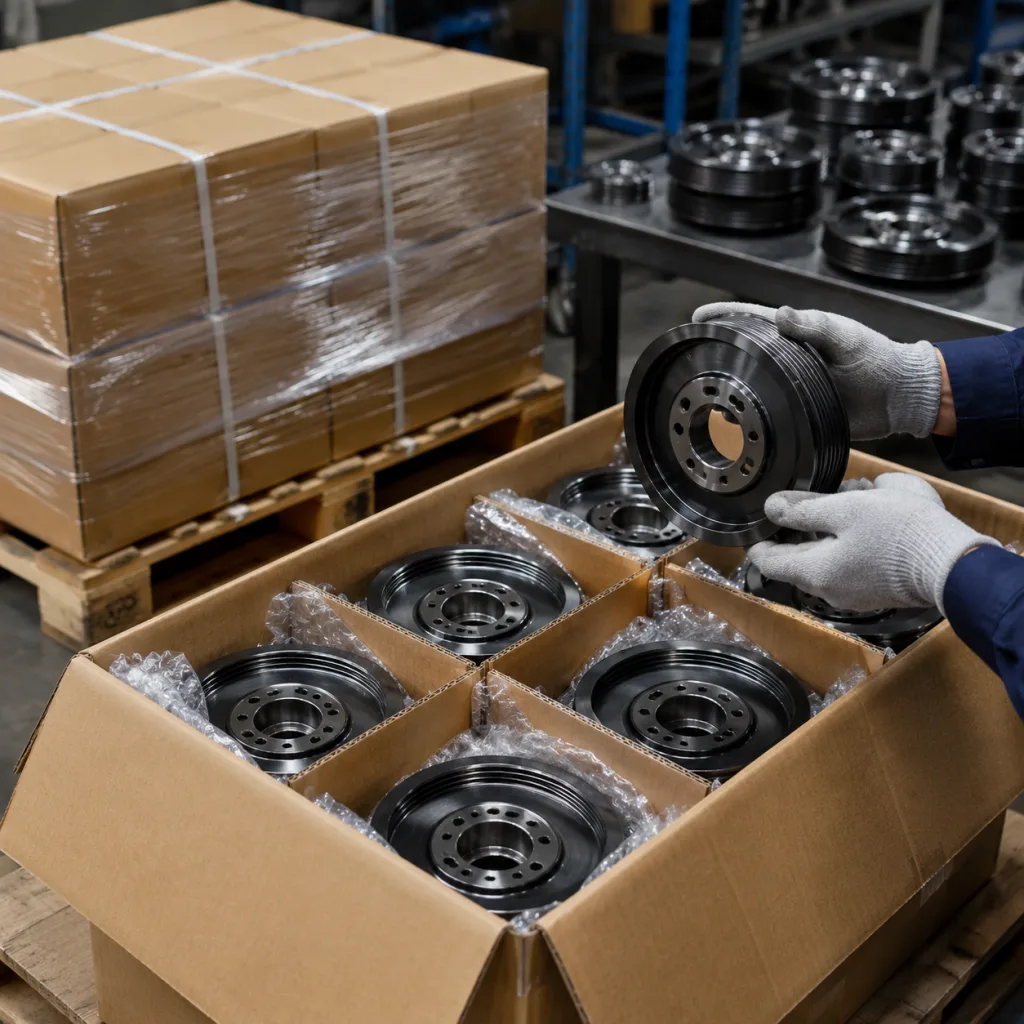
The first packaging layer has one job: stop the pulley from becoming its own damage source. It should prevent metal-to-metal contact, shield machined surfaces from corrosion and hold the part stable inside the carton. For damped pulleys, it must also avoid constant pressure on the elastomer.
A practical part-level specification may include:
Item
Recommended requirement
Verification method
Surface protection
VCI bag of 0.06-0.10 mm, anti-rust oil or sealed PE bag matched to 60-90 day sea transit
Visual check, bag seal check and humidity-storage review
Bore protection
Plastic sleeve, cap or wrapped hub area with no adhesive on machined bore
Incoming inspection of bore and keyway
Edge protection
Corrugated insert, foam ring or moulded pulp separator with 5-10 mm clearance from functional edges
Drop and vibration review
Contact prevention
One part per cell or fixed separator gap; no metal-to-metal contact after hand shake
Shake test before carton sealing
Rubber protection
No tight banding across damper ring; no oil pooling on rubber
Visual check after 24-48 hours unpacked
Identification
Part label on inner pack with part number, lot and quantity
Scan and PO cross-check
</tr></thead><tbody> </tbody></table>Loose pulleys should not be loaded directly into a master carton. The outside carton may look fine while the parts inside have marked belt grooves, chipped coating, dented timing features or damaged hub faces. On machined pulleys, a tiny burr or impact mark can become belt noise, visible runout complaints or rejection at the importer’s inspection bench.
For new part numbers, request a packing sample or pilot carton before mass packing. The supplier should photograph the empty carton, separator layout, protected pulley, closed carton and marked pallet. If the buyer requires a branded inner box, confirm artwork approval, barcode grade, print tolerance and MOQ before production. Custom printed boxes often require 500-1,000 pieces per SKU unless a shared print design is approved.
Carton Specification Deep-Dive: Weight, Strength and Movement Limits
A good master carton is not just “export quality.” It has measurable limits for board strength, gross weight, part movement and stack load. Those limits should reflect pulley weight, pallet height, storage duration and the way cartons will be handled at the destination warehouse.
Recommended carton controls:
Use double-wall corrugated cartons for heavy pulleys or master cartons above 15 kg gross weight; common export grades include 5-ply board with 44-48 ECT or equivalent compression performance.
Limit master carton gross weight to 20-25 kg where manual handling is expected, and target 10-15 kg for parcel shipments or high-frequency warehouse picking.
Keep identical part numbers in the same master carton unless the purchase order authorises mixed packing; mixed cartons need a visible carton-level packing list.
Add internal separators so pulleys cannot rotate, slide or strike each other during vibration; allow no free movement greater than about 10 mm after carton closure.
Seal cartons with reinforced tape, water-activated tape or staples where permitted by the destination market; use an H-seal for cartons above 15 kg.
Mark gross weight, net weight, carton number, quantity, origin, handling marks and stacking direction.
For parcel packs, carton approval may include a 76 cm drop test on one corner, three edges and six faces. For pallet-only freight, buyers can agree a lower-height handling test, but compression still matters. Bottom-layer cartons should tolerate the calculated pallet load with a safety factor of at least 1.5 during warehousing.
Carton design also affects labour cost. A carton that is too heavy slows unloading and put-away work. A carton that collapses under pallet load creates claims even if the pulley was manufactured correctly. Packaging trials should be documented within the supplier’s ISO 9001:2015 quality records and linked to the approved packing instruction for repeat orders.
Sea-Freight Scenario: Palletisation, Container Loading and Moisture Control
Picture a mixed aftermarket container moving by sea, waiting at port, then sitting in a humid inland warehouse before receiving inspection. The pulleys face vibration, temperature swings, container sweat and multiple forklift touches. The pallet specification has to control both mechanical damage and corrosion risk.
Use pallets suitable for the destination country and receiving warehouse. If solid wood packaging is used, it should comply with ISPM 15 requirements for treated wood packaging in international trade. Plastic pallets, plywood pallets or engineered-wood pallets may reduce documentation issues related to wood treatment.
Key pallet requirements:
Use standard 1,100 x 1,100 mm, 1,200 x 800 mm or buyer-specified pallets, and confirm forklift entry direction before shipment.
Keep pallet height normally within 1,100-1,200 mm unless the receiving warehouse approves higher loads; keep pallet gross weight within forklift and rack limits, often 500-800 kg for mixed aftermarket goods.
Column-stack cartons where possible to preserve compression strength, with no carton overhang beyond pallet edges.
Use corner boards on all vertical edges for heavy or high-value loads, normally 3-5 mm thick and full pallet height.
Apply stretch film plus at least two PET or composite straps per pallet; use edge protectors under straps to prevent carton crushing.
Add desiccant, container dry bags or a pallet shroud when the route has high humidity risk; typical container dry-bag loading is 1-2 kg per 20 ft container equivalent, adjusted by season and route.
Place pallet labels on at least two adjacent sides for forklift-side scanning.
In the container, heavier crankshaft pulley pallets should sit on the floor and should not carry unsupported top loads. If mixed engine components ship together, pulleys should never be stacked above fragile gaskets, sensors, plastic housings or boxed water pump assemblies. Use a load plan showing pallet sequence, gross weight by pallet and any non-stackable positions. For combined shipments across engine component lines, discuss custom manufacturing requirements early so packaging is designed around the bill of materials instead of corrected after the first container arrives.
Traceability Q&A: Labels and Documents Buyers Should Require
What traceability level is enough? Export packaging should link the pallet to the carton, the carton to the part number and the part number to the production batch. This supports aftermarket warranty claims and OEM/Tier-1 containment or corrective-action procedures.
Which label fields should be mandatory? Define them before production starts:
Customer part number and supplier part number.
OE cross-reference where applicable, using the buyer-approved fitment-data format.
Purchase order number and line number.
Quantity per carton and per pallet.
Lot number, production batch number or date code.
Country of origin.
Gross weight, net weight and carton dimensions.
Barcode, QR code or data matrix format if required by the buyer’s warehouse system.
How should labels be made scannable? Specify barcode type, print size, label position and scan distance. A common B2B approach is Code 128 or QR code with carton ID, SKU, quantity and lot number, printed at 203-300 dpi on a white label. Each pallet should carry a pallet ID linked to all carton numbers in the packing list. Carton numbering such as 1/48 through 48/48 reduces receiving errors.
Which compliance documents may be needed? Requirements depend on the destination market and material composition. Buyers may request REACH (EC) No 1907/2006 substance declarations for EU supply chains, rubber compound data, coating declarations and confirmation that packaging materials meet local import rules. Quality documentation should align with IATF 16949:2016 where automotive process controls apply, and ISO 9001:2015 for documented procedures, nonconforming output control and corrective action. Driventus maintains a documented quality system for incoming material control, process inspection, final inspection and packing verification.
Shipment-Release Workflow: From Checklist to Commercial Terms
Do not leave packaging approval until the container is ready. Attach the checklist to the purchase order, sourcing file or supplier quality agreement so the approved method is visible before production release.
Export packing checklist for crankshaft pulleys:
1. Confirm the approved packing drawing or packing instruction number, including revision level. 2. Verify that one pulley cannot contact another pulley inside the carton after a manual shake check. 3. Confirm the anti-corrosion method and expected protection period, such as 60 or 90 days from shipment date. 4. Check carton burst strength, ECT or compression specification where provided. 5. Confirm master carton gross weight and manual handling limit, ideally not above 20-25 kg. 6. Verify pallet type, dimensions, treatment status, stacking height and gross weight. 7. Confirm labels match the purchase order, part number, quantity and batch record. 8. Review photos of the inner pack, sealed carton, pallet and container loading before balance payment or shipment release. 9. Confirm export documents: commercial invoice, packing list, certificate of origin where required, wood treatment declaration where applicable and any material declarations requested by the buyer. 10. Retain packaging approval records for repeat orders and supplier scorecards.
For repeat sourcing programmes, define packaging-damage acceptance criteria at receipt. Practical limits include no rust on functional surfaces, no torn VCI bags, no missing carton labels, no broken pallet straps, no pallet lean greater than 5 degrees, no crushed carton corners exposing the part and no loose separators. Set the inspection sampling plan in advance, such as checking the first 5 cartons plus one carton per pallet, or using the buyer’s AQL procedure for larger shipments.
MOQ, price and lead time belong in the same discussion as the packaging standard. Plain export packing can often follow the part MOQ. Custom colour boxes, printed labels, moulded pulp inserts and private-label pallets may require separate packaging MOQ plus 7-15 extra days for material preparation after artwork approval. Treat these conditions as quotation terms, not clean-up work after the pulley price is agreed.
Frequently asked questions
The main risks are corrosion and impact damage to machined, coated or belt-contact surfaces. Because crankshaft pulleys are heavy for their size, loose parts can damage each other inside a carton even when the outer packaging appears acceptable.
Individual cell packing or separated inner packing is preferred for most export shipments. Bulk packing may be acceptable only when separators prevent part-to-part contact, gross carton weight stays within the agreed limit and the buyer has approved the method in writing.
IATF 16949:2016 and ISO 9001:2015 support documented packing procedures, traceability and corrective action. ISPM 15 applies to treated wood packaging in international trade, and REACH (EC) No 1907/2006 may apply to EU material declarations.
If you are defining crankshaft pulley packaging requirements export shipments must meet, Driventus can review part risk, carton layout, pallet specification, MOQ impact, lead-time assumptions and traceability needs before quotation. Share your packing standard or target market to [request a quote](/contact.html).