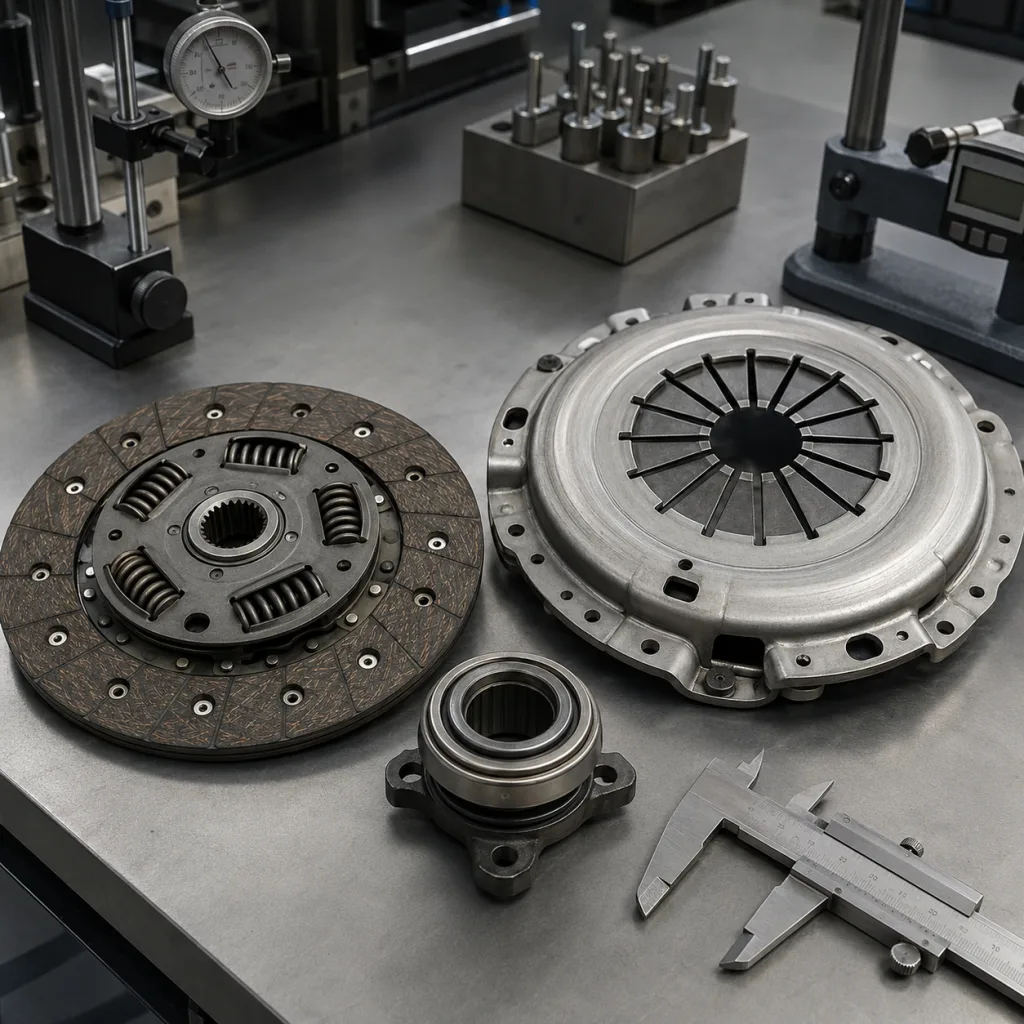
A serious search for an egr valve volvo oem supplier starts with risk, not catalogues. The part has to match the engine application, connector geometry, actuator behaviour, sealing face, emissions layout, and buyer approval process. If one of those details is vague, the lowest quote can become the most expensive option.
Procurement teams should lock the basics before price negotiation: engine code, model year range, verified OE cross-reference, connector type, actuator voltage, gasket interface, annual demand, first-order quantity, MOQ target, packaging format, Incoterm, and approval timeline. Driventus manufactures EGR valves and related engine components in Taizhou, Zhejiang, with production controls aligned to IATF 16949:2016 and ISO 9001:2015.
A controlled sourcing project may include drawing review, sample validation, connector and actuator checks, leakage testing, mounting-flatness inspection, packaging approval, MOQ planning, lead-time confirmation, and AQL agreement. This guide shows how to qualify an independent EGR valve manufacturer for Volvo-fitment programmes without treating every supplier claim as equal. Driventus is an independent aftermarket manufacturer; brand names are referenced for fitment only.
Decision Framework: What Must Be True Before RFQ
Do not open an EGR valve Volvo-fitment RFQ with “please quote.” Open it with the conditions that make the quote valid. EGR valves vary by engine family, emissions package, cooling layout, actuator design, connector shape, mounting interface, and ECU control logic. A supplier can match the outside shape and still fail on response, leakage, pin layout, or gasket sealing.
Before requesting price, confirm:
Target vehicle application, engine code, model year range, fuel type, emission stage, and market region
Verified OE part-number cross-reference if already used in the programme file, such as OE 06A… or OE 11251…
Physical sample, 2D drawing, 3D file, or validated benchmark part when the cross-reference is not enough
Connector specification, including pin count, locking tab direction, terminal plating expectation, and harness orientation
Actuator requirement, such as 12 V or 24 V supply, sensor type, position-feedback range, and known ECU command behaviour
Annual volume, first stocking order, quarterly demand forecast, target MOQ, and reorder point
Packaging requirement: neutral box, distributor brand, bulk tray, repair-chain kit, gasket included or gasket excluded
Import and compliance documents, including material declarations where required
Sample quantity, test plan, and acceptance criteria before commercial release
Separate one-time costs from serial pricing. Tooling, fixture adjustment, special connector sourcing, private-label artwork, or extra validation can be paid upfront, amortised into unit price, or waived after a volume commitment. Put that logic in the RFQ. Do not leave it to negotiation after samples are approved.
A practical approval path is simple: 3–5 samples for bench and fitment checks, 20–100 pieces for pilot intake and workshop feedback, then serial MOQ based on carton quantity, batch size, and export consolidation.
Driventus can support sourcing reviews through our catalog and engineering discussion for engine and emissions-related part families. If the buyer needs a part that is not already released, custom manufacturing can be assessed against drawings, physical samples, or validated benchmark parts.
Spec Deep-Dive: Where EGR Valve Quality Is Proven
An EGR valve is not a passive casting. It is a flow-control component working in hot, soot-heavy exhaust conditions while responding to ECU commands. For Volvo-fitment applications, the sourcing risk sits in the details: actuator response, sealing, connector retention, mounting flatness, corrosion resistance, and repeatability between the approved sample and serial production.
Use the technical file to control the part, not the sales sheet.
Item
Procurement Check
Typical Evidence Requested
Valve body
Casting integrity, machining datum control, porosity risk
Dimensional report, CMM data, casting inspection record
</tr></thead><tbody> </tbody></table>Write useful tolerances into the approval file. Examples include mounting-face flatness at 0.05–0.10 mm where gasket sealing is critical, connector terminal position checked by mating gauge, critical hole centre distance verified by CMM or fixture, and 100% functional testing before packing. Leakage acceptance must define pressure, medium, duration, and maximum allowable leakage. Without those four details, two suppliers may “pass” the same part using different test methods.
Driventus manages production under a documented quality system aligned with IATF 16949:2016 and ISO 9001:2015. For sourcing engineers, traceability is the practical test of control: incoming material checks, in-process inspection, final functional testing, batch identification, and nonconformance handling should all be visible during qualification. Factory audit documents can be prepared before sample approval or mass production.
Timeline Scenario: From Sample Request to Replenishment
Commercial feasibility is part of supplier qualification. Treat development samples, pilot orders, and serial purchasing as separate gates. If the first shipment is handled like full replenishment before fitment evidence is complete, the buyer carries unnecessary warranty and inventory risk.
A practical timeline looks like this:
1. RFQ review, 2–5 working days: Confirm application data, annual volume, cross-references, packaging, destination market, and target Incoterm. 2. Sample confirmation, 7–20 working days for released items: Check the physical sample, drawing, or benchmark part against the target specification. 3. Pilot order, typically 20–100 pieces: Use a limited quantity for warehouse intake, installation checks, scan-tool response review, and field feedback where applicable. 4. Serial supply: Agree MOQ, carton standard, inspection level, reorder trigger, and replenishment schedule. 5. Ongoing review: Monitor defect feedback, warranty coding, demand forecast updates, and engineering-change notices.
Lead time depends on release status. For released EGR valves, plan around inventory availability, production scheduling, 100% functional testing, final inspection, and export consolidation. A realistic range is 2–4 weeks when stock or scheduled production exists and 4–8 weeks when a fresh batch is needed. New development requires tooling review, sample manufacture, dimensional inspection, functional testing, packaging confirmation, and buyer approval. If tooling or actuator sourcing changes, 8–16 weeks is safer.
MOQ should follow real demand, not a broad vehicle-platform estimate. A useful formula is first order = 8–12 weeks of forecast demand + safety stock - current inventory, rounded to the nearest carton or pallet quantity. If monthly demand is 80 pieces and the buyer wants 10 weeks of cover, the opening order is about 200 pieces before safety stock.
For slow-moving Volvo-fitment SKUs, buyers may combine mixed SKUs in one shipment while keeping each SKU above the agreed production or packing minimum. Price should be discussed by volume band: sample pricing may be higher because of setup and testing, pilot orders may sit near base price, and serial pricing may improve at 300, 500, 1,000, or 3,000 pieces depending on material purchasing, actuator batch cost, packaging, and inspection workload. Tier-1 and OEM-style projects may also include PPAP-style documentation, process flow, control plan, measurement records, capability evidence, and annual price review rules.
Compliance Check: What Documents Actually Reduce Import Risk
EGR valves are emissions-related components, so documentation needs to be precise. A supplier should not claim vehicle manufacturer approval unless formal evidence exists. Driventus does not claim such approval. Driventus is an independent aftermarket manufacturer; brand names are referenced for fitment only.
For EU, UK, US, Canada, Australia, and Brazil import programmes, buyers may request:
IATF 16949:2016 certificate and ISO 9001:2015 certificate
Material declaration and restricted substance statement where applicable
REACH (EC) No 1907/2006 compliance declaration for relevant supplied articles
RoHS statement when requested by the buyer’s compliance system or marketplace channel
Production inspection records and functional test summary by batch
PPAP-style file where required, including process flow, control plan, FMEA summary, dimensional results, material records, and initial sample inspection report
Batch traceability records for warranty investigation, ideally linking carton label, production date, inspection lot, and major component batches
Vehicle emissions regulations such as ECE R-83 define pollutant-emissions requirements at vehicle level. They should not be presented as direct approval of an aftermarket EGR valve. For procurement teams, the safer route is part-level validation data, fitment evidence, quality records, and import documents.
Before shipment, compare the commercial document set with the destination country and customs broker requirements. Check declared part description, HS code consistency, Incoterm, currency, country of origin, pallet dimensions, wood-packaging status where applicable, and whether the shipment moves by air, sea, courier, or consolidated container.
Private-label packaging adds one more control point. Artwork approval should be locked before mass packing because relabelling finished cartons adds cost, delay, and claim risk.
Failure Modes: What a Factory Audit Should Catch
A good audit answers one question: can the factory repeat the approved sample at scale? It does not need to be theatrical. It does need to cover the process steps that affect fitment, electrical performance, durability, and field-claim handling.
Audit against the failure modes that matter:
Incoming castings, sensors, actuators, springs, seals, connectors, and machined subcomponents are accepted without written criteria
Critical dimensions are missing from the drawing or control plan, or inspection frequency is not defined by lot, shift, or setup
Machining fixtures are not labelled, controlled, or periodically verified against a master part or gauge
Valves are packed without complete functional testing, including opening/closing command, position feedback, abnormal noise, and leakage where required
Nonconforming parts are not segregated, recorded, reviewed for corrective action, or blocked from mixed return to production
Finished cartons cannot be traced to production date, operator or line, inspection record, and component batch
Packaging is not checked for export handling, moisture protection, barcode accuracy, and warehouse stacking
Actuator supplier, connector mould, machining datum, gasket material, or software-test parameters can change without approval
A simple scoring method works well: critical nonconformity for missing traceability or skipped functional testing, major nonconformity for uncontrolled gauges or mixed parts, and minor nonconformity for incomplete forms that do not affect shipped quality. For AQL inspection, buyers often use ANSI/ASQ Z1.4 or ISO 2859-1 sampling language, but emissions-related functional checks should be agreed separately because some characteristics need 100% testing rather than sample inspection.
The audit angle changes by buyer type. Multi-location repair chains usually care most about consistency, labelling accuracy, and claim response. Wholesalers focus on carton labelling, mixed-SKU consolidation, packing durability, and repeatable lead time. Tier-1 suppliers may extend the audit to change control, sub-supplier management, process capability, and corrective action response. Driventus can provide audit support documents and production process information during qualification.
Step-by-Step: Build the Sourcing Project File
A controlled sourcing project protects both buyer and manufacturer. First define the target outcome: catalogue expansion, private-label replenishment, repair-chain supply, or a custom part family for an emissions repair programme. Then the supplier can confirm feasibility, documents, timing, and commercial assumptions before final price negotiation.
Build the RFQ package in this order:
1. Application scope: Engine code, model year, emission stage, drive configuration where relevant, and target markets. 2. Reference basis: Verified OE cross-reference format, using only confirmed references such as OE 06A… where applicable. 3. Demand model: Expected annual demand, first-order quantity, reorder frequency, and target stock cover in weeks. 4. Commercial frame: Target price or landed-cost ceiling, with Incoterm and currency stated clearly. 5. Documentation package: Certificate copies, inspection report, functional test summary, material declaration, and PPAP-style file if needed. 6. Packaging standard: Artwork, barcode type, carton quantity, pallet limit, and gasket or accessory inclusion. 7. Acceptance criteria: Dimensional checks, leakage test condition, actuator response, connector mating, visual defects, and AQL level. 8. Warranty process: Defect code format, photos, scan-tool data, mileage, installation date, and returned-sample handling.
Freeze the RFQ data first. Approve samples second. Release the pilot order third. Negotiate long-run replenishment only after those gates are clear.
Avoid changing connector supplier, label design, gasket kit, or carton quantity after sample approval unless the change is documented. For private-label programmes, approve artwork proof, barcode scan result, carton compression expectation, and pallet layout before the first production packing run.
Buyers can begin with our catalog for released engine components or use custom manufacturing where a drawing, sample, or validated benchmark is available. For EGR valve Volvo OEM supplier projects, Driventus recommends confirming samples before committing to high-volume replenishment. This gives the buyer time to verify fitment, electrical response, documentation, packaging, and import paperwork under its own approval process.
Frequently asked questions
Yes. Driventus can review Volvo-fitment EGR valve requirements for distributors, repair chains, and OEM-style sourcing projects. Application data, sample parts, drawings, connector details, voltage requirements, annual volume, packaging standard, or verified cross-references help confirm feasibility before quotation.
Buyers commonly request IATF 16949:2016 and ISO 9001:2015 certificates, inspection records, functional test summaries, traceability controls, and material compliance statements such as REACH (EC) No 1907/2006 where relevant. For higher-control programmes, buyers may also request PPAP-style documents, dimensional reports, control plans, and batch-level test records.
No. Driventus is an independent aftermarket manufacturer; brand names are referenced for fitment only. Buyers should review fitment data, sample results, validation evidence, quality records, and import documents as part of their own sourcing approval process.
For EGR valve sourcing, send the application list, engine code, verified cross-reference, target annual volume, first-order quantity, documentation needs, inspection criteria, Incoterm, and packaging requirements. Driventus can review feasibility and help you [request a quote](/contact.html).