For importers and aftermarket distributors, egr valve acura wholesale sourcing is not a generic price exercise. It is a fitment, testing, documentation, and replenishment decision rolled into one. An exhaust gas recirculation valve works in a hot, carbon-heavy environment and must meter flow consistently across changing duty cycles, often near exhaust gas temperatures of 250–550°C depending on duty cycle and installation position. If the valve drifts out of calibration, leaks at the seat, uses the wrong connector key, or ships with an incomplete gasket set, the result is predictable: fault codes, returns, delayed claims analysis, and warehouse stock that cannot be sold with confidence.
Driventus manufactures engine and powertrain components in Taizhou, Zhejiang, and supplies export markets in more than 60 countries. For Acura-fit EGR valve programmes, procurement teams should evaluate more than unit price. Process control under IATF 16949:2016, ISO 9001:2015 documentation, dimensional validation, 100% end-of-line functional checks where specified, packaging durability, and batch traceability all affect the real landed cost. Driventus is an independent aftermarket manufacturer; brand names are referenced for fitment only.
Start with the fitment map, not the quote sheet
Acura applications can vary by engine family, model year, connector layout, mounting pattern, emissions configuration, and market region. The first buying decision is therefore not “Which supplier is cheapest?” It is “Can this SKU map be controlled without substitutions?”
A reliable RFQ file should show the target OE and aftermarket numbers, engine displacement, body model, production month/year breakpoints, voltage, pin count, connector key position, mounting-hole centre distance, port diameter, gasket type, and actuation type. Specify whether the valve is vacuum, solenoid, or electronically controlled. Add photos of the connector and mating side when part-number history is unclear.
For mixed Acura-fit ranges, Driventus recommends separating SKUs into three velocity groups:
A-items: regular replenishment references with stronger forecast confidence
B-items: quarterly consolidation references where MOQ and carton mix matter more
C-items: sample, pilot, or low-velocity references that should not be overstocked before local demand is proven
Driventus supports distributor programmes where one EGR valve family may map to several aftermarket references. Buyers can review related engine parts in our catalog and, when a programme requires adjacent components, compare coverage under engine components.
The common failure points are rarely mysterious: mixed connector variants, weak terminal retention, insufficient pintle movement under heat, poor gasket sealing, missing gasket kits, and inconsistent solenoid response. Control them before the first shipment. For egr valve acura wholesale supply, Driventus recommends sample approval with retained master samples, locked inspection criteria, and carton-level traceability before releasing a 500–2,000 piece pilot lot.
Compare commercial terms by landed risk, not headline price
Wholesale EGR valve sourcing changes quickly when the order mix changes. One high-runner reference may support cleaner pricing, branded packaging, and scheduled replenishment. A long-tail Acura-fit range may need mixed cartons, phased validation, and more conservative MOQ planning.
Sourcing item
Typical buyer decision
Procurement note
MOQ
100–300 pcs per regular reference, or 500–1,000 pcs mixed order by discussion
Confirm whether mixed cartons are acceptable for trial orders and whether MOQ changes for buyer-brand boxes
Sample cost
1–5 pcs per SKU for fitment and bench checks
Clarify whether sample charge is credited after mass order approval
Lead time
7–15 days for samples, 30–45 days for repeat production, 45–60+ days for new variants
Tooling, connector changes, casting changes, or new labels can extend schedule
Unit price logic
Based on SKU volume, actuator type, material, test scope, packaging, and Incoterms
Quote high-runner and slow-runner SKUs separately instead of averaging all items
Packaging
Neutral, buyer brand, bulk, or service kit with gasket
Export cartons should pass stacking, humidity, label-scan, and barcode checks
Incoterms
FOB Ningbo/Shanghai, CIF, or DDP by discussion
Confirm port, insurance, duties, customs responsibility, and inland delivery cost
Traceability
Batch code, date code, carton label, and production lot record
Required for return analysis, containment, and 8D reporting
Documentation
Inspection report, packing list, invoice, COO if needed, material declaration where applicable
Importers should specify market-specific paperwork before quotation
</tr></thead><tbody> </tbody></table>Do not compare EXW or FOB unit prices in isolation. Add packaging, inspection documents, spare gaskets, inner-box artwork, palletisation, ocean freight, customs duty, local relabelling, and expected warranty reserve. That is the number your finance team will live with.
For established distributors, annual forecast sharing helps stabilise raw material planning and production slots. For new import programmes, Driventus can start with sample validation, a pilot lot, and phased stocking by SKU priority. This avoids tying cash to slow-moving variants before installation data confirms demand.
What an audit-ready EGR valve file should contain
A supplier qualification should prove how the valve is built, tested, traced, and corrected when something goes wrong. Driventus operates under IATF 16949:2016 and ISO 9001:2015 frameworks. Buyers can review our quality system before scheduling supplier qualification.
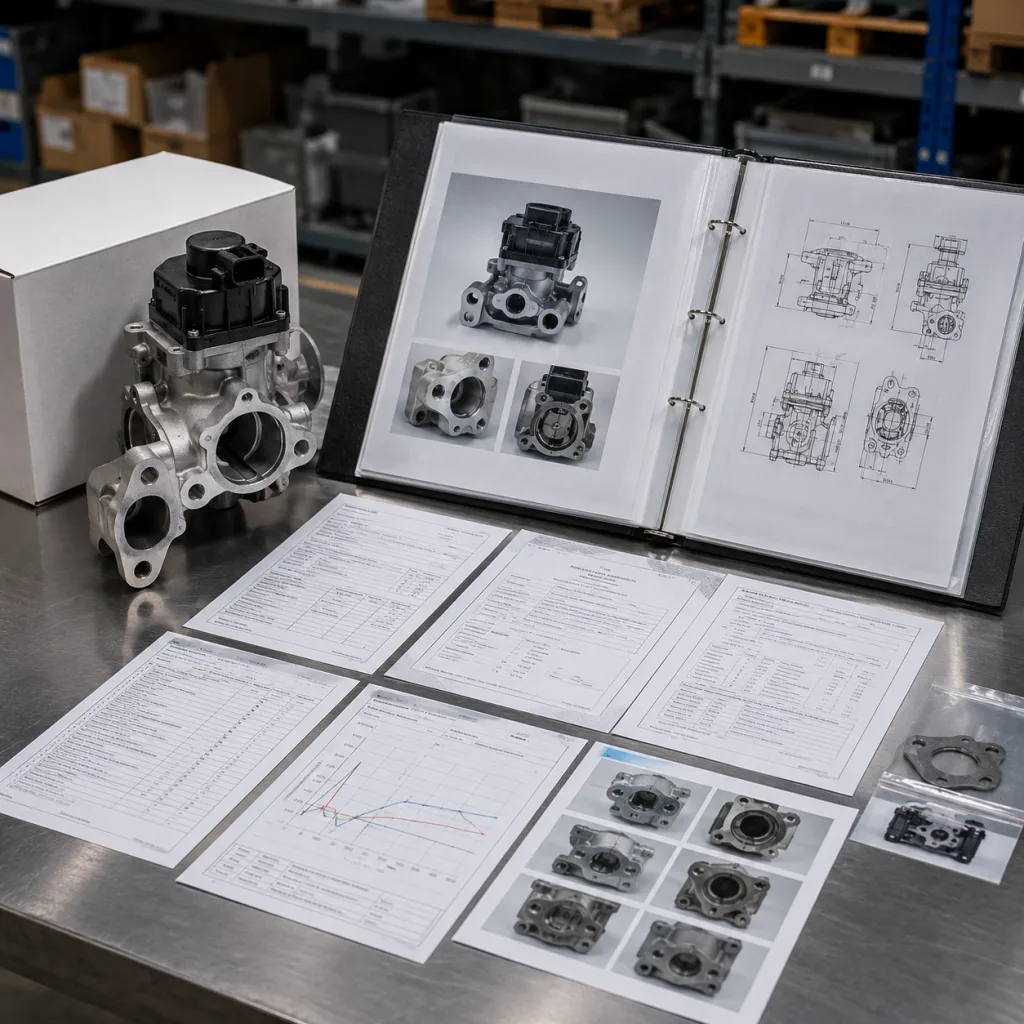
For audit preparation, request an APQP-style file covering drawing revision, BOM, process flow, control plan, inspection instruction, gauge list, end-of-line test record format, packaging standard, and traceability route. Incoming controls typically cover castings, machined housings, coils, springs, terminals, seals, gaskets, and fasteners. In-process checks may include port machining dimensions, sealing-surface flatness, bore condition, pintle travel, spring force, terminal insertion, connector lock fit, and torque confirmation for assembled fasteners.
Compliance expectations depend on the destination market. For the EU and UK, material declarations may reference REACH (EC) No 1907/2006 where applicable. For emissions-related components, buyers should also understand how the part may be represented in catalogues and whether it is sold for road-use applications in that market. Vehicle-level emissions regulations such as ECE R-83 do not automatically approve an individual aftermarket EGR valve.
Driventus does not claim approval or endorsement by any vehicle manufacturer. Driventus is an independent aftermarket manufacturer; brand names are referenced for fitment only.
For factory audits, procurement teams normally request:
Valid IATF 16949:2016 and ISO 9001:2015 certificates with scope and expiry date checked
Process flow chart, control plan, PFMEA summary, and inspection plan for the EGR valve family
Material and component traceability procedure from incoming lot to finished carton
End-of-line test method summary, including leakage, electrical, actuation, and visual criteria
Gauge calibration records for calipers, height gauges, electrical testers, torque tools, and leak-test equipment
Non-conforming product, containment, rework approval, and corrective action procedure
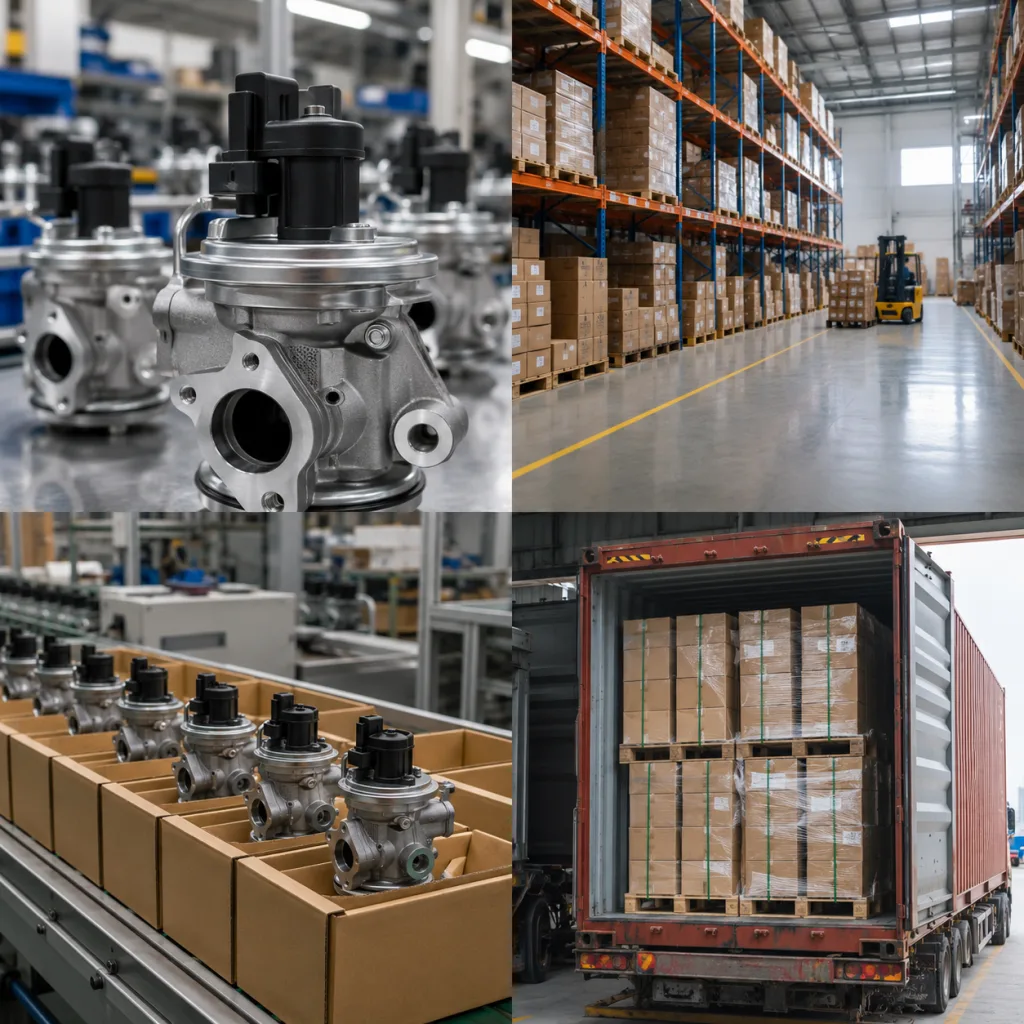
Packaging specification, barcode label format, master carton weight limit, and drop-test evidence where required
Technical failure modes to lock down before production
An EGR valve can look correct on the bench and still fail in the field. The seat may leak. The pintle may bind after thermal cycling. Coil resistance may sit outside the accepted range. A connector latch may pass visual inspection but fail retention during installation.
Procurement specifications should use measurable acceptance criteria, not phrases such as “OE quality”. For a typical Acura-fit EGR valve programme, Driventus recommends confirming these points before production release:
Mounting hole position, port geometry, flange thickness, and bolt pattern checked against approved drawings; common drawing tolerances are often controlled around ±0.05–0.15 mm for critical machined features where applicable
Sealing-surface flatness controlled to drawing requirement, commonly ≤0.05–0.10 mm depending on flange size and gasket design
Connector housing shape, terminal layout, pin count, polarity, locking feature, and CPA/secondary lock fit verified by gauge and mating connector
Coil resistance or sensor output checked against approved sample range at 20°C; resistance window should be stated per SKU, not assumed across all references
Valve movement tested for response consistency, return position, stroke travel, and no sticking after heat exposure
Leakage tested under defined pressure and time conditions, for example at 20–80 kPa for seat and gasket-interface checks, with the acceptable decay or flow limit written into the inspection plan
Thermal exposure agreed for the target application, such as repeated hot/cold cycling from -30°C to 120°C on the actuator side where required by the buyer
Vibration and connector-retention checks agreed for the installation position, including terminal pull-out force and latch engagement confirmation
Gasket material confirmed for temperature, exhaust condensate, oil vapour, and coolant-contamination resistance where relevant
Where a buyer supplies a reference sample, Driventus can compare dimensional, electrical, and functional characteristics and issue a comparison report covering critical-to-fit and critical-to-function points. If a programme requires a non-standard connector, revised bracket, changed spring force, different gasket set, barcode label, or buyer-specific packaging, the project may be handled through custom manufacturing.
A practical rollout sequence for MOQ, lead time, and stock
For egr valve acura wholesale purchasing, MOQ should follow SKU velocity and warranty exposure. High-demand references can justify full production lots and branded packaging. Slow-moving applications are better introduced through consolidated orders or mixed export shipments where feasible.
A practical sourcing sequence is:
1. Share target references, annual forecast, destination market, expected monthly demand, and packaging requirements. 2. Confirm fitment matrix, connector type, gasket requirement, OE cross-reference convention, and any excluded model-year ranges. 3. Review sample price, MOQ, target unit price band, estimated lead time, Incoterms, and inspection requirements. 4. Approve pre-production samples, mating-connector fit, gasket kit, carton label, and packaging artwork where applicable. 5. Place pilot order, commonly 100–500 pcs for priority SKUs or a mixed trial order when agreed, and monitor installation feedback, scan data, and return rate. 6. Move to scheduled replenishment once demand and quality data are stable, with reorder points based on sales velocity plus production and ocean-freight lead time.
Lead time depends on raw material availability, production queue, packaging, and whether new validation work is required. As a planning reference, buyers often allow 7–15 days for sample preparation, 10–20 days for sample evaluation and approval, 30–45 days for standard mass production after deposit and artwork approval, and 25–40 days for sea freight depending on destination route. New tooling, a changed connector, first-time branded packaging, or additional validation can add 2–6 weeks.
For inventory planning, calculate reorder point as average weekly sales multiplied by total replenishment weeks, then add safety stock for customs delay, peak season, and warranty replacement. A distributor selling 80 pcs per month with an 8-week replenishment cycle may need at least 160 pcs plus 20–30% safety stock before triggering a new order. Buyers should also account for sea freight variability, customs clearance, local labelling, and inland distribution time when setting reorder points.
Import manager Q&A for supplier selection
Is the lowest quoted price enough?
No. EGR valves are emissions-related components, so unclear fitment, missing test limits, or weak end-of-line testing can create downstream costs that exceed the saving on unit price. Compare suppliers on audit readiness, technical response speed, fitment discipline, and claims-analysis support.
What should be visible before approval?
Use this checklist during supplier review:
Does the supplier provide batch-level traceability on cartons, inner boxes, parts, and inspection records?
Are inspection criteria tied to controlled drawings, gauges, approved samples, and measurable tolerances?
Can the supplier explain leakage, electrical, actuator response, terminal-retention, and visual test methods with acceptance limits?
Are certificates current and issued under IATF 16949:2016 or ISO 9001:2015, with the correct manufacturing scope?
Can the supplier support neutral packaging, buyer-brand packaging, barcode labels, gasket kits, and pallet specifications?
Is there a defined response process for field returns, quarantine, root-cause analysis, replacement policy, and 8D reports?
Are brand names used only for fitment reference, not claimed endorsement or misleading catalogue approval?
Can the supplier hold master samples and drawing revisions for repeat orders without uncontrolled substitution?
How should the RFQ be structured?
Include target annual volume, first-order quantity, delivery port, packaging style, barcode format, required documents, and any local compliance declarations. Ask suppliers to quote by SKU tier rather than as one blended total. High-runner references, mid-volume references, and long-tail references usually have different MOQ and cost structures. This allows Driventus to quote on the same assumptions used by your internal landed-cost model.
Frequently asked questions
Yes. Subject to MOQ, packaging approval, and legal trademark controls, Driventus can supply neutral or buyer-brand packaging. Buyer-brand projects usually require approved artwork, carton specification, barcode format, and a packaging MOQ. Brand names are used only for fitment reference, not endorsement.
Provide target reference numbers, vehicle fitment range, annual forecast, first-order quantity, destination market, packaging requirement, delivery terms, and any inspection or documentation needs. Connector photos, mating connector details, samples, or drawings improve quotation accuracy.
Inspection documentation can be provided according to order requirements. Typical checks include dimensional inspection, leakage testing, electrical or actuator response checks, visual inspection, traceability verification, and packaging inspection. Buyers should state whether they need a standard inspection report, batch test data, or shipment-level documentation.
For Acura-fit EGR valve sourcing, share your SKU list, forecast, target MOQ, packaging requirement, required documents, and destination market. To compare sample cost, pilot quantity, lead time, and mass-production options, [request a quote](/contact.html).