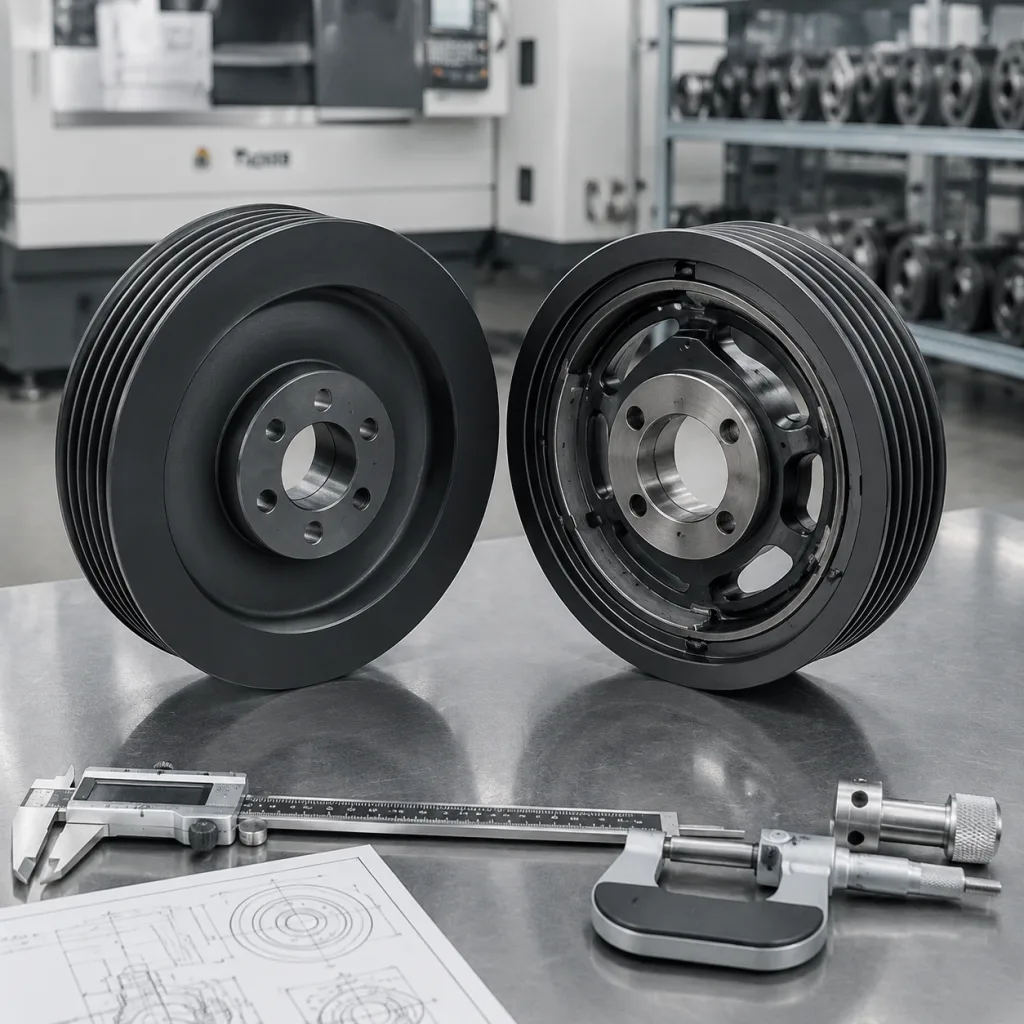
Crankshaft pulley dimensions decide more than whether a belt appears to line up. They influence accessory speed, belt tracking, crank nose fit, torsional damping, bearing load, seal life and NVH complaints after installation. For procurement teams, the drawing is the buying control point: it anchors quotation comparison, PPAP review, incoming inspection and warranty sorting. A supplier can match the outside diameter and still miss the bore, offset, groove pitch, bolt pattern or rubber damper geometry. That is where avoidable claims start. This guide focuses on the dimensions and controls buyers should lock down when sourcing crankshaft pulleys for aftermarket, OEM service or Tier-1 programmes. It covers functional measurement points, realistic tolerance discussions, construction choices, RFQ data, inspection evidence and commercial trade-offs used by Driventus Auto Parts in Taizhou, Zhejiang. Driventus is an independent aftermarket manufacturer; brand names are referenced for fitment only.
Start With the Dimensions That Can Stop the Line
Do not treat a crankshaft pulley drawing as a catalogue sketch. Start with the features that can block assembly, shift the belt plane or create vibration. For belt drive accuracy, procurement teams should request a 2D drawing, 3D model where available, material specification, process route and inspection control plan. If no drawing exists, ask the supplier to create one from at least three good samples so a worn, repaired or non-standard pulley does not become the master.
Dimension or feature
Buyer specification point
Typical inspection method
Outside diameter
Define effective belt diameter, not only maximum casting diameter; common range 90-220 mm
Vernier caliper, CMM, diameter gauge
Bore diameter
State nominal size, fit class and go/no-go limits; many hubs require ±0.015-0.030 mm control
Air gauge, plug gauge, CMM
Keyway width and depth
Confirm width, depth, radius and angular position to crank datum
Keyway gauge, CMM, optical comparator
Mounting bolt PCD
Define hole diameter, PCD, counterbore and thread clearance; hold PCD commonly within ±0.05-0.10 mm
CMM, fixture gauge
Overall width
Include hub projection and inertia ring width because these affect engine bay clearance
Caliper, height gauge
Belt groove profile
Specify rib count, pitch, included angle, groove depth and flank radius for PK or V-belt drives
Profile projector, contour gauge
Offset from mounting face
Control belt plane alignment; many programmes hold offset within ±0.10-0.25 mm
CMM, dedicated runout fixture
Radial and axial runout
Define TIR measured at belt grooves and mounting face; typical target below 0.10-0.15 mm
Dial indicator, rotating fixture
Damper rubber width and position
Specify rubber width, exposure, concentricity and flash allowance
Visual gauge, section check, CMM
</tr></thead><tbody> </tbody></table>For reverse-engineered aftermarket applications, include the OE cross-reference when available, for example OE 06A107065 format where applicable. Use it for fitment communication, not as a substitute for measurement. The RFQ should define datum A as the crank mounting face, datum B as the bore axis and datum C as the keyway or bolt-hole clocking feature. Without that datum structure, two suppliers may measure the same crankshaft pulley dimensions and report different results.
Tolerance Decisions: Where to Tighten and Where Not To
Tight tolerances are not automatically better. They raise machining cost, scrap risk and inspection time. Loose tolerances are not cheaper if they create belt walk, vibration or field returns. The right limit depends on engine family, belt type, hub design and whether the part is a solid pulley or a harmonic damper assembly.
Use this decision logic before approving a drawing package:
Tighten bore tolerance when the pulley is crank-centred through the hub; many machined hubs need ±0.015 to ±0.030 mm control.
Tighten offset tolerance when the accessory drive uses long belt spans or multiple driven components; belt plane location is commonly held within ±0.10-0.25 mm from the mounting datum.
Tighten groove runout when the belt is narrow, high-speed or sensitive to noise; common targets are below 0.15 mm TIR, with tighter applications at ≤0.08-0.10 mm.
Control mounting face flatness when clamp load and axial wobble are recurring risks; typical ranges are 0.03-0.08 mm.
Specify surface roughness where contact function matters; bore and mounting faces often sit around Ra 0.8-3.2 µm, depending on fit and sealing requirements.
Define coating thickness because zinc, phosphate or e-coat can change fit and corrosion life; thin protective coatings are often 5-15 µm unless the customer specifies otherwise.
State balance acceptance using ISO 21940 grade or a customer gram-mm value, especially after machining or rubber bonding.
Put numeric limits on rubber features such as section thickness, concentricity, flash, voids and visible separation.
Outside diameter for passenger car and light commercial pulleys commonly falls in the 90-220 mm range, but catalogue dimensions are not enough for production approval. State the measuring plane and whether paint, phosphate or other coating thickness is included. These values are sourcing examples, not universal limits. For controlled programmes, Driventus works from customer drawings, OE samples, validated reverse-engineering data or customer-approved control dimensions. Buyers can review related engine drive components in our catalog or request application-specific drawings through the sourcing team.
Solid Pulley or Harmonic Damper? Compare the Real Risks
Material and construction choices change the failure mode. A solid pulley mainly challenges machining accuracy, coating control and balance. A rubber-damped pulley adds bond strength, heat ageing, concentricity and torsional performance. A lower unit price can be false economy if the supplier changes the casting route, rubber compound or balance process without approval.
Construction type
Common material route
Main benefit
Procurement risk to check
Solid pulley
Steel, cast iron or aluminium alloy
Simple geometry and stable cost
Runout, bore fit, coating thickness
Rubber-damped pulley
Metal hub, elastomer ring, outer inertia ring
Torsional vibration reduction
Bond strength, rubber ageing, concentricity
Multi-groove serpentine pulley
Machined or formed V-rib profile
Compact accessory drive layout
Groove pitch and flank geometry
Timing-belt related pulley
Machined tooth profile
Positional accuracy
Tooth form, pitch error, hardness
</tr></thead><tbody> </tbody></table>For damped pulleys, do not let the elastomer remain a vague line item. Procurement files should define hardness range, ageing resistance, adhesion requirements and storage conditions. A practical specification may call out rubber hardness such as 60-75 Shore A, heat ageing at 100-125°C for a defined period, and no visible bond separation after section inspection or torque loading. Dimensional inspection alone cannot prove damping performance.
Typical production control includes incoming material checks, casting or forging lot traceability, CNC turning of the bore and faces, groove machining with tool-wear monitoring, rubber bonding parameters, cure time and temperature control, dynamic balancing, coating thickness checks and final visual inspection. For higher-volume programmes, ask whether the supplier tracks bore diameter, offset and groove runout with SPC and whether Cpk targets such as 1.33 apply to critical features.
Driventus operates under IATF 16949:2016 and ISO 9001:2015 frameworks. Buyers can review our quality system for audit preparation, supplier approval and documentation planning.
Build the RFQ in This Order
A clear RFQ prevents price comparisons built on hidden assumptions. If the request only says “same as OE sample,” suppliers may quote different materials, coatings, inspection levels, packaging standards and validation scope. Build the RFQ from function to evidence, then to commercial terms.
1. Application and fitment: list engine codes, model years and regional variants where applicable, including manual/automatic or AC/non-AC versions when pulley offset changes. 2. Controlled drawing: include datum structure, tolerances, surface finish, coating, material grade and measuring temperature, normally 20°C for precision dimensions. 3. Reference samples: provide an OE sample or approved aftermarket sample for profile verification and reverse engineering; send at least two good samples if available. 4. Critical-to-quality features: identify bore, keyway, belt groove profile, offset, PCD, runout, axial wobble and damping ring position. 5. Validation requirements: define balance, salt spray target, rubber bond check, thermal ageing, torsional endurance or overspeed test where relevant. 6. Inspection level: state whether the buyer expects 100% runout or balance checks, AQL sampling, or PPAP-style dimensional reports. 7. Packaging requirement: specify export carton strength, VCI or oil rust prevention, labels, barcode format, pallet height and mixed-SKU rules. 8. Compliance needs: include REACH (EC) No 1907/2006 substance restrictions where required for EU supply chains.
For custom programmes, Driventus can support drawing development, fixture design and production validation through custom manufacturing. This is useful when an importer has a physical sample but no complete engineering drawing. Separate one-time tooling from part price in the RFQ. A new rubber mould, casting pattern, broach, balance fixture or go/no-go gauge can change first-order economics even when the later unit price looks attractive.
When a Shipment Arrives, Inspect for These Failure Modes
Incoming inspection should look for the ways crankshaft pulleys actually fail in use. Dimensional conformity must be supported by repeatable inspection and process evidence. The most useful supplier documents are measurable records tied to drawing revision, batch number and inspection date.
A practical documentation pack includes:
Initial sample inspection report with actual measured values for all drawing dimensions, not only pass/fail marks.
Material certificate for metal and elastomer components, including grade, heat number or compound batch where applicable.
Hardness or tensile test records where relevant, especially for rubber-damped pulleys.
Coating thickness and corrosion test records if specified, such as 72-240 hour salt spray targets depending on market requirement.
Dynamic balance record for rotating assemblies, with residual unbalance value and correction method.
Process flow chart, PFMEA and control plan for approved programmes.
Capability data for bore, offset, runout and groove profile when the programme requires statistical evidence.
Batch traceability information and packaging inspection record.
Where a customer requires PPAP-style documentation, agree the exact level before quotation. IATF 16949:2016 expects structured risk control and change management, while ISO 9001:2015 supports documented process consistency and corrective action. These standards do not guarantee fitment for every application; they define management-system requirements that help control production quality.
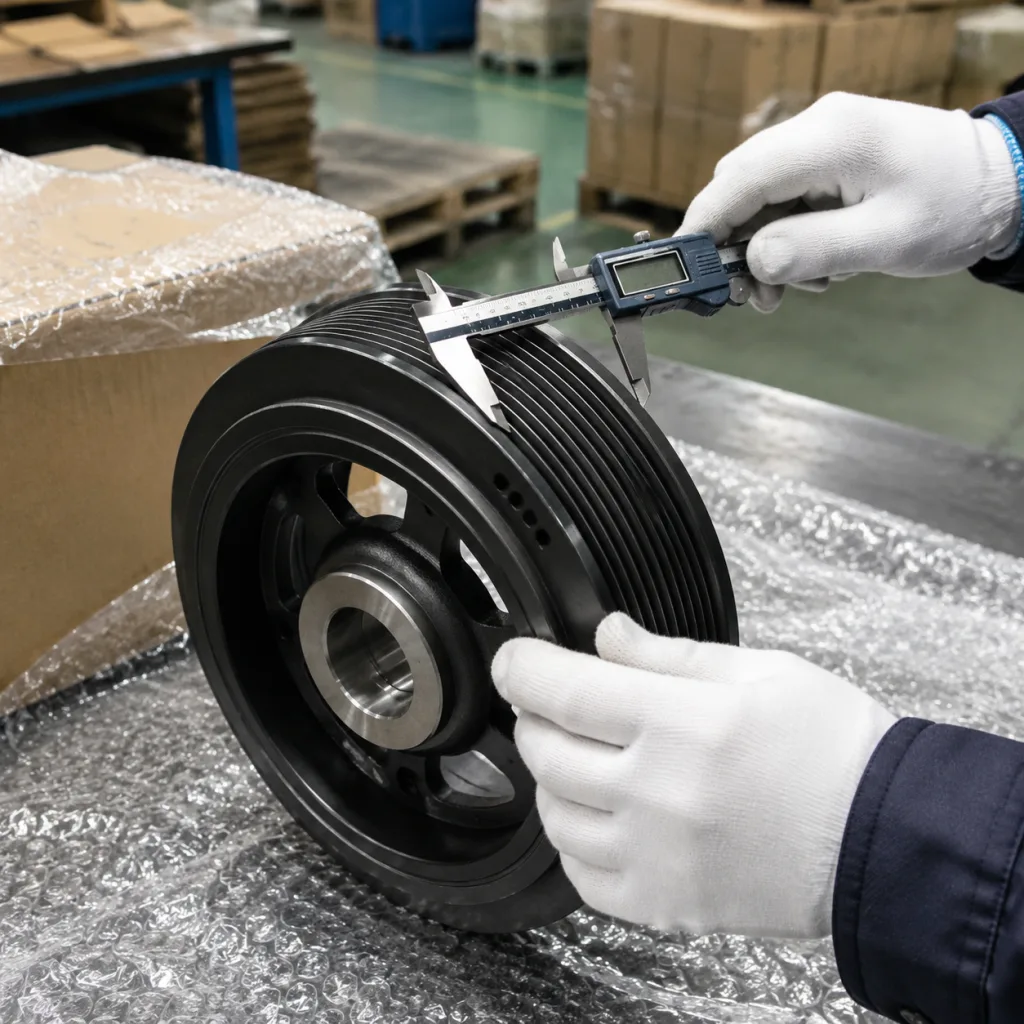
For buyer-side incoming inspection, check at least five pieces from the first shipment if the programme is new, or follow AQL sampling for larger batches. Measure bore, overall width, offset, groove profile and runout from the drawing datum structure. For damped pulleys, inspect rubber surface condition and bonding line for cracks, voids, uneven extrusion, oil contamination or ring displacement. If one critical dimension fails, quarantine the batch and request the supplier’s measurement record before rework, sorting or return decisions.
Importer Scenarios: What Changes the Buying Decision?
Aftermarket distribution is not only an engineering problem. Dimensional accuracy must be matched with stable availability, cross-reference discipline and packaging that survives warehouse handling. Many pulleys look similar on the shelf, so part marking and label control reduce picking errors.
When comparing suppliers, ask for:
Quotation based on the same drawing revision, sample standard, coating, inspection level and packaging requirement.
MOQ by part number and by production batch; existing items may start around 50-200 pieces, while new tooling or rubber-bonded designs often require 300-1,000 pieces depending on mould and material setup.
Price breaks at practical quantities such as 100, 300, 500 and 1,000 pieces so landed-cost planning is not based on a single trial quantity.
Tooling charge, if a new casting, forging, rubber mould, broach, balance fixture or inspection gauge is required.
Standard lead time for sample, pilot run and mass production; typical planning windows are 15-30 days for drawing/sample confirmation, 30-60 days for new tooling, and 35-55 days for mass production after deposit and approval.
Warranty handling process with photo, installation information, batch code and inspection evidence.
Export packaging specification and carton drop-test expectations, including whether each pulley is bagged, boxed, oiled, labelled and separated to prevent groove damage.
The best supplier choice depends on the buyer’s situation. A distributor adding slow-moving SKUs may value low MOQ and accurate labels more than aggressive tooling investment. A repair-chain programme may prioritise batch consistency and fast warranty response. An OEM service or Tier-1 customer usually gives more weight to change control, traceability and validation records than the lowest unit price.
Price logic should be evaluated with the process route. A machined solid pulley usually prices mainly on material weight, machining cycle time, coating and balance work. A harmonic damper adds rubber compound, bonding preparation, mould capacity, cure cycle, destructive validation and higher scrap risk. For importers, a slightly higher unit price may be justified if the supplier includes 100% balance inspection, controlled rubber bonding and traceable batch records. Driventus manufactures crankshaft pulleys and related powertrain components in Taizhou, Zhejiang, with export supply to more than 60 countries. Driventus is an independent aftermarket manufacturer; brand names are referenced for fitment only.
Frequently asked questions
The most important features are bore diameter, keyway geometry, outside diameter, belt groove profile, mounting bolt PCD, offset from the mounting face, overall width, radial runout and axial runout. For damped pulleys, rubber ring position, concentricity and bond condition are also critical.
No. Outside diameter is only one functional feature. A pulley with the correct diameter can still fail fitment because of bore tolerance, offset, groove pitch, bolt pattern, runout or damper construction. Buyers should require a drawing, datum-based inspection method and measured sample report.
Yes. Driventus can work from customer drawings, physical samples or validated fitment requirements for aftermarket and OEM service programmes. Tooling, MOQ, validation scope, lead time and documentation level are agreed during RFQ review.
If you are comparing suppliers or building a controlled drawing pack, send your sample details, target volumes, required crankshaft pulley dimensions and inspection requirements. Our engineering team can review the application and help you [request a quote](/contact.html)