connecting rod · 2026-06-19

Connecting Rod Porsche Manufacturer China: Sourcing Guide

A low quote for Porsche-fit connecting rods means little until the supplier proves repeatable control of material, heat treatment, machining datum strategy, bore geometry, bushing installation, bolt preload, weight matching and traceability. The sample set is only the opening test; production lots decide whether the programme is safe to scale. Driventus manufactures connecting rods and related engine components in Taizhou, Zhejiang, for B2B aftermarket distributors, OEM/Tier-1 programmes and repair-chain buyers in more than 60 countries. This guide reframes a connecting rod Porsche manufacturer China project as a procurement decision: what to lock before RFQ, where failures usually start, how manufacturing routes differ, how MOQ and lead time behave, and which audit records should be checked before purchase order release. Driventus is an independent aftermarket manufacturer; brand names are referenced for fitment identification only.

Start With the Buy/No-Buy Gate, Not the Unit Price

Treat the first supplier review as a gate decision. If the factory cannot document the core controls behind a fatigue-critical part, the quotation should not move to commercial comparison.

For Porsche-fit aftermarket ranges, the minimum gate covers material control, heat treatment, CNC machining, cap registration, big-end and small-end geometry, bushing fit, connecting rod fasteners, weight matching and batch traceability. Ask for evidence, not adjectives. “High strength” and “precision machined” are not specifications.

Use this initial file to decide whether a connecting rod Porsche manufacturer China candidate deserves sampling:

  • Application list by engine family, displacement, turbo/non-turbo version and production range
  • OE part-number cross-reference format where applicable, using buyer-supplied OE references
  • Controlled 2D drawing, 3D file, master sample report or sample approval record
  • Material grade, heat treatment route and target hardness, preferably as an HRC range
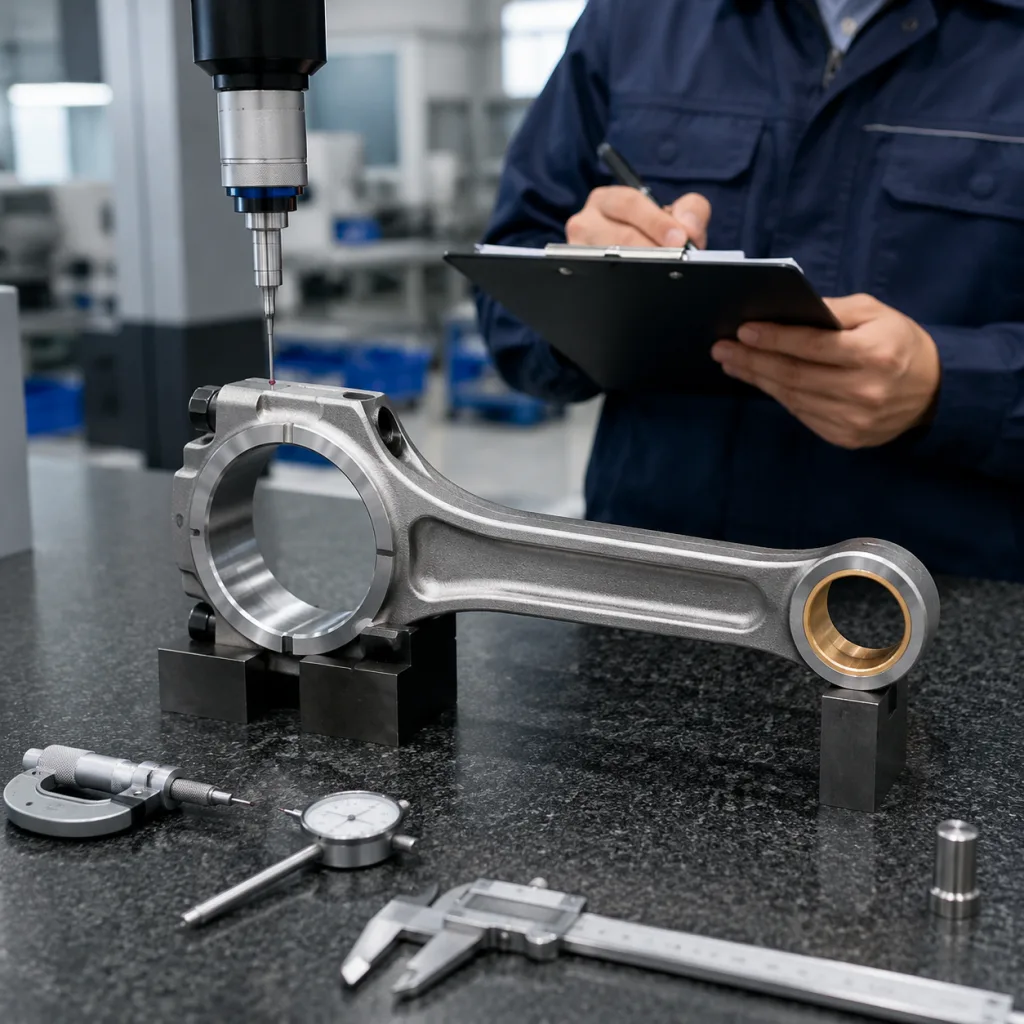
  • Big-end and small-end bore tolerances after final honing with bolts tightened to the stated torque or torque-angle method
  • Centre-to-centre length tolerance, plus twist and bend limits measured on an agreed fixture
  • Connecting rod bolt specification, thread size, lubricant condition, tightening method and replacement/reuse policy
  • Weight-matching requirement, including total weight and big-end/small-end balance per engine set
  • Packaging standard, VCI or oil protection, carton drop strength and carton labelling requirements
  • Batch traceability from raw material heat number to finished goods shipment and customer invoice

One question quickly exposes risk: which processes are in-house, and which are subcontracted? The answer should name the process owner for forging or billet cutting, heat treatment, shot peening if used, CNC roughing, cap cutting, bolt fitting, final honing, bushing machining, washing, preservation and final packing. This matters when a claim appears six months later and the buyer needs root-cause analysis instead of blame shifting.

Driventus manufactures engine and powertrain components under IATF 16949:2016 and ISO 9001:2015 certified systems, with process records available for customer review during qualification. Buyers can also review our catalog and the engine component range at /products/engine-components.html.

Where Connecting Rod Programmes Usually Fail

Most connecting rod sourcing failures do not begin with a dramatic broken part. They start with small uncontrolled variables: a bolt substitution, a honing condition that differs from inspection, a bushing pressed without enough interference, or a bore measured at one depth only. These details decide whether production repeats the approved sample.

Connecting rods for high-output flat and inline engines may use forged steel, billet steel or powdered-metal routes, depending on the application, load target and price band. The route affects grain flow, fatigue strength, machining allowance, weight consistency and cost. A forged H-beam rod with upgraded bolts and a fully machined billet rod can both be marketed as “performance,” but they do not carry the same cost base or inspection burden.

</tr></thead><tbody> </tbody></table>A robust control plan should include incoming material inspection, in-process gauging, final dimensional inspection, hardness testing, inspection status identification and segregation of non-conforming product. On launch lots, buyers often request 100% final checking of big-end bore, small-end bore, centre distance and visual defects. Once capability is proven, the programme can move to an agreed sampling plan.

Critical dimensions should be measured in the same assembled condition used by the engine builder: specified bolts, lubricant, tightening sequence and clamp condition. If rods are supplied with bolts installed, the record should show whether final honing was completed after bolt installation and cap torquing.

Driventus supports standard catalogue supply and custom manufacturing when buyers provide drawings, samples or defined performance targets. Custom projects normally require sample approval and, where appropriate, a pilot lot before mass production.

RFQ Spec Deep-Dive: Lines That Must Be Measurable

An RFQ for Porsche-fit connecting rods should remove interpretation. Two suppliers can quote the same fitment and deliver very different products if the buyer leaves material, bore condition, bolt policy or weight matching undefined. If a value is unknown, write “supplier to propose” and require confirmation; do not leave a blank.

Include these measurable lines in the RFQ:

  • Engine application and model-year range for fitment reference, including naturally aspirated, turbocharged and performance variant distinctions
  • Rod type: forged H-beam, forged I-beam, billet, or OE-style replacement
  • Material requirement, such as 4340-grade steel, EN24/40CrNiMoA equivalent, or a buyer-approved equivalent where specified
  • Big-end bore nominal size and tolerance after bolt tightening to the stated method; high-performance buyers commonly request tolerance windows in the ±0.005 mm to ±0.010 mm range where the design supports it
  • Big-end bore roundness and cylindricity requirement, measured at multiple depths rather than only at the bore mouth
  • Small-end bore or bushing ID requirement, including pin clearance target if available; bronze bushing press fit and oil-hole alignment should be defined
  • Centre-to-centre length and permitted deviation, commonly controlled within ±0.02 mm to ±0.05 mm depending on the design and measurement method
  • Maximum bend and twist allowance, stated per 100 mm or per full rod length so suppliers quote against the same standard
  • Total weight and end-weight matching tolerance per set, such as ±1 g total weight and tighter end balance for performance sets where required
  • Surface finish requirements on bearing and pin bores, for example Ra values on honed surfaces rather than generic “smooth finish” wording
  • Bolt supplier, thread size, under-head radius compatibility, lubricant condition, tightening procedure, stretch target if used and reuse policy
  • Required tests, such as hardness, magnetic particle inspection, tensile testing by batch, salt-spray requirement for coated parts, or CMM report
  • Compliance needs for destination markets, including REACH (EC) No 1907/2006 where relevant to chemical substances in articles and packaging

Match the specification to the selling channel. A distributor selling repair parts may prioritise coverage, stable inventory and repeatability. A performance buyer may require tighter weight matching, stronger bolt specifications, magnetic particle inspection and batch-level CMM reporting. The safe comparison is quote-to-spec: ask every supplier to confirm each tolerance, test and document line by line, then price approved alternatives separately.

Driventus does not claim approval or endorsement by any vehicle manufacturer. Fitment information helps distributors and repair networks identify compatible aftermarket parts. Driventus is an independent aftermarket manufacturer; brand names are referenced for fitment only.

RFQ Spec Deep-Dive: Lines That Must Be Measurable

Three Sourcing Scenarios and How MOQ Really Changes

MOQ is not one fixed number. It changes with engineering effort, material planning, fixture use, bolt sourcing, inspection load and packaging requirements. A catalogue rod can move quickly. A changed bore, different bolt, new coating or private-label carton can reset the economics.

Failure mode to avoid Why it matters Evidence to request
Unverified raw materialAlloy chemistry and heat number cannot be linked to the batchMill certificate, incoming inspection record
Poor heat-treatment controlStrength, toughness and fatigue resistance become inconsistentFurnace batch record, hardness report, process parameter log
Weak machining datum strategyBore alignment, cap fit and repeatability drift between lotsFirst article inspection, control plan, CMM data
Big-end bore not checked under clamp loadBearing crush and oil film stability may be compromisedBore size, roundness and surface finish report after specified tightening
Small-end bushing variationPin clearance, lubrication and seizure resistance are affectedBushing material, press fit record and ID inspection
Loose weight controlEngine-set imbalance increasesTotal weight and end-to-end weight record
Bolt lot or tightening changesCap clamp load can vary, causing movement or frettingBolt grade, supplier trace, torque-angle instruction
Inadequate cleaning or preservationAbrasive residue and corrosion reach the assemblerWashing record, oil/VCI specification, final visual check

</tr></thead><tbody> </tbody></table>Read price as a cost stack. Material grade and section size, forging or billet route, machining time, bolt brand and grade, bushing material, heat treatment, shot peening or surface coating, 100% inspection, CMM report frequency, packaging and shipment consolidation all affect the unit figure. A premium fastener, 100% magnetic particle inspection or individual CMM report can change both price and lead time.

Separate the timeline into engineering review, sample production, buyer validation, mass production and export logistics. A practical planning range is 3–7 working days for drawing and RFQ clarification, 2–4 weeks for samples where material and fixtures are available, 30–60 days for mass production depending on batch size and process load, plus sea or air freight. Often the longest delay is not machining. It is specification alignment, testing and buyer-side approval.

Buyers can shorten the schedule by sending drawings, sample photos, current demand forecast, target landed cost and documentation requirements at RFQ stage. For new distributor onboarding, Driventus can discuss phased orders: sample sets, pilot batch, then scheduled production based on forecast. A common sequence is sample approval, pilot order with full inspection records, repeat order with agreed AQL or critical-dimension controls, then forecast-based replenishment. Buyers can request a quote with their application list, expected annual volume and destination market.

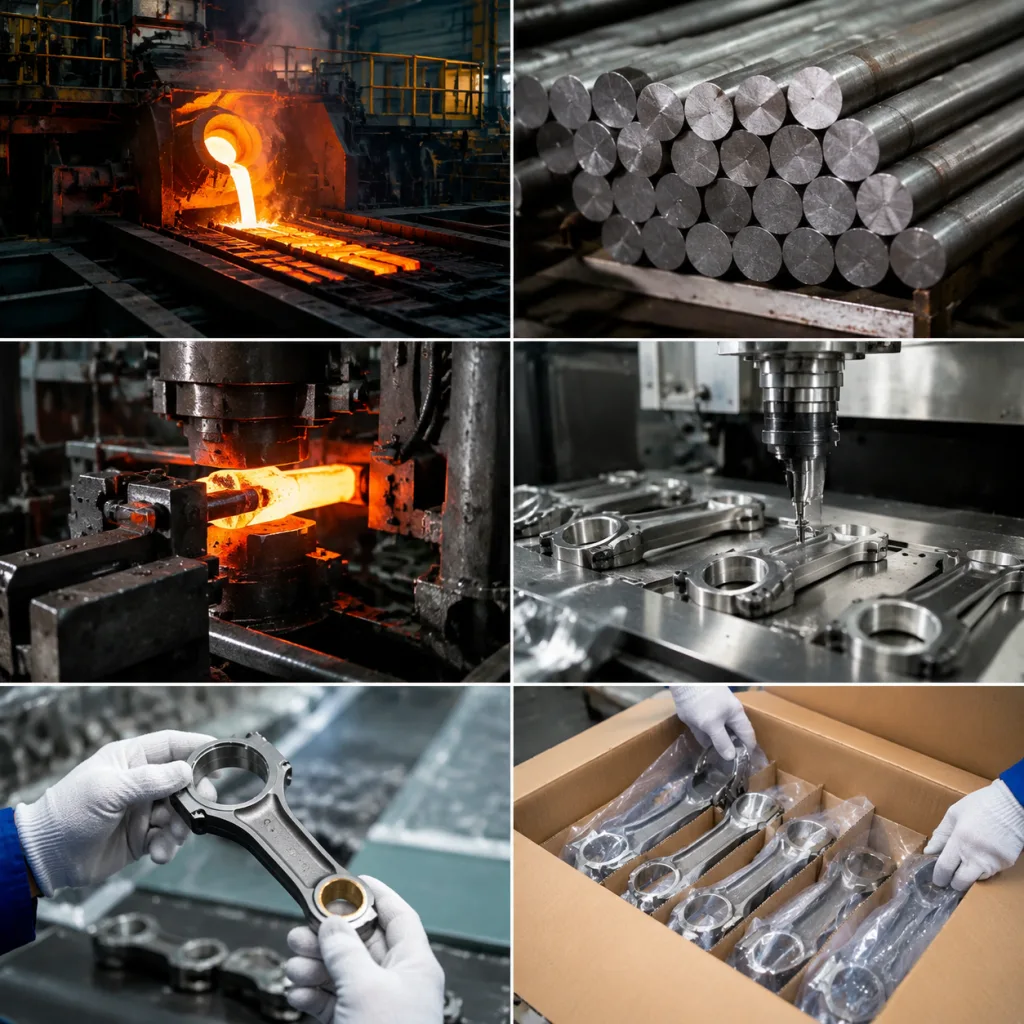
Audit Walkthrough: Follow One Rod From Steel to Carton

A useful factory audit does not stop at certificates. It follows one part through the real production path and checks whether the quoted process matches the shop-floor process. For connecting rods, that means raw material receiving, heat treatment, machining, cap work, bolt fitting, honing, bushing operations, inspection, washing, preservation and packing.

Use the walkthrough to verify these points:

1. Quality management scope: certification to IATF 16949:2016 and ISO 9001:2015, certificate validity and scope matching engine component manufacturing. 2. Traceability: links between heat number, production batch, machining lot, bolt lot, bushing lot, final inspection lot and packaging records. 3. Measurement control: calibrated bore gauges, micrometers, height gauges, surface roughness testers and CMM use where applicable, with gauge R&R records for critical dimensions. 4. Process capability: evidence that big-end bore, small-end bore, centre distance, bend, twist and weight remain stable over production lots; Cp/Cpk data can be requested for high-volume programmes. 5. Special process control: heat treatment validation, hardness mapping, shot peening parameters if used and, where required, magnetic particle inspection. 6. Assembly condition: confirmation that final bore inspection is performed with specified bolts installed and tightened using the agreed lubricant, torque or torque-angle sequence. 7. Change control: approval process for material, bolt supplier, bushing material, machining programme, inspection method, coating or packaging changes. 8. Non-conformance handling: quarantine area, root-cause analysis, corrective action process, rework approval rules and customer notification triggers.

The document package should match order risk. A standard aftermarket replenishment order may need material certificates, hardness reports and dimensional records. A custom or high-performance programme may require first article inspection, batch test reports, CMM layout, bolt certificates, heat-treatment records, magnetic particle inspection reports and retained samples.

For launch orders, ask how long inspection records and retained samples are kept, and whether batch codes appear on the part, carton label or both. Driventus maintains a documented quality system for production planning, inspection, traceability and continuous improvement. For international buyers, remote audits, document reviews, video process walkthroughs and pre-shipment inspection arrangements can be supported before regular supply begins.

Audit Walkthrough: Follow One Rod From Steel to Carton

Q&A for Import Managers Comparing Supplier Fit

What changes when the buyer is a wholesaler rather than a repair chain? A wholesaler usually needs mixed SKUs, consolidated shipments, carton-level labels and private-label options. A repair-chain buyer often prioritises stable availability, repeatable set matching, clear installation support and fast claim review.

What does an OEM or Tier-1 buyer usually add? More formal documentation. PPAP-style submissions, engineering change control, long-term cost-down planning, capability data and stricter approval gates are common.

Which supplier signals reduce total procurement risk? Look beyond unit price. Stronger candidates can support multiple engine component categories, link heat number to machining lot and carton label, protect parts against sea freight corrosion, explain price validity, answer technical questions in English, and provide structured 8D responses.

What packaging details should be fixed before release? Define neutral or buyer-branded packaging, barcode rules, carton-level SKU labels, engine-set packing, master carton quantities, pallet plans and rust-prevention period. For many importers, receiving errors and corrosion claims cost more than small unit-price differences.

How should claims be handled? Agree on required evidence before the first shipment: photos, batch codes, installation notes, mileage or running hours, failed-part return rules and review timing. The supplier should have a clear process for containment, root-cause analysis and corrective action.

What does a practical reorder model include? MOQ by SKU, carton quantity, forecast horizon, safety stock target, price-validity period and lead-time trigger. Without these rules, the buyer may approve a good sample but still struggle with stock gaps or inconsistent batches.

For import managers, the lowest quoted price can be outweighed by defect handling, incomplete documentation, unclear change responsibility or slow corrective action. Driventus positions its connecting rod supply within a broader engine component programme, helping buyers consolidate sourcing while maintaining technical review for critical parts.

Frequently asked questions

Yes. Driventus can support neutral or buyer-branded packaging for qualified B2B orders, subject to artwork approval, carton specification, barcode rules, carton MOQ and applicable market compliance requirements. Fitment references are used only for application identification.

Depending on the project, Driventus can provide material certificates, dimensional inspection reports, hardness results, batch traceability records, packaging specifications, bolt information, CMM data where agreed, and quality management certificates for IATF 16949:2016 and ISO 9001:2015.

No. Driventus does not claim approval or endorsement by any vehicle manufacturer. Driventus is an independent aftermarket manufacturer; brand names are referenced for fitment only.

If you are qualifying a connecting rod Porsche manufacturer China sourcing programme, send your application list, drawings or samples, annual forecast, target MOQ, packaging needs and documentation requirements. Contact Driventus to discuss technical review and quotation at /contact.html

Request a Quote
Sourcing case Typical buyer input Indicative MOQ logic Sampling and lead-time logic
Existing catalogue rodApplication, annual volume and destination marketLower MOQ, often set by stock status or one production batchStock sample or next-batch sample; fastest route when no design change is needed
Modified catalogue rodDrawing changes, bolt preference, surface finish or packaging requirementMedium MOQ, driven by material, bolt and setup changesPrototype or pilot lot before mass production; extra review for changed dimensions
New custom rodDrawing, sample, target material, bolt standard and test planHigher MOQ, driven by engineering, fixture and validation costFirst article plus validation lot; tooling, programming or fixture cost may apply
Private-label packagingLabel artwork, carton spec, barcode rules and compliance marksMOQ may follow print-shop carton or label minimumsPackaging sample approval adds artwork, print and carton lead time