A crankshaft Kia OEM supplier decision can fail on details that never appear in a unit-price table: heat-number traceability, journal grinding discipline, reluctor interface accuracy, anti-rust packaging, and the factory’s response when demand changes. Procurement teams buying Kia-fit crankshafts need a sourcing process that separates fitment claims from measurable evidence. Driventus manufactures crankshafts and related engine components in Taizhou, Zhejiang, and exports to more than 60 countries. We support aftermarket and contract manufacturing programs through IATF 16949:2016 and ISO 9001:2015 management systems, PPAP-style documentation where required, and batch-level traceability. This guide turns the sourcing work into practical checks: what to specify, where failures occur, how to compare suppliers, what evidence to request, and how to set commercial terms without implying vehicle-maker approval.
Decision Framework: Lock the Application Before You Ask for Price
A crankshaft quote is only useful when the application is controlled. Start with engine code, displacement, fuel type, model year range, transmission fitment where relevant, destination market, and expected annual volume. If the program uses OE part-number cross-references, list them in a controlled format such as OE 23110… with supersession notes. Vehicle names alone leave too much room for error.
Samples help, but they can mislead. A used crankshaft may confirm flange, keyway, and trigger details, yet worn journals, damaged oil holes, or previous undersize grinding can move critical dimensions by 0.25 mm or 0.50 mm. For final approval, combine samples with drawings, bearing-clearance targets, or an approved aftermarket reference.
Use this RFQ checklist to reduce back-and-forth:
Engine family, vehicle applications, and market destination
OE 23110… cross-reference, buyer SKU, revision level, and supersession status
Material requirement, such as 42CrMo/40Cr steel forging or QT700-class nodular iron casting
Main journal and rod journal nominal diameters, tolerance band, and undersize policy
Failure Modes: Where Crankshaft Programs Usually Break
The hard question is not whether a supplier can machine one good sample. It is whether the same result holds across production batches, material lots, fixture changes, and export handling. A credible crankshaft Kia OEM supplier should control the main process steps internally or use audited special-process partners with clear records.
Typical Driventus crankshaft process flow:
Stage
Control point
Procurement relevance
Raw material receipt
Mill certificate, heat number, chemistry check
Confirms grade before cutting or forging
Forging or casting
Heat number, visual inspection, blank weight
Supports traceability and defect screening
Normalising or heat treatment
Hardness, microstructure, distortion check
Reduces fatigue and grinding allowance risk
Rough machining
Datum control, centre-hole condition
Protects alignment for finish cuts
Induction hardening where specified
Case pattern, hardness depth, temper control
Protects journal wear surfaces
Journal grinding
Diameter, roundness, cylindricity
Critical for bearing life and oil clearance
Oil-hole drilling and chamfering
Burr inspection, chamfer size, flow path check
Reduces contamination and scoring risk
Dynamic balancing
Residual unbalance record by part or batch
Supports NVH consistency
Final inspection
CMM, roughness, hardness, runout
Confirms shipment release
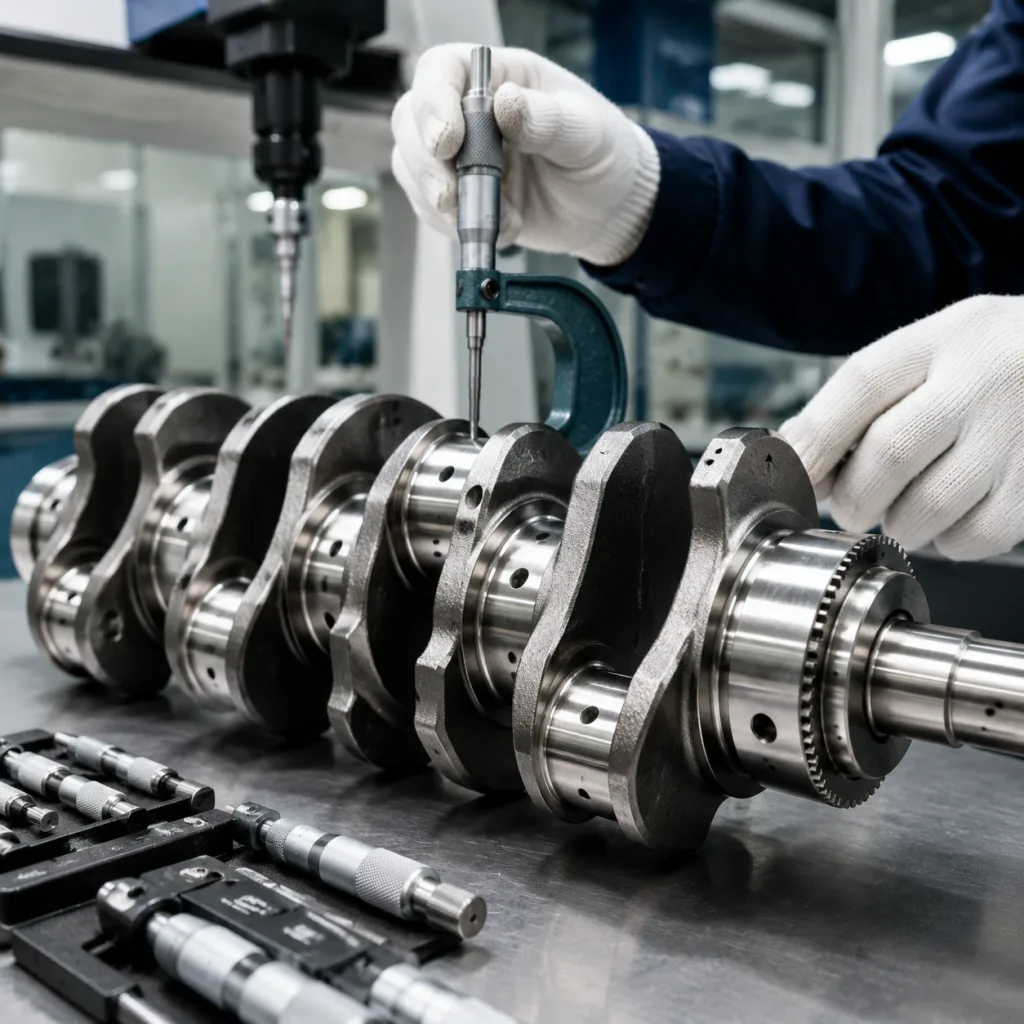
</tr></thead><tbody> </tbody></table>Watch the failure points. Diameter drift starts in grinding. Burrs hide in oil holes. Mixed revisions happen when cross-references are not locked. Poor journal protection creates corrosion claims long after the parts passed inspection. Practical controls include 100% visual and anti-rust inspection, first-piece approval after tool or fixture changes, hourly or lot-based journal checks during grinding, and full-layout inspection on first articles.
The reaction plan matters as much as the gauge list. Nonconforming parts should be red-tagged, quarantined, analysed for root cause, corrected, reinspected after rework, and released only by authorised quality staff. Stop-ship authority should be explicit.
Commercial Comparison: MOQ, Lead Time, and Packaging Trade-Offs
Commercial terms depend on tooling status, engine-family complexity, inspection depth, packaging format, and private-label requirements. Existing references usually move faster because fixtures, gauges, packaging drawings, and baseline inspection records already exist. New development parts need more engineering time and a cleaner approval path.
Indicative procurement parameters:
MOQ for existing aftermarket references: commonly 50–100 pieces per part number; mixed-SKU pallets may be possible when journal protection and carton size are compatible
MOQ for new development: usually 100–300 pieces after sample approval; lower starts may require a tooling, fixture, or engineering charge
Sample lead time: typically 30–60 days for new development after drawing, sample, and material confirmation
Mass production lead time: commonly 45–75 days after deposit, sample approval, and packaging artwork approval
Price drivers: raw forging or casting cost, grinding time, hardness specification, balance requirement, inspection depth, packaging format, and annual forecast
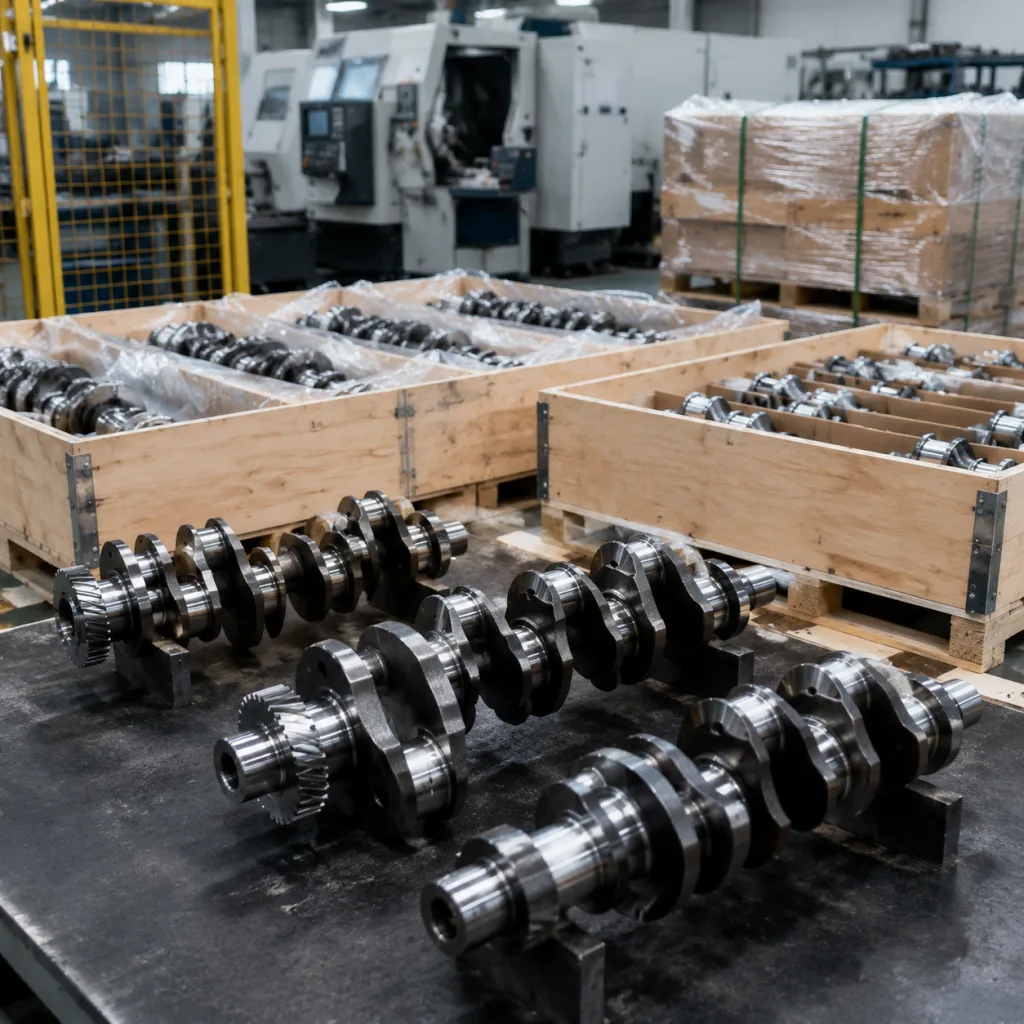
Export packaging: VCI bag or paper, anti-rust oil, journal guards, individual cartons, plywood or reinforced pallets, corner protection, and desiccant for long ocean routes
Documentation: commercial invoice, packing list, certificate of origin where required, and batch inspection report linked to carton or pallet markings
Do not treat lead time as a single promise. Tie it to milestones: drawing review, DFM check, sample manufacture, sample inspection report, buyer validation, packaging approval, deposit, material booking, production, final inspection, and shipment release. For repeat programs, a 3-month rolling forecast with 4–8 weeks of firm orders helps protect machining capacity without forcing excessive first-order inventory.
For private-label or drawing-controlled programs, Driventus can discuss custom manufacturing with controlled samples, dedicated packaging, agreed inspection records, and shipment planning matched to the buyer’s distribution model.
Evidence Review: What an Audit Should Prove
Quality claims are easy to write. Evidence is harder. Driventus operates under IATF 16949:2016 and ISO 9001:2015 management systems, which support process control, corrective action, traceability, calibration, and customer-specific requirements. They do not replace part-level validation for a specific crankshaft reference.
For regulated markets, material and packaging declarations may also matter. REACH (EC) No 1907/2006 is commonly requested by EU importers for chemical compliance review. Buyers may also request IMDS-style material data, although exact reporting requirements depend on the customer, destination market, and supply-chain role.
Audit documents buyers may request include:
IATF 16949:2016 and ISO 9001:2015 certificates with valid scope and expiry date
Process flow chart, control plan, and key operation work instructions
PFMEA summary for machining, heat treatment, grinding, balancing, and packing risks where applicable
Initial sample inspection report with actual values, not only pass/fail marks
Material certificate, heat-treatment record, and hardness test record by batch
Gauge calibration status for micrometers, air gauges, CMM, hardness tester, and roughness tester
Traceability procedure from raw material heat number to finished-goods batch and shipment
Nonconforming-product procedure and corrective action examples for previous dimensional or packaging issues
Our quality system page outlines how Driventus manages inspection, traceability, and export documentation for engine and powertrain components. If an on-site or remote audit is planned, send the agenda, target part numbers, required standard clauses, and evidence list in advance. Production, quality, engineering, and export teams can then prepare the right records instead of generic presentation files.
Spec Deep-Dive: Dimensions That Decide Fitment and Warranty
Kia-fit crankshafts can look similar while differing in stroke, reluctor configuration, flange detail, oil-hole geometry, thrust-face width, or pulley interface. One small mismatch can block assembly, create sensor faults, affect balance, or shorten bearing life. Dimensional acceptance criteria therefore need to be agreed part by part.
Common inspection points for Kia-fit crankshaft sourcing:
Feature
Typical verification method
Practical acceptance logic
Main journal diameter
Micrometer or air gauge
Drawing tolerance; many programs require control within 0.005–0.015 mm bands
Rod journal diameter
Micrometer, air gauge, roundness tester
Bearing clearance and rod bearing life
Roundness and cylindricity
Roundness tester
Often controlled in micron-level ranges for finished journals
Runout
Dial indicator or CMM
Rotation stability; confirm at specified datum supports
Stroke
CMM or dedicated fixture
Compression ratio and balance consistency
Surface roughness
Roughness tester
Common journal target Ra 0.2–0.4 µm unless customer drawing differs
Hardness
Rockwell or equivalent method
Journal durability; confirm target range and test location
Oil-hole chamfer
Visual and dimensional check
Prevents burr-related scoring and oil-film damage
Flange, keyway, and trigger wheel interface
CMM, gauges, assembly fixture
Flywheel, pulley, gear, or sensor fit
</tr></thead><tbody> </tbody></table>Sample approval may include dimensional inspection, assembly trial, bearing oil-clearance measurement with the intended bearings, dynamic balance review, packaging trial, corrosion-resistance check after simulated storage, and endurance testing. Aftermarket distributors usually focus on fitment accuracy, stable supply, and low warranty rate. Tier-1 and contract programs often require deeper submission packages, including dimensional results, material data, process flow, control plan, PFMEA, and sample retention rules aligned with the buyer’s internal PPAP-style process.
Importer Scenario: First Order, Ocean Freight, and Claim Prevention
Imagine the first shipment reaches a distributor’s warehouse after six weeks at sea. The cartons look acceptable, but two pallets show light corrosion, one SKU has mixed labels, and the claim file lacks measured values. At that point, the cost is no longer just replacement parts. It includes sorting labour, customer delays, warranty friction, and management time.
Prevent that scenario before shipment. A practical supply agreement should define:
Approved part number, OE cross-reference, revision level, and supersession rule
Drawing or sample approval status, including who owns the master sample
Inspection report format, sampling frequency, and critical dimensions to report every batch
Anti-rust method, minimum storage expectation, and re-oiling rule after inspection or repacking
Claim window, photo requirements, measured-value evidence, and sample return process
Incoterms, shipment mode, consolidation plan, and responsibility for destination customs documents
Forecast method, reorder point, and buffer stock for recurring demand
Pre-shipment inspection is useful for first orders and new part numbers. Buyers may request photos of journal protection, pallet condition, carton labels, random dimensional checks, anti-rust application, and batch markings before release. For long ocean routes to the EU, UK, US, Canada, Australia, or Brazil, corrosion prevention should be a written specification: VCI protection, sealed bags, desiccant, and dry container loading checks.
Driventus is an independent aftermarket manufacturer; brand names are referenced for fitment only. No vehicle manufacturer approval, affiliation, or endorsement is implied.
Frequently asked questions
Yes. Driventus supplies crankshafts for aftermarket and contract manufacturing programs, subject to application confirmation, sample or drawing review, MOQ, and validation requirements. Buyers should provide engine code, OE 23110… cross-reference where available, annual volume, first-order quantity, packaging requirement, and market destination.
Available documents may include inspection reports, material certificates, heat-treatment records, process flow, control plan, packaging specification, and management-system certificates for IATF 16949:2016 and ISO 9001:2015. For drawing-controlled programs, Driventus can discuss PPAP-style evidence such as dimensional results, PFMEA summary, gauge calibration status, and sample approval records.
No. Driventus is an independent aftermarket manufacturer; brand names are referenced for fitment only. Parts are supplied according to agreed drawings, samples, cross-references, and inspection criteria, without claiming endorsement by any vehicle manufacturer.
For pricing, MOQ, sample review, or audit scheduling, send the target engine family, OE 23110… reference if available, required tolerance or drawing package, first-order quantity, and annual forecast. You can [request a quote](/contact.html).