Camshaft Infiniti Wholesale Sourcing Guide
Camshaft Infiniti wholesale sourcing is not a catalogue exercise. It is a risk-control decision for buyers who need the right lobe profile, trigger geometry, surface finish, packaging, and replenishment rhythm to repeat across shipments. One wrong bank position or a poorly protected journal can turn a low-cost purchase into timing faults, receiving holds, and warranty noise.
Driventus manufactures engine and powertrain components in Taizhou, Zhejiang, supplying customers in 60+ countries with production controls aligned with IATF 16949:2016 and ISO 9001:2015. This guide takes a practical procurement angle: how to frame the RFQ, where camshaft programmes usually fail, which tolerances matter, how MOQ should be discussed, what to audit, and how to compare offers beyond unit price.
Driventus is an independent aftermarket manufacturer. Brand names are referenced only for fitment identification.
Start With The Camshaft Decision Tree
Infiniti applications split quickly once the buyer moves beyond model name. Engine family matters, but so do valve train layout, production year, market, camshaft position, trigger feature, and bank orientation. A wholesale programme should separate intake from exhaust, bank 1 from bank 2, left bank from right bank, naturally aspirated from turbocharged variants, and any camshaft position sensor or trigger-wheel configuration.
Use this decision path before requesting price:
1. Confirm the vehicle application range, production years, engine code, displacement, and destination market. 2. Identify the exact camshaft position: intake, exhaust, bank 1, bank 2, left, or right. 3. Match the reference by approved sample, technical drawing, 3D scan data, or buyer-supplied aftermarket reference. 4. Add the OE or interchange number only as an identification aid, not as proof of approval. 5. Define critical dimensions: journal diameter, total length, lobe lift, thrust face, keyway or trigger position, and lobe nose orientation. 6. State whether the order is a trial lot, replenishment, or private-label launch. 7. Separate the demand forecast by part number instead of giving one blended annual volume.
This structure keeps a camshaft Infiniti wholesale RFQ from becoming a vague engine-family quote. A useful first enquiry often covers 3–10 high-turn references with estimated annual demand per reference. If the buyer cannot provide a drawing, Driventus can review a physical sample and build the dimensional checklist from datum points such as front face, rear thrust face, journal centreline, keyway or trigger position, and lobe orientation.
Packaging and market details belong in the first RFQ, not after price negotiation. State whether the line needs neutral packaging, distributor branding, bulk service packs, or mixed-reference master cartons. Also flag destination requirements such as REACH (EC) No 1907/2006 where applicable.
Buyers can review related engine product coverage in our catalog and the engine component family page at /products/engine-components.html. OE part-number cross-references, such as OE 13020… or OE 13025… when supplied by the buyer, should be used for identification only. Driventus does not claim approval, authorization, or endorsement by any vehicle manufacturer.
Where Infiniti-Fit Camshaft Programmes Fail
Most camshaft failures in sourcing do not start with a dramatic manufacturing defect. They start with small assumptions: an intake shaft treated like an exhaust shaft, a trigger feature copied without a clear datum, a lobe profile checked too late, or packaging approved from a photo instead of a drop-risk review.
The production route must match the original duty cycle and contact environment. Depending on construction and load conditions, aftermarket camshafts may use cast iron, chilled cast iron, forged steel, or assembled tube-and-lobe designs. Material choice affects surface hardening, wear behaviour, machining stability, and cost. It should not be changed without buyer approval.
Key failure modes to control:
- Wrong position supplied: intake, exhaust, bank 1, bank 2, left, and right versions are mixed in quotation or packing.
- Poor trigger alignment: the camshaft position sensor reads an incorrect signal, causing timing correlation faults or diagnostic trouble codes.
- Unstable journal geometry: diameter, roundness, or runout variation affects oil film stability, bearing clearance, noise, and wear.
- Lobe profile drift: lift or phasing variation changes valve timing and idle quality.
- Surface condition issues: roughness, burrs, corrosion, or contamination shortens follower and journal life.
- Unproven assembled design: press-fit, concentricity, torque, pull-out, or feature orientation is not validated.
- Weak packaging: a precision-ground part arrives with impact marks, rust, or mixed-reference labels.
A controlled process normally includes incoming material verification, blank casting or forging review, rough machining, stress relief or heat treatment where specified, semi-finish turning, lobe grinding, journal grinding, trigger-feature machining, deburring, cleaning, anti-corrosion protection, and final inspection. For assembled designs, the joining process should also define torque, pull-out, concentricity, and orientation checks.
For wholesale orders, Driventus defines inspection frequency by risk level, process history, order volume, and the customer quality agreement. New references commonly require 100% checks on critical features during sample approval, followed by risk-based sampling after stable production is proven. First-article inspection is recommended for new references, tooling changes, material changes, engineering revisions, or production transfers.
The Tolerance Sheet Buyers Should Ask For
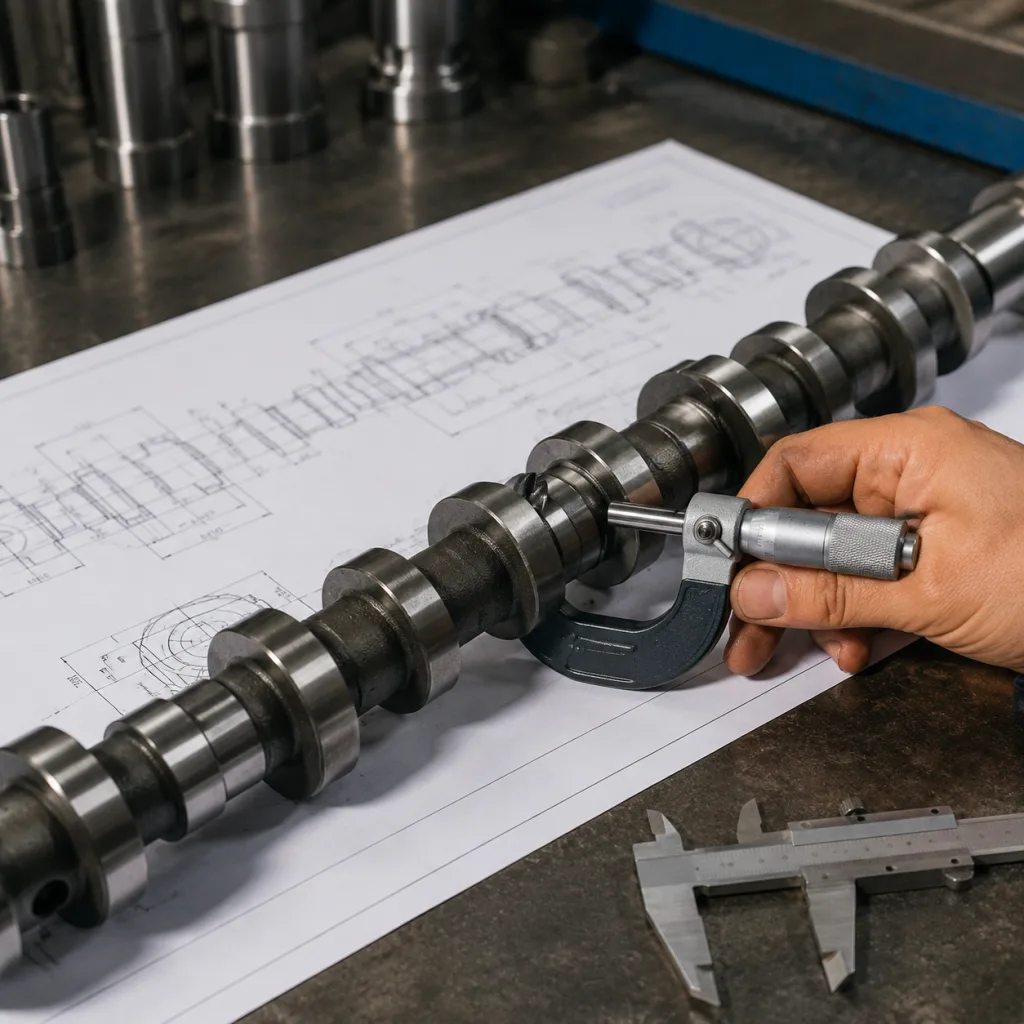
A good quotation does not only say “standard quality.” It states what will be measured, how it will be measured, and which drawing or approved sample controls the final value. The exact targets must follow the approved technical file, but the checks below show whether a camshaft process is being controlled tightly enough for replacement distribution.
| Control item | Typical procurement check | Practical target to confirm | Why it matters |
|---|---|---|---|
| Journal diameter | Micrometer and roundness inspection | Often held within ±0.010–0.020 mm where drawing allows | Oil film stability and bearing clearance |
| Journal roundness | Roundness tester or V-block method | Commonly reviewed within 0.005–0.010 mm | Noise, wear, and oil-pressure consistency |
| Lobe lift | Profile measurement against master data | Typically checked within ±0.030–0.050 mm | Valve opening accuracy |
| Lobe phasing | CMM or dedicated cam measuring equipment | Often controlled within ±0.5°–1.0° cam angle | Timing consistency across cylinders |
| Surface hardness | Batch hardness record | Drawing-defined, often HRC or HV range by material | Wear resistance at lobes and journals |
| Runout | Between-centres inspection | Commonly reviewed within 0.03–0.05 mm TIR | Noise, vibration, and bearing load control |
| Trigger feature position | Gauge or CMM check | Drawing-defined angle and datum reference | Camshaft position sensor signal accuracy |
| Surface roughness | Roughness tester on lobes and journals | Buyer should define Ra value by contact surface | Oil retention and follower life |
| Audit area | Evidence to request | Buyer acceptance focus |
|---|---|---|
| Quality management | IATF 16949:2016 and ISO 9001:2015 certificates, process flow, control plan | Certificate validity, scope, and camshaft-related process coverage |
| Material control | Mill certificate, incoming inspection record, material traceability method | Heat number link from raw blank to finished batch |
| Machining process | CNC capability, fixture control, tool wear management, lobe profile inspection | Set-up approval, tool-change rules, and critical-feature records |
| Heat treatment or surface hardening | Furnace record, hardness map, batch traceability where applicable | Temperature record, hardness range, and rejected-batch handling |
| Measurement system | Calibration status, gauge R&R plan, CMM or cam profile measuring capability | Calibrated gauges for journals, lobes, runout, and trigger features |
| Nonconformity control | Segregation area, corrective action records, 8D response process | Physical isolation, root-cause discipline, and response time |
| Export readiness | Packing specification, palletisation method, document accuracy, HS code support | Carton strength, label accuracy, and shipment-document consistency |

| Comparison factor | Low-control supplier risk | Controlled wholesale programme |
|---|---|---|
| Fitment data | Broad, unclear application claims | Position-specific and engine-code-based cross-reference |
| Inspection | Limited final check | Defined control plan, tolerance targets, and batch records |
| Packaging | Generic carton, higher impact risk | Individual protection and export pallet planning |
| Lead time | Quoted without capacity confirmation | Linked to tooling, material, blank stock, and production slot |
| MOQ and price | One price without batch explanation | Price breaks tied to 50/100/300/500 pc or agreed lot sizes |
| Claims handling | Informal replacement discussion | Traceable batch review, photo evidence, and corrective action |
| Compliance | Documents supplied after shipment | Requirements agreed before purchase order |