Crankshaft Isuzu OEM Supplier: What Buyers Should Verify
When you evaluate a crankshaft Isuzu OEM supplier, unit price is only one part of the decision. A crankshaft is a load-bearing rotating component, so dimensional control, metallurgy, traceability, and repeatable delivery have a direct effect on oil film stability, bearing life, vibration, and long-term engine reliability. Driventus is an independent aftermarket manufacturer; brand names are referenced for fitment only. For distributors, OEM programmes, and multi-site repair networks, a supplier should be able to work from a drawing, a sample, or a confirmed cross-reference while maintaining the same journal geometry, hardness range, surface finish, and balance performance from lot to lot. A credible manufacturing partner should also operate under IATF 16949:2016 and ISO 9001:2015 quality processes, support REACH (EC) No 1907/2006 material documentation when required, and prepare export paperwork that matches your receiving controls. This guide outlines the checks that matter before you approve samples, place a trial order, or move into series supply.
What buyers should verify before sourcing
Treat a crankshaft as a controlled machined component, not as a generic metal part. Before issuing an RFQ, confirm the exact engine family, displacement, fuel system, bearing sizes, flange pattern, stroke, and any revision point in the application history. Many fitment failures begin with incomplete application data rather than poor machining, so the first step is to remove ambiguity from the enquiry.
Check
Why it matters
What to request
Application match
Incorrect stroke, journal size, gear interface, or flange pattern can stop installation
Drawing, sample part, or OE cross-reference for validation
Material route
Forged steel, cast iron, ductile iron, and machined routes perform differently under load
Material certificate, heat-treatment route, and hardness range
Journal geometry
Small deviations can disrupt oil film stability and accelerate bearing wear
Journal diameter, taper, roundness, surface finish, and runout report
Balance
Excess imbalance increases vibration, fatigue, and noise complaints
Dynamic balance target, correction method, and measurement record
Traceability
Lot control is essential for audits, containment, and claim handling
Heat number, batch record, inspection report, and label format
</tr></thead><tbody> </tbody></table>If you are screening suppliers, start with our catalog and narrow the enquiry to the engine family and reference number instead of asking for a generic crankshaft quote. That makes the first sample more meaningful, reduces revision cycles, and helps the supplier confirm whether an existing process route can meet your requirement.
Manufacturing controls that affect life and fit
Crankshaft durability depends on consistent control across several manufacturing stages. The strongest indicators are usually found in the factory flow, inspection plan, and process records rather than in a sales presentation.
Material selection: forged steel, ductile iron, cast iron, or another approved route matched to engine duty cycle and customer specification
Rough machining: stable datum setup to protect concentricity, stroke accuracy, flange alignment, and counterweight geometry
Heat treatment: controlled process parameters with verified hardness profile, case depth where applicable, and core strength before final finishing
Finish grinding: journal diameter, surface finish, taper, roundness, fillet radius, and thrust face geometry controlled to drawing
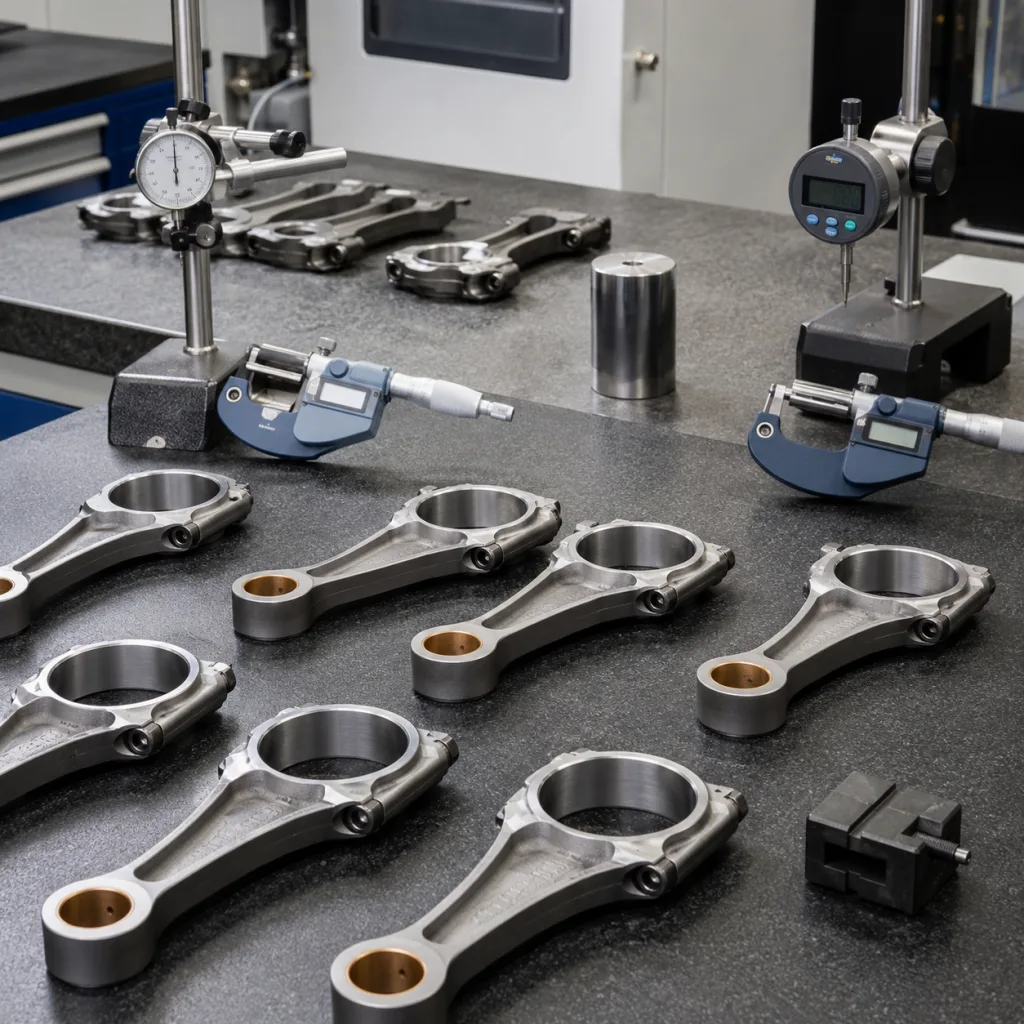
Inspection: magnetic particle inspection, dimensional gauging, hardness checks, runout measurement, and final balance verification
Corrosion protection: anti-rust oil, VCI wrapping, sealed packaging, or customer-specified export protection to preserve surfaces in transit
For higher-output or duty-sensitive applications, ask whether the plant can support fillet rolling, induction hardening, nitriding, counterweight changes, revised oil holes, or other drawing-controlled features through custom manufacturing. These details should be agreed before tooling or sampling begins, because they affect machining sequence, inspection frequency, and cost. If your sourcing range also includes pistons, gaskets, timing parts, or water pumps, consolidating adjacent categories through engine components can reduce supplier count and simplify technical communication.
Quality system and documentation
A capable crankshaft supplier should provide a documentation file your quality team can review without chasing missing information. Define the required package at RFQ stage, then confirm it again before sample approval and shipment.
IATF 16949:2016 and ISO 9001:2015 certificates, with valid scope and expiry dates
First article or initial sample inspection report covering critical dimensions and tolerances
Material certificate with heat number, grade, and traceability to production batch
Heat-treatment, hardness, case-depth, or surface-treatment record where applicable
Runout, journal geometry, surface finish, and balance records for controlled characteristics
REACH (EC) No 1907/2006 material declaration when requested by the destination market or customer file
Packaging, labelling, carton count, pallet configuration, and rust-protection method aligned to warehouse requirements
Where a programme needs additional validation, buyers may request corrosion evidence, endurance information, or customer-specific test references. SAE J2527 is commonly associated with accelerated corrosion testing for coated components, while ECE R-83 sits at the vehicle emissions compliance level rather than as a crankshaft-only test. The practical goal is to make every shipment repeatable, traceable, and defensible during audit or claim review. Review our quality system before shortlisting a factory so the document expectations are clear from the start.
MOQ, lead time, and export handling
MOQ and lead time deserve early attention because crankshafts are heavy, machining-intensive, and costly to rework or move twice. A reliable supplier should explain the commercial structure clearly before you issue a purchase order, especially when tooling, dedicated fixtures, or customer-specific packaging are involved.
MOQ by engine family, material route, and current tooling status
Sample lead time, pre-production timing, and series-production lead time
Tooling ownership, fixture requirements, revision control, and drawing responsibility
Incoterms, customs documents, certificate of origin if required, and destination-market requirements
Spare parts labelling, barcode format, private-label artwork, and warehouse receiving rules
For distributors, the strongest stocking plan is often a mix of fast-moving references and build-to-order items. This protects service levels without tying too much cash into slow inventory. For OEM programmes or fleet maintenance networks, the planning should also account for seasonal demand, container consolidation, and safety stock at destination. If you are quoting a mixed basket of engine parts, one factory source can simplify inbound inspection, improve carton consistency, and reduce freight fragmentation. Once the specification and commercial terms are ready, use request a quote to begin pricing and sample review.
From sample to series supply
The move from sample approval to series supply should follow a structured validation sequence, particularly when the buyer needs stable cross-reference support across several markets or repair networks.
1. Share the engine code, application range, annual volume, target market, and expected order pattern. 2. Provide a drawing, a sample part, or a verified OE reference so the supplier can confirm fitment and revision status. 3. Define the inspection points that must appear on the first article report, including journal dimensions, runout, hardness, surface finish, and balance. 4. Confirm packaging, label content, barcode format, carton strength, rust protection, and pallet loading requirements. 5. Agree acceptance criteria, sampling quantity, claim-handling process, and the conditions for moving from trial order to repeat production.
This approach is faster than requesting a quote against a vague description because it removes interpretation risk at the source. It also helps the factory decide whether the crankshaft should use a new forging route, an existing process window, or a customer-specific revision. Driventus is an independent aftermarket manufacturer; brand names are referenced for fitment only. If you need a repeatable supply path rather than a one-off sample, define the validation plan before the first order and keep the approved sample, inspection report, and packaging standard linked to the same revision record.
Frequently asked questions
Yes, if the drawing defines the engine family, critical dimensions, material route, tolerances, surface finish, and inspection points. A sample part is still useful for checking revision details, oil-hole position, flange geometry, and fitment risk before production.
Typical documents include commercial invoice, packing list, material traceability, dimensional report, and any heat-treatment, hardness, balance, or inspection record specified on the order. Some markets also require REACH documentation, certificate of origin, or customer-specific labelling files.
Yes. Carton design, labels, barcode format, pallet height, rust protection, and warehouse handling requirements can be aligned to distributor or programme needs once MOQ, artwork, and destination terms are confirmed.
If you are qualifying a new crankshaft source for Isuzu programmes, send your drawing, target volume, reference number, and inspection plan to begin a review at [request a quote](/contact.html).