Crankshaft Ford Supplier: How to Source for OE Fit
Sourcing a crankshaft for Ford applications is a controlled technical purchase, not a simple catalogue match. Procurement teams need to confirm dimensional compatibility, material traceability, process capability, inspection records, and dependable delivery before approving a supplier. A qualified crankshaft Ford supplier should support OE cross-references, provide journal and runout data, maintain heat-treatment records, and use packaging that protects precision-machined parts during export handling.
Driventus is an independent aftermarket manufacturer; Ford and other brand names are referenced for fitment identification only. For Ford engine programmes, buyers typically compare part-number families, engine codes, machining features, balance requirements, and the intended use case—passenger car, light commercial, or diesel applications. The following guide explains what to verify before issuing a PO, how to assess manufacturing capability, and which documents should be available for audit, first-article approval, and receiving inspection.
What buyers should verify before sourcing
A Ford crankshaft purchase should begin with fitment control. Confirm the engine family, displacement, cylinder count, main and rod bearing sizes, flange pattern, sensor ring or tone wheel features, and whether the original design uses a forged or cast crankshaft. If an OE reference is available, validate the cross-reference against engine and drawing data rather than relying only on vehicle model, year, or market description.
Fitment errors often come from small design differences: thrust bearing position, rear flange detail, counterweight profile, oil-hole layout, or reluctor configuration. These features should be checked before quotation so that samples, pricing, and production planning are based on the correct part.
Core sourcing checks
OE part-number cross-reference, for example OE 06A107065 when the application data uses that convention
Engine code, displacement, production year range, and regional application
Material specification and heat-treatment route
Main journal and rod journal diameter, fillet radius, face width, and oil-hole position
Straightness, runout, concentricity, and balance limits
Surface finish on main and rod journals
Flange pattern, sensor ring features, and thrust bearing design
Pack quantity, export packaging, corrosion protection, and carton labelling requirements
For buyers covering multiple vehicle lines, it is safer to consolidate through our catalog and map each application to verified engine codes rather than model names alone. This reduces wrong-fit returns and creates a clearer approval trail for purchasing, warehouse, and aftersales teams.
Manufacturing capability that matters for crankshafts
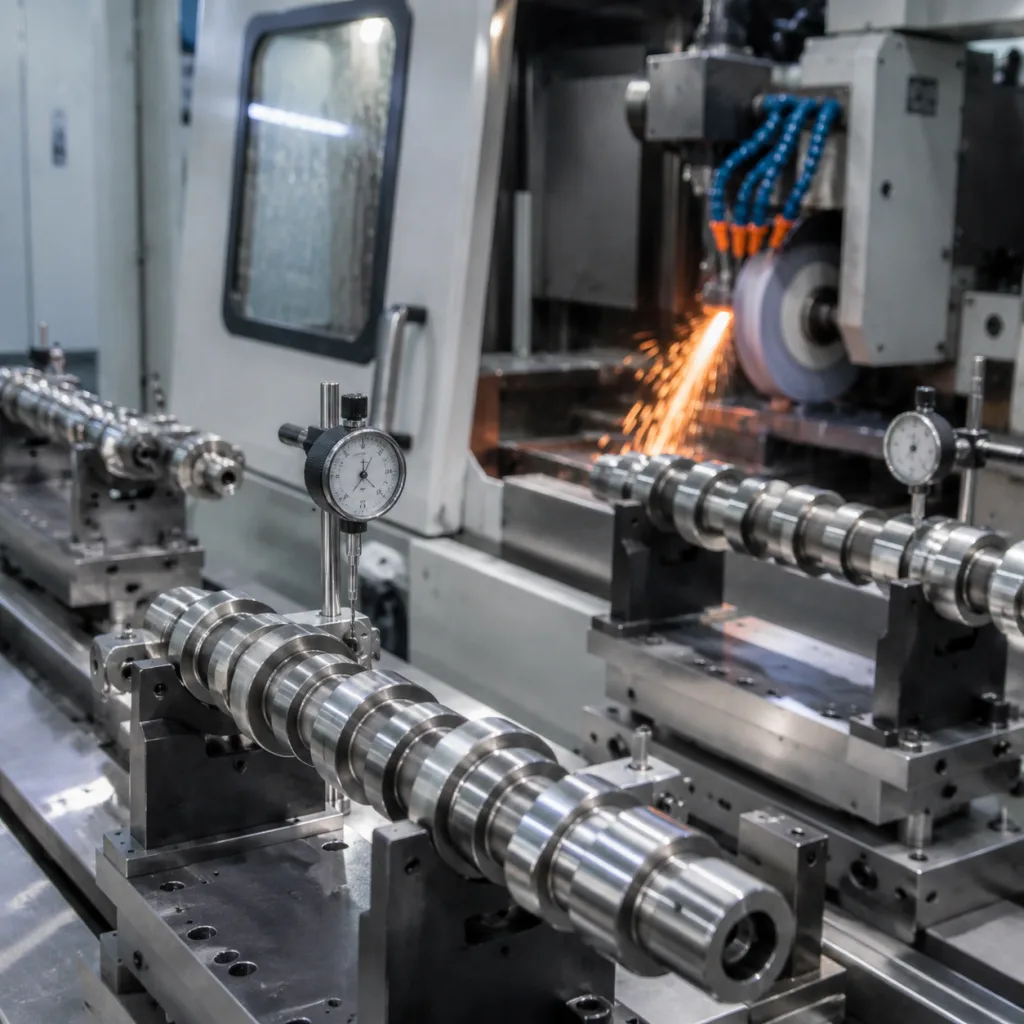
A supplier should be able to explain the full manufacturing route: raw material selection, forging or casting, rough machining, heat treatment such as induction hardening or nitriding where applicable, finish grinding, fillet rolling when specified, cleaning, preservation, and final inspection. For procurement, the key question is not only whether a part can be made, but whether the supplier can repeat the same geometry, hardness, and balance performance across batches.
Crankshafts work under bending, torsional, and bearing-load stress. Small process variations can affect fatigue performance, oil-film stability, vibration, and installation quality. That is why buyers should review both equipment capability and the records used to control production.
Typical capability indicators
Item
What to ask for
Why it matters
Material
Steel grade or casting grade, melt route, certification
Supports traceability and fatigue performance
Heat treatment
Hardness range, case depth where applicable, process record
Improves wear resistance and dimensional stability
Machining
CNC process control, fixture plan, gauge list
Maintains consistent journal geometry and repeatability
</tr></thead><tbody> </tbody></table>Driventus is set up for B2B supply across aftermarket and OEM/Tier-1 channels, with process documentation aligned to IATF 16949:2016 and ISO 9001:2015. Buyers planning a formal supplier review can compare documents through our quality system, including the controls used for inspection, traceability, and corrective action.
MOQ, lead time, and export terms
For a crankshaft Ford supplier, commercial terms are part of technical viability. A low unit price is not helpful if tolerances drift between repeat orders, labels are inconsistent, or replenishment shipments miss the repair season. MOQ, lead time, and logistics terms should therefore be reviewed together with part validation.
When evaluating MOQ and lead time, ask for:
MOQ by part number, by engine family, and by mixed-SKU order
Standard lead time for production items and availability for stocked items
Sample lead time for first-article approval and dimensional validation
Forecast requirements for repeat replenishment orders
Carton specification, pallet dimensions, gross weight, and container loading method
Corrosion protection method for sea freight and long-term warehousing
Incoterms offered, such as FOB, CFR, CIF, or DDP where applicable
Labelling, barcode, and documentation requirements for distributor receiving systems
For distributors and repair-chain buyers, stable replenishment is usually more valuable than one-off price reductions. A well-planned order can combine slower-moving crankshaft references with higher-volume engine parts to improve shipment efficiency and inventory coverage.
If your programme needs a private-label package, barcoding, country-specific labels, or kit assembly, use custom manufacturing to align packaging and product configuration before the order is released. Early agreement on these details prevents rework at the warehouse and makes inbound inspection faster.
Inspection data to request at receiving
The receiving department should not rely only on carton labels or a generic packing list. Ask the supplier for a document pack that supports incoming inspection, warranty analysis, and batch traceability. For crankshafts, the pack should link the shipment to raw material records, heat-treatment history, final measurement data, and packaging identification.
Recommended documents
Certificate of conformity
Material certificate and heat-treatment summary
Inspection report with main and rod journal dimensions
Runout, straightness, and balance data
Surface hardness or case-depth report where applicable
Surface finish values for bearing journals when specified
Crack detection record where required by the programme
Packaging list with batch number, production date, quantity, and carton or pallet reference
Incoming inspection can be structured by risk level. First shipments and newly developed references normally require tighter dimensional checks, while repeat lots from a stable supplier may move to sampling plans once performance is proven. In either case, the batch number on the carton should match the certificate and inspection report.
If your organisation audits suppliers on environmental compliance, ask whether the part and packaging materials are controlled against REACH (EC) No 1907/2006. For field validation or surface durability programmes, buyers may also request test references such as SAE J2527 where relevant, although corrosion requirements should always be matched to the specific application and customer standard.
Why aftermarket sourcing is different from OE purchasing
OE purchasing focuses on direct line-side supply, nominated materials, and programme-specific approvals. Aftermarket sourcing is broader and often more complex at the fitment level. The same engine family may appear across multiple Ford nameplates, regions, and model years, while service parts may be catalogued under different references depending on market convention.
Driventus is an independent aftermarket manufacturer; brand names are referenced for fitment only. Buyers should not assume one crankshaft is suitable for every engine revision. Verify the drawing revision, sensor tone wheel arrangement, thrust bearing design, flange details, journal sizes, and any changes in counterweight profile before releasing bulk orders.
For multi-location repair chains, wholesalers, and regional distributors, the main commercial risks are wrong-fit returns, inconsistent carton content, weak batch traceability, and parts damaged during long-distance transport. These problems create costs beyond the original purchase price: claim handling, technician downtime, stock corrections, and customer dissatisfaction.
A capable aftermarket supplier reduces those risks with controlled cross-reference support, documented production lots, clear carton identification, and tested packaging. This is especially important when one sourcing programme covers several markets with different vehicle parc profiles and catalogue habits.
How Driventus supports Ford programme sourcing
Driventus manufactures engine and powertrain components in Taizhou, Zhejiang, and ships to buyers in more than 60 countries. For crankshaft programmes, our focus is repeatable production, application review, documentation, and supply continuity for B2B customers.
What procurement teams can request:
Application review by engine code, OE cross-reference, and key dimensions
First-article samples for dimensional validation and fitment confirmation
Batch-level traceability and inspection records
Material and heat-treatment documentation where required
Export packaging suited to retail, wholesale, e-commerce, or warehouse use
Private-label packaging, barcode support, and kit assembly options
Commercial planning for mixed-SKU orders and repeat replenishment
If you are consolidating Ford fitments across several markets, our technical team can help define the correct part family before you place volume orders. Share the OE reference, engine code, sample photos, drawing data where available, annual demand, and target delivery market so the quotation can reflect the right specification.
Start with our catalog, then move to a formal quotation through request a quote. A complete enquiry helps us respond with the correct cross-reference, MOQ, lead time, packaging proposal, and document plan.
FAQ
Q1: Can you supply a crankshaft for Ford applications by OE reference? Yes. We can review OE cross-references when the application data is provided, including engine code, dimensions, photos, and drawing revision where available. Brand names are used only to identify fitment.
Q2: What quality documents are available with shipment? Typical shipment packs can include material records, heat-treatment summaries, inspection reports, batch traceability, and a certificate of conformity. Additional documents can be arranged for programme-specific requirements.
Q3: Do you support private label or custom packaging? Yes. We support custom manufacturing, including private-label packaging, barcode requirements, corrosion protection, and kit assembly for distributors, repair chains, and OEM/Tier-1 programmes.
Frequently asked questions
Yes. We can review OE cross-references when the application data is provided, including engine code, dimensions, photos, and drawing revision where available. Brand names are used only to identify fitment.
Typical shipment packs can include material records, heat-treatment summaries, inspection reports, batch traceability, and a certificate of conformity. Additional documents can be arranged for programme-specific requirements.
Yes. We support custom manufacturing, including private-label packaging, barcode requirements, corrosion protection, and kit assembly for distributors, repair chains, and OEM/Tier-1 programmes.
If you need a technical review for fitment, MOQ, lead time, or documentation, send your application data and we will respond with a sourcing proposal. Please [request a quote](/contact.html).