Camshaft Volvo OEM Supplier: Sourcing Guide for B2B Buyers
Sourcing a camshaft for Volvo applications is a technical procurement decision, not a simple catalogue lookup. Buyers need repeatable geometry, controlled surface hardness, reliable traceability, and stable supply across engine families used in passenger vehicles, light commercial applications, and fleet repair networks. The critical questions are whether the camshaft matches the specified lift, duration profile, lobe separation, journal diameter, sensor-drive configuration, and surface finish, and whether the supplier can support audits, batch records, export packaging, and repeat orders without specification drift. Driventus is an independent aftermarket manufacturer; Volvo and other brand names are referenced for fitment identification only. We manufacture engine and powertrain components in Taizhou, Zhejiang, under IATF 16949:2016 and ISO 9001:2015 quality-management systems, serving B2B buyers in the EU, UK, US, Canada, Australia, Brazil, and other export markets. If you are evaluating a camshaft Volvo OEM supplier for distribution, private label, or contract supply, the strongest purchasing criteria are documented validation, application accuracy, and long-term supply continuity.
What buyers should verify before sourcing a Volvo camshaft
For procurement teams, the buying decision begins with application control. Volvo engines differ by displacement, fuel system, valvetrain design, emissions package, production year, and market region, so a familiar engine family name alone is not enough to confirm interchangeability. Before requesting a quote, verify the OE reference, engine code, intake or exhaust position, camshaft sensor or trigger-wheel design, and whether the application uses hydraulic lash adjusters, roller followers, bucket tappets, or another valvetrain arrangement.
A qualified supplier should be able to provide:
OE or aftermarket cross-reference confirmation where reliable application data is available
Material specification, production route, and heat-treatment method
Journal diameter, overall length, lobe height, base circle, runout limits, and keyway or sensor-drive details
Surface-finish and hardness targets for lobes and journals
Packaging, rust-prevention, and preservation method for export shipment
Batch traceability, inspection records, and clear carton or part identification
If the purchase is for a distributor, repair chain, or fleet service programme, also confirm whether the camshaft is intended as a direct replacement part, a service component for specific engine codes, or a product developed for remanufacture-compatible use. That distinction affects warranty handling, stocking logic, technical support, and return-rate control.
Manufacturing controls that matter in supply contracts
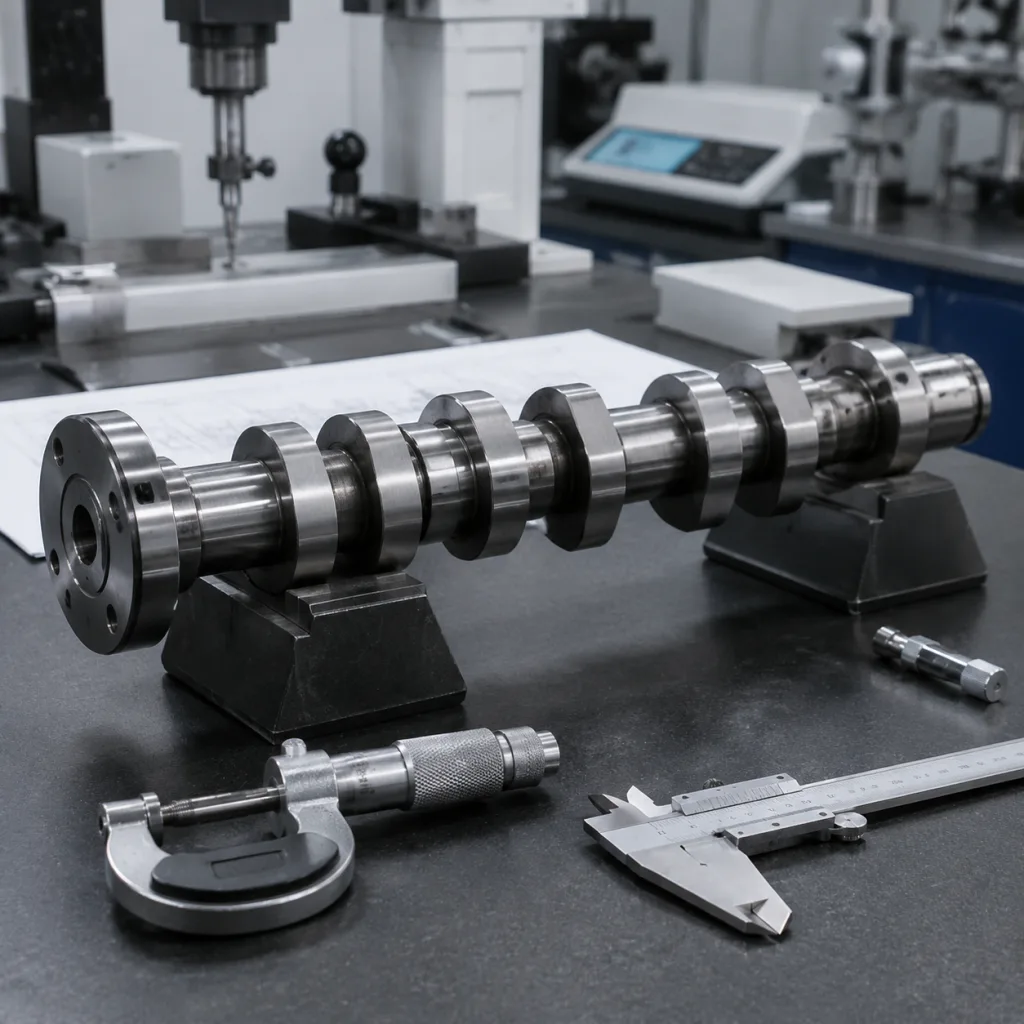
A camshaft is a high-contact rotating component. Small deviations in lobe geometry, journal alignment, hardness, or surface finish can affect valve timing, start-up noise, oil-film stability, wear, emissions performance, and engine efficiency. For that reason, buyers should look beyond catalogue fitment claims and evaluate process capability. The factory should control machining, heat treatment, straightening where required, grinding, cleaning, preservation, and final inspection through documented checkpoints.
Core controls expected from a qualified supplier
Control point
What to verify
Why it matters
Raw material
Alloy grade, incoming inspection, and mill certificate traceability
Supports fatigue strength, machinability, and consistency between batches
Heat treatment
Hardness range, case depth where applicable, and process records
Protects lobe and journal wear resistance under high contact stress
Machining and grinding
Lobe profile, journal concentricity, runout, surface finish, and datum control
Preserves valve timing accuracy and reduces noise or installation issues
Dimensional inspection
Journal size, cam lobe geometry, end features, sensor-drive details, and thrust surfaces
Ensures OE-equivalent fit and correct assembly into the cylinder head
Cleaning and preservation
Deburring, cleanliness, anti-rust protection, and handling controls
Reduces contamination risk, corrosion, and damage in storage or transit
Final QC
Visual inspection, batch identification, packaging checks, and shipment release records
Reduces returns, mis-picks, and mixed-SKU shipment errors
</tr></thead><tbody> </tbody></table>Driventus operates under IATF 16949:2016 and ISO 9001:2015 controls, with inspection records available for procurement review. For buyers building supplier approval files, this evidence is often as important as the component itself because it shows whether the same specification can be reproduced across repeat production lots.
OE-equivalence, fitment, and validation testing
When a camshaft is sourced for Volvo-fitment applications, OE-equivalence should be demonstrated through controlled measurements and agreed test evidence. A part number match is useful, but it is not sufficient on its own. Buyers should request dimensional reports against the target specification, confirm the engine code and model-year coverage, and, for sensitive programmes, evaluate samples taken from the same production route planned for mass shipment.
Validation commonly includes:
Runout and straightness measurement
Lobe lift, base circle, and profile verification
Journal diameter and surface-finish inspection
Surface hardness testing on lobes and journals
Visual review of oil passages, keyways, slots, trigger features, or machined ends where applicable
Noise, wear, or functional screening in representative engine builds when required by the programme
Corrosion-protection review for warehouse storage and international transit
If your organisation requires supplier qualification, align the test method with the intended sales market and your internal warranty policy. EU buyers may need material and chemical-compliance information relevant to REACH (EC) No 1907/2006, while fleet or high-volume distribution programmes may apply internal durability, installation, and return-analysis protocols. A responsible supplier should not claim endorsement by the vehicle manufacturer unless formal approval exists. The correct basis for sourcing is conformance to the agreed specification and fitment for the stated application.
MOQ, lead time, and export support for procurement teams
For B2B buyers, the supply model must match inventory strategy. A camshaft programme for Volvo applications may begin with lower-volume samples or first-article approval, then move to scheduled replenishment once demand is proven. The right supplier should support trial orders, forecast-based production, and repeat lots while keeping critical dimensions, packaging, labelling, and documentation consistent from one shipment to the next.
Typical procurement questions include:
1. What is the MOQ for a new camshaft reference or engine family? 2. What is the sample lead time and standard production lead time after approval? 3. Can the supplier support mixed-SKU export cartons or consolidated shipments for distributor orders? 4. Are dimensional reports, packing lists, invoices, certificates, and other commercial documents prepared for customs clearance? 5. Is tooling ownership, tooling retention, or long-term part availability defined in the contract? 6. How are engineering changes, supersessions, and batch identification communicated?
Driventus supports export supply to more than 60 countries and can align packaging, labelling, preservation, and documentation with importer requirements. For larger programmes, buyers can review our catalog and related engine components to consolidate sourcing from one manufacturing base, simplify supplier management, and improve shipment planning across multiple engine-part categories.
Why factory audit and documentation reduce sourcing risk
A supplier audit should test process discipline, traceability, and corrective-action capability. Procurement teams do not need a sales presentation; they need evidence that the factory can manufacture the same camshaft specification repeatedly, identify problems quickly, and prevent nonconforming parts from reaching the customer. This is especially important when the parts will be sold through distributors, private-label channels, or fleet repair networks where warranty costs can multiply across many branches.
Use this audit checklist:
Incoming material traceability and supplier-control records
CNC machining and grinding process controls
Heat-treatment parameters, hardness records, and batch linkage
In-process inspection frequency and final inspection sampling plan
Gauge calibration and measurement-system control
Nonconformance reporting and CAPA workflow
Change-control process for drawings, profiles, materials, and packaging
Packaging protection for sea freight, air freight, warehouse handling, and long storage
Driventus shares its quality system documentation for buyer review and supports custom manufacturing when an application requires a non-catalogue profile, dedicated packaging, private-label cartons, or a controlled SKU programme. For distributors building a reliable Volvo-fitment range, this combination of audit access and technical documentation helps reduce sourcing risk before the first production order is placed.
How procurement teams can structure a purchase request
To shorten quotation time, send a complete RFQ package. The more accurate the technical file, the lower the risk of incorrect cross-referencing, sample rework, tooling delay, or order changes after approval. A clear RFQ also helps the supplier separate standard catalogue possibilities from custom-development requirements.
Include:
Engine code, vehicle application, model year, and market region where known
Intake or exhaust position and quantity required per engine
OE number, aftermarket reference, drawing, or sample part if available
Photos of end features, sensor-drive details, keyways, oil holes, and markings when a sample is used
Annual demand forecast, first-order quantity, and target MOQ
Required packaging format, labelling language, barcode needs, or private-label requirements
Target sales market and compliance expectations
Requested inspection documents, sample approval process, and shipment terms
If you are consolidating supply for distributors, wholesalers, e-commerce channels, or repair networks, a single quotation should cover sample cost, tooling assumptions, batch size, expected lead time, inspection scope, and confirmation of dimensional checks. This makes supplier comparison more objective and improves internal approval speed. For fast review, request a quote with your application sheet, drawings, photos, or sample reference.
Frequently asked questions
Driventus supplies Volvo-fitment camshafts as an independent aftermarket manufacturer with OEM-grade quality controls. We do not claim vehicle manufacturer approval or endorsement. Brand names are used only to identify fitment and application compatibility.
Buyers can request dimensional inspection records, material traceability, batch identification, packaging details, and quality-system information aligned with IATF 16949:2016 and ISO 9001:2015. Destination-specific export documents can also be prepared when required.
Yes. Driventus supports custom camshaft manufacturing for special profiles, dedicated packaging, private-label programmes, and non-catalogue references, subject to technical review, tooling assessment, sample approval, and confirmed order volume.
If you need a stable source for Volvo-fitment camshafts, send your OE reference, engine code, application details, and annual demand. Our team will review the specification and return a commercial offer via /contact.html.