Crankshaft Infiniti Wholesale: Sourcing Guide for Buyers
Procurement teams sourcing crankshaft Infiniti wholesale orders need more than a part number match. The decision should be based on fitment evidence, dimensional compatibility, material grade, machining consistency, balance control, packaging protection, and documentation that supports receiving inspection. For Infiniti applications, the crankshaft is a rotating load-bearing component; small deviations in journal diameter, runout, oil-hole finish, or fillet geometry can affect bearing life, oil film stability, and NVH performance. Driventus supplies crankshafts for aftermarket and B2B replacement channels from Taizhou, Zhejiang, with production controls aligned to IATF 16949:2016 and ISO 9001:2015. Driventus is an independent aftermarket manufacturer; brand names are referenced for fitment identification only. Buyers can review our catalog, quality system, and custom manufacturing options before issuing a request for quote. This guide explains what sourcing teams should verify before placing a wholesale order, including OE cross-reference discipline, inspection records, and commercial terms that matter to importers, distributors, and private-label programs.
What wholesale buyers should verify first
Before confirming a crankshaft Infiniti wholesale order, start with application matching and measurable acceptance criteria. Fitment should be checked by engine code, OE reference, sample comparison, and any known model-year variations. A crankshaft that appears similar can still differ in reluctor wheel design, rear flange pattern, nose length, keyway position, oil-hole layout, or thrust bearing location.
Dimensional checks that affect acceptance
- Main and rod journal diameter against the agreed tolerance
- Journal roundness and taper
- Runout at the centre main journals
- Surface finish on bearing, thrust, and seal surfaces
- Fillet radius consistency and transition finish
- Oil-hole chamfering and cleanliness
- Rear flange, pilot, and nose dimensions
- Dynamic balance state and correction method
The purchase order should also define packaging requirements, because crankshafts are heavy, machined components with vulnerable journals and edges. VCI wrap, journal sleeves, end protection, rigid cartons or crates, and traceable lot labels help reduce transit damage and make warehouse identification easier. For distributor stock, clear SKU labels and carton-level traceability can prevent picking errors when multiple Infiniti-related crankshaft references are stored together.
Materials, process control, and standards
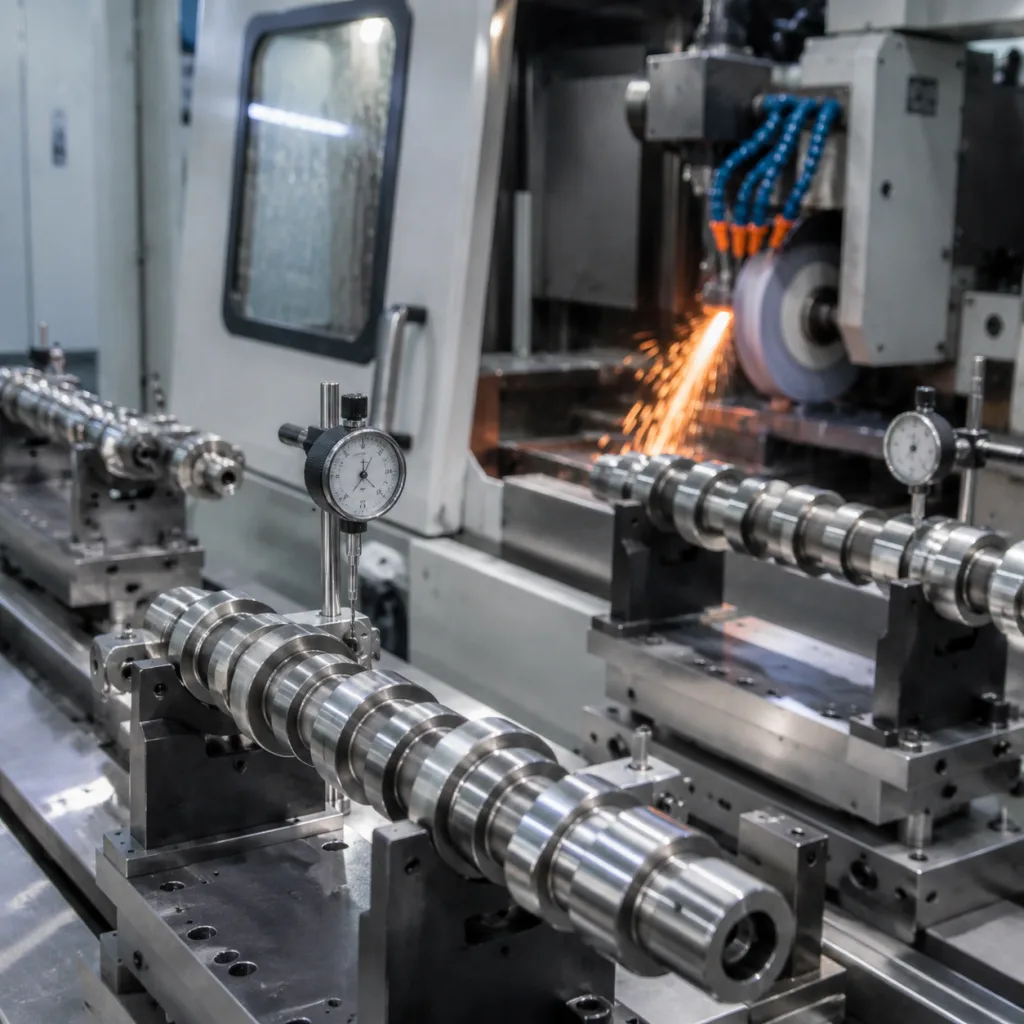
Material and process control determine whether a crankshaft can perform consistently across a wholesale batch. Buyers should ask how the supplier controls raw material sourcing, heat treatment, straightening, rough machining, finish grinding, polishing, cleaning, and final inspection. Depending on the application, crankshafts may be produced from cast iron, forged steel, or other specified materials; the correct choice should follow the target OE reference, operating load, and market requirement rather than a generic description.
Validation documents buyers can request
- Material certificate by heat number or batch
- Heat treatment or hardness record where applicable
- First article inspection report for new or revised SKUs
- Final dimensional inspection record
- Surface finish and runout results for critical journals
- Balance verification record
- Cleaning, rust prevention, and packaging confirmation
- Packaging and lot traceability sheet
For export programs into the EU, UK, US, Canada, Australia, Brazil, and other regulated or documentation-heavy markets, clear records are often more valuable than a small unit price reduction. Documentation helps import managers answer customer claims, verify incoming lots, and maintain consistent quality expectations across repeat orders. A supplier aligned with IATF 16949:2016 and ISO 9001:2015 should be able to explain inspection flow, nonconforming product control, corrective actions, and traceability from material intake to shipment.
Wholesale MOQ, lead time, and commercial planning
Wholesale planning works best when technical approval and commercial terms are discussed together. For crankshaft Infiniti wholesale programs, the MOQ may vary by SKU, current inventory, material availability, machining schedule, and whether the part is a standard catalog item or a custom development. Buyers should separate sample approval time from mass-production lead time, especially when drawings, fixtures, gauges, or packaging artwork need to be prepared.
Typical buyer questions to settle early
- What is the MOQ per SKU and per shipment?
- What is the first sample lead time?
- Is there a separate lead time for new tooling, fixtures, gauges, or validation?
- Can mixed-SKU cartons or pallets be supplied for warehouse picking?
- Which inspection documents are included at shipment?
- What Incoterms, payment terms, and export documents are available?
- How are backorders, substitutions, and engineering revisions communicated?
Importers and distributors should also forecast reorder cycles. Crankshafts take more planning than small service parts because they require protected packaging, careful handling, and controlled machining capacity. If the program serves multiple regional warehouses, confirm pallet configuration, carton dimensions, gross weight, label format, and whether private-label packing is needed before the production slot is booked.
How to compare suppliers without overpaying
The lowest quoted price is not always the lowest landed cost. A crankshaft supplier that omits inspection data, packaging protection, or cross-reference checks may create extra cost through returns, warranty claims, rework, stock segregation, or delayed customer deliveries. A fair comparison should include the part specification, inspection scope, packaging standard, traceability, lead time reliability, and after-sales response.
Red flags in low-cost offers
- No OE cross-reference discipline or engine-code confirmation
- No inspection data for critical dimensions
- Vague material description such as “standard steel” without records
- No balance requirement stated
- No runout, hardness, or surface finish targets where needed
- No traceability on cartons, bags, or labels
- Packaging that leaves journals, threads, or flanges exposed
- Reluctance to provide samples, photos, reports, or batch information
To avoid overpaying, ask each supplier to quote against the same specification and document list. Compare price per accepted part, not only price per shipped part. A slightly higher unit cost can be justified if it reduces incoming inspection time, protects the component in transit, and supports repeatable fitment for Infiniti aftermarket applications. For private-label programs, also include the cost of label control, packing consistency, and claim-handling support in the evaluation.
Factory audit points that matter for crankshafts
A useful factory audit should focus on the controls that directly affect crankshaft performance. Buyers can review material receiving records, machining equipment, grinding and polishing controls, gauge calibration, cleanliness practices, balancing equipment, rust prevention, and final packing. The audit should also confirm how the factory identifies each lot, separates nonconforming parts, and records corrective actions when measurements move toward tolerance limits.
Key audit questions include whether gauges are calibrated and logged, whether operators follow a control plan, how often critical journals are measured, how balance correction is verified, and how finished crankshafts are protected before packing. Storage conditions matter as well: machined journals should be protected from corrosion, impact, and contamination before export.
When to ask for custom support
Custom manufacturing is relevant when the buyer needs a special nose length, a non-standard rear flange, revised counterweight geometry, a specific reluctor configuration, or packaging built for a private-label warehouse flow. In those cases, share the drawing, sample, target OE reference, engine code, and annual volume as early as possible. Clear input shortens development time, reduces revision cycles, and helps the engineering team confirm whether the request can be produced within the required tolerance, cost, and lead-time targets.
Frequently asked questions
Yes. We supply B2B aftermarket programs and can match applications by engine code, OE cross-reference, or sample part. Brand names are referenced for fitment only.
Buyers can request material certificates, inspection reports, balance records, packing lists, and lot traceability documents. Requirements can be set before order confirmation.
Send the engine code, OE reference, target annual volume, and packing requirement. We will confirm fitment, MOQ, and lead time, then you can request a quote.
If you need a verified supply route for Infiniti crankshafts, send your engine code and target volume. Contact Driventus to request a quote at /contact.html
Request a Quote