Connecting Rod Volvo Wholesale: Buyer Sourcing Guide
A connecting rod Volvo wholesale program fails when it is treated as a catalog lookup. The part has to match the engine, the bearing system, the piston pin, the crank journal, the cap, the bolt process, and the packaging route that gets it to the repair channel without corrosion or mix-ups. For import buyers, the costly problems are familiar: big-end bore drift, wrong pin or journal pairing, unmatched caps, weak lot traceability, late replenishment, and documents that do not satisfy customs, warranty review, or a customer audit. This guide shows how Driventus structures Volvo-fitment connecting rod supply for distributors, wholesalers, repair-chain buyers, and OEM or Tier-1 sourcing teams that need private-label or project-based production. It covers specification control, material choices, machining checks, MOQ logic, lead-time planning, packaging, inspection evidence, and audit questions to resolve before issuing a purchase order. Driventus is an independent aftermarket manufacturer; brand names are referenced for fitment only.
Start With the Engine Data, Not the Product Photo
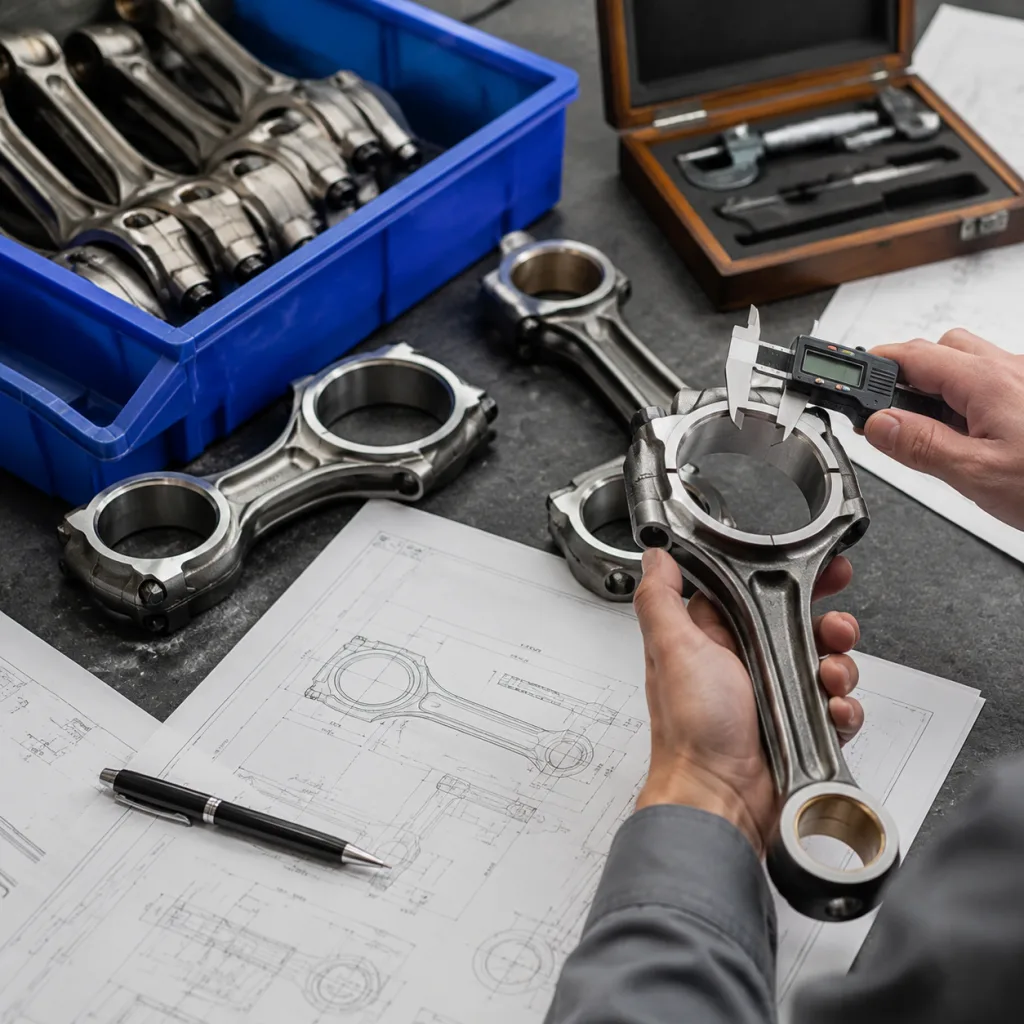
A connecting rod transfers combustion load from the piston pin to the crankshaft journal. That sounds simple until two visually similar rods differ by pin size, crankpin diameter, big-end width, centre distance, bolt type, or bearing shell compatibility. For Volvo-fitment applications, a wholesale quote should begin with measurable data.
A buyer data pack should include, where available:
Data point
Why it matters
Buyer action
Engine code and displacement
Avoids mixing similar Volvo-fitment references
Provide application table by market year
Centre-to-centre length
Controls piston deck height and compression geometry
Confirm drawing or sample measurement
Big-end bore and width
Determines bearing crush and side clearance
Match to crankpin and bearing shell supplier
Small-end bore and width
Determines piston pin fit and float condition
Confirm pin diameter and bushing requirement
Rod bolt specification
Affects clamp load and cap stability
State bolt size, grade, and torque method if known
Set weight requirement
Reduces imbalance claims in repair kits
Define single-rod or 4/5/6-cylinder matched set
Packaging format
Changes MOQ, price, and lead-time
Confirm neutral, private-label, or bulk packing
</tr></thead><tbody> </tbody></table>Driventus supplies engine components for aftermarket and project-based B2B channels. Buyers can review related engine parts through our catalog and the engine component range at /products/engine-components.html. Cross-references are managed by application data, sample verification, and technical drawings where available. We do not claim approval or endorsement by any vehicle manufacturer.
The buying structure changes the risk profile. Common connecting rod Volvo wholesale orders include:
Mixed-SKU distributor shipments with 3–20 engine references in one export order
Repair-chain replenishment programs for high-turnover references with quarterly forecasts
Private-label boxed sets, usually 4-piece, 5-piece, or 6-piece engine sets with barcode labels
Drawing-based production for controlled aftermarket or Tier-1 projects
Sample-first orders of 1–5 sets before annual blanket purchasing
If an OE part-number cross-reference is required, the buyer should provide the reference list and application table. Driventus can map fitment data against supplied references, but brand-owned part numbers are reference information only. Before quotation, state whether substitute references are allowed, whether caps must ship assembled to their original rods, and whether inspection will be handled by the buyer, a third party, or Driventus QC before shipment.
Where Connecting Rod Programs Usually Go Wrong
Most failures are not caused by a missing catalog line. They come from loose specification language. “Steel rod for Volvo engine” is not enough. Buyers need the material route, heat-treatment method, hardness range, batch traceability, machining sequence, and actual inspection values for the dimensions that affect oil film, bearing life, and piston alignment.
Common material routes include forged steel, powder metallurgy, and billet-machined material for special projects. Forged steel is often preferred for wholesale replacement programs where impact strength, fatigue resistance, and aftermarket acceptance matter. Powder metallurgy may be appropriate when the original design route and fracture-split cap geometry require it. The chosen route should be documented, not assumed.
A practical specification review should include measurable limits. Final values must follow the approved drawing or sample, but the table below shows the type of controls buyers should request during quotation:
Control item
Procurement check
Typical target or evidence requested
Material route
Forging, powder metallurgy, or special route
Material certificate with heat/lot number
Steel grade
Mechanical and fatigue suitability
Grade confirmation, e.g. 40Cr/42CrMo or project-approved equivalent
Heat treatment
Hardness and structure stability
Batch hardness report, commonly controlled within about 4 HRC where specified
Big-end bore
Bearing fit and roundness
Bore gauge report; tolerance commonly controlled in micron-level bands per drawing
Big-end roundness
Oil film stability and bearing life
Roundness record after cap assembly and bolt torque
Small-end bore
Piston pin or bushing fit
Bore gauge record and bushing ID/OD data where used
Centre distance
Compression height and engine geometry
CMM or fixture report; typical control request ±0.02 mm or tighter if drawing requires
Parallelism/twist
Piston and bearing alignment
Fixture or CMM report with defined datum method
Side-face width
Crankshaft side clearance
Micrometer record against drawing limit
Rod weight
Set balance control
Weight sorting record, often grouped within 1–3 g per set if requested
Bolt torque process
Clamping repeatability
Torque-angle or torque-value instruction and assembly record
Surface cleanliness
Debris and rust control
Washing process, residual debris check, and anti-rust method
</tr></thead><tbody> </tbody></table>The machining route should be visible from blank receiving to packing: datum machining, rough boring, cap cutting or fracture processing where applicable, bolt assembly, finish boring or honing, bushing pressing if required, small-end finishing, deburring, washing, anti-rust treatment, and final packing. Visual similarity is secondary. Big-end bore size and roundness, cap alignment, bolt seating condition, small-end axis parallelism, and side-face width directly influence bearing temperature, oil film stability, noise, vibration, and harshness.
Driventus uses controlled machining fixtures and in-process checks to reduce variation between cavities and batches. Critical dimensions are checked at setup, during production, and at final inspection. For new or modified references, buyers should request a first-article inspection report with actual measured values, not pass/fail marks only. For custom projects, buyers can discuss drawing-based development through custom manufacturing, including sample machining, first-article inspection, controlled batch release, and change approval before mass production.
Build the Approval File Before the First Shipment
A supplier certificate is useful. It is not the whole approval file. Wholesale connecting rod programs should be checked against the supplier’s management system and the part-level control plan. Driventus operates under IATF 16949:2016 and ISO 9001:2015 certification, supporting process control, corrective action, supplier management, traceability, calibration, and documented inspection planning.
For procurement teams, the key question is whether each carton can be linked back to the production batch. A useful shipment pack normally includes commercial invoice, packing list, country-of-origin information where required, material certificate, final inspection report, packaging specification, and batch or lot traceability. For first production, buyers may also request sample approval records, control plan, process flow chart, and first-article inspection report.
Regulatory and import expectations differ by market. European Union and United Kingdom importers may need material declarations that consider REACH (EC) No 1907/2006 where applicable to substances in supplied articles or packaging. Packaging may require separate checks for wood treatment, carton recyclability statements, or market-specific labelling. North American, Australian, and Brazilian buyers often focus on customs description, country of origin, importer-confirmed HS code, commercial invoice accuracy, and batch traceability.
Before approving a connecting rod Volvo wholesale supplier, request:
Valid IATF 16949:2016 and ISO 9001:2015 certificates covering the manufacturing site
Process flow diagram for forging or blank sourcing, machining, inspection, cleaning, and packing
Control plan with critical dimensions, gauges, sample size, and inspection frequency
Material certificate and heat-treatment record by batch or heat number
First-article inspection report for new, revised, or reactivated parts
Gauge calibration records for bore gauges, micrometers, CMM, and fixtures used on critical dimensions
Packaging specification with VCI bag, oil paper, anti-rust oil, desiccant, or other corrosion-protection method
Nonconformity, containment, root-cause, and corrective-action procedure
Driventus provides access to its quality system information for sourcing teams preparing supplier qualification files. Factory-audit requests can be reviewed case by case, including remote document review, video process review, or on-site audit scheduling where commercially justified. For controlled wholesale programs, define the acceptance standard before shipment: AQL level, critical dimension list, sample size, photo requirements, and whether destructive or material verification testing is required.
Choose the Buying Scenario Before Negotiating Price
The lowest unit price is rarely the best first question. Commercial feasibility depends on order mix, tooling status, packaging requirements, inspection depth, and forecast visibility. Existing SKUs with validated tooling can normally move faster than drawing-based development or low-volume special references. For import managers, the shipment structure should be fixed early: loose rods, matched sets, private-label cartons, master cartons, palletisation, barcode format, and inspection point.
Typical commercial logic for connecting rod Volvo wholesale orders is:
Scenario
Typical MOQ logic
Lead-time planning
Price impact
Existing validated SKU
MOQ may start from 50–200 pcs per reference depending on stock and batch status
About 30–45 days after order confirmation if components and packaging are ready
Lowest setup cost and fastest quote
Mixed distributor order
MOQ can be reviewed by total shipment value and carton efficiency
About 35–55 days if several references are combined
Better freight efficiency, more picking control needed
Private-label packing
MOQ often follows carton/artwork run, commonly 300–500 pcs or agreed batch
Add 7–15 days for artwork, label, and carton approval
Higher unit cost from packaging and label control
New drawing-based reference
MOQ normally follows tooling, fixture, and validation economics
Samples about 45–70 days; bulk production often 60–90 days after approval
Higher first-order cost from development and inspection
Urgent replenishment
MOQ depends on available semi-finished or finished stock
Air shipment can reduce transit time but not machining or inspection time
Higher landed cost from freight and handling
</tr></thead><tbody> </tbody></table>Price is shaped by material route, rod weight, machining hours, bushing requirement, bolt specification, heat treatment, inspection level, scrap allowance, packaging format, and order stability. A small trial order costs more per piece because setup, inspection, export documents, and packaging are spread across fewer rods. A 6- or 12-month forecast often improves capacity planning and reduces emergency freight, even when purchase orders are released monthly or quarterly.
A wholesale discussion should define:
Target annual volume by SKU and destination market
Initial sample quantity, normally 1–5 sets or an agreed inspection lot
MOQ by reference, carton, production batch, or consolidated shipment value
Standard neutral packaging, buyer carton, or private-label set packing
Required labels, barcodes, QR codes, language fields, and country-of-origin text
Ocean, rail, air, or consolidated freight preference with target incoterms
Pre-shipment inspection point and required report format
Spare parts data format for the buyer’s ERP system, including SKU, cross-reference, carton dimensions, gross weight, and net weight
Split lead-time into sample, production, inspection, and logistics stages. For new references, allow time for drawing confirmation, sample machining, dimensional verification, and fitment checks if required. For repeat orders, forecast sharing helps stabilise capacity. For sea freight to Europe, North America, Australia, or Brazil, add realistic port, customs, and inland delivery time instead of judging supplier performance only by factory ready date.
For wholesale packaging, Driventus can supply neutral cartons or buyer-specified packaging, subject to artwork approval and local import requirements. Options include single-rod cartons, matched-set boxes, inner plastic or VCI bags, foam or corrugated separators, master cartons, pallet wrapping, corner protection, and carton drop or compression review. Corrosion protection should match transit time, climate, and storage conditions. For ocean freight or humid warehouse routes, define the expected storage period, such as 6–12 months, so anti-rust oil, VCI material, desiccant, and carton strength can be specified before quotation.
Audit the Batch Flow, Not the Factory Brochure
A useful audit follows the part. Generic factory photos do not prove connecting rod capability. Procurement teams should verify whether the supplier controls critical operations internally or relies on subcontractors without traceability. The audit should track raw material lot, blank, rod, cap, bolt, inspection record, label, carton, and shipment document.
Technical audit questions
Which operations are performed in-house: forging or blank control, heat treatment, machining, honing, bushing, shot blasting, washing, anti-rust treatment, and packing?
How are big-end bore size, roundness, cylindricity, and cap alignment checked after the specified bolt torque is applied?
What is the inspection frequency for centre-to-centre length, parallelism, twist, side-face width, and small-end bore?
What are the drawing tolerances for the critical dimensions, and what action limit is used before parts reach the tolerance edge?
How are rods grouped by weight for sets, and is the grouping tolerance 1 g, 2 g, 3 g, or buyer-defined?
How are caps kept matched to original rods during machining, washing, inspection, and packing?
What is the reaction plan when a bore, centre distance, or parallelism value trends toward the control limit?
Are bore gauges, micrometers, torque tools, CMM equipment, and custom fixtures calibrated under a documented system?
Are retained samples kept for first production and major revisions, and for how long?
Commercial audit questions
What MOQ applies to existing SKUs, low-turnover references, and new development projects?
Can the supplier support mixed-container orders without increasing carton mix-up risk?
How are private-label cartons, labels, and barcodes controlled to avoid wrong-brand or wrong-SKU packing?
What documents are supplied with each shipment, and can batch numbers be linked to carton labels?
What is the normal corrective-action response time after a customer claim, for example 24–48 hours for containment and 5–10 working days for root-cause reporting?
Can production batches be reserved against quarterly forecasts, and what happens if forecast releases are delayed?
Are tooling, fixture, or packaging costs amortised into the unit price or charged separately?
What inspection standard applies before shipment: buyer AQL, supplier standard, or 100% check for defined critical dimensions?
The audit should also confirm that sales data, drawings, samples, and cross-reference tables are revision-controlled. If a buyer changes bearing supplier, piston pin specification, carton format, or target application list, the connecting rod specification may need rechecking before bulk release. For higher-risk programs, request a pilot batch before annual blanket orders and require written approval before any change to material route, subcontractor, bolt supplier, or machining datum.
A Practical RFQ Path With Driventus
Driventus is based in Taizhou, Zhejiang, and exports engine and powertrain components to more than 60 countries. The product range includes pistons, crankshafts, gaskets, water pumps, turbochargers, and connecting rods. This wider engine-component base helps distributors consolidate purchasing across related repair categories while keeping part-level inspection records for critical components.
For connecting rod sourcing, Driventus can support:
Application review based on buyer-supplied engine data, drawings, samples, or cross-reference lists
Sample supply before bulk order confirmation, with sample quantity and inspection scope agreed in advance
Dimensional inspection reports for controlled references, including actual measured values for critical dimensions
Batch traceability from material lot through machining, inspection, packing, and shipment
Neutral or private-label packaging for wholesale channels, including carton artwork and barcode review
Mixed-SKU export shipments for distributors, with carton-level SKU control and packing-list discipline
Project review for drawing-based, modified, or low-volume specifications
MOQ, price, and lead-time review based on tooling status, annual volume, packaging, and destination market
A strong connecting rod Volvo wholesale RFQ starts with the data that controls cost and risk: target applications, expected annual volume, required cross-references, critical dimensions, packaging format, destination market, inspection standard, and any audit requirement. That information reduces quotation errors and aligns MOQ, lead-time, and validation steps before purchase orders are issued.
A practical first enquiry should state: engine references, required quantity per SKU, single rods or matched sets, private-label or neutral packaging, destination port or country, target incoterms, required documents, and whether samples are needed before bulk production. If the buyer has a target landed-cost limit, Driventus can review the main cost levers, such as packaging, shipment consolidation, order frequency, and inspection scope, without weakening critical dimensional controls.
Driventus is an independent aftermarket manufacturer; brand names are referenced for fitment only.
Frequently asked questions
Please provide engine application data, target quantity, destination country, packaging requirements, and any buyer-controlled cross-reference list. Drawings, samples, material route, critical dimensions, and required inspection reports help confirm fitment and reduce quotation risk.
Yes. Driventus can review neutral or private-label packaging requirements, including carton artwork, labels, barcodes, master cartons, pallet rules, VCI or anti-rust protection, and carton strength. Packaging approval should be completed before bulk production.
No. Driventus is an independent aftermarket manufacturer; brand names are referenced for fitment only. Any OE-style references are used only to help buyers identify applications and should be verified against buyer data.
If you are qualifying a connecting rod supplier for Volvo-fitment wholesale programs, share your application list, target volume, critical dimensions, inspection standard, and packaging requirements. You can [request a quote](/contact.html) or contact the team directly at /contact.html