connecting rod · 2026-06-17

Connecting Rod Skoda OEM Supplier Sourcing Guide

A connecting rod Skoda OEM supplier search can go wrong when the RFQ starts with a catalogue line instead of the engine programme. Skoda applications can sit across several Volkswagen Group engine families, and small differences in bore geometry, bearing width, cap design, bolt specification, or bushing detail can turn a cheap cross-reference into a warranty problem. Buyers need proof: controlled dimensions, material traceability, repeatable machining, batch records, and clear aftermarket positioning without unsupported vehicle-maker approval claims. This guide gives procurement teams a sharper way to qualify suppliers—what to lock before quotation, where audits fail, how to judge MOQ and lead time, and which validation records matter for EU, UK, North American, Australian, and Brazilian importers. Driventus manufactures engine and powertrain components in Taizhou, Zhejiang, under IATF 16949:2016 and ISO 9001:2015 systems, with export experience across 60+ countries. Driventus is an independent aftermarket manufacturer; brand names are referenced for fitment identification only.

Start With the Engine Programme, Not the Catalogue Match

The first decision is not price. It is whether the supplier can identify the rod correctly and keep that definition stable through sampling, production, packing, and claims.

Skoda fitment can cover 1.2L, 1.4L, 1.6L, 1.8L, and 2.0L petrol and diesel platforms, including naturally aspirated and turbocharged versions. Some use cracked-cap rods. Others use machined caps. Bearing width, pin diameter, bolt style, bushing detail, and cap orientation can differ even when a catalogue description looks similar.

Before nominating a connecting rod Skoda OEM supplier, buyers should build the sourcing file around controlled inputs:

  • Engine code, displacement, fuel type, aspiration, and production range
  • OE part-number cross-reference where available, such as OE 06A…, 03L…, 04E…, or 11251… conventions when supplied by the buyer
  • Big-end bore diameter, small-end bore diameter, centre-to-centre length, bearing width, and pin diameter
  • Bolt specification, thread form, tensile grade, torque-angle requirement, and whether bolts are single-use
  • Material route, such as forged C70S6/S55C/40Cr-grade steel, powder metal, or another buyer-approved specification
  • Cap type, bushing type, oil-hole position, chamfer direction, and orientation marking requirements
  • Packaging, labelling, barcode, carton quantity, and country-specific import documentation requirements

The reason is simple: a connecting rod is fatigue-critical. A 0.010 mm shift in big-end roundness, excess pin-bush interference, centre-distance error, or inconsistent bolt stretch can disturb bearing crush, piston deck height, oil-film stability, combustion noise, and long-term reliability.

A strong supplier will not ask buyers to trust a model-year listing alone. It will work from drawings, samples, approved cross-reference data, or a documented inspection standard. It will also keep revision history, approval status, and batch traceability visible.

Driventus can review fitment targets through our catalog and engine programme discussions, including related parts listed under engine components.

Where Factory Audits Usually Expose Risk

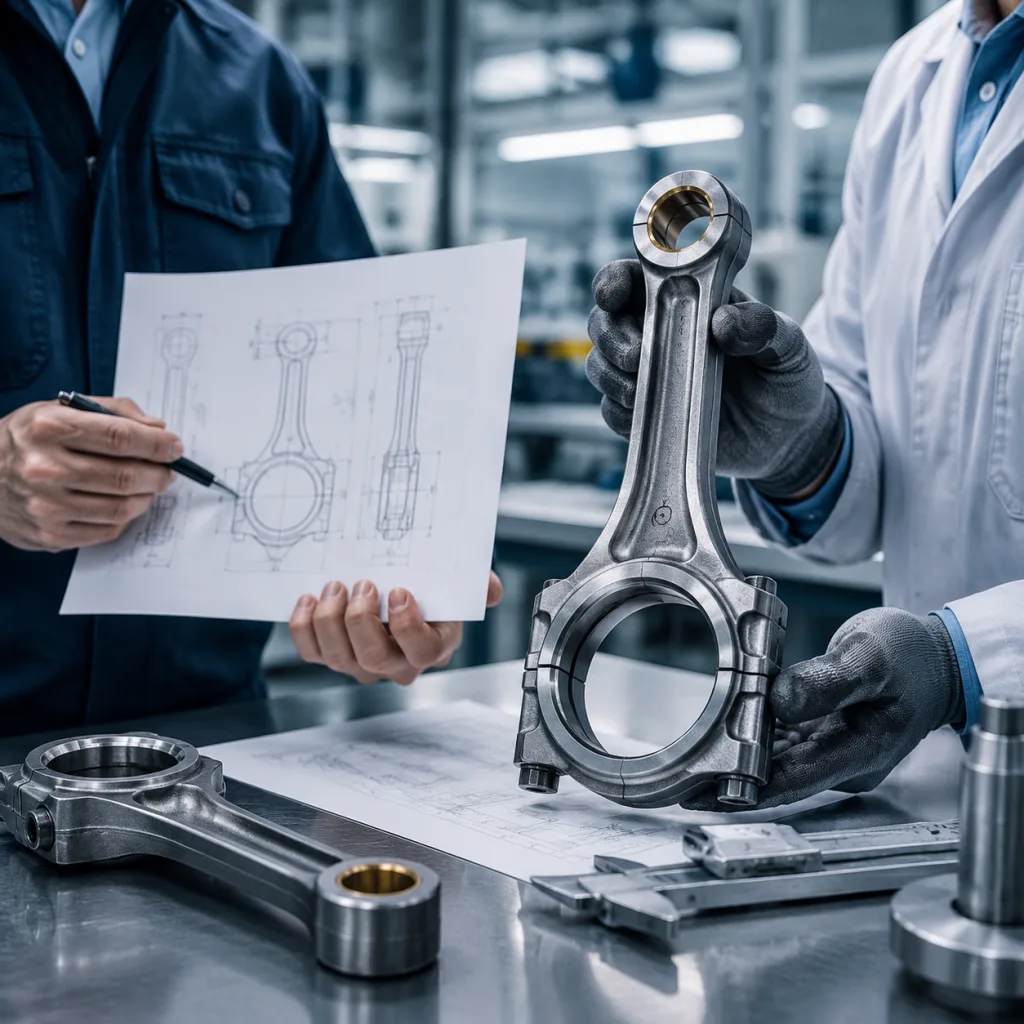
A factory audit should not become a certificate-collection exercise. For connecting rods, the weak points usually appear in bore geometry, parting-face control, heat-treatment consistency, bolt-hole machining, weight spread, and unverified cross-reference claims.

Ask the supplier to trace one finished rod backwards: carton label, packing list, inspection report, machining lot, heat-treatment batch, material heat number, and incoming steel record. If that chain breaks, traceability is only purchase-order deep.

</tr></thead><tbody> </tbody></table>The audit should follow the manufacturing route: raw material intake, forging or forming, heat treatment, shot blasting, rough machining, cap separation, bolt-hole machining, finish boring, honing, cleaning, inspection, and export packing. Skipping the route and reviewing only finished stock leaves too much risk hidden.

Driventus maintains a documented quality system aligned with IATF 16949:2016 and ISO 9001:2015. Buyers can use these systems as a baseline for supplier qualification, factory audit preparation, batch release, and ongoing performance review.

Specification Deep-Dive: The RFQ Lines That Decide Fitment

Two quotations are not comparable unless both suppliers price the same part, inspection level, and documentation package. The RFQ should state whether the programme is for direct aftermarket replacement, private-label distribution, engine rebuild kits, remanufacturing support, or supply into a larger assembly. It should also say whether the target is a drawing-controlled part, a reverse-engineered sample match, or a catalogue cross-reference subject to buyer approval.

Lock these details before price comparison:

  • Material: forged steel or buyer-approved equivalent, with EN 10204 3.1-style material certificate or equivalent batch certificate where required
  • Heat treatment: hardness range, case/core requirement if applicable, furnace batch ID, and process controls defined on the drawing or agreed control plan
  • Big-end bore: diameter, roundness, cylindricity, bearing-width control, and surface finish after cap assembly and bolt tightening
  • Small-end bore: bushing material, oil-hole position, interference fit, final bore tolerance, and pin clearance target
  • Centre distance: controlled between big-end and small-end bores, commonly held within ±0.02 mm to ±0.05 mm depending on drawing and engine family
  • Surface finish: bearing-contact surfaces typically specified by Ra value, with many buyers targeting Ra 0.4–0.8 μm unless the drawing states otherwise
  • Weight matching: total rod weight and big-end/small-end balance, often sorted within 2–5 g per engine set for rebuild kits where required
  • Fasteners: connecting rod bolts supplied loose or pre-installed, with thread class, coating, torque value, torque-angle step, and reuse policy defined
  • Cleanliness: deburring, chip control, oil-hole cleaning, anti-rust oil, VCI protection, and export packaging standard
  • Documentation: inspection report, material certificate, hardness record, packing list, certificate of origin, and traceability file where applicable

Indicative tolerance bands can help suppliers quote consistently, but they must not replace the buyer drawing. For early RFQ alignment, buyers may reference sample targets such as big-end bore tolerance within 0.010–0.020 mm, roundness within 0.005–0.010 mm, small-end bore tolerance within 0.008–0.015 mm, and perpendicularity or parallelism confirmed by CMM. Final values should come from the controlled drawing, reference sample, or approved inspection standard.

Regulatory expectations also need a line in the RFQ. REACH (EC) No 1907/2006 may apply for substance declarations into the EU. Some private-label importers request RoHS-style declarations even when the rod itself does not make that legally mandatory. If the part is supplied within a broader engine emissions repair or service programme, buyers may need to understand vehicle-level rules such as ECE R-83; that regulation does not certify an individual connecting rod.

For drawing-based programmes, Driventus can support custom manufacturing with controlled samples, process flow review, inspection plans, tolerance confirmation, and agreed packaging specifications.

Specification Deep-Dive: The RFQ Lines That Decide Fitment

MOQ and Lead Time: Compare Scenarios, Not Promises

A low MOQ is not automatically buyer-friendly. For an uncommon rod, it may mean mixed inventory, old stock, or a cross-reference that has not been validated recently. MOQ should reflect tooling status, machining setup time, material procurement, validation workload, inspection labour, packing complexity, and slow-moving inventory risk.

Use the commercial scenario to judge whether the offer is realistic:

Audit area What to check Procurement relevance
Quality certificationIATF 16949:2016 and ISO 9001:2015 certificates, scope, expiry, issuing body, and last surveillance-audit statusConfirms the management-system basis for automotive production
Material controlSteel grade certificate, heat number traceability, incoming chemical/mechanical records, and batch quarantine rulesReduces batch-mix and fatigue-performance risk
Heat treatmentFurnace charts, hardness map, quench controls, load pattern, calibration status, and typical hardness target such as 28–36 HRC where drawing permitsSupports strength, durability, and repeatability
Machining capabilityCNC boring, honing, bolt-hole machining, fixture control, cap alignment, dowel or serration control, and tool-life limitsControls bore size, roundness, surface finish, and centre distance
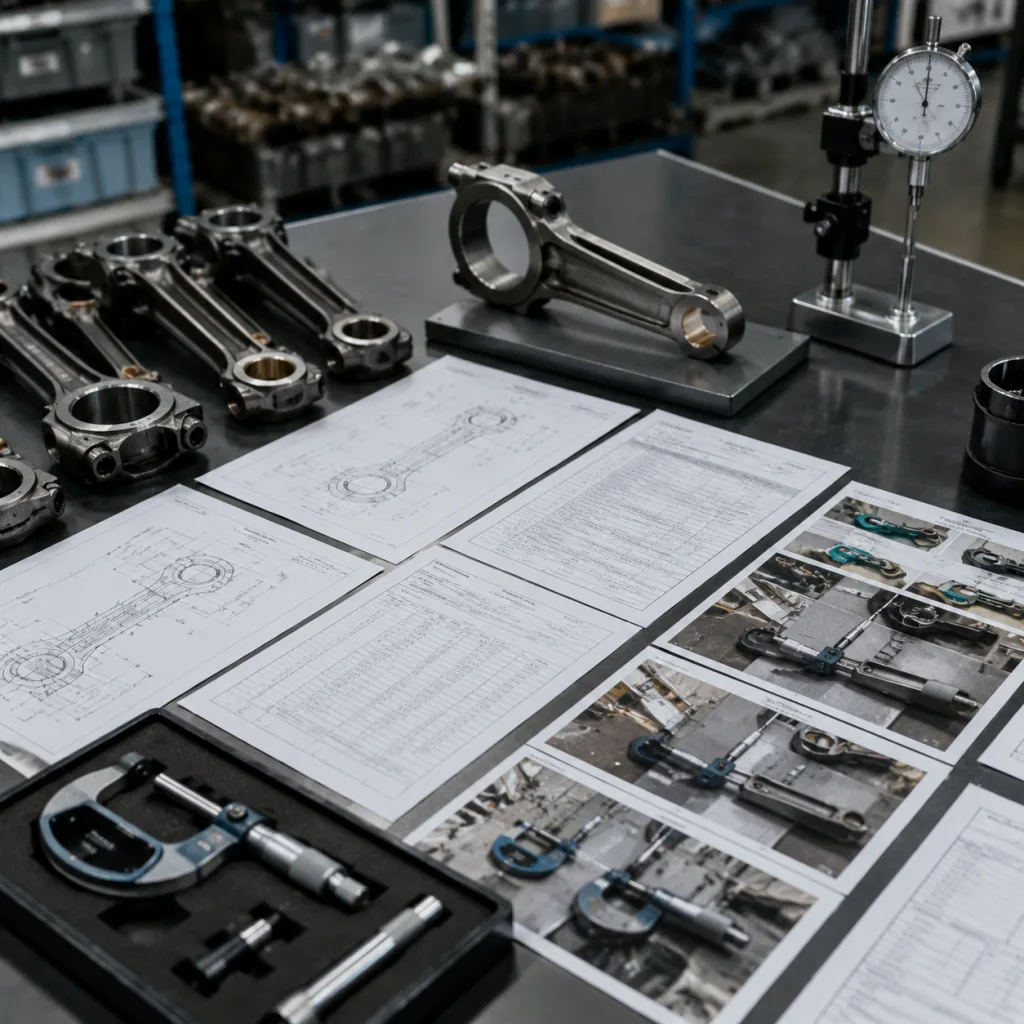
MetrologyCMM, air gauges or bore gauges with 0.001 mm resolution, surface roughness testers, calibrated torque tools, and MSA recordsProvides dimensional evidence for PPAP-style review
Process capabilityCp/Cpk records on big-end bore, small-end bore, centre distance, and weight where volume justifies statistical controlShows whether tolerances are stable rather than sorted after machining
Nonconforming materialSegregation area, NCR records, rework rules, scrap approval, 8D closure, and customer notification thresholdsShows whether defects are contained before shipment
PackagingVCI bag or oil protection, bore guards, impact separation, carton burst strength, pallet marking, and moisture controlProtects machined surfaces during 30–45 day ocean export logistics

</tr></thead><tbody> </tbody></table>Lead time should be broken into stages. A practical plan is 7–15 days for drawing or sample review and quotation, 20–35 days for prototype or first-article samples when fixtures already exist, 45–75 days for new tooling or fixture development, 30–60 days for mass production after approval, 3–7 days for final inspection and packing, plus vessel booking or airfreight time. Active repeat items may move faster. Even then, buyers should allow time for dimensional approval, packaging confirmation, label proofing, and market-specific documentation.

Price comparison should separate unit price from one-time tooling, sample cost, inspection requirement, packing cost, and logistics term. EXW or FOB Ningbo/Shanghai pricing may look lower than CIF or DDP pricing, but it transfers more freight, insurance, customs, and local handling responsibility to the buyer. Compare landed cost per sellable set, not only price per rod.

Set commercial controls before the first purchase order: payment terms, warranty process, incoterms, spare-parts claim handling, sample approval before deposit, pre-shipment inspection before balance payment, and claim windows tied to batch traceability. Importers should also confirm HS code, country-of-origin marking, invoice description, pallet label format, and any local documentation needed for customs or customer onboarding.

Approval Evidence: What to Request at Each Risk Level

Validation should match risk. A repeat catalogue replenishment order does not need the same file as a new private-label launch, but every shipment needs enough evidence to defend fitment, material origin, and batch control.

For first approval, request a package such as:

  • First article inspection report with actual measured values for at least 3–5 sample pieces
  • Material certificate linked to batch, heat number, and forging or bar-stock lot
  • Hardness test report and heat-treatment record, including furnace batch and calibration reference
  • Big-end and small-end bore measurement after assembly at the specified bolt torque or torque-angle condition
  • Surface roughness record on bearing, thrust, and bushing surfaces
  • Bolt torque, torque-angle, or bolt-stretch verification where applicable
  • Weight comparison report for matched sets, including total weight and big-end/small-end split if required
  • Magnetic particle inspection or crack-detection record when specified for forged or high-load applications
  • Cleanliness and deburring check, especially around oil holes and bushing edges
  • Packaging drop, vibration, or transport protection assessment for export shipments
  • Traceability plan showing how batches, cartons, inspection records, and customer purchase orders connect

For higher-volume programmes, many buyers use an AIAG PPAP-style file as the reference, even when the programme is aftermarket rather than OE production. The submission level should be agreed in advance. A Level 2 or Level 3-style package may include process flow, PFMEA, control plan, dimensional results, material records, capability data, MSA evidence, sample parts, and appearance or packaging approval where relevant.

The control plan should call out critical characteristics: big-end bore diameter, small-end bore diameter, centre distance, surface finish, hardness, bushing fit, bolt-hole geometry, weight, and part marking. These are the features most likely to create installation complaints or engine failure if they drift.

Ongoing production needs its own release routine. Buyers can request AQL-based visual inspection, 100% checks for critical bore dimensions where agreed, periodic CMM layout, hardness checks per heat-treatment batch, and retained samples for each shipment. The supplier should also report process changes before shipment, including material source changes, fixture replacement, heat-treatment route changes, bolt supplier changes, or packaging redesign.

A credible connecting rod Skoda OEM supplier should also be clear about its commercial and technical status. Aftermarket manufacturers can provide OE-equivalent fitment and performance targets, but they should not claim endorsement, approval, or authorisation by a vehicle manufacturer unless that status is documented, contractually valid, and relevant to the supplied programme.

Approval Evidence: What to Request at Each Risk Level

When Driventus Is the Right Fit for a Programme

Driventus is best suited to buyers who want the sourcing discussion tied to application evidence, inspection records, export packing, and repeat supply planning—not only a unit price. Typical customers include aftermarket distributors, wholesalers, OEM and Tier-1 suppliers, and multi-location repair chains.

The company manufactures engine and powertrain parts including pistons, crankshafts, gaskets, water pumps, turbochargers, and connecting rods. That broader range can help distributors consolidate related engine-component sourcing when technical and commercial requirements align.

For connecting rod programmes, Driventus can support:

  • Application review based on buyer-supplied drawings, samples, engine codes, or OE cross-reference data
  • Technical discussion on forged steel, machining route, tolerance stack-up, cap design, bushing fit, and packaging
  • RFQ alignment covering MOQ, sample cost, tooling status, inspection level, incoterms, and target lead time
  • Controlled sample plan with first-article inspection, dimensional report, material record, and buyer sign-off
  • Batch inspection reports, heat-number traceability, hardness records, and carton-level identification where agreed
  • Private-label packing for distributor channels, including barcode, carton hierarchy, and export pallet labelling
  • Mixed SKU shipments for regional warehouses to combine rods with pistons, gaskets, pumps, and other engine parts
  • Export documentation for EU, UK, US, Canada, Australia, and Brazil-bound orders, including invoice, packing list, certificate of origin, and buyer-requested declarations where applicable
  • Commercial planning for MOQ, forecast demand, sample timing, production release, inspection hold points, and repeat shipments

Supplier selection should balance landed cost with audit readiness, traceability, process capability, and claim control. A low unit price has limited value if the supplier cannot prove bore geometry, material origin, fastener specification, heat-treatment consistency, or production repeatability.

Driventus structures each programme around documented requirements, agreed inspection points, practical commercial terms, and clear aftermarket positioning rather than unsupported brand claims. Driventus is an independent aftermarket manufacturer; brand names are referenced for fitment identification only. To discuss drawings, MOQ, lead time, or a sample plan, buyers can request a quote.

Frequently asked questions

Yes. Driventus can review buyer-supplied drawings, samples, engine codes, dimensions, or OE cross-reference conventions for Skoda fitment. Supply is for independent aftermarket or agreed B2B manufacturing programmes and does not imply vehicle-maker endorsement.

Depending on programme scope, Driventus can provide first-article inspection reports, material certificates, hardness records, heat-number traceability, bore measurements, packing information, and quality-system documentation aligned with IATF 16949:2016 and ISO 9001:2015.

MOQ and lead time depend on tooling status, forecast volume, machining setup, validation requirements, packaging type, documentation needs, and mixed-SKU shipment planning. Active applications may start around 100–300 pieces, while new drawing programmes often require higher MOQ and staged sample approval.

If you are qualifying a connecting rod supplier for Skoda-related applications, share the engine code, drawing, sample, dimensions, target MOQ, annual forecast, packaging requirement, and cross-reference data with Driventus for review. Start a sourcing discussion at /contact.html

Request a Quote
Item Typical consideration Buyer action
Existing active applicationOften 100–300 pieces per SKU when forgings, fixtures, and bolts are availableConfirm current production history, sample availability, stock age, and last batch date
Intermittent or slow-moving applicationOften 300–800 pieces because setup and inspection cost must be absorbedAsk whether MOQ can be split across releases after one qualified production batch
New drawing programmeOften 500–1,500 pieces, plus sample and fixture cost where tooling is not sharedAsk for development timeline, sample stages, tooling ownership, and approval criteria
Private-label packingMOQ affected by carton print run, label, barcode, manual, and inner-pack requirementsLock artwork, EAN/UPC format, language rules, carton quantity, and packing hierarchy early
Mixed container ordersUseful for distributors buying pistons, gaskets, pumps, and rods togetherAlign shipment dates, carton markings, pallet plans, and warehouse receiving priorities
Repeat forecastBetter cost stability with rolling demand visibility and material planningShare 3–6 month forecast, safety-stock target, and preferred monthly or quarterly release schedule