crankshaft pulley · 2026-06-17

Crankshaft Pulley Jeep Wholesale Sourcing Guide

Crankshaft pulley Jeep wholesale sourcing is a fitment-control problem first and a price negotiation second. One program may span several Jeep engine families, model years, belt layouts and OE reference groups; one wrong offset or damper design can turn into noisy returns, slow-moving stock or warranty disputes. Buyers need proof that dimensions, rubber damping, balance, corrosion protection, labels and export packing stay consistent from the pilot lot to replenishment orders. This guide is for aftermarket distributors, repair-chain buyers and sourcing engineers evaluating a crankshaft pulley manufacturer in China. It shows where decisions fail, what to specify, which records to request and how to structure an RFQ so pricing, MOQ and validation are clear before purchase. Driventus is an independent aftermarket manufacturer; brand names are referenced for fitment only.

Start With the Fitment Matrix, Not the Unit Price

A reliable wholesale program starts with the application matrix. Not a photo. Not a single sample. Jeep crankshaft pulley coverage can include compact SUV, off-road and light-truck applications with different belt routes, damper widths, hub interfaces and accessory layouts. If those differences are not separated at RFQ stage, the lowest quote may simply be the least-defined quote.

Procurement teams should ask the supplier to map every pulley by engine code, model-year range, belt groove count, outside diameter, hub bore, offset, overall height, keyway or bolt pattern and damping construction. Then group demand into fast movers, steady sellers and long-tail SKUs. This makes MOQ, stocking risk and tooling decisions easier to judge.

For sourcing review, buyers can compare available engine and powertrain parts through our catalog and the engine component range at /products/engine-components.html. Where a standard item does not cover the target application, Driventus can review drawings, samples or 3D scan data through custom manufacturing.

A useful RFQ file should include:

  • Annual forecast by SKU and destination market, split into A/B/C groups such as 1,000+, 300–1,000 and under 300 pcs/year
  • Pilot order quantity and replenishment rhythm, for example 50–100 pcs/SKU before quarterly repeat orders
  • Packaging format: neutral carton, distributor brand box, bulk service pack or mixed repair-chain kit
  • Label fields: buyer part number, supplier part number, batch number, quantity, country of origin, production date and EAN/UPC/Code 128 barcode
  • Target Incoterms, discharge port, pallet rules and pre-shipment inspection level
  • Buyer-supplied OE cross-reference format, such as OE 06A… or OE 11251…, when used for identification

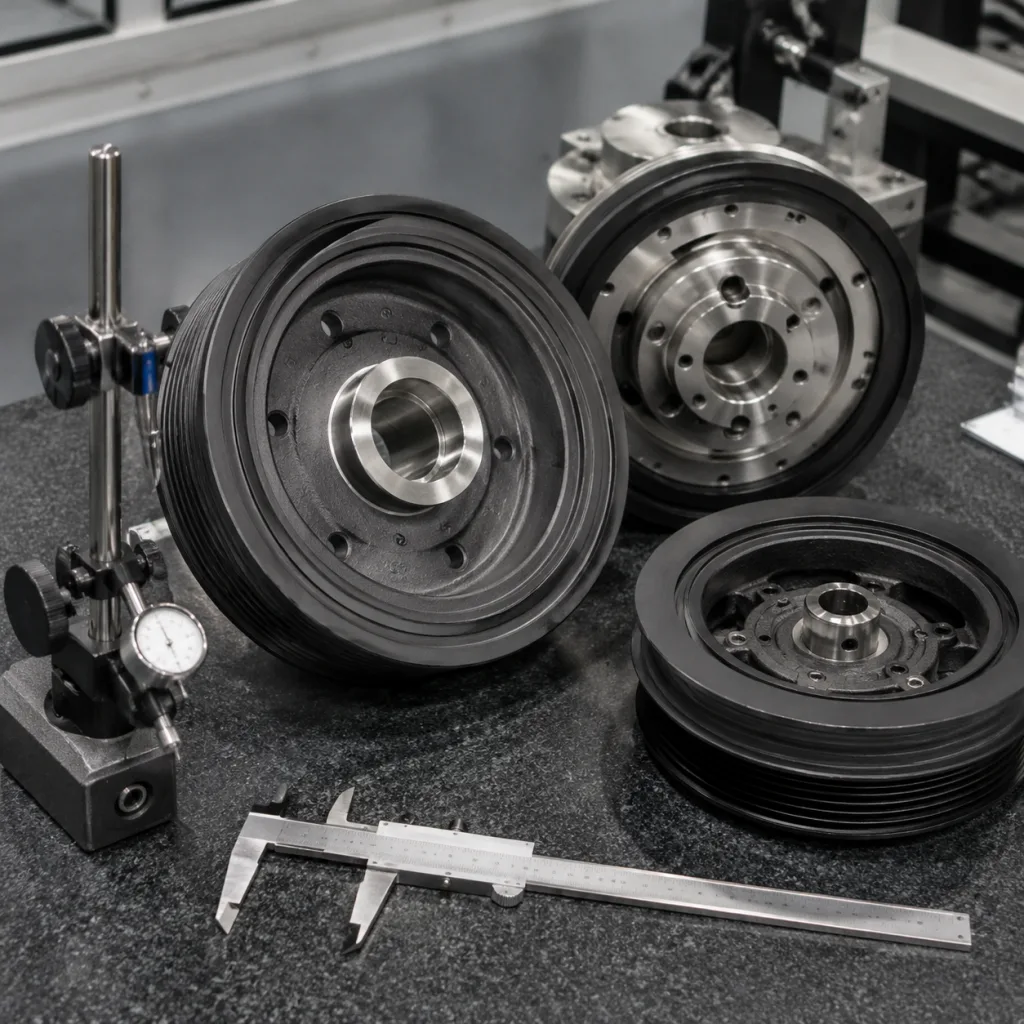
The supplier must also identify whether each item is a solid pulley, bonded rubber harmonic damper or multi-piece torsional vibration damper. These designs are not interchangeable. Substituting a solid pulley for a damped application may reduce the purchase price, but it can create NVH complaints, belt-drive wear and accessory-load issues. For crankshaft pulley Jeep wholesale orders, the matrix should also flag left-hand/right-hand drive differences, air-conditioning belt variants and alternator or power-steering layout changes where they affect groove position.

Audit the Failure Points Inside the Factory

Certification opens the door. It does not finish supplier qualification. Driventus operates under IATF 16949:2016 and ISO 9001:2015, with process controls covering incoming material inspection, machining, rubber bonding, dynamic balancing, final inspection and traceability. During onboarding, buyers should verify certificate scope, expiry date and issuing body.

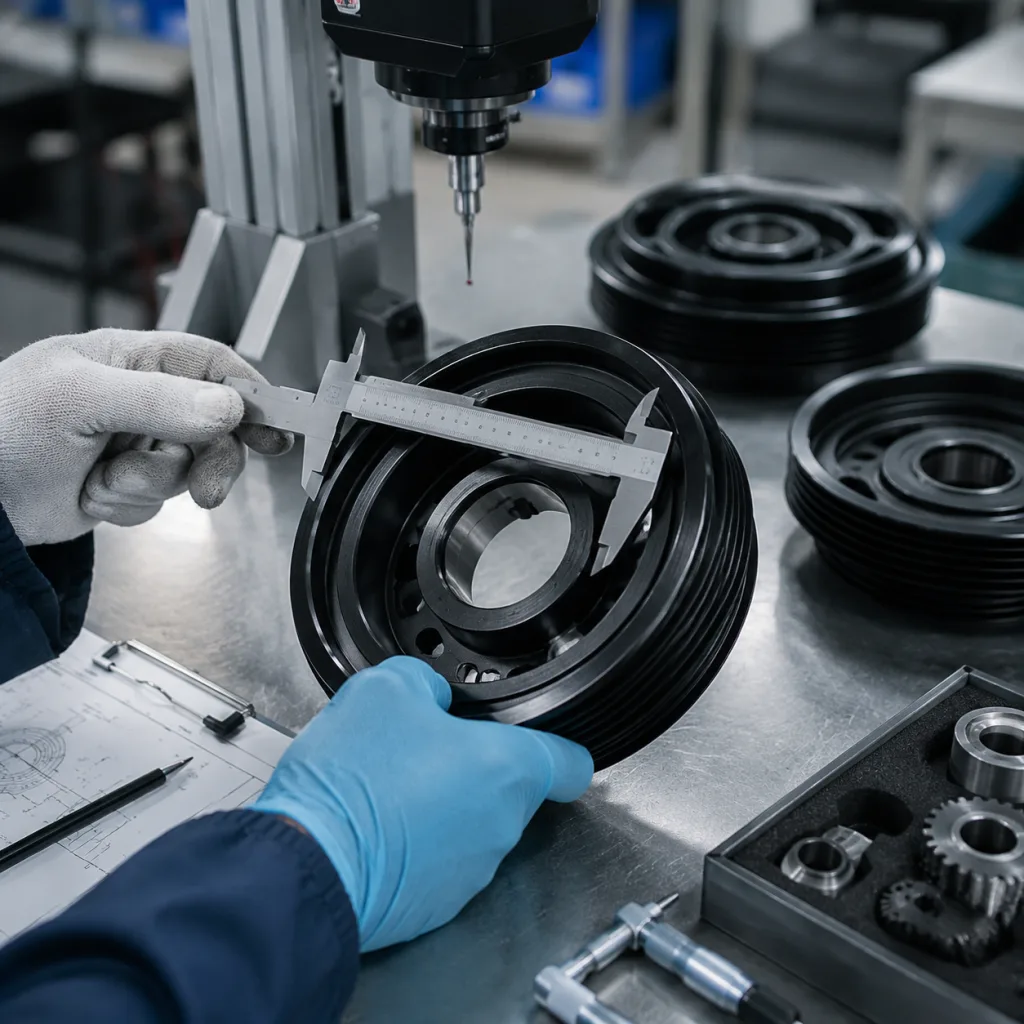
The audit should then move to the operations that cause real field failures: rubber compound control, metal surface preparation, adhesive handling, cure consistency, bore and groove machining, runout control and balance correction. A clean office and a polished presentation do not prove that pulleys will run true after thousands of cycles.

Ask to see the last three production lots for a similar pulley family. The records should connect incoming material, machining inspection, rubber cure data, balancing results and final AQL reports. If the records are scattered or cannot be tied to batch labels, traceability is weak.

</tr></thead><tbody> </tbody></table>A buyer-side checklist should include gauge calibration status, GR&R or repeatability evidence for critical gauges, nonconforming-material quarantine, adhesive shelf-life control and FIFO control for rubber compounds. For high-volume pulleys, request Cpk evidence on bore diameter, groove position and runout; after production stabilizes, a capable process should normally target Cpk ≥1.33 for agreed critical dimensions.

Driventus can support buyer audits with process flow charts, control plans, PPAP-style documentation where agreed, inspection records and batch-level traceability. The company’s quality system is structured for export customers that need repeatable documentation, not only pre-shipment photos.

Specify the Part Like an Engineer, Not a Buyer

A crankshaft pulley does not have an easy job. It sees torsional vibration, belt tension, temperature cycling, oil mist, road salt and water. For Jeep wholesale supply, the RFQ should define the characteristics that decide fitment, NVH performance and service life.

Key specifications to state include:

  • Pulley outside diameter tolerance based on drawing or sample reverse engineering, commonly ±0.20–0.50 mm depending on diameter and function
  • Hub bore and keyway dimensions with the gauge method stated; critical bores often require ±0.01–0.03 mm control when press-fit or closely located
  • Belt groove count, PK/V-rib profile, pitch, groove angle and effective belt-line position
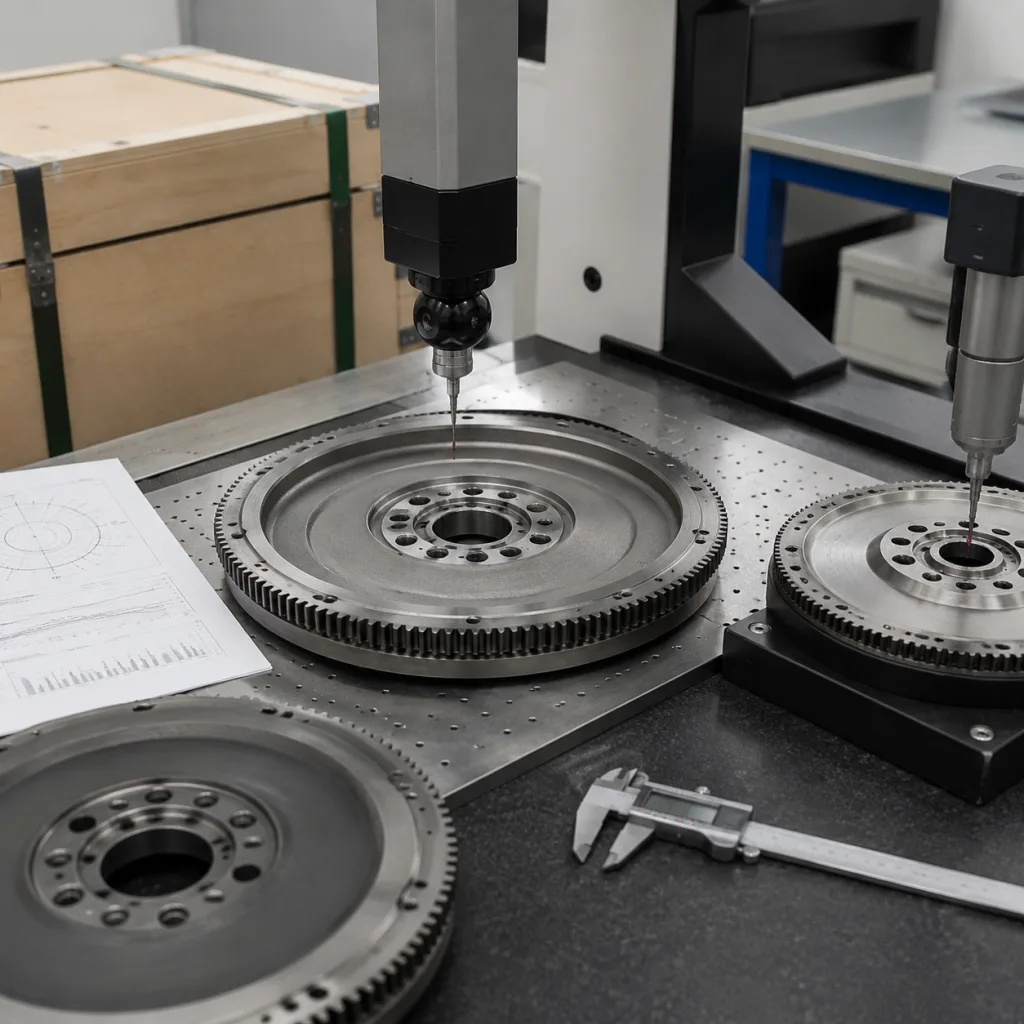
  • Axial runout and radial runout inspection points, with typical aftermarket targets of ≤0.15–0.30 mm unless the buyer drawing states otherwise
  • Rubber hardness range for damped pulleys, often specified as Shore A with an agreed tolerance such as ±5 points
  • Bond-strength validation method for rubber-to-metal joints, including peel, shear or destructive separation checks on representative samples
  • Dynamic balance acceptance criteria by pulley size and speed range, stated as residual unbalance in g·mm or grade equivalent rather than only “balanced”
  • Coating type, coating thickness, salt-spray target and packaging corrosion protection, such as zinc phosphate/e-coat or black paint with 96–240 h neutral salt spray depending on market need

International buyers should also define substance and environmental compliance early. For EU and UK programs, REACH (EC) No 1907/2006 declarations may be requested for materials and coatings. Regulated vehicle service channels may also require IMDS entry, material declarations or restricted-substance statements. These requirements affect coating choice, rubber additives and documentation workload, so they belong in the RFQ before sampling.

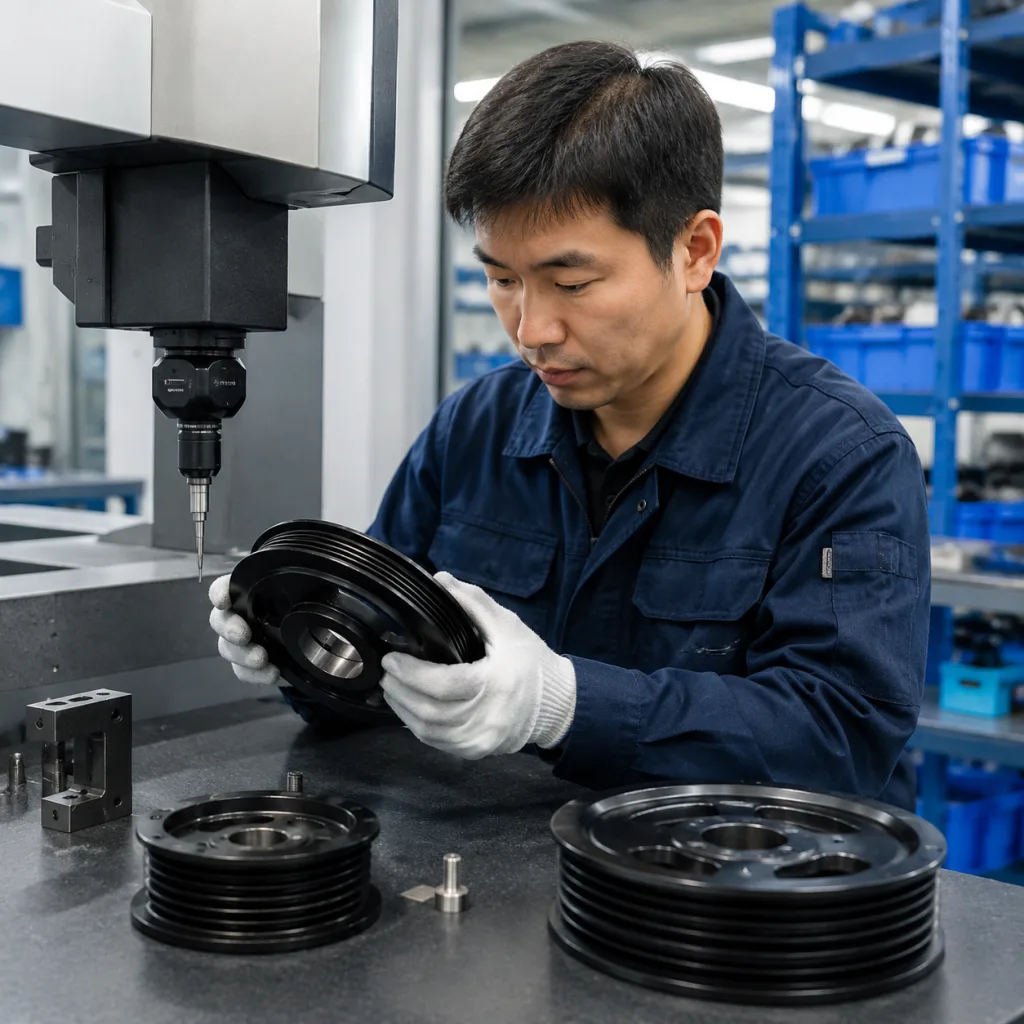
Dimensional approval should rely on a signed first-article report, not informal confirmation. The report should record at least OD, bore, bolt circle or keyway, pulley width, overall height, groove position, runout, hardness, coating thickness and balance result. For private-label programs, agree a golden sample or retained master sample for each high-volume SKU so production, incoming inspection and claim reviews use the same reference point.

Specify the Part Like an Engineer, Not a Buyer

Compare MOQ and Lead Time by Order Scenario

MOQ is not one number. It changes with tooling status, annual volume, pack format and order mix. Existing Driventus crankshaft pulley items can usually be quoted with lower MOQ than new-development items. New tooling requires drawing review, sample approval and trial production before mass shipment, so the launch schedule must include engineering time as well as commercial approval.

Audit item What to check Procurement relevance
Material traceabilitySteel grade, casting or forging batch, rubber compound lot and heat/lot numberSupports claim investigation and recall containment
Machining controlBore, keyway, groove profile, bolt circle, offset and face runoutReduces fitment and belt-alignment claims
Rubber bondingShot blasting or phosphating, adhesive batch, open time, cure temperature and cure timeControls damper-separation risk
Dynamic balanceBalancing speed, residual unbalance limit, correction method and acceptance recordLimits vibration and bearing load
Final inspectionAQL plan, gauge calibration, visual criteria and critical-dimension checksConfirms shipment consistency
Packaging validation1.0–1.2 m carton drop resistance, VCI or oil protection, label scan accuracyReduces logistics damage and mis-picks

</tr></thead><tbody> </tbody></table>Separate the timeline into sample lead time, production lead time and freight time. Existing-item samples may take 7–15 days when parts are available. New-development samples often require 30–45 days after drawing or sample confirmation. Standard mass production is commonly planned at 30–45 days after deposit and packaging approval, while private-label or mixed-SKU orders need extra time for artwork, barcode testing and carton printing. Ocean freight then adds roughly 25–45 days depending on destination port; air freight is usually reserved for samples, urgent warranty stock or launch shortages.

Do not approve a wholesale program on one good-looking sample. Build in time for sample measurement, bench fitting, packaging approval and pre-shipment inspection. A pilot lot of 50–100 pcs across representative SKUs gives better evidence of machining repeatability, label accuracy, carton strength and mixed-SKU packing discipline before a container-level purchase.

For mixed Jeep pulley orders, Driventus can consolidate crankshaft pulleys with related engine components such as gaskets, water pumps and timing parts where the buyer’s import model supports combined shipments. Consolidation can reduce freight cost per unit, but only if carton marking, SKU separation and packing-list control are strict. Buyers should specify max carton weight, pallet size, stacking limit, desiccant or VCI bag requirement and whether each pulley needs foam, divider board or individual polybag protection.

Use Validation Evidence to Block Warranty Surprises

Crankshaft pulley failures are rarely small events for the customer. They can cause belt misalignment, accessory-drive noise, charging problems, coolant pump under-speed or damage to nearby components. The sourcing decision should therefore include validation evidence that matches the part design and the buyer’s claim-risk tolerance.

For damped crankshaft pulleys, request evidence for rubber adhesion, torsional damping stability, runout, balance and thermal ageing where applicable. For solid pulleys, focus more heavily on dimensional accuracy, groove machining, hub interface control and corrosion resistance. The validation plan should state which checks happen on every lot, which happen per production shift and which type tests repeat only after material, tooling or process changes.

Useful validation records include:

  • First article inspection report with critical dimensions and actual measured values, not pass/fail only
  • Material certificate or incoming material verification record showing steel grade, heat number and rubber compound lot
  • Rubber hardness and bonding process record for damped designs, with cure temperature, time and adhesive batch where applicable
  • Dynamic balance report or production control data showing acceptance limit and measured residual unbalance
  • Coating thickness and salt-spray report where specified, including test duration and red-rust criteria
  • Batch traceability sheet linked to carton labels, pallet numbers and production date
  • Pre-shipment inspection report with AQL sampling plan, such as AQL 1.0 for critical defects and AQL 2.5 for major defects when agreed

For higher-risk launches, add bench fitment checks on mating crank noses or master gauges, belt-tracking verification with a reference belt, thermal cycling such as -30°C to 120°C where the design requires it, and ageing checks on rubber-damped assemblies. Define claim handling before shipment too. A useful claim file needs photos of the failed part, installation mileage, batch label, belt condition, vehicle application and installation notes so the supplier can separate product defects from misapplication or installation damage.

IATF 16949:2016 and ISO 9001:2015 do not define the exact pulley dimension. They do, however, set expectations for controlled processes, traceability, corrective action and continual improvement. Use them as part of supplier qualification while still defining part-specific engineering requirements in the purchase specification.

Driventus does not claim approval or endorsement by any vehicle manufacturer. Driventus is an independent aftermarket manufacturer; brand names are referenced for fitment only.

Use Validation Evidence to Block Warranty Surprises

RFQ Checklist: What to Send for a Fast Quote

A good RFQ answers the supplier’s first questions before they are asked. For crankshaft pulley Jeep wholesale projects, buyers should provide an existing part number list, physical samples, drawings or a fitment file with engine and year coverage. Photos help with identification, but they cannot reliably confirm groove profile, bore depth or damping construction.

Send the following in one package:

  • Target SKU list with buyer part numbers and any OE cross-reference supplied by the buyer
  • Annual forecast and first-order quantity by SKU, separated into trial order, 6-month forecast and 12-month forecast
  • Required market: EU, UK, US, Canada, Australia, Brazil or other destination
  • Target price logic, such as EXW/FOB comparison, landed-cost ceiling, currency, validity period and expected price break at 100/300/500/1,000 pcs
  • Packaging type, label template, barcode rules, carton dimensions and palletization requirement
  • Inspection requirements, including any third-party inspection agency, AQL level and required inspection photos or videos
  • Compliance documents required for customs or customer onboarding, including REACH, material declaration, certificate of origin or test report where needed
  • Target shipment date and preferred Incoterms, such as EXW, FOB Ningbo/Shanghai, CIF or DAP

If the buyer needs exclusivity, private labelling or a dedicated drawing-controlled item, state it before quotation. These terms affect tooling ownership, sample retention, artwork control and long-term pricing. For new items, the RFQ should also clarify whether the buyer owns the physical sample, 2D drawing, 3D model and inspection standard, and whether any no-sell or market-exclusivity period is requested.

A fast quotation normally needs three commercial inputs: expected first order, annual volume and target launch date. With those numbers, the supplier can separate one-time tooling cost from unit price, recommend a realistic MOQ and confirm whether neutral packaging or private-label packaging is the better first step. Procurement teams ready to compare cost, MOQ and development timing can request a quote with the application list, destination market and forecast.

Frequently asked questions

Send the SKU list, target annual volume, first-order quantity, destination market, packaging requirements and any available drawings, samples or buyer-approved OE cross-references. For faster pricing, include target Incoterms, expected price breaks, required validation documents and whether each item is existing catalog, sample-matched or new development.

Yes. Driventus can support neutral packaging, distributor branding and barcode labels. Private-label cartons and labels may have higher MOQ because printing, artwork approval, barcode testing and packing-line setup must be controlled by SKU.

No. Driventus is an independent aftermarket manufacturer; brand names are referenced for fitment only. Product qualification is based on buyer specifications, dimensional checks, process controls and agreed validation evidence.

For a sourcing review, send your Jeep pulley application list, forecast, target MOQ, packaging requirements and required inspection documents. Driventus can confirm price logic, lead time and documentation options through /contact.html

Request a Quote
Order scenario Common MOQ driver Planning consideration
Existing catalog pulleyBatch production and packaging setupOften 50–200 pcs/SKU when stock or regular production exists
Low-volume applicationMixed-SKU consolidationMay require grouped production windows or 20–50 pcs/SKU inside a larger order
New-development pulleyTooling, fixtures and validation samplesTooling and samples commonly need 30–60 days before mass order release
Private-label packCarton print, label and barcode setupMOQ may be higher than neutral pack, especially below 300–500 boxes/SKU
Repair-chain service kitSKU pairing and instruction sheet controlRequires pack accuracy checks and line-clearance records