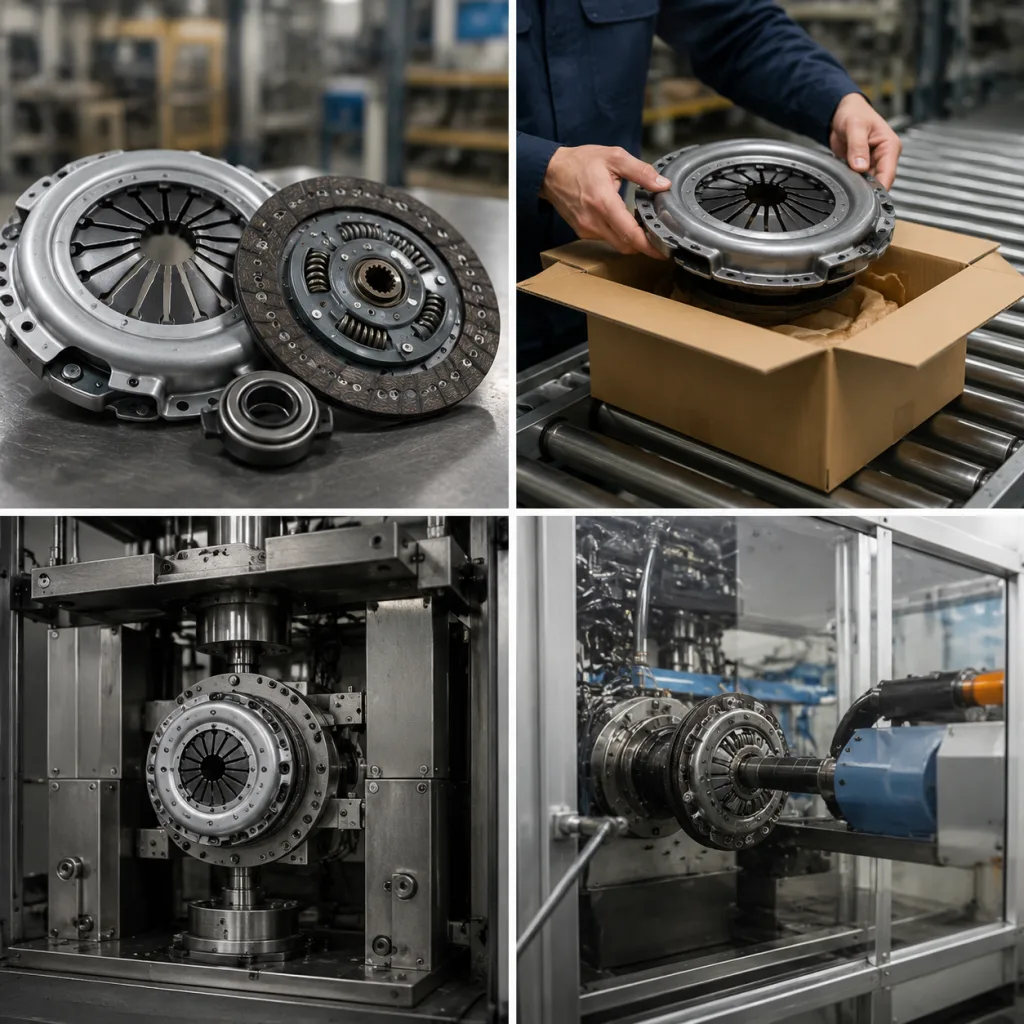
A clutch kit Dodge replacement programme can fail long before the part reaches a workshop. The usual weak points are not catalogue coverage alone; they are return rates, inconsistent release feel, spline mismatch, noisy bearings, weak packaging, and friction material that behaves differently from batch to batch.
For distributors, repair-chain buyers, and import managers, the right sourcing question is simple: will the kit install correctly, release cleanly, hold the required torque, survive export handling, and repeat that performance across every shipment? That answer depends on cover height, disc diameter, input shaft spline, release bearing interface, flywheel condition, and production controls.
This guide reframes Dodge replacement clutch sourcing as a commercial risk-control process. It covers dimensional matching, kit contents, validation, failure modes, MOQ logic, packaging, catalogue data, and documentation expected by professional buyers in the EU, UK, North America, Australia, and Brazil. Driventus is an independent aftermarket manufacturer; brand names are referenced for fitment only.
Decision framework: when a Dodge clutch kit is truly OE-equivalent
OE-equivalent should mean measurable interchangeability, not a similar-looking cover and disc. Before adding any clutch kit Dodge replacement SKU to a range, buyers should lock the application group, engine torque band, transmission input shaft, flywheel type, release mechanism, and installation constraints.
A useful approval file answers four questions:
Does the kit physically match the target vehicle application?
Does the cover deliver the required clamp load at the specified installed height?
Does the disc release cleanly without drag, judder, or hub interference?
Can the supplier repeat those results across production batches?
Part-number cross-references can help identify an application, but they should not be treated as evidence of vehicle manufacturer approval. If an OE-style reference is used in the sourcing file or catalogue, it should be clearly limited to fitment identification.
Critical OE-equivalent parameters should be fixed with target values and tolerances in the drawing or inspection file:
Disc outside diameter: commonly 215, 228, 240, 250, 280, or 300 mm, checked to ±0.30 mm unless the buyer drawing is tighter
Friction width and effective contact band: typically controlled to ±0.50 mm to prevent overhang or reduced swept area
Hub spline count, major diameter, minor diameter, and lead-in chamfer: verified with go/no-go gauges and mating shaft checks
Clutch cover bolt circle diameter and dowel positions: commonly held within ±0.20 mm on production fixtures
Diaphragm spring installed height: controlled against the approved setup height, often within ±0.30 mm
Clamp load at specified cover height: set by application torque requirement, with production acceptance often at target load ±8–10%
Release bearing internal diameter, face profile, and travel range: matched to fork or concentric slave cylinder geometry
Pilot bearing or bushing size where included: checked by bore, OD, width, and fit class
Disc lateral runout and facing parallelism: generally targeted at ≤0.50 mm after hub mounting for passenger and light commercial kits
For regional distributors, the risk is rarely one obvious mismatch. It is usually a kit that installs, then creates heavy pedal effort, low release margin, or variable engagement feel. Driventus supports application consolidation reviews through our catalog and technical drawing comparison where buyer samples or approved target specifications are available.
Spec deep-dive: contents, dimensions, and export packaging
A replacement kit is not one part. It is a controlled bill of materials. The standard set usually includes the clutch cover assembly, driven disc, and release bearing. Depending on the application, the kit may also need a pilot bearing, alignment tool, cover bolts, flywheel bolts, or concentric slave cylinder.
For B2B supply, every item should be fixed at part-number level. A change in bearing source, bolt grade, disc facing compound, grease specification, accessory pack, or carton structure should trigger a revision notice before shipment.
Checkpoint
Why it matters
Typical verification method
Disc diameter
Torque capacity and flywheel contact match
Caliper or CMM measurement against drawing, normally ±0.30 mm
Spline count and fit
Prevents installation failure and hub rattle
Go/no-go spline gauge and shaft trial fit; 100% check for first batch
Cover height
Controls clamp load and release position
Height gauge under defined fixture load, commonly ±0.30 mm
Clamp load
Affects torque transmission and pedal effort
Load-deflection test on clutch cover, target ±8–10% unless specified
Disc runout
Reduces judder and poor release
Dial indicator after hub mounting, usually ≤0.50 mm
Bearing travel
Prevents over-travel or incomplete disengagement
Bench travel and face contact check across specified stroke
Fastener grade
Maintains cover retention under thermal cycling
Material certificate, hardness check, and torque audit
Kit weight
Confirms correct BOM and packaging load
Gross and net weight check per carton and master carton
</tr></thead><tbody> </tbody></table>Packaging deserves the same discipline as dimensions. Clutch kits are heavy, have machined contact surfaces, and can be damaged by vibration, humidity, and poor stacking during ocean freight. The cover fingers must be protected. The disc must not move freely. Bearings and accessory packs need a fixed location inside the carton.
A practical export packaging specification should define carton board grade, inner divider material, VCI paper or bag requirement, desiccant use for high-humidity routes, drop-test height, carton compression strength, pallet pattern, label placement, and barcode rules.
Useful working benchmarks include 5-ply export cartons for kits above 10 kg, 3-ply cartons only for lighter passenger kits, maximum carton gross weight of 18–22 kg where manual handling rules apply, and pallet height below 1.1–1.2 m for safer container loading. For mixed-pallet orders, confirm carton size and stack plan before mass production. If scanning is required, approve EAN/UPC, buyer SKU, batch code, production date, and country-of-origin placement before pre-shipment inspection.
Validation sequence: prove fit, release, durability, then repeatability
Validation should not be a thick report created after a problem appears. It should be a staged sequence: approve the new SKU, check the pilot batch, control repeat orders, and revalidate when a material, supplier, tool, or process changes.
For Dodge replacement programmes, the target is stable engagement, adequate release reserve, predictable pedal effort, and no abnormal noise under normal service conditions. The test plan should separate engineering approval from routine shipment release.
Relevant validation items include:
Static clamp load test at specified installed height, recorded as a load-deflection curve rather than a single pass/fail value
Lift-off and release travel curve measurement, including release reserve at the bearing stroke limit
Driven disc burst speed test under controlled conditions, commonly specified at 1.8–2.0 times expected maximum engine speed for the application group
Torsional damper characteristic test for spring rate, hysteresis, idle-stage movement, and stop-pin contact
Facing shear strength and rivet pull-out inspection after thermal exposure where required
Balance check for cover and disc assembly where specified, with buyer-agreed residual imbalance limit
Thermal fade and recovery assessment on friction material, including coefficient trend before and after heat cycling
Salt spray or corrosion screening for exposed metal surfaces where the buyer requires it, often 48–96 hours for export packaging approval rather than performance certification
Bearing rotation noise and axial play check before kit packing, especially where the release bearing is sourced from a separate supplier
Published standards help with management systems and material compliance, even though clutch kits are not governed by one universal global performance standard. Driventus operates under IATF 16949:2016 and ISO 9001:2015 controls. For export programmes, buyers may also request material declarations aligned with REACH (EC) No 1907/2006. Importers should separately review regional packaging, labelling, and waste obligations.
The practical rule is this: full validation for new or changed SKUs, dimensional and functional audits for pilot batches, and sample-based final inspection for repeat orders. Buyers can review this control logic through the Driventus quality system.
Failure modes: where low-cost clutch programmes lose margin
Most clutch claims are blamed on installation, flywheel condition, hydraulic faults, or driver behaviour. Some are. But manufacturing variation still creates avoidable returns, and small deviations often combine into a workshop complaint.
Common margin-killing failure modes include:
Correct disc diameter but excessive hub-to-facing runout, causing drag or difficult gear engagement
Acceptable clamp load but incorrect diaphragm finger height, creating heavy pedal effort or limited release reserve
Correct bearing dimensions but poor grease fill, seal quality, or rotation noise control
Friction material with inconsistent density or coefficient range, causing judder, slip, or uneven bedding
Hub spline machining variation that passes a visual check but fails shaft fit or creates rattle
Cover flatness and bolt-hole position drift that complicates installation or distorts clamp behaviour
Anti-corrosion oil or coating transfer onto friction facings during storage or transport
Weak cartons that allow cover finger damage, bearing impact, or mixed accessory packs
A supplier audit should therefore go beyond certificates. Buyers should review friction facing batch traceability, diaphragm spring material and heat-treatment records, hardness range, cover stamping flatness, riveting force records, broaching tool wear monitoring, bearing grease specification, noise checks, and final BOM verification against label and barcode.
The commercial impact is direct. A low ex-works price can disappear if the defect rate rises by 0.5–1.0 percentage point, especially when labour reimbursement, return freight, branch-level disputes, and customer downtime are included. Repair chains need the same release feel across locations. Wholesalers need predictable technical support costs.
Driventus can support buyer-specific drawings, private-label packaging, and application range development through custom manufacturing, subject to technical review, minimum order quantity, and validation plan agreement.
Procurement workflow: from SKU target list to first shipment
A clutch kit Dodge replacement order moves faster when technical approval and commercial terms are handled together. Separating them creates delays: samples pass, then packaging is wrong; price is agreed, then the bearing type changes; the container is ready, then the label data fails inspection.
Use this workflow before placing the order:
1. Confirm target applications by model year range, engine, transmission, flywheel type, release system, and market region. 2. Review cross-reference logic and remove unsupported brand approval claims. 3. Request 2D drawings or critical-to-quality dimensions for the cover, disc, bearing, pilot bearing, and bolt pack. 4. Approve physical samples through installation trial or controlled bench comparison, normally 2–5 kits per priority SKU. 5. Check clamp load, release curve, spline fit, disc runout, bearing travel, and packaging drop-test reports. 6. Review IATF 16949:2016 and ISO 9001:2015 certificate scope and expiry. 7. Confirm REACH (EC) No 1907/2006 material declaration needs for the EU market. 8. Agree carton label, barcode, batch code, pallet specification, and spare label artwork before production. 9. Define AQL or final inspection criteria before shipment, such as AQL 1.0 for critical defects and AQL 2.5 for major visual or packaging defects. 10. Set claim handling rules, photo evidence requirements, labour-claim limits, and traceability process.
MOQ should reflect the production reality. Existing catalogue items may be set by carton, pallet, or batch economics. For mixed-SKU distributor orders, a workable starting point is often 50–100 kits per fast-moving SKU or 300–500 kits across a consolidated order, depending on model mix and packaging. New development items usually need a higher commitment because drawings, gauges, tooling, pilot runs, and validation must be amortised. If annual volume is uncertain, expect a sample charge or tooling contribution.
Compare prices on landed cost, not only ex-works unit price. Include kit contents, bearing type, accessory pack, carton strength, pallet utilisation, defect allowance, inspection cost, sea freight, duties, and return handling. A cheaper kit that omits bolts, downgrades the release bearing, or weakens the carton can cost more after claims and repacking.
Lead time depends on whether the SKU already exists. Existing tooling can often move from sample approval to production in about 30–45 days, plus freight time. New applications need drawing confirmation, tooling or fixture work, pilot production, and validation before commercial release; 60–90 days before first shipment is a realistic planning window, and longer if buyer-specific packaging, lab testing, or multiple regional fitment trials are required.
Scenario: preventing wrong orders across distributor and repair-chain channels
Picture a distributor launching Dodge clutch kits across North America, Australia, and Latin America. The part number looks similar across markets. The workshops assume interchangeability. Then returns start: one branch reports difficult release, another finds the pilot bearing missing, and another discovers the kit is unsuitable for a specific flywheel setup.
This is usually a data problem before it becomes a product problem. Clear fitment communication reduces incorrect orders and protects the technical support team.
Recommended distributor data fields include:
Vehicle make and model family for fitment only
Engine displacement, fuel type, power rating, and engine code where relevant
Transmission code or type when available, including manual gearbox family and input shaft spline count
Production date range, model year range, and market region because North American, EU, Australian, and Latin American catalogues can differ
Disc diameter, spline count, and hub profile
Kit contents list, including whether pilot bearing, bolts, alignment tool, or concentric slave cylinder is included
Interchange or OE-style reference field, if supported by the buyer’s data policy
Installation notes, including flywheel inspection, flywheel machining limit, hydraulic system checks, and recommended bedding-in advice
Country or region restrictions if applications differ by market
Supersession note when an old SKU is replaced by a consolidated kit
Treat the data handover as a product deliverable. Before launch, buyers should request a spreadsheet or ACES/PIES-compatible data export where applicable, carton label artwork, sample photos, and installation note text. For repair-chain programmes, add a technical bulletin covering flywheel scoring, oil contamination, hydraulic bleeding, release bearing alignment, and cover-bolt torque sequence. These points are frequent causes of false product claims.
Driventus is an independent aftermarket manufacturer; brand names are referenced for fitment only. Any catalogue reference to Dodge or related vehicle names should identify compatibility only, not imply vehicle manufacturer endorsement. For launch planning, buyers can share their target SKU list, annual demand forecast, expected MOQ, packaging format, and required lead time when they request a quote.
Frequently asked questions
Start with disc diameter, spline count, cover bolt pattern, release bearing type, and the exact engine-transmission application. Also inspect the flywheel, pilot bearing, and hydraulic release system, because those conditions often determine whether a correct replacement kit performs properly after installation.
Yes. Driventus can support private-label packaging, buyer-specific carton labels, barcode rules, and defined kit contents after technical and commercial review. New applications may require sample approval, drawing confirmation, MOQ agreement, and validation testing before mass production.
For supplier management, IATF 16949:2016 and ISO 9001:2015 are the main quality system references. Importers may also request material compliance documentation aligned with REACH (EC) No 1907/2006 depending on destination market requirements.
If you are building or reviewing a Dodge clutch kit replacement range, Driventus can compare samples, drawings, MOQ, packaging needs, target prices, lead-time expectations, and forecast volumes. Share your SKU list and sourcing requirements at /contact.html