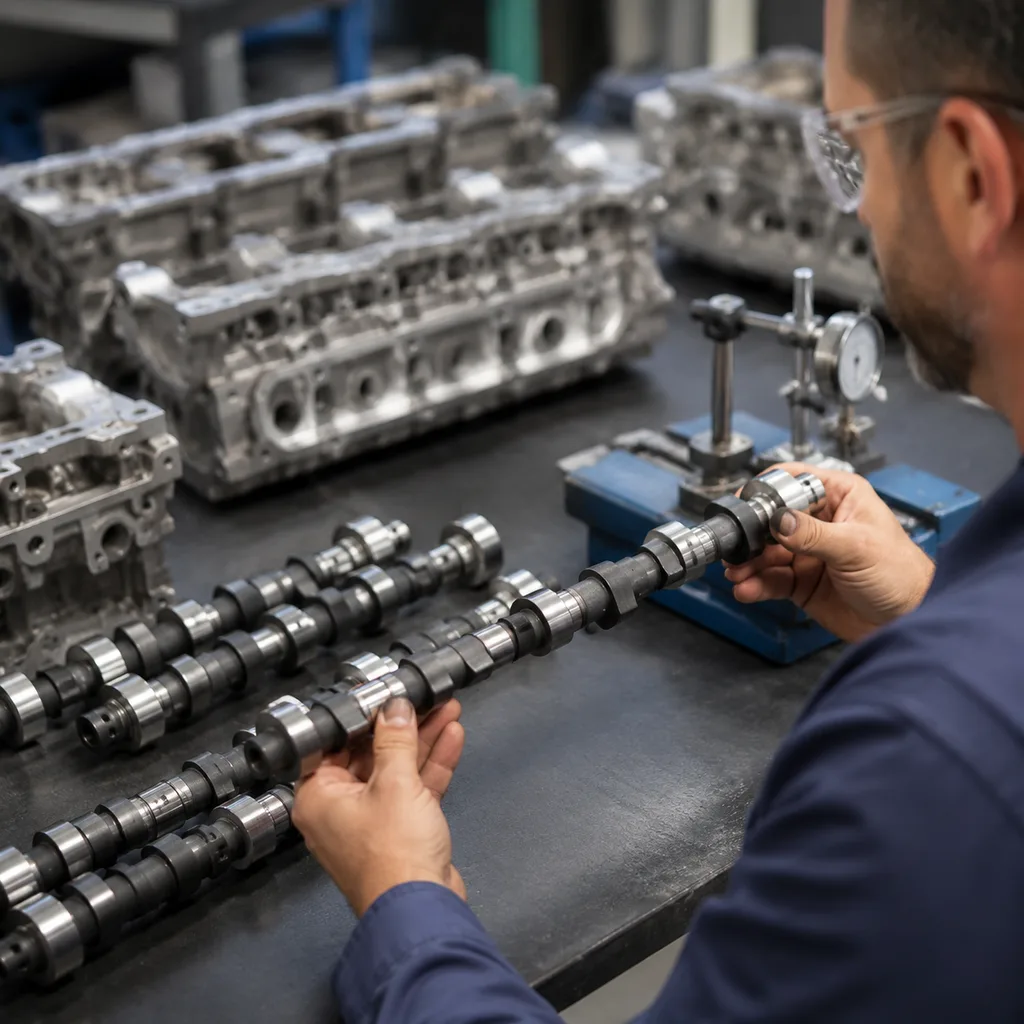
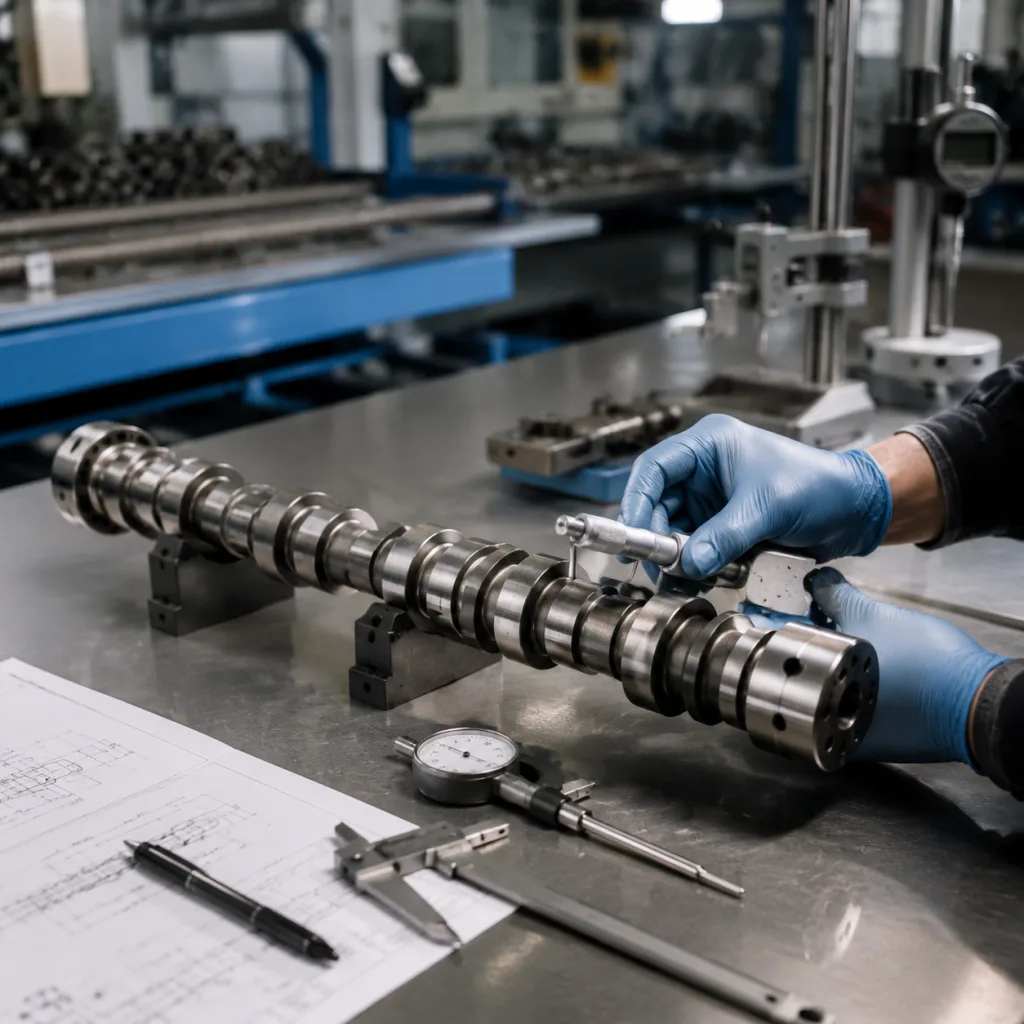
A camshaft GMC replacement program is not just a fitment check. For distributors, repair-chain buyers, engine rebuilders, and fleet parts teams, the part has to reproduce the original valve events while holding the right journal geometry, surface hardness, oil-control features, sensor indexing, and export packaging performance across multiple engine applications. Small deviations can trigger warranty exposure: low oil pressure at the journals, cam/crank correlation faults, unstable idle, valve-train noise, accelerated lobe wear, or premature lifter damage.
This guide helps procurement teams evaluate replacement camshafts for GMC applications without treating them like generic hardware. It focuses on the checks that matter: OE-equivalent dimensional control, material and heat-treatment requirements, validation testing, documentation, packaging, MOQ/price/lead-time logic, and supplier approval. It is written for B2B buyers comparing aftermarket supply options, not for retail installation advice. Driventus is an independent aftermarket manufacturer; vehicle and brand names are referenced for fitment identification only.
Where camshaft GMC replacement programs fail
Most sourcing problems start with assumptions. A buyer matches the vehicle badge, accepts a part number, and only later discovers the engine family, year range, sensor setup, or emissions package changed the cam profile or indexing.
That is why the first decision is not price. It is whether the supplier can prove the part matches the application in the ways that affect engine behavior. For a camshaft GMC replacement, the failure modes tend to be predictable:
The journal diameters are nominally correct, but oil clearance is wrong.
The reluctor wheel or trigger target is off by a small angle and causes a correlation fault.
The lift curve looks close on paper, but actual timing shifts idle quality and emissions behavior.
Heat treatment is inconsistent, so lobes polish too quickly or spall under load.
Packaging allows corrosion or impact damage before the part reaches the workshop.
If any of those issues appear after launch, the result is rarely isolated. It spreads into returns, claims, and distributor distrust. The better question is not, “Can this camshaft fit?” It is, “What evidence shows this camshaft will behave like the approved part across the whole supply run?”
Driventus supports range reviews through our catalog and engine-component application data at /products/engine-components.html. For larger programs, the best starting point is an application list that includes the target region, annual demand, OE-style references, and any known supersession history.
The specs that matter first
A camshaft is a timing component with rotating bearing surfaces and high-load sliding or rolling contact at the lobes. Procurement should focus on the dimensions that control valve event accuracy, oil-film stability, and sensor synchronization, not just whether the part installs in the head or block.
Check point
Why it matters
Typical control method
Journal diameter
Maintains oil clearance and oil pressure
Micrometer, air gauge, and roundness inspection
Journal runout
Reduces bearing load, vibration, and uneven oil film
V-block or between-centres runout test
Lobe lift and base circle
Controls valve lift, cylinder filling, and idle stability
Cam profile measuring equipment
Opening and closing angle
Confirms valve timing against the intended application
Lift-at-angle or profile trace measurement
Lobe taper and crown
Supports lifter rotation on flat-tappet designs
Profile and contact-pattern inspection
Thrust face width
Controls axial movement and timing-chain alignment
Caliper, CMM, and mating-part check
Reluctor position
Prevents cam/crank correlation faults and diagnostic trouble codes
Angular measurement fixture
Phaser or sprocket interface
Ensures correct timing adjustment and assembly clamping
Fixture check and mating-component trial
Oil passage alignment
Supports phaser function and lubrication flow
Plug gauge, borescope, and flow check
Surface roughness
Reduces break-in wear and bearing distress
Roughness tester after final finishing
</tr></thead><tbody> </tbody></table>If the supplier cannot show cam profile data, angular lift verification, or a controlled comparison to an approved sample, the buyer has limited evidence that the replacement part is equivalent beyond external appearance. That matters most on engines with cam phasers, variable valve timing, cylinder deactivation, or sensitive cam-position monitoring.
For production purchasing, define the measurement standard before you place the order. The RFQ should state drawing characteristics, tolerance limits, sample quantity, measuring equipment, and inspection frequency. Separate safety-critical and function-critical dimensions from visual checks so the supplier does not blur the difference.
A practical benchmark many buyers use is journal diameter control around ±0.01 mm, runout at 0.03 mm TIR or tighter, and lobe lift variation within ±0.02 mm versus the approved master. Final acceptance limits should still follow the drawing or approved sample, but explicit numbers prevent vague supplier claims. For cam-position features, request angular indexing tolerance in degrees rather than only a visual pass/fail note.
Material and heat-treatment decisions
Most replacement camshafts are produced from chilled cast iron, ductile iron, billet steel, or forged steel. The correct choice depends on the follower type, lubrication regime, and expected contact stress. A roller-follower camshaft has different surface needs from a flat-tappet camshaft, and a camshaft used with a phaser may also need tighter control of oil passages and torsional stability.
A procurement specification should include:
Material grade or agreed equivalent, supported by chemical analysis records
Casting, forging, or billet process route with traceability batch number
Lobe, journal, and thrust-face hardness range with test method stated
Case depth, induction-hardened zone, or chilled-layer requirement where applicable
Microstructure inspection for chilled-cast or heat-treated components
Surface roughness limits for journals, lobes, and thrust faces
Straightness and runout control after heat treatment and final grinding
Crack detection after heat treatment, machining, and finish grinding
Cleanliness requirement for oil holes, cross-drilled passages, and internal galleries
Rust-prevention method suitable for export storage and long-distance container shipment
The risk is not only wear. Inconsistent material or heat treatment can create valve-train noise, lifter spalling, metal debris in the lubrication system, bearing distress, unstable cam phaser operation, or repeat repairs that hurt distributor confidence. A sample that survives an installation trial is useful, but it does not prove serial production will stay stable.
Supplier review should therefore include metallurgical evidence, batch traceability, and process-control records. Driventus manages camshaft production within an IATF 16949:2016 and ISO 9001:2015 aligned quality system, with incoming material checks, in-process inspection, heat-treatment monitoring, and final audit controls for export programs. When you compare quotes, ask whether hardness testing, profiling, magnetic particle inspection, and anti-corrosion packing are included; those items change the real landed cost.
A simple rule helps here: compare like for like. A camshaft that is 5% cheaper but skips profile verification or corrosion protection can cost more after rework, claim handling, or warehouse damage. Ask suppliers to state whether the quote is based on 100-piece trial quantities, 500-piece repeat orders, or annual contract volume so you can normalize the price correctly.
How to validate a replacement camshaft
Validation should answer one question: does the part stay within spec under normal aftermarket service conditions, and can the supplier repeat that result in production? It does not need to duplicate OEM development work, but it should prove the part is stable.
Use a sequence that moves from geometry to function:
1. Verify the full dimension set against the drawing, an approved sample, or confirmed interchange data. 2. Measure the cam profile at defined angular increments. 3. Compare lift-at-angle data with the target application. 4. Test hardness at the lobes, journals, and thrust faces. 5. Check surface roughness after final grinding or polishing. 6. Inspect for cracks after heat treatment and finish machining. 7. Check runout and straightness after heat treatment. 8. Trial-fit with lifters, followers, sprockets, phasers, retainers, or thrust plates. 9. Confirm cam sensor target or reluctor indexing. 10. Verify oil passage cleanliness and flow. 11. Review packaging with a drop, vibration, or handling test for export cartons. 12. Assess corrosion protection with salt-spray or humidity exposure if needed.
Set acceptance criteria before the first sample shipment. Typical B2B expectations include first-article approval from one sample lot, three consecutive dimensional lots meeting spec, and no critical nonconformities during assembly trial. If the camshaft is part of a private-label launch, require golden samples and traceability records for each lot for at least the agreed warranty period.
For emissions-sensitive applications, replacement components should not alter timing or operating characteristics in a way that conflicts with the certified configuration. That is especially relevant when cam timing, overlap, or phaser control can affect idle emissions, catalyst warm-up, evaporative strategy, or onboard diagnostics. If your market requires it, include the relevant emissions references and material declarations in the validation file instead of treating them as separate paperwork later.
What buyers need beyond the drawing
Procurement teams usually need more than a technical drawing and a unit price. A replacement camshaft program depends on stable part numbering, application control, packaging rules, inspection documents, and a warranty process that can work for distributors, engine rebuilders, or multi-location repair chains.
Before approving a supplier, request:
Application list with engine codes, year ranges, market notes, and interchange references
Supersession policy for OE-style and aftermarket references
PPAP-style documentation where required by OEM, Tier-1, or professional-channel customers
First article inspection report for new SKUs
Control plan covering machining, heat treatment, grinding, cleaning, rust prevention, and final inspection
Batch traceability method from raw material to carton label
Inspection certificate or outgoing quality report format for each shipment
Export carton dimensions, pallet quantity, gross weight, and corrosion-protection period
Private-label packaging options, barcode format, and label data fields
Non-conformance, containment, and corrective-action procedure
Warranty claim review process, including evidence required from the field
Lead time, MOQ, forecast planning assumptions, and buffer-stock options
Commercially, most programs move through three order types: sample lots, pilot stock, and repeat production. MOQ depends on complexity and packaging. A simple single-cam part may be available at 30-50 units MOQ for a paid sample or pilot run, while a broader private-label program may need 100-200 units per SKU to justify label setup, carton printing, and scheduling. For repeat orders, pricing often improves at 300-500 units or more, with lower cost again at 1,000+ annual volume commitments.
Lead time should be staged too. A stock sample may ship in 7-15 days, pilot production in 20-35 days after approval, and normal repeat orders in 35-55 days depending on heat-treatment queue, grinding capacity, and carton availability. If a supplier promises faster delivery, ask whether the part is already made, whether the carton is generic or branded, and whether the lead time includes export booking and final inspection.
For distributors, packaging and label control are not minor details. A technically acceptable camshaft can still create operational cost if cartons do not survive container movement, labels are inconsistent, SKUs are mixed, or superseded references are not controlled in the warehouse system. Confirm barcode rules, carton strength, protective sleeves, corrosion inhibitor, and pallet configuration before the first production order. Also verify whether quoted pricing includes inner wrapping, end caps, VCI protection, palletization, and photo confirmation before shipment.
When replacement is the right route
Replacement sourcing works when the buyer needs OE-equivalent function and fitment, not a performance redesign. It fits engine rebuilders, aftermarket distributors, repair chains, fleet maintenance networks, and importers that want predictable installation outcomes across a defined vehicle population.
Use replacement rather than redesign when the requirement is simple: match the approved part, keep the same operating behavior, and maintain supply continuity. Do not accept silent deviations in cam timing, valve lift, sensor relationship, phaser interface, or oil-control features unless the change has been formally approved and documented.
For a camshaft GMC replacement project, the approval path is straightforward:
1. Define engine families, production years, regions, and annual demand. 2. Confirm engine codes, sensor configuration, fuel system, and emissions package. 3. Review interchange references and OE-style part numbers such as OE 126… only after fitment verification. 4. Compare drawings, approved samples, or reverse-engineered dimensional reports. 5. Approve material, hardness, surface finish, and heat-treatment specification. 6. Complete sample inspection, profile verification, and assembly trial with mating parts. 7. Confirm corrosion protection, packaging, labelling, MOQ, lead time, and forecast plan. 8. Place a controlled pilot order before full stocking. 9. Monitor early field feedback and close any application or packaging issues before range expansion.
This route reduces mismatch risk and gives import managers a documented basis for supplier approval. It also supports reordering when a product line expands across additional GMC applications or when a distributor adds related valve-train and engine-component SKUs. For pricing and replenishment, agree a reorder trigger point before launch, such as 6-8 weeks of cover for fast movers or 12 weeks for slower regional SKUs, so stock-outs do not force emergency buys at premium freight rates.
Frequently asked questions
Provide the engine family, model year range, target market, OE-style reference if available, sample photos, annual volume, and packaging requirements. Drawings, measured samples, or application data with engine codes improve quote accuracy. To sharpen the quote, include target MOQ, expected annual usage, required lead time, and whether the price must include private-label cartons, barcodes, or corrosion-protection packaging.
Yes, if the cam profile, journal geometry, heat treatment, oil passages, sensor features, and mating interfaces are controlled against approved application data. OE-equivalent means designed to match function and fitment; it does not mean vehicle manufacturer approval. Buyers should confirm tolerances, sample approval, and batch traceability before authorizing volume production.
Yes. Driventus can support private-label packaging, controlled labels, application files, documentation packages, and custom manufacturing for qualified B2B buyers, subject to MOQ and technical review. For planning purposes, private-label launches are typically quoted with a pilot MOQ, then a lower repeat-order price once artwork, carton spec, and application data are finalized.
If you are reviewing a camshaft replacement range for distribution, repair-chain supply, or an engine rebuild program, share your application list and volume forecast to [request a quote](/contact.html).