Connecting Rod Mitsubishi Wholesale Sourcing Guide
Connecting rod Mitsubishi wholesale sourcing is a batch-control decision, not a catalogue exercise. The part is small, but the risk is not: one wrong centre distance, cap mismatch, bolt issue or weight spread can turn a rebuild programme into claims, air freight and lost workshop trust. For distributors, importers, remanufacturers and Tier-1 sourcing teams, the right supplier is the one that can repeat bore geometry, centre-to-centre length, surface finish, material properties and fastener performance across orders—not only on a sample bench. Driventus manufactures engine and powertrain components in Taizhou, Zhejiang, exporting to 60+ countries with quality management aligned with IATF 16949:2016 and ISO 9001:2015. This guide uses decision checks, failure modes, specification points and RFQ steps to help buyers evaluate Mitsubishi-fit connecting rod supply. Driventus is an independent aftermarket manufacturer; brand names are referenced for fitment only.
Start With the Fitment Decision, Not the Vehicle List
Mitsubishi-fit connecting rods are usually purchased for aftermarket rebuild programmes, remanufacturing lines, regional distributor stock and private-label engine component ranges. The first decision is not “which vehicle models are covered?” It is “which engine families, dimensional variants and batch quantities can we control without creating dead stock or fitment risk?”
Build the range around engine data. A vehicle-level application list can hide mid-year engine changes, crankshaft variations, piston pin differences and market-specific engine codes. For a connecting rod mitsubishi wholesale programme, ask for an application matrix that separates engine code, displacement, fuel type, production year, piston pin diameter, bearing shell width and rod quantity per engine.
Lock these documents before approving a new supplier:
Application list with engine code, production year range and market region
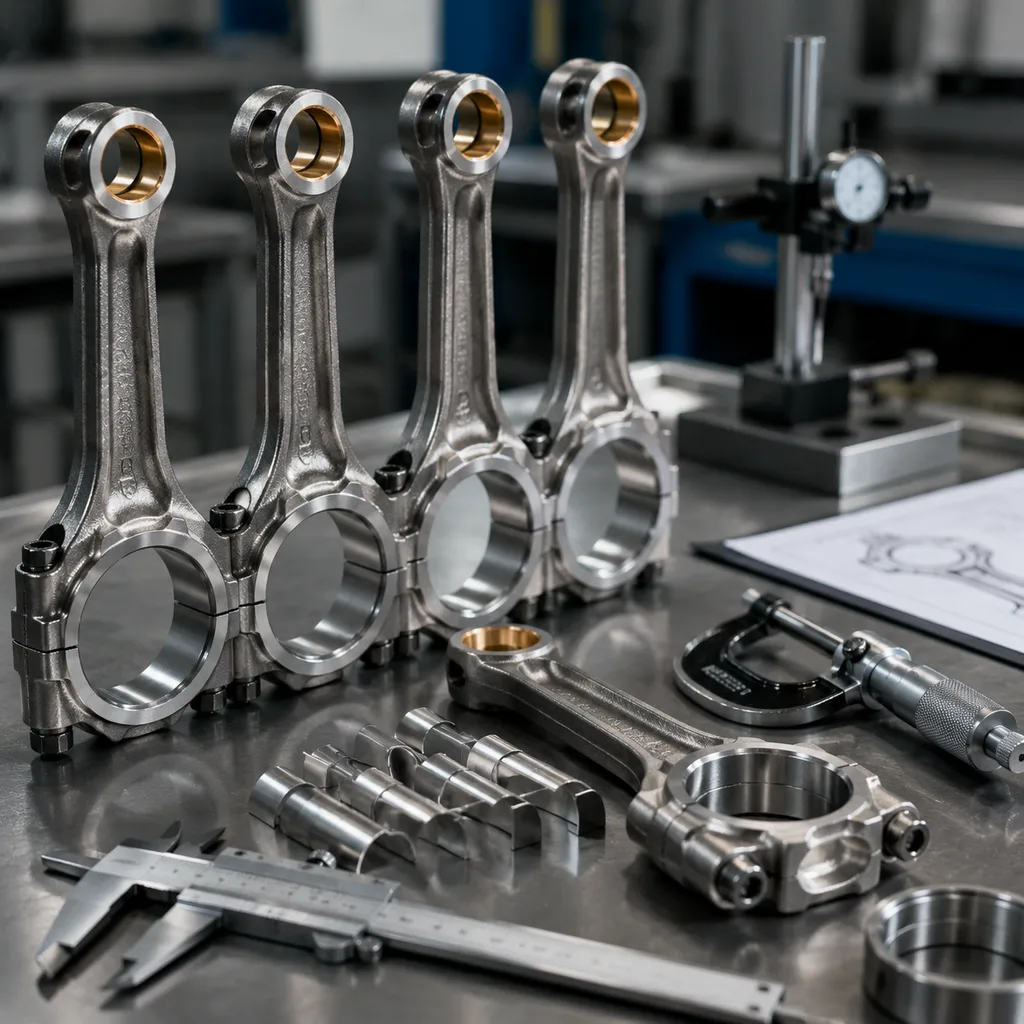
Dimensional drawing with tolerances for big-end bore, small-end bore and centre distance
Material declaration, heat-treatment process summary and hardness target
Batch inspection report template showing measuring tools and sampling plan
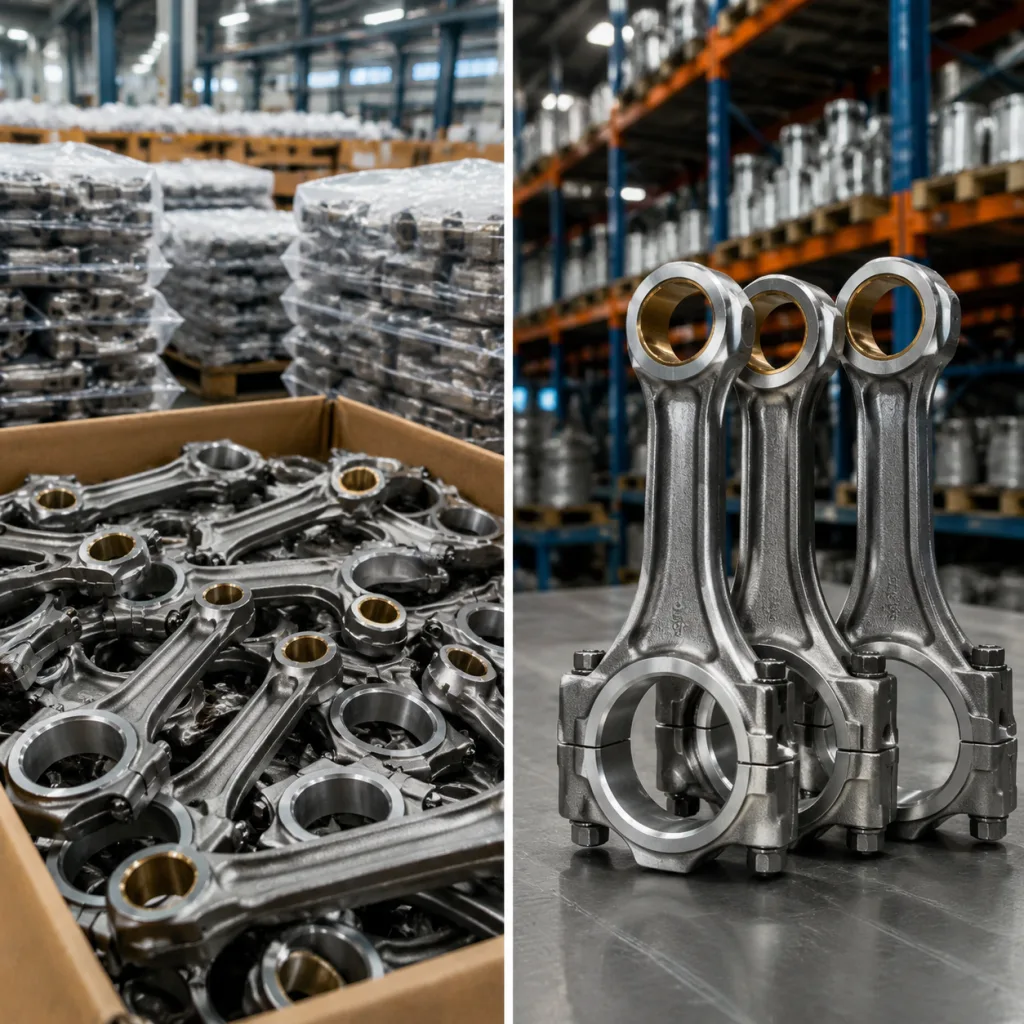
Packaging specification for sea freight, carton stacking and pallet handling
Use demand classes early. A-class SKUs can justify dedicated production lots. B-class SKUs may be consolidated into scheduled releases. C-class rods should be treated carefully; mixed-SKU consolidation with other engine components may prevent slow inventory from absorbing cash. A practical first order often combines sample approval, pilot quantity and a repeat-order forecast, allowing the supplier to reserve machining capacity and raw material without forcing every low-volume part number into a high standalone MOQ.
Spec Deep-Dive: Dimensions That Decide Whether the Rod Survives
A connecting rod is loaded in alternating tension and compression. It also has little tolerance for vague RFQ language. “Standard size” is not enough. The RFQ should state the inspection method, torque condition and acceptance criteria for each critical dimension. If the buyer has no final drawing, ask the supplier to quote against a controlled sample report and mark which dimensions need customer confirmation before tooling or mass production.
Procurement item
What to specify
Practical acceptance point
Centre-to-centre length
Drawing nominal plus tolerance
Common target ±0.03 mm; tighter programmes may request ±0.015 mm
Big-end bore roundness
Measured after cap assembly and bolt torque
Typically within 0.005–0.010 mm, depending on bearing design
Small-end bore
Pin clearance and bush material if applicable
Confirm honed size after bushing press-fit, not before installation
Side width
Rod-to-crank side clearance
Control width variation within the set to avoid oil-control issues
Weight class
Total and reciprocating-end weight range
Typical rebuild sets require rods grouped within 2–5 g per set
Bolt grade and torque method
Torque, angle or stretch method if specified
Record torque value, lubricant condition and bolt batch
Surface finish
Bore Ra and parting face condition
Big-end and small-end bore Ra often specified around 0.4–0.8 μm
</tr></thead><tbody> </tbody></table>Driventus can manufacture forged or machined connecting rods depending on programme volume, engine duty and price target. Material selection should be supported by chemical composition checks, hardness results and heat-treatment records. State whether the rod is forged steel, powder-metal style, billet-machined or cast/forged to an aftermarket design, because that choice affects tooling cost, fatigue margin, machining allowance and MOQ.
Small details deserve direct wording. If the part uses a bronze small-end bushing, specify bushing alloy, press-fit control, oil-hole alignment and post-installation bore size. For cap-split designs, confirm whether fracture-split, machined-split or serrated cap location is used. Require cap-and-rod pairing marks that remain readable after cleaning. For rod bolts, specify grade/class, thread size, under-head radius, washer face condition and whether bolts are single-use for installation.
When the inquiry includes an OE part-number cross-reference, use it as a fitment reference only, for example OE 06A… or OE 11251… if already provided in the buyer’s source data. Do not treat any cross-reference as approval by the vehicle manufacturer.
Commercial Planning: MOQ, Lead Time and the Cost of Slow Movers
The commercial structure should match how the rods will actually move. A distributor building regional coverage may need mixed SKUs in one shipment. A remanufacturer may buy fewer SKUs, but it needs stricter batch consistency because rods are installed in sets and weight variation can affect rebuild quality.
Confirm these variables before comparing prices:
MOQ per part number and MOQ per shipment, for example 100–300 sets for existing common SKUs and higher quantities for new development
Whether one engine set is packed as four, six or application-specific quantity
Sample lead time for dimensional approval, commonly 15–30 days if blanks and fixtures exist
Mass production lead time after deposit and artwork approval, commonly 35–60 days for repeat items and 60–90 days for new tooling or fixture work
Availability of neutral, Driventus or private-label packaging
Carton strength, anti-corrosion oil or VCI packaging, desiccant use and pallet height
Incoterms, export carton marks, HS code support and documentation language
Lead time is not a single number. It is shaped by tooling status, raw material availability, machining capacity, heat-treatment scheduling and packaging requirements. Existing designs usually move faster than new drawings that require fixture development or first-article validation. Separate first-article approval lead time from repeat-order lead time; the first order includes drawing confirmation, sample measurement, packaging validation and sometimes customer-side fitment checks.
Price should be compared by landed cost and risk, not by unit price alone. A useful RFQ table separates rod unit price, bolt cost if quoted separately, bushing cost, packaging cost, inspection/report cost, inland freight, export handling and sea freight basis. For mixed containers, ask whether the supplier prices by set, piece, carton or SKU lot. Otherwise, a low price on a high-volume four-cylinder rod can hide expensive slow-moving diesel SKUs.
Forecast sharing improves price and delivery stability. A 6- to 12-month rolling forecast helps plan forging blanks, machining slots, inspection resources and export consolidation. For importers, it also reduces urgent air freight caused by fragmented purchase orders or late SKU additions. A workable release plan is to hold 8–12 weeks of demand in confirmed purchase orders and another 3–6 months as non-binding forecast, then review slow movers quarterly before adding more Mitsubishi-fit applications.
Failure Modes to Audit Before You Approve the Factory
A credible connecting rod supplier should show process control, not only clean samples. Driventus operates under IATF 16949:2016 and ISO 9001:2015 principles, with documented control plans, incoming inspection, in-process checks and final release records. Buyers can review the quality system before supplier approval.
Focus the audit on the failures that create claims:
Wrong material lot or missing heat-number traceability
Heat-treatment drift causing hardness outside the approved range
Big-end bore distortion after cap assembly or bolt torque
Cap-and-rod mix-ups during machining, cleaning, inspection or packing
Rod bolt torque variation caused by lubricant, thread or washer-face inconsistency
Weight spread inside an engine set beyond the buyer’s rebuild tolerance
Weak corrosion protection leading to rust during sea freight or warehouse storage
Final cartons that cannot be linked to production batch records
Audit questions for procurement teams
Ask how non-conforming rods are segregated, how measuring equipment is calibrated, and how cap-and-rod pairing is protected through every operation. Connecting rod caps are not interchangeable after machining. The process must prevent mix-ups through physical control, marking or matched-set handling.
Request one completed production traveller from raw material receipt to final carton label. It should show material lot, heat-treatment batch, machining operation checks, bore measurement results, rod bolt installation record, final inspection approval and packing quantity. For higher-risk programmes, request retained samples or PPAP-style documents such as process flow, control plan, FMEA summary, dimensional report, material certificate and initial sample inspection report.
Compliance documentation may also be required for import markets. Depending on buyer location and material declarations, requests may include REACH (EC) No 1907/2006 screening, conflict minerals statements or packaging material declarations. These documents do not prove performance, but they support customs clearance, customer onboarding and retailer compliance files.
Comparison Matrix: Low Unit Price vs. Controlled Supply
Supplier comparison only works when each offer quotes the same specification, inspection level, packaging standard and logistics terms. A low unit price can be erased by poor carton strength, mixed cap sets, inconsistent weight classes, weak corrosion protection or missing technical records.
Supplier factor
Lower-risk sourcing position
Higher-risk sourcing position
Certification
IATF 16949:2016 and ISO 9001:2015 quality management with relevant scope
No current certificate or unclear scope
Drawing control
Controlled drawing revision, tolerance list and change approval
Catalogue photo only
Batch records
Material, hardness, torque and dimensional records available
Final visual check only
MOQ policy
Mixed-SKU options and set-based packing for wholesale orders
High MOQ per SKU with no consolidation
Packaging
VCI or oil protection, export cartons and pallet plan
Loose packing or weak cartons
Traceability
Lot code on carton and retained records for each production batch
No link between shipment and production batch
Engineering support
Drawing review, sample report and first-article approval
Sales-only communication
</tr></thead><tbody> </tbody></table>For OEM, Tier-1 or repair-chain buyers, supplier approval should include sample measurement, packaging drop or handling review where relevant, and a clear corrective-action process. Compare how each supplier handles revision changes, engineering questions and repeat-order deviations. A supplier that explains why a tolerance, material or MOQ is required is usually safer than one that accepts every target without engineering review.
Use a weighted comparison instead of a lowest-price table. For example, assign 30% to technical match, 25% to quality records and traceability, 20% to price and payment terms, 15% to lead time and capacity, and 10% to packaging/export support. This prevents a small unit-price saving from outweighing the cost of rejected rebuild sets, bearing failures, repacking labour or delayed shipment.
Driventus supports wholesale supply, private-label programmes and technical development for Mitsubishi-fit applications without claiming vehicle manufacturer approval or endorsement.
RFQ Sequence: From Application Data to First Purchase Order
A complete RFQ reduces rework. It also prevents suppliers from quoting the wrong rod against an incomplete model description. For connecting rod mitsubishi wholesale projects, give enough fitment, technical and commercial detail for feasibility to be checked before price negotiation starts.
Send the RFQ in this order:
1. Target engine family or application list with engine code, displacement and year range 2. Existing sample photos if available, including cap, bolt, oil hole and bushing details 3. Drawing or key dimensions if available, including bore, width, length and weight targets 4. Required quantity by SKU, order frequency and annual forecast 5. Required sample quantity, approval deadline and sample freight arrangement 6. Packaging type: neutral, buyer brand or Driventus brand, with carton size limits if any 7. Destination port or delivery term, such as EXW, FOB Ningbo/Shanghai, CIF or DDP discussion basis 8. Required certificates, inspection reports and compliance declarations 9. Target launch date, repeat-order schedule and safety-stock expectation
Driventus can review supplied samples, drawings or application lists and advise whether an existing design, modified design or new development route is appropriate. For high-volume programmes, the review can include a cost breakdown by material, machining, heat treatment, inspection and packaging so procurement teams can compare offers on a like-for-like basis.
Define what happens after sample approval. Include target first PO quantity, accepted dimensional report format, label artwork deadline, inspection frequency for repeat orders and preferred claim-handling process. If the buyer needs private-label supply, artwork should be approved before mass production cartons are ordered; otherwise rods may be ready while packaging is still waiting for confirmation.
To start, send fitment data, estimated annual volume and destination market through request a quote.
Frequently asked questions
MOQ depends on the part number, tooling status, packaging and shipment mix. Existing common items are often planned around 100–300 sets per SKU or consolidated mixed-SKU shipments, while new development may require a higher launch quantity to cover fixtures, sampling and inspection setup.
Yes. Driventus can support neutral packaging, Driventus packaging or buyer-specified private-label cartons, subject to artwork approval, carton testing needs and minimum order quantities. Technical markings, lot codes and application labels must remain accurate for traceability.
No. Driventus is an independent aftermarket manufacturer; brand names are referenced for fitment only. Any OE-style number or vehicle name is used only to identify application compatibility and does not imply vehicle manufacturer approval.
If you are comparing suppliers for Mitsubishi-fit connecting rods, send your application list, target volume, drawing or sample data, and packaging requirements. Driventus can review the programme and provide a practical sourcing proposal at /contact.html