Connecting Rod Jeep OEM Supplier Sourcing Guide
A Jeep-fit connecting rod order can fail long before the container ships. The usual cause is not one wrong dimension; it is a loose sourcing file. Material route, heat treatment, bore geometry, bolt control, weight matching, corrosion protection, labels, and batch records all need to line up before a purchase order is released. This guide is for aftermarket distributors, OEM programme buyers, Tier-1 sourcing teams, and repair-chain category managers evaluating a connecting rod Jeep OEM supplier in China. Driventus manufactures engine and powertrain components in Taizhou, Zhejiang, and exports to more than 60 countries. Our range includes connecting rods, pistons, crankshafts, gaskets, water pumps, and turbochargers for aftermarket and private-label programmes. Driventus is an independent aftermarket manufacturer; brand names are referenced for fitment only. Use this guide to tighten RFQs, audits, validation plans, quote comparisons, and import documentation.
Start With the Rod’s Job, Not the Price
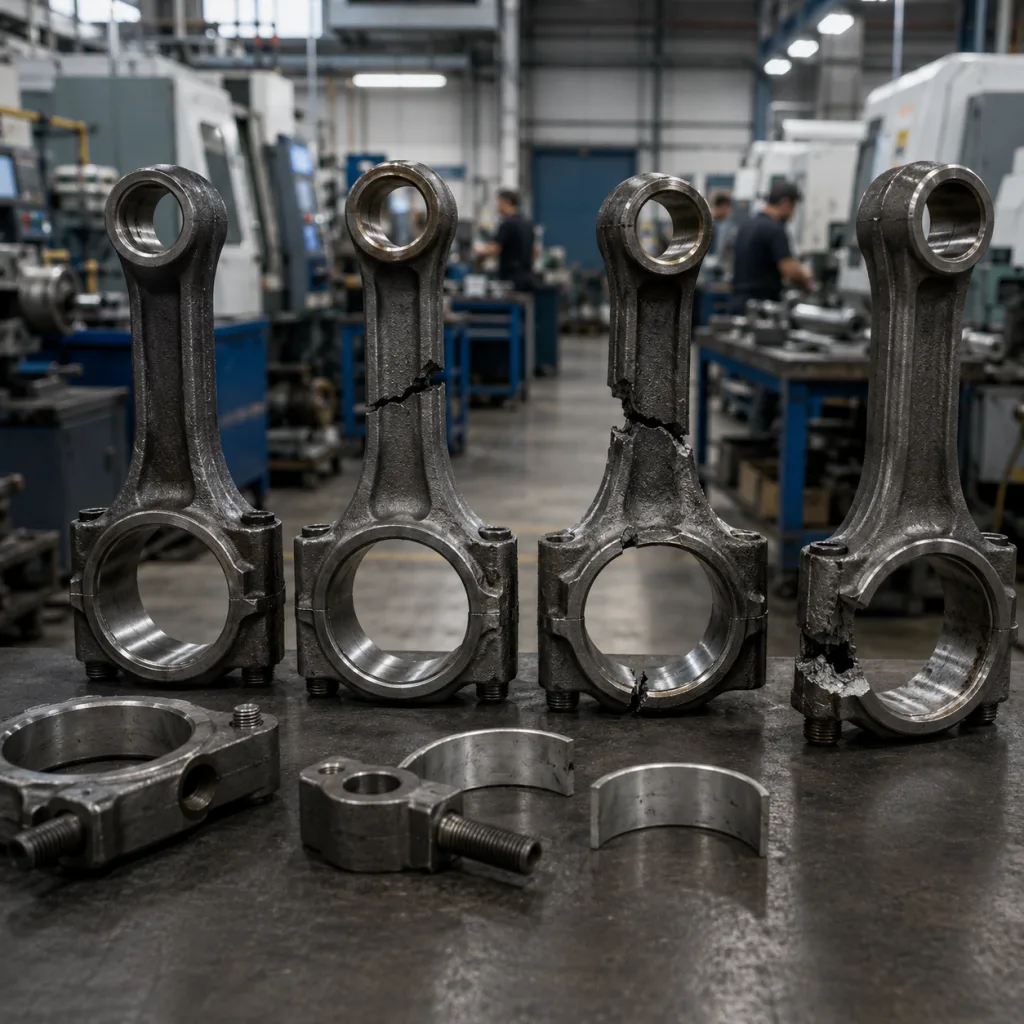
A connecting rod survives repeated tensile and compressive loads that can exceed several tonnes per firing cycle in high-load petrol or diesel engines. If metallurgy, heat treatment, bore geometry, or bolt clamp is weak, the symptoms are expensive: bearing distress, small-end noise, fatigue cracking, lost clamp load, or complete rod failure.
So the first sourcing question is not “Who is cheapest?” It is “Who can control the chain from steel to packed carton?” A credible supplier should explain steel sourcing, forging or powder-metal forming, heat treatment, rough machining, finish boring, honing, bolt assembly, final inspection, and packing release without hiding behind broad claims.
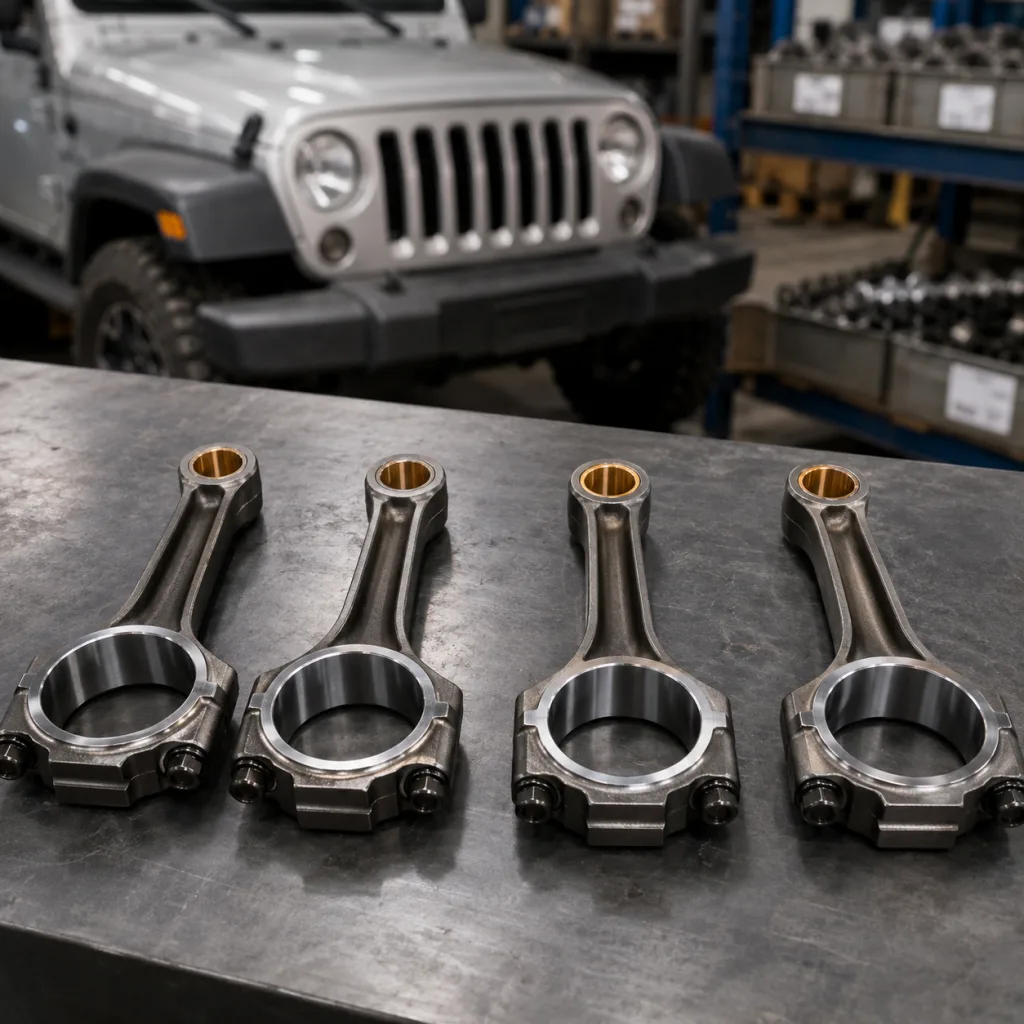
For Jeep-fit applications, define the rod by the engine family, displacement, bore and stroke package, centre-to-centre length, big-end bore, small-end bore or bush size, bearing width, total rod weight, big-end/small-end balance, and bolt specification. The RFQ should also state model-year range, fuel type, quantity per engine set, target service level, and whether the programme is standard replacement, remanufacturing, or performance-oriented rebuilding. If an OE part-number cross-reference appears in the enquiry, it should be buyer-supplied and used only for fitment identification, not as a claim of vehicle-maker approval.
Procurement teams should lock these items before comparing offers:
- Forming route: forged steel, powdered metal, or cast, matched to duty cycle, warranty exposure, and retail positioning.
- Material evidence: chemical composition, heat number, mill certificate, hardness range, tensile-strength data where available, and batch-level mechanical records.
- Critical geometry: centre distance, big-end bore diameter, bore roundness, bore cylindricity, side-face width, surface finish, pin-bush geometry, and bolt torque or torque-angle specification.
- Set control: individual rods, 4/6/8 engine sets, weight grouping, or fully weight-matched sets within an agreed gram window.
- Export protection: rust inhibitor, VCI bagging, separators, carton compression strength, drop resistance, pallet pattern, desiccant, and warehouse label format.
- Channel packaging: neutral cartons, distributor branding, private-label cartons, GS1/EAN/UPC barcodes, QR lot codes, and mixed-SKU pallet labels.
Driventus supports sourcing teams through our catalog, including engine-component programmes listed under engine components.
Audit the Process Trail Before You Approve Samples
A sample can look correct and still come from an unstable process. That is why a serious connecting rod Jeep OEM supplier should be ready for a technical audit before sample approval or mass production. Certification is not proof that every rod is good, but it shows whether the factory has a structure for traceability, corrective action, calibration, document control, operator training, nonconforming-material control, and engineering-change management. Driventus operates under IATF 16949:2016 and ISO 9001:2015 management systems. Buyers can review our quality system when assessing supplier approval requirements.
The audit should follow the part family, not a generic factory slideshow. Ask for records from incoming steel through cutting, heating, forging or forming, shot blasting, heat treatment, rough machining, cap separation or machining, bolt installation, finish boring/honing, washing, inspection, oiling, packing, and shipment release. For a new or high-risk programme, request a process flow diagram, PFMEA, control plan, work instructions, inspection frequency, reaction plan, and last-three-batch quality history.
| Audit area | Evidence to request | Procurement relevance |
|---|---|---|
| Material control | Mill certificate, steel grade, heat number, batch ID, incoming inspection record | Confirms steel chemistry, traceability, and batch segregation |
| Forming process | Forging temperature window, die maintenance record, flash-trim check, shot-blast record | Reduces laps, underfill, scale inclusion, and geometry drift |
| Heat treatment | Furnace chart, load map, hardness record, quench and temper parameters | Reduces fatigue, distortion, decarb, and hardness variation risk |
| Machining | Control plan, fixture maintenance log, tool-change record, first-piece approval | Supports bore, side-face, and centre-distance consistency |
| Measurement | CMM report, air gauge record, calibrated micrometer list, master setting ring, gauge R&R where required | Verifies dimensional capability and measurement reliability |
| Fasteners | Bolt material record, thread inspection, torque-angle or stretch procedure, lubricant condition | Critical for big-end clamp load and cap security |
| Cleaning | Wash process, residual-chip check, oil-hole verification, cleanliness standard if specified | Prevents bearing damage from chips, abrasive residue, or blocked oil passages |
| Packing | Rust-prevention method, carton specification, pallet plan, label approval | Reduces corrosion, warehouse errors, and shipping damage |
| Programme type | Typical buyer objective | MOQ and lead-time logic |
|---|---|---|
| Existing aftermarket SKU | Add coverage to distributor range | Lowest development time; check stock, batch timing, and whether 50–100 set pilot orders are available |
| Private-label programme | Sell under buyer brand | MOQ depends on printed carton run, label format, barcode rules, and artwork approval; 300–500 sets per SKU is a common planning range |
| Drawing-based development | Match buyer technical file | Requires drawing review, sample build, gauge confirmation, validation plan, and approved revision control before mass production |
| Multi-SKU consolidation | Reduce supplier count | Requires forecast by engine family, shipment schedule, mixed-pallet rules, and packaging standardisation to avoid fragmented small batches |