Connecting Rod for Jeep Cherokee Replacement Sourcing
A connecting rod for Jeep Cherokee replacement program is not won by matching a catalogue line and chasing the lowest quote. The rod has to carry the original engine geometry, bearing interface, mass balance, bolt clamp load, and fatigue margin without creating new rebuild risk. Small misses matter: centre distance can shift piston deck height, big-end roundness can disturb the oil film, cap movement can destroy bearing crush, and poor bolt control can turn an otherwise correct-looking part into a warranty problem. This guide gives B2B buyers a sharper sourcing route for aftermarket Jeep Cherokee replacement demand. It covers how to confirm fitment, where failures usually start, what to specify in metallurgy and machining, how to validate samples, how to inspect incoming lots, and how to compare suppliers without relying on generic application claims. Driventus is an independent aftermarket manufacturer; brand names are referenced for fitment only.
Start With Fitment Risk, Not the Catalogue Match
A catalogue application is only the starting point for a connecting rod for Jeep Cherokee replacement program. Cherokee service demand can span different years, engine families, rebuild habits, and inventory mixes. Treat the application table as a lead, then verify the engine code, bore and stroke configuration, piston pin diameter, bearing shell width, crankpin journal diameter, compression height, and rod orientation.
The decision rule is simple: if the order supports a warranty-sensitive repair program, a new market launch, or mixed-engine inventory, do not release bulk production on an application claim alone.
Ask the supplier to quote against measurable fitment data:
Centre-to-centre length between big-end and small-end bores, commonly controlled within ±0.025–0.050 mm unless the drawing specifies tighter limits
Big-end bore diameter after cap assembly and bolt tightening, with roundness typically held within 0.005–0.010 mm for bearing stability
Small-end bore diameter or bushing inside diameter, with pin clearance agreed against piston-pin diameter and oiling strategy
Big-end width and side-clearance compatibility against crankshaft journal width and bearing-shell stack-up
Pin-end width and piston boss clearance, including chamfer direction and oil-hole orientation
Bolt thread specification, under-head radius clearance, torque or torque-angle method, and clamp-load target
Unit weight, big-end weight, and small-end weight for multi-cylinder sets, commonly grouped within 2–4 g total weight and 1–2 g end-weight spread when requested
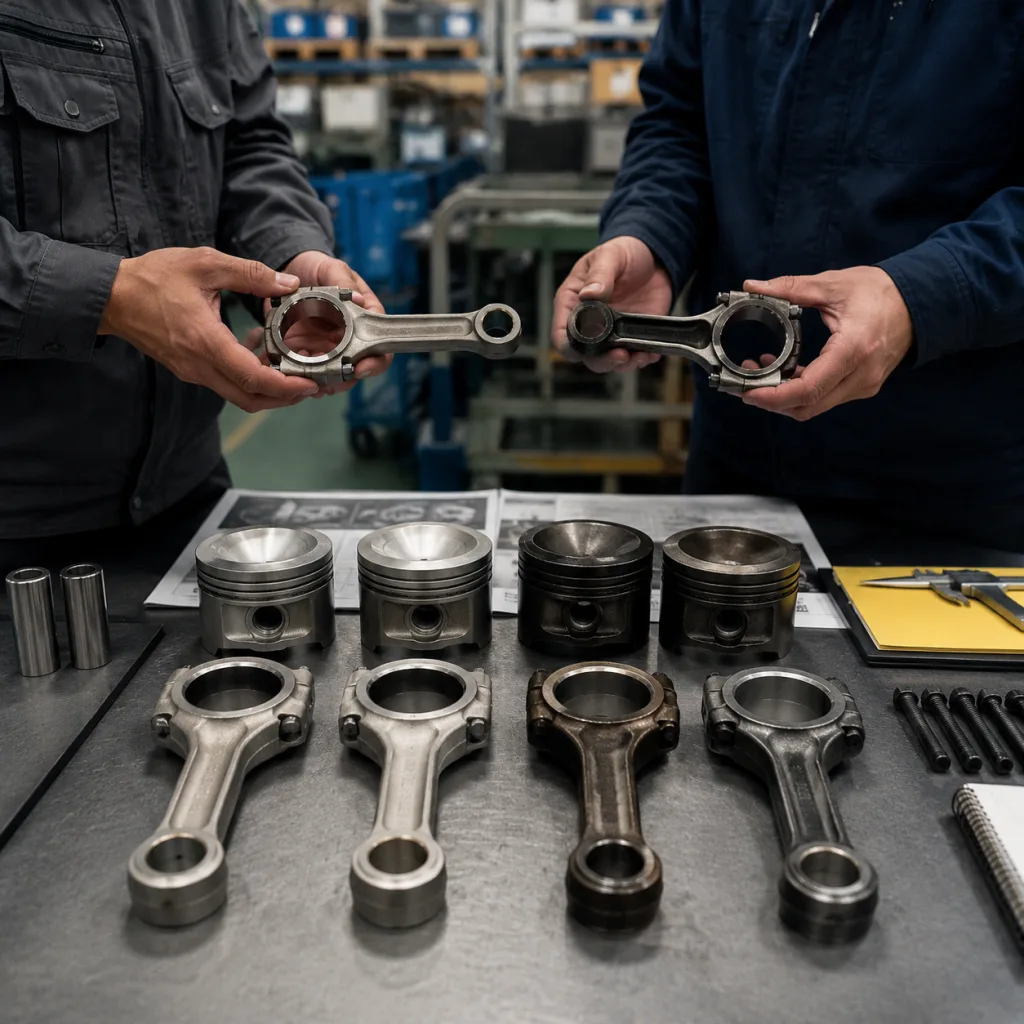
For first orders, approve the part the way a rebuilder will use it. Install 2–5 sample sets with the intended bearings, pins, pistons, and bolts. Record bearing clearance, side clearance, pin fit, piston deck height, cap seating, and rotating smoothness. If one of these checks is unstable, the issue belongs in sample approval, not in a field complaint.
Buyers can review related engine component coverage in our catalog and the engine-specific product grouping at /products/engine-components.html. For cross-application projects, Driventus can also review samples and drawings under custom manufacturing. No supplier should claim approval or endorsement by a vehicle manufacturer unless formal, verifiable authorisation exists.
Where Replacement Rod Programs Fail
Most rod sourcing problems are not dramatic at the quotation stage. They hide in measurement conditions, vague material language, cap handling, or uncontrolled substitutions. A replacement rod should be treated as a precision rotating component, not a commodity forging, casting, or machined item.
The most common mistake is measuring the big end without the specified bolts, lubricant, torque sequence, and final tightening angle. The bore may look acceptable loose and move outside the bearing window once assembled correctly.
Failure mode
What usually causes it
Procurement control
Piston deck variation
Centre-to-centre length drift
100% or sampled CMM/fixture verification; typical aftermarket tolerance ±0.025–0.050 mm
Bearing distress
Big-end bore out-of-round or weak shell crush
Check after bolts are tightened to the defined torque/angle; typical roundness 0.005–0.010 mm
Pin noise or seizure
Incorrect small-end bore or bushing finish
Gauge inspection after bushing finishing or honing; pin clearance agreed with buyer
Piston and bearing side loading
Parallelism or twist error
Fixture or CMM verification against drawing datum; report in mm per 100 mm or angular minutes
Engine imbalance
Loose weight grouping
Set grouping by total weight and end weights; typical service target 2–4 g total spread
Cap movement
Bolt proof, thread, or clamp-load inconsistency
Batch testing, hardness check, thread gauge, and torque-angle validation where specified
Oil-film damage
Poor surface finish, burrs, or blocked oil holes
Ra target agreed for bore surfaces; burr-free oil holes and chamfers required
Strength variation
Undefined steel grade or heat treatment
Batch hardness report with defined range, often around 28–36 HRC for quenched-and-tempered steel depending on grade
</tr></thead><tbody> </tbody></table>Avoid vague descriptions such as “high strength steel.” The purchase specification should state the material grade, hardness range, heat-treatment record, inspection basis, measurement method, tightening condition, and acceptance criteria. For forged steel programs, typical grades may include 40Cr, 42CrMo, C70S6, or buyer-specified equivalents; substitutions should require written approval.
Production-route controls need equal attention. Forged steel rods require billet traceability, forging-temperature control, grain-flow discipline, normalising or quench-and-temper records, shot-peening control where specified, magnetic particle inspection after heat treatment if required, and final machining after cap separation. Bushed small ends need defined bushing material, interference fit, oil-hole alignment, press direction, and final bore finish. Fracture-split rods need strict cap matching and face protection because caps are not interchangeable and the mating faces must not be polished, mixed, or damaged.
Build the Validation Gate in Three Releases
Do not ask one sample set to prove an entire program. For a new connecting rod for Jeep Cherokee replacement launch, separate validation into three gates: sample approval, pilot-lot approval, and mass-production release. Each gate answers a different question.
Sample approval asks: does the design fit and assemble correctly? Pilot approval asks: can the supplier repeat the result under production conditions? Mass release asks: is the control plan strong enough to prevent drift over time?
A practical validation package can include:
Material certificate and chemical composition check, with heat number linked to the production lot
Hardness testing on heat-treated samples, normally 3–5 pieces per heat-treatment batch or per agreed control plan
Metallographic review for grain structure, decarburisation risk, inclusion level, and heat-treatment consistency
Magnetic particle inspection or other crack detection where applicable, especially on forged rods after heat treatment and machining
Dimensional inspection report with critical characteristics highlighted and measurement equipment identified
Bolt torque, angle, thread engagement, and residual clamp-load verification using the specified lubricant or dry condition
Big-end bore distortion check after repeated tightening cycles, commonly 3–5 assembly cycles for serviceability review
Fatigue or endurance testing for new tooling, new material grades, heat-treatment changes, or high-warranty-risk programs
Surface roughness measurement on bearing and pin interfaces, including confirmation that oil holes and chamfers are burr-free
Salt-spray or corrosion-resistance checks for packaged inventory where ocean freight, long storage, or humid markets are expected
Validation triggers should be written before the purchase order is placed. Trigger reapproval for initial sourcing, new tooling, material change, heat-treatment supplier change, machining process change, bolt supplier change, packaging change, relocation of production equipment, or recurring annual requalification. This prevents undocumented substitutions during long aftermarket runs.
For repeat orders, use full dimensional reporting on the first lot, reduced reporting after stable performance, and revalidation after any 4M change: man, machine, material, or method. Driventus operates under IATF 16949:2016 and ISO 9001:2015 principles for process control, traceability, corrective action, and production approval discipline. For export markets, documentation may also need to support customer compliance reviews under REACH (EC) No 1907/2006 where restricted substances are relevant to coatings, packaging, rust inhibitors, labels, or auxiliary materials.
Incoming Inspection: Fast Triage Before Stock Release
Incoming inspection has to work in a warehouse, not only in a lab. Distributors and repair-chain buyers often receive mixed replacement demand across several engine families, so the inspection plan should be simple enough to repeat and strict enough to catch engine-damaging defects before stock is released.
Use this triage sequence:
1. Confirm part label, application reference, batch number, supplier lot, quantity, and purchase order match. 2. Verify packaging protects machined bores, cap faces, fracture-split faces, bushings, and bolts from corrosion and impact. 3. Check that each cap remains matched to its rod body and that orientation marking is clear, permanent, and away from functional surfaces. 4. Sample centre-to-centre length, bore diameters, big-end width, and side-face condition using calibrated gauges. 5. Inspect bearing tang slots, oil holes, chamfers, bushing finish, and bolt seats for burrs, blockage, dents, or plating contamination. 6. Weigh rods by set where engines are serviced in complete sets, recording total weight and end-weight spread if matched sets were purchased. 7. Review inspection reports, material certificates, heat-treatment records, and lot traceability before stock release.
A common high-volume approach is 100% visual and identity verification, 100% cap-orientation confirmation, and sampled dimensional inspection under ANSI/ASQ Z1.4 or ISO 2859-1. Critical defects should trigger lot containment, not casual sorting. Examples include big-end bore error, cap mismatch, crack indication, wrong bolt specification, incorrect small-end bushing size, missing traceability, and mixed part numbers.
Keep reference samples and first-article reports for every approved part number. If the warehouse finds oil-hole blockage, rust on machined surfaces, damaged cap faces, or an out-of-limit bore, quarantine the lot, photograph the evidence, and link the issue to the supplier batch number before discussing rework. Driventus can align documentation formats with importer requirements, including PPAP-style submissions where requested by OEM or Tier-1 buyers. The company’s quality system supports batch traceability from material intake through machining, heat treatment, final inspection, and export packing.
Supplier Comparison: What Changes the Real Cost
The cheapest rod can become the most expensive part in the engine if it causes teardown, warranty labour, or reputation loss. When sourcing a connecting rod for Jeep Cherokee replacement demand, compare suppliers on process control, order flexibility, and change discipline—not just catalogue breadth.
Use these questions to separate controlled manufacturing from opportunistic trading:
Does the supplier manufacture the rod in-house or trade finished inventory?
Are forging, heat treatment, machining, bolt sourcing, bushing installation, and inspection traceable by lot?
Can the supplier provide dimensional reports for centre distance, bore size, roundness, twist, parallelism, weight, and hardness?
Are rods sold individually, in matched sets, or both, and what total-weight and end-weight tolerance applies?
How are caps protected from mix-up during machining, washing, inspection, and packing?
Can packaging be specified for ocean freight, long storage, and humidity exposure, including VCI bags, rust inhibitor, desiccant, or sealed cartons?
What is the process for engineering change notification, deviation approval, and obsolete cross-reference control?
Are samples available for fitment and rebuild validation before bulk shipment?
Commercial terms follow the technical route. Catalogue rods may allow lower MOQs. Custom or drawing-controlled rods usually need tooling, fixtures, first-article approval, and larger commitments. As a planning guide, sample orders often involve 2–5 sets, pilot orders may run 50–200 sets, and repeat production MOQs depend on forging batch size, machining setup time, bolt procurement, and packaging configuration.
Price is usually shaped by material grade, forging route, machining complexity, bushing requirement, bolt specification, weight matching, inspection level, packaging, and annual volume. Lead time is shortest for stocked catalogue rods, longer for production runs after raw material and forging scheduling, and longest for new tooling or PPAP-style approval.
For aftermarket distributors, matched sets reduce installer complaints because weight variation and dimensional spread are controlled inside the set. For repair chains, consistent packaging, scannable labels, country-of-origin marking, and stable supersession logic matter too. For OEM and Tier-1 buyers, the supplier should be ready for process audit, control-plan review, capability study, and corrective-action closure. Driventus manufactures engine and powertrain components in Taizhou, Zhejiang, and exports to more than 60 countries. Connecting rod programs can be supplied as catalogue coverage, sample-based development, or drawing-controlled production depending on buyer requirements.
RFQ Document Pack: Questions Buyers Should Settle Up Front
A good RFQ prevents arguments later. It tells the supplier how the part will be judged, which documents are mandatory, and whether the order is a catalogue purchase, a sample-based development, or a drawing-controlled program. The document level should match volume, warranty exposure, destination-market requirements, and launch risk.
Minimum recommended document set:
Application list and buyer-approved cross-reference table, if applicable
Technical drawing or critical-dimension report showing nominal values, tolerances, datum references, and tightening condition
Material certificate or internal material specification, linked to heat number or batch number where available
Heat-treatment record or hardness report, with acceptance range and test location
Final inspection report with batch number, sample size, measurement equipment, and responsible inspector
Packaging specification and corrosion-protection method, including carton strength, pallet pattern, VCI or oil type, and storage recommendation
Declaration support for relevant restricted-substance reviews, where applicable
Warranty handling, containment timing, root-cause analysis, and nonconformance response procedure
Before quoting, settle these questions: What annual demand is realistic? How many samples are needed? Is the first order a pilot or saleable stock? Which Incoterms apply? Is matched-set packing required? What inspection level is included in the unit price? Are PPAP-style documents required, or is a simpler batch report enough? What launch date is fixed, and what can move?
If the order is based on an OE part-number cross-reference, use it only for fitment identification, for example OE 06A… when provided by the buyer. Do not use cross-references as evidence of vehicle-maker approval. Driventus is an independent aftermarket manufacturer; brand names are referenced for fitment only.
For new programs, provide samples or drawings, target annual volume, market destination, packaging requirements, inspection level, target landed-cost range, and repair-chain labelling rules. Driventus can then confirm feasibility, inspection scope, MOQ, price drivers, lead time, and whether catalogue supply or custom manufacturing is the better route. To begin a technical review, buyers can request a quote.
Frequently asked questions
Verify engine application, centre-to-centre length, big-end bore, small-end bore, width, bolt specification, cap matching, side clearance, pin fit, and set weight limits. Request batch inspection records, material documentation, and the tightening method used for bore measurement before approving bulk shipment.
Yes. Matched sets are often preferred for rebuilders and repair chains because total weight and end-to-end weight variation can be controlled within agreed limits. Buyers should state the required grouping tolerance, such as 2–4 g total set spread and 1–2 g end-weight spread if the program requires it.
No. Cross-references are used for fitment identification only. Driventus is an independent aftermarket manufacturer; brand names are referenced for fitment only, and no vehicle-maker approval is claimed.
If you are sourcing a connecting rod for Jeep Cherokee replacement program, share your sample, drawing, target annual volume, first-order quantity, inspection requirements, packaging rules, and launch timing for a practical feasibility review. Contact Driventus at /contact.html