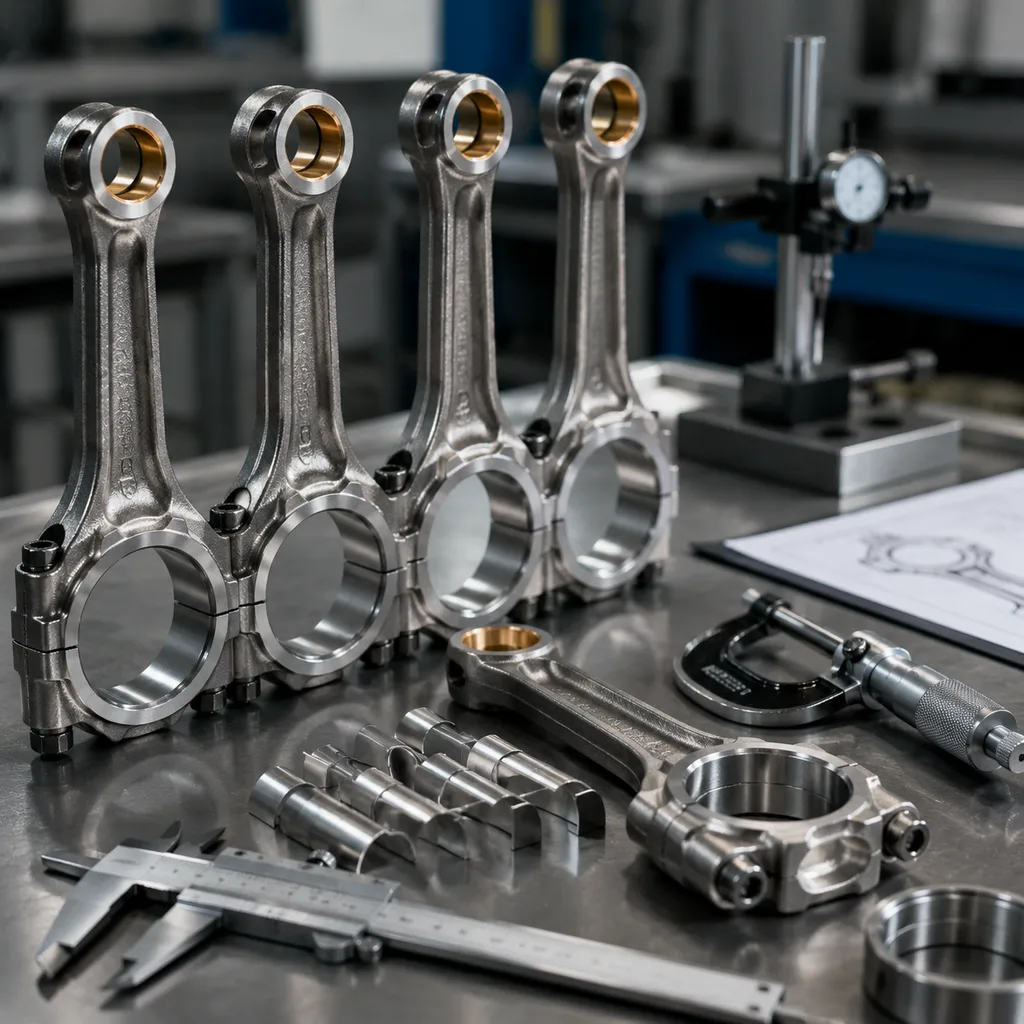
Connecting Rod for Isuzu MU-X Replacement: B2B Sourcing and Approval Guide
A connecting rod for Isuzu MU-X replacement is not a “close enough” catalogue purchase. In a diesel engine it carries combustion load, inertia load, bearing crush and repeated cap-bolt clamping. If the rod is wrong, the repair may still assemble—but the bearing, pin end or cap joint can fail soon after.
For distributors, rebuilders and repair-chain buyers, the buying decision should answer one practical question: can this rod be installed through a normal overhaul process without extra corrective machining or uncontrolled warranty risk?
That decision depends on engine code, OE cross-reference, sample or drawing confirmation, bore and mass control, material validation, cap matching, documentation and repeatable batch management. It also depends on the market. The MU-X name has been used with different diesel engines and revisions by region and production period, so fitment cannot be approved from the vehicle model alone.
This article reorganizes the sourcing process into the decisions that actually prevent returns: what must match the OE design, which measurements matter most, how to read supplier validation, where failures usually start, and what documents should travel with the shipment. Driventus supplies engine components for aftermarket and B2B repair channels, with production managed under IATF 16949:2016 and ISO 9001:2015 systems. Driventus is an independent aftermarket manufacturer; Isuzu and MU-X names are referenced only to identify vehicle fitment.
Decision point: when is an MU-X replacement rod acceptable for purchase?
Start with the acceptance standard, not the catalogue listing. A replacement rod is acceptable only when it matches the original engine design in geometry, bearing housing behavior, mass range, cap clamping and fatigue capability.
For diesel SUV engines used in the Isuzu MU-X, the rod must handle high compressive combustion loading, tensile inertia loading, bending stress, bearing crush forces and repeated cap-bolt tightening. Visual similarity is weak evidence. A rod can look correct and still damage a bearing if the housing bore is oversize, tapered or distorted after the cap is tightened.
A buyer should treat these features as critical-to-function:
Centre-to-centre length, controlled to drawing tolerance rather than visual comparison
Big-end bore diameter, roundness and cylindricity after cap assembly and bolt tightening
Small-end bore diameter, bush interference and pin clearance, where applicable
Big-end and small-end widths, including side-clearance compatibility with the crankshaft and piston boss
Bolt seat geometry, thread engagement, dowel or serration features and cap joint accuracy
Oil-hole position, diameter and edge break if specified by the original design
Total weight, plus big-end and small-end balance range for matched sets
Bearing shell compatibility, including tang position and shell width
Cap pairing, cap orientation marks and lot traceability
For receiving targets, many rebuild programs treat big-end housing bore roundness and cylindricity in the 0.005–0.010 mm range as critical, subject to the approved drawing and bearing supplier data. Surface finish should also be specified. For precision bearing seats, ask suppliers to state Ra values instead of writing only “machined finish.”
Weight control is just as practical. A dimensionally correct rod that falls outside the required mass class can introduce vibration after overhaul, especially in mixed sets. Repair-chain buyers should normally request same-lot sets, total mass variation held within an agreed gram range, and tighter big-end/small-end balance matching where the engine builder requires it.
The purchase rule is simple: do not buy on application name alone. Buy against inspection evidence, batch controls and a confirmed fitment basis.
Spec deep-dive: the measurements that prevent fitment and bearing problems
Before issuing a purchase order for a connecting rod for Isuzu MU-X replacement program, lock down the technical boundary conditions. The vehicle model name is not enough. Request the engine code, displacement, model year range, market, OE number if available, and at least one confirmed sample or drawing reference for first supply.
Specification item
What to confirm
Practical target or evidence to request
Procurement risk if omitted
Application match
Engine code, model year range, market, piston pin type and bearing family
OE cross-reference, sample photos, catalogue notes by engine
Wrong fitment, mixed inventory or avoidable returns
Material
Forged steel grade or equivalent material specification
Mill certificate or chemical record per heat/lot
Reduced fatigue strength or inconsistent heat-treatment response
Heat treatment
Hardness range and through-hardening or local hardening process where applicable
Hardness report with test locations; typical forged steel rods are often specified in an HRC or HB band
Bolt-seat deformation, bore movement or early fatigue cracking
Big-end bore
Diameter, roundness, cylindricity and surface finish after cap tightening
100% or sampled bore-gauge report; roundness/cylindricity often controlled at 0.005–0.010 mm where drawing requires
Bearing seizure, oil-pressure loss, knock or accelerated wear
Small-end bore
Bush material, interference fit and final bore size
Pin-bore report, bush retention check and oil-hole alignment
Pin noise, scuffing, bush movement or pin seizure
Centre distance
Crank-pin to piston-pin centre distance
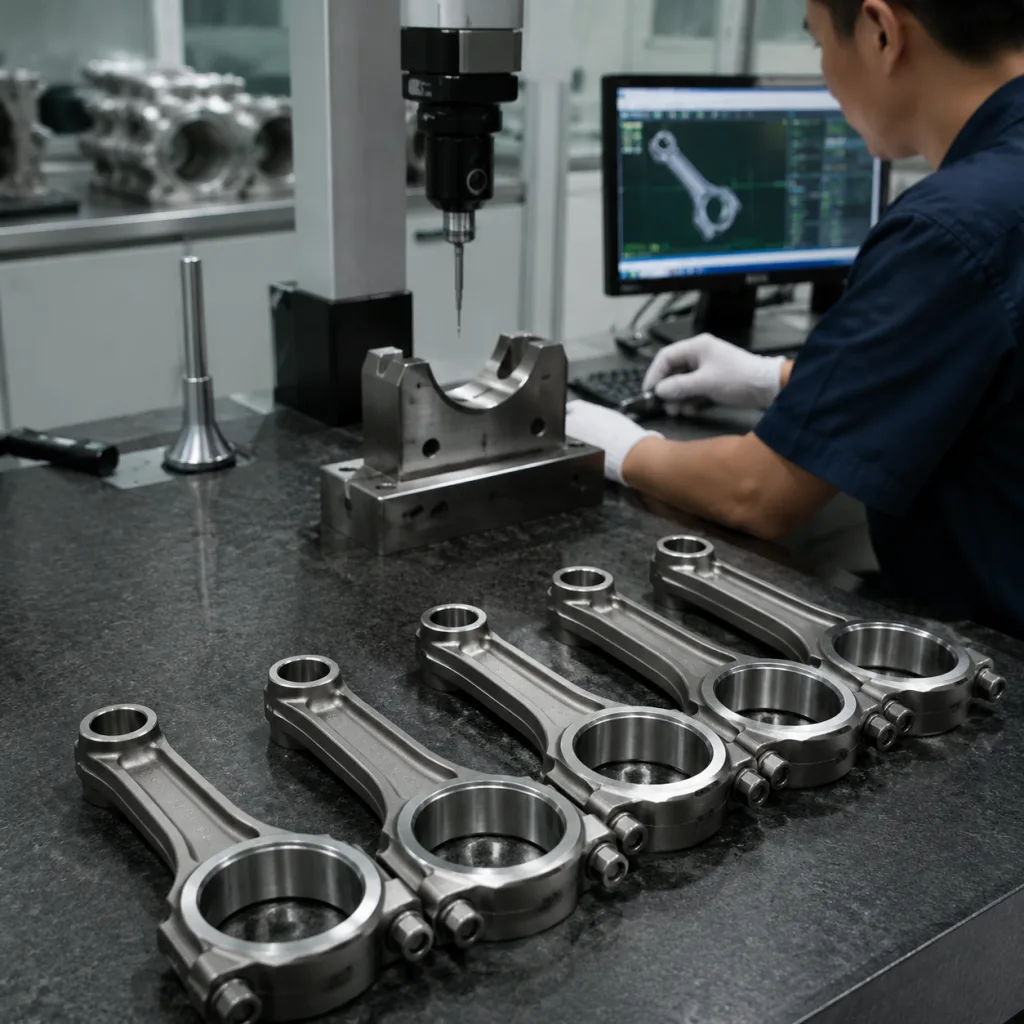
CMM or dedicated fixture report; verify against sample/drawing
Piston protrusion variation, compression imbalance or contact risk
Rod bolts
Bolt grade, thread quality, torque procedure and single-use policy if required
Bolt material/grade, thread gauge result and tightening method
Cap fretting, clamp-load variation or cap separation
Weight control
Total weight, big-end weight and small-end weight range when specified
Set weight record; define accepted gram range before shipment
Engine imbalance after rebuild or vibration complaints
Cleanliness
Residual swarf, abrasive media and oil-hole cleanliness
Washed and packed parts; visual or particle cleanliness check for larger programs
Bearing scoring, oil restriction and early failure
Traceability
Lot number, inspection record and packing label
Part/pack/carton lot code tied to inspection data
Poor recall control and slow warranty investigation
</tr></thead><tbody> </tbody></table>Most B2B buyers cannot re-measure every feature on arrival. Use a focused receiving plan. For a new supplier or first article, inspect 5 pieces or 10% of the lot, whichever is greater. Reduce sampling only after repeated conforming shipments.
Prioritize the features that create expensive failures: big-end bore, small-end bore, centre distance, cap match and mass. These checks find most of the risks that a visual inspection misses.
If the project requires an OE part-number cross-reference, include it in the enquiry exactly as supplied by the customer or repair database. Do not shorten it. Do not replace it with “MU-X diesel.” Different markets and production periods can carry different diesel engine variants and revisions, making engine code and build context essential for correct sourcing.
Validation route: what a capable supplier should prove before bulk orders
Dimensional inspection answers one question: will the rod assemble correctly? Validation answers a different one: will it survive diesel engine service with a reasonable durability margin?
A capable supplier should be able to explain both first-production approval and routine production controls. Ask for the actual controls used on the rod family being purchased, not a generic quality statement.
Typical validation and production controls include:
Chemical composition checks for steel batches, tied to a heat number or material lot
Forging process control, including billet temperature, die condition and trimming consistency
Normalizing, quenching, tempering or other heat-treatment verification as defined by the rod design
Metallographic inspection where required by the part family, including decarburization or grain-flow review
Hardness testing at defined locations, with an agreed acceptance band rather than a single nominal value
Magnetic particle inspection for surface cracks where applicable, especially around the beam, bolt seats and cap area
Big-end bore measurement after cap-bolt tightening to the specified torque, angle or stretch procedure
Fatigue testing or load-cycle validation on representative samples during development or major process change
Rod-bolt torque, clamp-load or stretch verification using production bolts and the specified lubricant condition
Bush retention, pin-bore finish, pin-bore cylindricity and oil-feed alignment inspection
Cleaning checks to reduce the risk of abrasive residue, shot, machining chips or blocked oil holes
Corrosion-resistance or packing-condition checks when specified by the buyer for sea freight or long storage
A normal production route should be traceable from steel to carton. It often looks like this: steel incoming inspection, billet cutting, forging, trimming, heat treatment, shot blasting, straightness check, rough machining, cap splitting or cap machining, bolt-hole machining, cap assembly, big-end finish boring or honing, small-end bush pressing and sizing where applicable, final washing, anti-rust protection, final inspection and packed traceability.
One control deserves special attention: cap matching. If caps are swapped after finish boring, the rod may become unusable even if every individual piece appears well machined. Ask how caps are marked, stored, assembled and protected from mix-up.
For first-article approval, request an inspection report covering at least 5 measured pieces across the lot. One “golden sample” is not enough. Critical data should include big-end bore after tightening, centre distance, widths, pin bore, total mass and visual or crack-inspection result. For repeat orders, agree whether each shipment includes a certificate of conformity only or a short dimensional report.
Where coatings, cleaning agents, rust preventives or packaging materials are supplied into the EU, importers may also require restricted-substance screening or supplier declarations aligned with REACH (EC) No 1907/2006. These compliance checks do not replace mechanical validation, but they may support the importer’s technical and compliance file.
Driventus production is managed through a documented quality system based on IATF 16949:2016 and ISO 9001:2015. For connecting rods, this matters because performance depends on disciplined control across forging, heat treatment, machining, cap matching, measurement, cleaning and packing. A certificate is useful. It should not be the only approval basis.
Failure modes: what goes wrong when the rod is wrong—or installed wrong
Connecting rod warranty claims rarely announce themselves as “rod geometry problem.” The first visible damage usually appears in the bearing system. That is why claim analysis must separate product nonconformity from assembly error, lubrication failure, contamination and pre-existing engine damage.
A useful claim file should include mileage after repair, oil-pressure data if available, photos of all bearing shells, bolt condition, cap orientation, torque method used and whether the crankshaft was measured or ground.
Common symptoms and likely causes include:
Rod knock after overhaul: big-end bore out of tolerance, incorrect bearing shell, excessive oil clearance, insufficient crush or contaminated oil passages. Even a few hundredths of a millimetre error in housing bore or bearing selection can move oil clearance outside a safe range.
Bearing wiping or seizure: oil starvation, housing-bore distortion, incorrect cap orientation, dirty oil galleries, crankshaft journal taper or debris from inadequate cleaning.
Pin-end noise: small-end bush bore too large, incorrect pin clearance, poor bush finish, misaligned bush oil feed or insufficient lubrication during first start.
Uneven piston protrusion: centre-to-centre length variation, mixed rod set, incorrect piston assembly, bent rod from hydrolock or incompatible piston-and-rod combination.
Vibration after repair: rod mass mismatch, end-balance mismatch, mixed components from different weight classes or replacement of one rod without checking the remaining set.
Cap fretting: clamp-load inconsistency, reused torque-to-yield bolts where new bolts are required, damaged cap mating surfaces, incorrect thread lubrication or debris trapped between cap and rod body.
Early bolt failure: wrong bolt grade, damaged threads, over-stretching, incorrect washer/seat condition or use of an impact tool instead of controlled tightening.
Procurement can reduce these risks before the parts ever reach a workshop. Require rods to be supplied in matched sets when the repair procedure calls for it. Specify cap pairing marks and batch identification. Do not allow warehouse teams to mix rods from different lots unless mass and critical dimensions have been checked.
If rods are sold individually, the label should still show application, lot, weight class if used and whether bolts are included.
Installation discipline also matters. A correct rod can fail if cap bolts are lubricated incorrectly, tightened with the wrong method, reused against the engine procedure or assembled with debris between the cap and rod body. Multi-location repair chains should require crank journal measurement, bearing clearance confirmation by gauge or micrometer method, final rotation check and oil-system cleaning before start-up.
Buying scenarios: stock item, scheduled production or custom review?
A replacement program should be built around repeatability. Fitment, inspection, packaging and documentation must work not only for the first sample, but for later batches shipped to different warehouses or repair locations.
Use this sourcing checklist before approving a supplier for a connecting rod for Isuzu MU-X replacement program:
Confirm the exact vehicle market, engine code and production year range.
Identify the piston pin type, bearing family and any known engine revision.
Request a drawing-based dimensional report for the first article sample.
Ask whether rods are supplied individually, in matched sets or by weight class.
Confirm whether rod bolts are included and whether they must be replaced after one use.
Request material, hardness and heat-treatment records by production batch.
Confirm that caps are matched and marked to prevent incorrect assembly.
Verify bearing shell compatibility and the big-end housing bore specification.
Define inspection tolerances in writing, especially for bore, centre distance, width, weight and finish.
Review cleaning, rust prevention and impact protection for ocean freight.
Require lot traceability on the part, inner pack or carton label.
Define warranty evidence requirements before the first shipment.
Agree on carton labeling, private-label needs and barcode requirements if applicable.
Confirm MOQ, sample quantity, production lead time, payment term and shipment mode before tooling or batch scheduling.
Then classify the project commercially.
Scenario 1: stocked catalogue item. Sample dispatch may take about 3–7 working days. Bulk shipment depends mainly on packing, label requirements and export booking.
Scenario 2: scheduled production. If forgings or machining capacity must be arranged, a typical production window is often 30–60 days after deposit and sample approval.
Scenario 3: new or revised version. If reverse engineering, drawing creation, tooling or fixture changes are required, allow 60–90 days or more before stable bulk supply.
MOQ and price should be evaluated together. A small trial order may be possible, but the unit cost can be higher because inspection, setup, packing and export documentation are spread across fewer pieces. For ongoing B2B supply, pricing usually improves when the buyer commits to carton-level or pallet-level quantities, freezes private-label artwork and forecasts annual demand by quarter.
For slow-moving applications, repeated urgent micro-orders are usually inefficient. A consolidated batch with mixed engine parts may be more practical.
Catalogue data should also be written by engine, not by vehicle name only. Export programs covering Australia, the UK, the EU, Latin America, the Middle East and Southeast Asia are especially exposed to regional engine differences and mid-run specification changes.
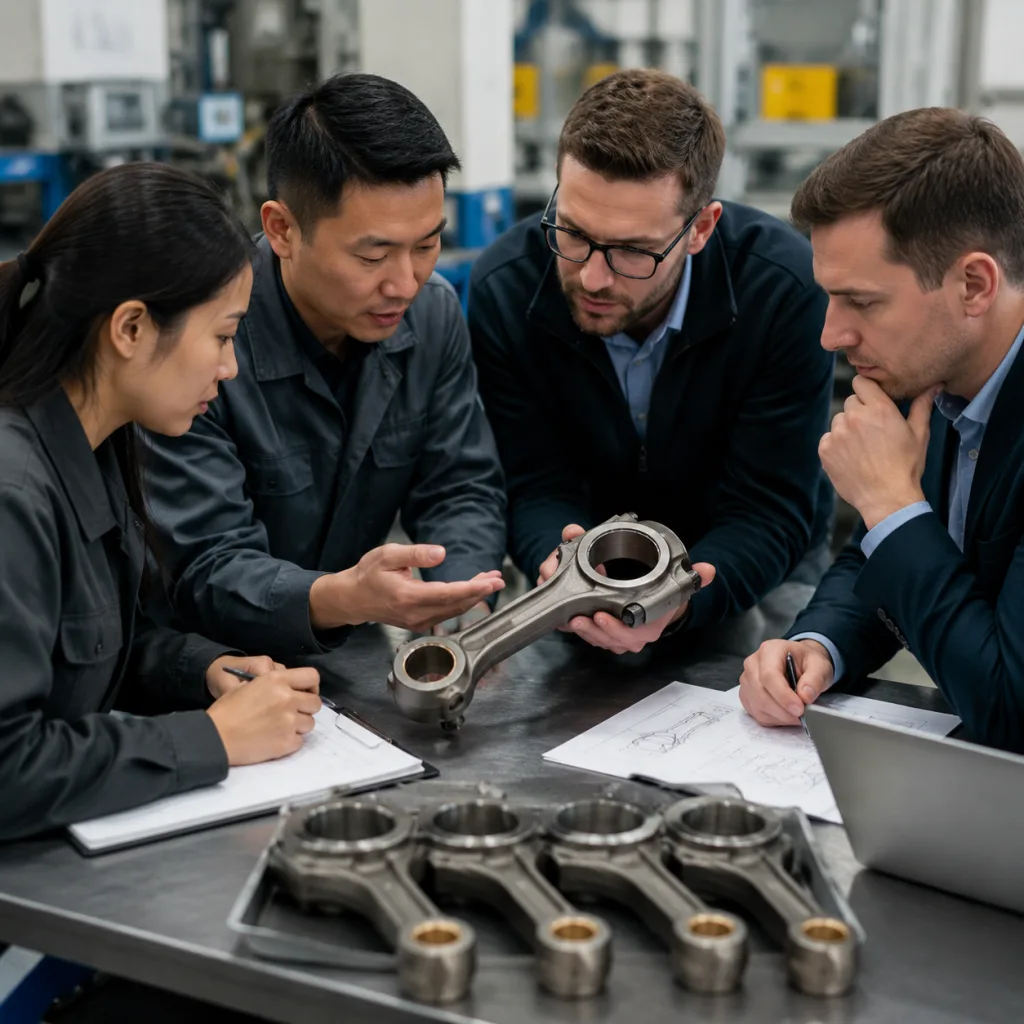
If an existing catalogue number does not cover the required version, Driventus can review samples, drawings or cross-reference data through custom manufacturing. This is useful for private-label rod sets, regional applications that are not yet catalogued, or controlled alternatives to an existing supplier.
Import approval Q-and-A: documents, receiving checks and warranty files
What should be defined before shipment?
Define the documentation package in the PO. State the part number, revision or sample reference, quantity, packaging specification, required labels, inspection documents and any special compliance declarations. If these requirements are left until after production, disputes become more likely.
What documents should travel with a production order?
A practical package may include:
Commercial invoice and packing list with part number, quantity, net weight and gross weight
Certificate of conformity referencing the agreed specification, drawing, sample or PO revision
Material certificate or chemical composition record tied to heat or production lot
Dimensional inspection report for critical features, including big-end bore after cap tightening
Hardness inspection record with test method and locations
Process-flow or control-plan summary when required for customer approval
Lot traceability record linking cartons, inspection report and production batch
Packaging photos before dispatch, including inner pack, anti-rust method and export carton
Restricted-substance or compliance declaration where applicable
First-article inspection report for new or revised applications
Corrective-action format and response time for any nonconforming shipment
How should receiving inspection be handled?
Use a simple AQL-style plan for cosmetic and packing checks, but apply tighter sampling to critical dimensions. A practical arrangement is 100% verification of labels and carton count, sampled visual inspection for corrosion or handling damage, and dimensional checks on a defined number of rods per lot.
If any cap mismatch, crack indication, incorrect bore or wrong application label is found, quarantine the full lot until the supplier confirms containment.
Why does documentation matter after the sale?
For regulated fleets, corporate service networks and large repair programs, documentation consistency can be as important as the component itself. Missing batch records delay receiving inspection and make warranty analysis difficult. They also make it harder to distinguish a part issue from an installation, lubrication or contamination problem.
Warranty terms should define the evidence required, such as failed part return, bearing photos, oil condition, installation record and engine mileage after repair.
Driventus can support B2B sourcing discussions for standard and application-specific connecting rods, including sample review, inspection planning, documentation alignment, private-label packing and export packaging. Buyers can request a quote with engine details, target annual volume, packaging requirements, destination market, preferred Incoterm and any OE cross-reference format available from their system.
Frequently asked questions
Yes, if it is correctly matched to the engine application and validated for material strength, bore accuracy, weight control, bolt clamping and bearing compatibility. Buyers should verify engine code, production year range, market, OE cross-reference and inspection data before approving the part for repair use.
It depends on engine condition and the repair procedure. After serious bearing damage, hydrolock, piston impact or imbalance concerns, many rebuilders prefer matched sets. At minimum, any single replacement rod must match the original rod family, dimensions and weight range, and should not be mixed across lots without checking mass and critical dimensions.
Provide the vehicle market, engine code, model year range, sample photos or drawings, required quantity, packaging format, destination, timing requirement and any available OE cross-reference from your system. This reduces catalogue mismatch and helps confirm whether stock supply, scheduled production or custom review is needed.
For sourcing review, sample validation or production pricing, send your engine code, OE reference, sample details, target volume and packaging requirements to the Driventus team. You can start with a soft enquiry at /contact.html