Connecting Rod for Honda CR-V OE Equivalent Sourcing
Sourcing a connecting rod for Honda CR-V OE equivalent replacement programs requires more than matching the part by appearance or vehicle name. Buyers need controlled evidence for bore geometry, centre distance, weight matching, material strength, bolt retention and surface condition against the intended engine application. For aftermarket distributors and repair-chain buyers, the risk is practical and expensive: one rod outside specification can lead to bearing noise, unstable oil film, piston height errors, vibration complaints or repeat engine removal. This guide outlines the procurement checks Driventus recommends for Honda CR-V replacement connecting rods, including fitment confirmation, dimensional inspection, metallurgy, validation testing, documentation, MOQ, price logic, lead-time planning and packaging control. It is written for importers, category managers and sourcing engineers comparing independent aftermarket supply with OE-service replacement expectations. Driventus is an independent aftermarket manufacturer; brand names are referenced for fitment only.
OE-Equivalent Fitment Scope for CR-V Applications
Honda CR-V engine families differ by market, model year, displacement and emissions configuration. A replacement connecting rod must therefore be confirmed by engine code, piston pin diameter, crankpin journal size, big-end width, rod length and bolt specification, not by vehicle model alone. For a connecting rod for Honda CR-V OE equivalent program, buyers should request drawing-based confirmation and, where available, OE part-number cross-references in the format already used in the buyer’s interchange data, such as OE 13210… or OE 13211… references when applicable.
Typical CR-V-related engine families that require separate verification may include B-series, K-series, R-series and L-series variants depending on model year and market. Do not assume interchange between 2.0 L, 2.4 L and 1.5 T applications. Even where the engine family appears similar, piston compression height, crankshaft journal size, fracture-split cap design, bushing type or rod bolt torque method can make rods non-interchangeable.
For replacement programs, Driventus validates application fitment through sample measurement, drawing review and batch traceability. Listings in our catalog and related engine components are useful starting points, but final quotation should be based on the buyer’s engine code, annual volume, packaging requirement, target market and documentation needs.
Key fitment data to confirm before purchase:
Engine code, displacement, fuel type and market version, not only vehicle model.
Big-end bore diameter after cap assembly and bolt tightening to the specified torque or torque-angle method.
Crankpin journal diameter and bearing shell width used in the target rebuild program.
Small-end bore or bushing inner diameter, including piston pin clearance target.
Centre-to-centre length between crankpin and piston pin bores, typically controlled within ±0.02 mm to ±0.05 mm depending on drawing requirement.
Big-end width and crankshaft side-clearance compatibility, often checked against a side clearance target of about 0.10–0.35 mm after assembly.
Rod bolt thread, grade, tightening method, lubricant condition and replacement policy.
Weight class or maximum rod-to-rod mass variation per engine set, commonly requested at ≤2 g total mass variation or tighter where the buyer specifies end-weight matching.
Critical Dimensions and Tolerances Buyers Should Specify
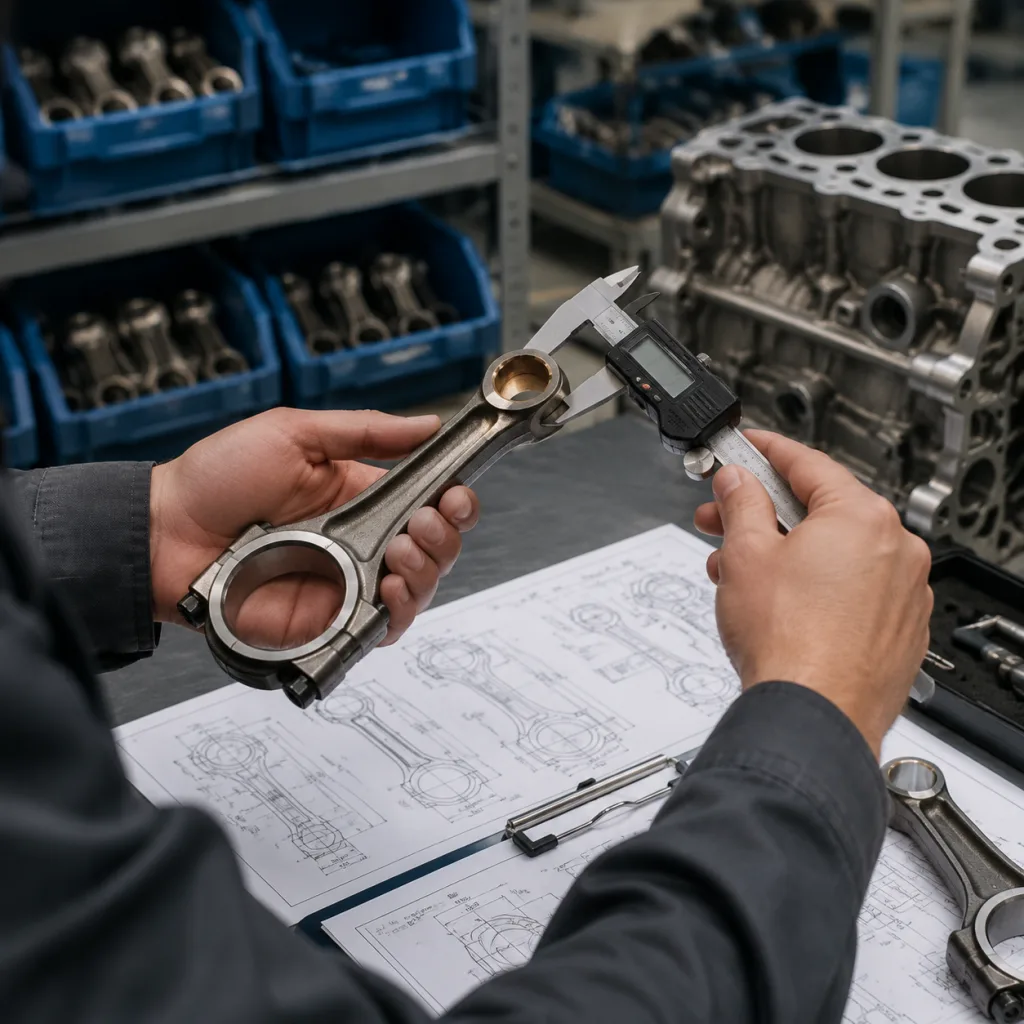
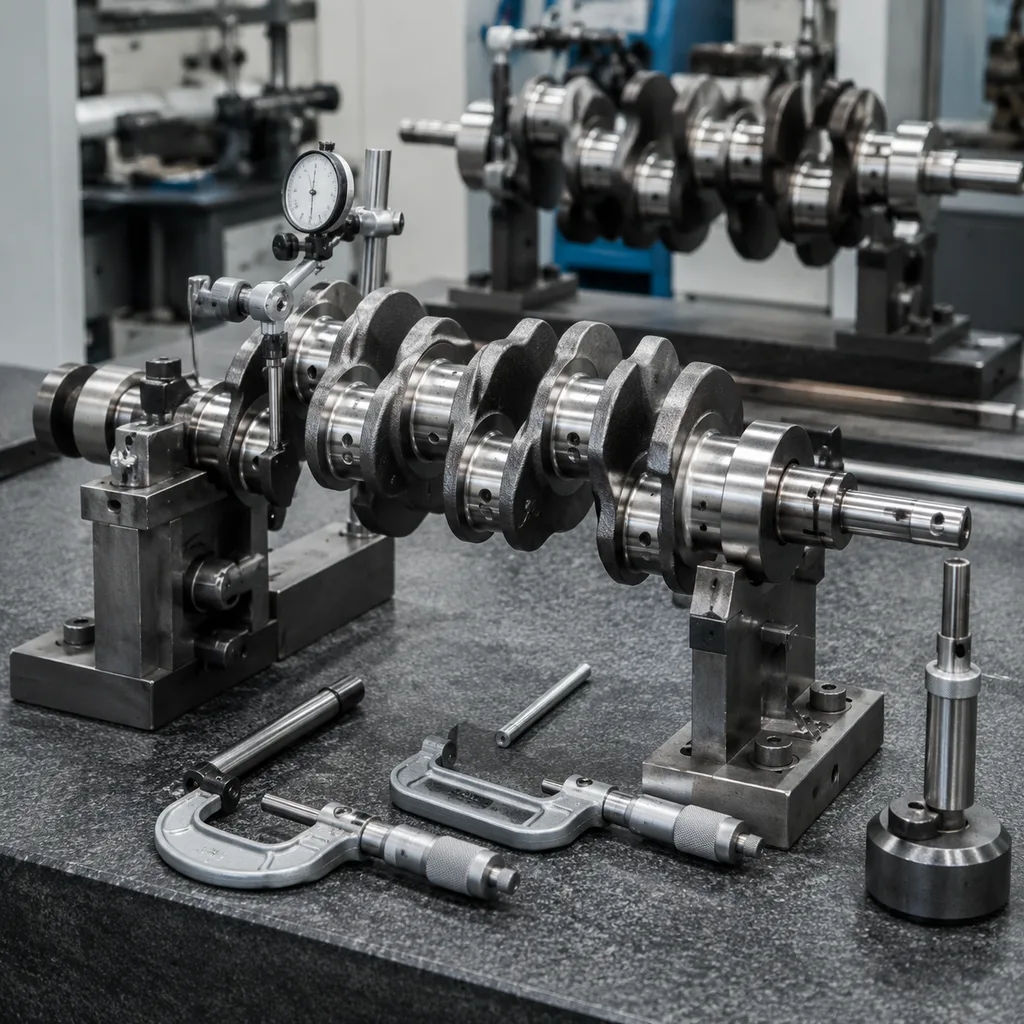
Connecting rod failure is often associated with fatigue, but many field complaints begin with dimensional drift: an oval big-end bore, incorrect housing width, poor bushing finish, bend or twist, or excessive mass variation across a set. For OE-equivalent replacement, dimensional control should be documented at both process and final-inspection stages, with the rod measured in the same assembled condition used during engine installation.
Buyers should put numeric acceptance limits into the RFQ instead of asking only for “OE quality.” Final values must follow the approved drawing or sample reverse-engineering result, but a practical sourcing specification normally includes big-end bore tolerance, bore roundness, cylindricity, small-end clearance, surface roughness, centre distance, bend, twist and mass balance. If the supplier quotes without knowing these values, the price is usually based on visual interchange rather than a controlled replacement standard.
Control item
Procurement relevance
Typical verification method
Practical RFQ target to define
Centre-to-centre length
Maintains compression height and piston travel
CMM or dedicated rod gauge
Nominal drawing value with ±0.02–0.05 mm tolerance
Big-end bore diameter
Controls bearing crush and clearance
Air gauge or bore gauge after bolt torque
Nominal housing bore with tolerance such as ±0.008–0.015 mm
Big-end bore roundness
Supports oil film stability
Air gauge at multiple clock positions
Usually ≤0.006–0.010 mm depending on design
Small-end bore finish
Controls pin movement and wear
Bore gauge and surface roughness tester
Pin clearance and Ra target, commonly Ra ≤0.4–0.8 µm
Big-end width
Affects crankshaft side clearance
Micrometer or width fixture
Nominal width with ±0.02–0.05 mm tolerance
Bend and twist
Prevents piston skirt and bore side loading
Rod alignment fixture
Often ≤0.03–0.05 mm per 100 mm reference length
Set weight variation
Reduces vibration in assembled engines
Digital balance by total and end-to-end mass
Commonly ≤2 g total mass; ≤1 g end weight for stricter programs
</tr></thead><tbody> </tbody></table>Driventus can provide lot-level inspection reports when required for B2B supply contracts. For buyers managing multiple repair-chain branches, set-level packing is usually preferable because it reduces the chance of mixing rods from different weight groups during engine rebuilds. For high-volume orders, a reasonable control plan may use 100% checks for visual defects, thread condition and critical bore go/no-go verification, plus statistical sampling for CMM dimensions, hardness and roughness by lot.
Material, Forging and Heat-Treatment Controls
Most replacement connecting rods in this vehicle category use forged steel or powder-metal designs depending on the engine family. The sourcing decision should follow the original design route unless a custom engineering review supports a change. Substituting forged steel for a powder-metal rod, or the reverse, can affect fracture-split cap behaviour, bolt seating, bearing housing geometry and machining strategy.
For forged steel rods, buyers should ask for material grade confirmation such as 40Cr, 42CrMo, C70S6 or the supplier’s approved equivalent, with chemical composition tied to a heat number. For powder-metal or fracture-split designs, the cap-matching process is critical: caps should not be mixed, and the parting face should not be machined in a way that changes the intended fracture location. Typical hardness targets vary by material and design, but RFQs should request a defined range, for example HRC 28–36 for many quenched-and-tempered forged steel applications, rather than accepting an open-ended “heat treated” statement.
Driventus manufacturing controls focus on repeatability rather than visual similarity alone. Relevant process checks include:
Steel grade verification by material certificate, heat number and incoming inspection.
Controlled forging or forming temperature, die condition and trimming parameters to reduce grain-flow inconsistency.
Normalising, quenching and tempering records where applicable, with furnace batch number and hardness results.
Shot peening where specified, with media size, coverage and intensity recorded for fatigue-critical surfaces.
Cap machining after controlled assembly to maintain big-end geometry under the specified bolt load.
Thread, parting-face, dowel, serration and bolt-seat checks before final release.
Magnetic particle inspection or equivalent crack screening for samples or 100% inspection where the program requires it.
100% visual inspection for cracks, burrs, thread damage, rust, dents and handling marks.
Quality management follows IATF 16949:2016 and ISO 9001:2015 principles through documented control plans, process audits, nonconforming material handling and corrective action records. Details of Driventus’ quality system are relevant for buyers conducting supplier qualification, factory-audit reviews or private-label approval.
Validation Testing for Replacement Confidence
A connecting rod for Honda CR-V OE equivalent use should be validated against the operating loads expected in the original engine application. Static measurement is only one part of that work. Buyers should also ask how the supplier confirms fatigue strength, bolt retention, bearing housing stability and surface integrity after repeated load cycles.
Driventus validation plans are adapted to the specific rod design and buyer requirement. Common controls include hardness testing, tensile-property review from material lots, magnetic particle inspection for surface discontinuities, dimensional capability studies and fatigue testing on representative samples. Where the buyer provides an original sample or approved drawing, reverse measurement is used to confirm geometry before tooling release.
A practical PPAP-style approval route for a new or transferred rod program usually includes first-article inspection on 3–5 pieces, capability review on 30 pieces for critical dimensions, and pilot-lot approval before mass shipment. For stable repeat orders, buyers may request AQL sampling such as AQL 1.0 for critical visual and thread defects and AQL 2.5 for minor packaging defects, while keeping 100% controls for cap matching, bolt installation and traceability labels. Fatigue testing requirements should define load direction, cycle count, stress level and acceptance criteria; for example, no visible crack or bore deformation outside tolerance after a supplier-agreed high-cycle bench test.
For replacement import programs, documentation should normally include:
Production part approval-style dimensional report with nominal, tolerance, actual value and measuring equipment.
Material certificate or chemical composition confirmation tied to heat number.
Heat-treatment record with hardness range and furnace batch identification.
Inspection plan for critical-to-function dimensions, including sampling frequency and reaction plan.
Batch traceability code on product label, inner box, master carton and pallet sheet.
Sample-retention or reference-part record where required, normally kept for at least the warranty period or agreed contract term.
Packaging drop or transport suitability review for export cartons, including corrosion protection period such as 6–12 months under normal warehouse storage.
Driventus does not claim vehicle manufacturer approval or endorsement. The goal is OE-equivalent fit, function and durability for independent aftermarket replacement, supported by data that importers and repair networks can review before launch.
Sourcing Checklist for Distributors and Repair Chains
Category buyers should separate technical equivalence from commercial convenience. A low unit price does not help if rods arrive without traceability, if bearing fit requires rework, or if mixed weight groups create noise complaints after installation. The most reliable programs define product, inspection, labelling and packaging requirements before price negotiation.
For commercial planning, buyers should separate sample cost, tooling cost, unit price, packaging cost and inspection-document cost. Existing-tool items normally price differently from new-development items. As a working B2B framework, MOQ may start around 100–300 pieces for stocked or existing-tool rods, 500–1,000 pieces for buyer-brand packaging, and 1,000–3,000 pieces for new tooling or custom engineering, depending on design complexity and material. Lead time is usually driven by tooling status: samples may take 15–30 days from confirmed data for existing designs, 45–75 days for new tooling, and 30–45 days for repeat mass production after deposit and packaging artwork approval. Exact terms should be confirmed by RFQ because steel cost, machining time, validation depth, carton format and shipping mode all affect the final quotation.
Use this checklist when evaluating suppliers:
Confirm application by engine code, market and production year range.
Require drawing or sample-based dimensional confirmation before price finalisation.
Define whether rods are supplied individually, in engine sets of 4, or in matched weight groups.
Specify whether rod bolts are included, excluded or treated as single-use hardware packed separately.
Request capability data for big-end bore, centre distance, bend, twist and weight control.
Confirm the quoted Incoterm, currency, payment term, MOQ breakpoints and price validity period.
Review warranty process, claim evidence requirements, response time and replacement or credit method.
Check compliance obligations for target markets, including REACH (EC) No 1907/2006 where applicable to supplied materials and packaging.
For private-label or engineered programs, Driventus can support custom manufacturing based on buyer drawings, samples or target specifications. This is useful when distributors need unified packaging, regional fitment tables or consolidated supply across multiple Asian, European and North American engine families.
What Driventus Provides for B2B Replacement Programs
Driventus manufactures engine and powertrain components in Taizhou, Zhejiang, and exports to more than 60 countries. For connecting rods, the supply model is designed for importers, wholesalers, OEM/Tier-1 service programs and multi-location repair groups that require repeatable fitment, controlled documentation and stable replenishment rather than one-off purchasing.
Standard B2B support can include application review, sample matching, lot inspection reports, carton labelling, neutral or buyer-brand packaging and consolidated shipment with related engine components such as pistons, crankshafts, gaskets and water pumps. Commercial terms depend on annual volume, tooling status, validation requirement, packing format and the level of reporting required by the buyer.
For a typical RFQ, buyers should send engine code, OE/interchange number, sample photos, target annual demand, destination country, preferred Incoterm, packaging style and any inspection-report requirement. Driventus can then separate the quotation into existing-tool supply, custom tooling if needed, sample schedule, mass-production lead time, carton quantity, gross weight, pallet plan and documentation package. This makes the offer easier to compare across suppliers because unit price is not mixed with one-time tooling, private-label artwork, extra testing or urgent air-freight costs.
Driventus is an independent aftermarket manufacturer; brand names are referenced for fitment only. Buyers can share target engine codes, sample photos, drawings, interchange references and annual demand to receive a practical quotation. To start a review, request a quote with the application details and any existing sourcing notes.
Frequently asked questions
Confirm by engine code, crankpin size, piston pin size, centre distance, big-end width, rod bolt specification and weight class. Vehicle model alone is not enough because CR-V applications vary by year, market, displacement and emissions configuration.
Yes. For repair-chain and distributor programs, rods can be packed as matched sets where the specification requires controlled set weight variation, commonly ≤2 g total mass variation or tighter end-weight matching when agreed in the RFQ.
No. OE-equivalent means designed to match required fit, function and dimensional characteristics for the replacement application. Driventus does not claim approval or endorsement by any vehicle manufacturer.
For drawings, samples, engine-code lists, target MOQ, packaging needs or annual demand forecasts, contact Driventus for a technical and commercial review at /contact.html