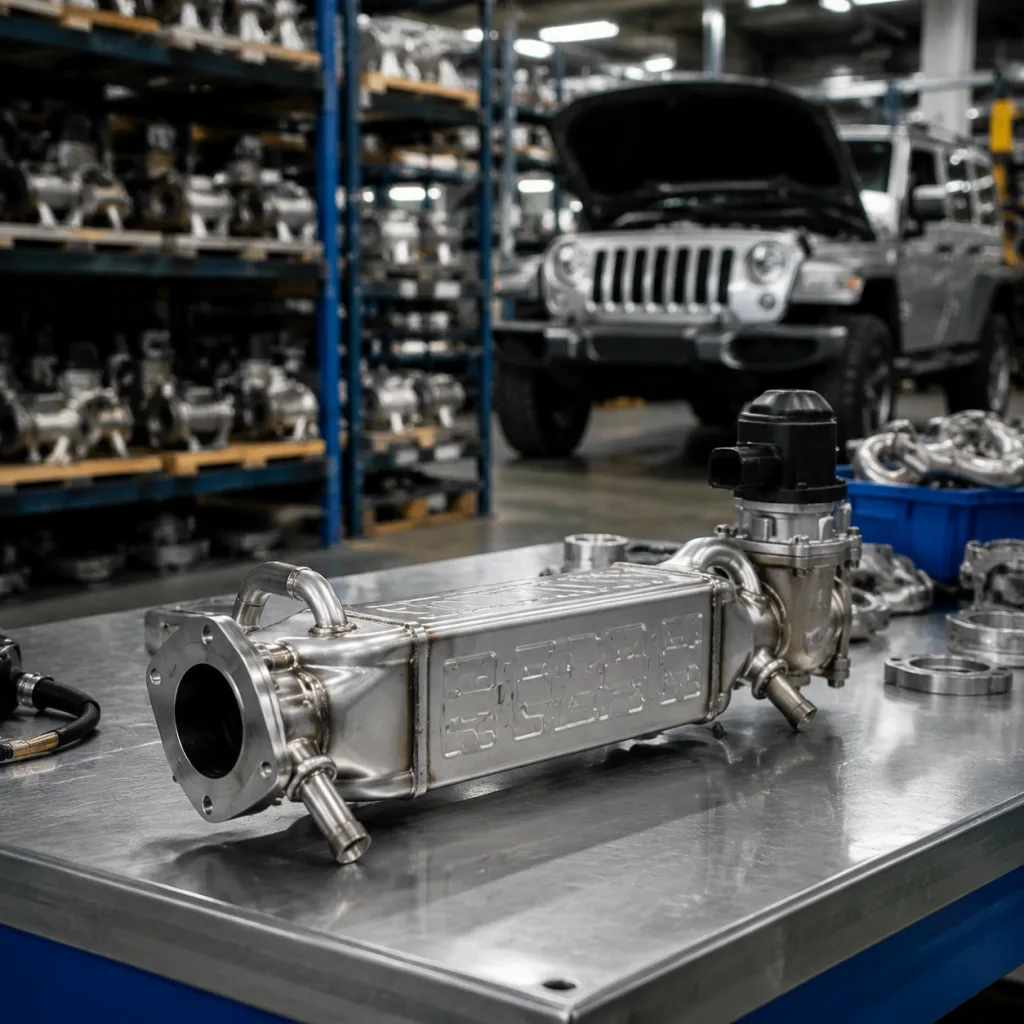
A search for an egr cooler jeep manufacturer china will return plenty of factories, traders, and catalogue sellers. The hard part is separating a part that only looks correct from a programme that can survive warranty pressure, mixed SKU demand, and repeated export orders.
For Jeep-fitment EGR coolers, price is only one variable. Buyers also need evidence of tube-to-header brazing control, flange accuracy, stainless-steel consistency, pressure integrity, cleaning, packaging, traceability, and fitment data discipline across diesel and petrol applications. One weak point can turn a cheap unit into a claim, a lost technician, or a blocked container release.
Driventus manufactures engine and powertrain components in Taizhou, Zhejiang, and supplies B2B customers in more than 60 countries. Our production controls are structured around IATF 16949:2016 and ISO 9001:2015, with incoming material checks, pressure testing, and batch-level inspection records. Driventus is an independent aftermarket manufacturer; vehicle brand names are referenced only to identify fitment. This guide gives sourcing teams a sharper way to qualify Jeep-fitment EGR cooler suppliers in China without assuming vehicle manufacturer approval.
Start with the buying decision, not the unit price
A Jeep-fitment EGR cooler runs hot, wet, acidic, and under vibration. It sees thermal cycling, exhaust condensate, coolant pressure, and installation stress. That is why the lowest quotation can be the most expensive option if weld porosity, tube blockage, flange distortion, contamination, or a poor bypass-valve interface triggers early returns.
Use a simple decision framework before discussing annual volume:
Supplier type: confirm whether you are dealing with a manufacturer, trading company, or mixed sourcing office.
Export record: check destination-market experience, document accuracy, carton labelling, and repeat-order history.
Quality system: request current IATF 16949:2016 and ISO 9001:2015 certificates, including scope, expiry date, site address, and certification body.
Material discipline: verify stainless-steel grade, gasket material traceability, coolant-side compatibility, and REACH (EC) No 1907/2006 awareness for EU-bound shipments.
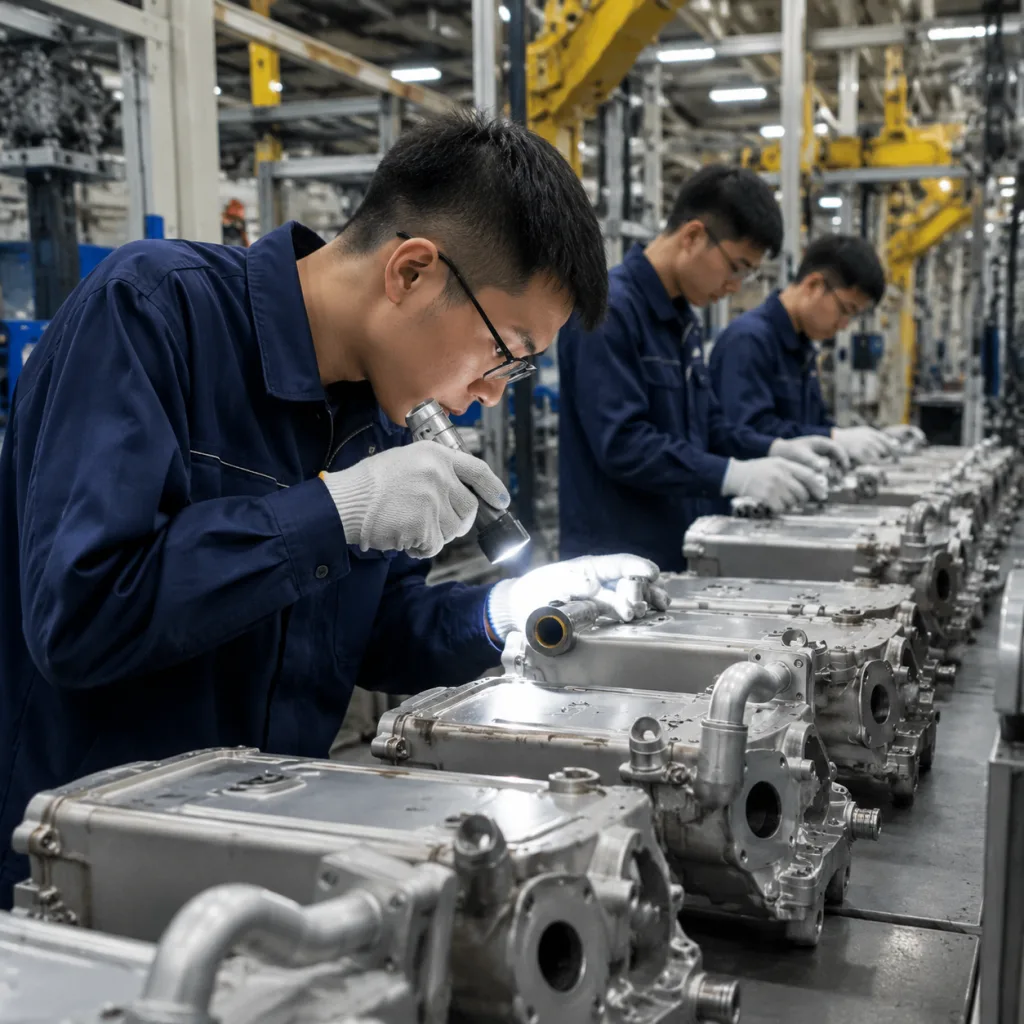
Process proof: ask for brazing, TIG/MIG welding, cleaning, leak testing, pressure testing, fixture maintenance, and gauge calibration records.
Fitment control: review OE cross-reference mapping, sample approval, application notes, and controlled drawings for each part family.
A strong supplier can connect all of these points. A weak one answers only with photos and a price list. For buyers building a Jeep-fitment range, our catalog can help compare EGR coolers with adjacent engine components and identify consolidation opportunities across the engine bay.
Where EGR cooler programmes usually fail
Most EGR cooler problems are not mysterious. They come from small process gaps repeated across many parts: a flange that drifts, a weld that is not controlled, a core that is not cleaned, or packaging that lets a bracket bend during transit. Final inspection helps, but it cannot replace repeatable heat-exchanger production.
Watch the failure modes that create claims:
Failure mode
What it usually points to
Record to request
Coolant leak at the core
Weak brazing, weld porosity, or poor pressure-test discipline
Batch pressure and leak-test report
Exhaust leak at flange
Flange distortion, poor flatness control, or damaged sealing face
Gauge or CMM report
Slow installation
Bracket, port, or actuator-interface dimensional drift
In-process inspection sheet
Reduced heat exchange
Tube blockage, contamination, or inconsistent core assembly
Cleaning checklist and core assembly record
Early corrosion
Wrong stainless grade or poor material traceability
Material certificate and thickness check
Transit damage
Weak carton, poor internal support, or poor pallet plan
Carton specification and drop-test result
</tr></thead><tbody> </tbody></table>The key question is not “Do you inspect?” It is “Which process step prevents this failure, and how is that step recorded?” Critical alignment points include exhaust flanges, coolant ports, mounting brackets, gasket faces, actuator interfaces, and bypass housings.
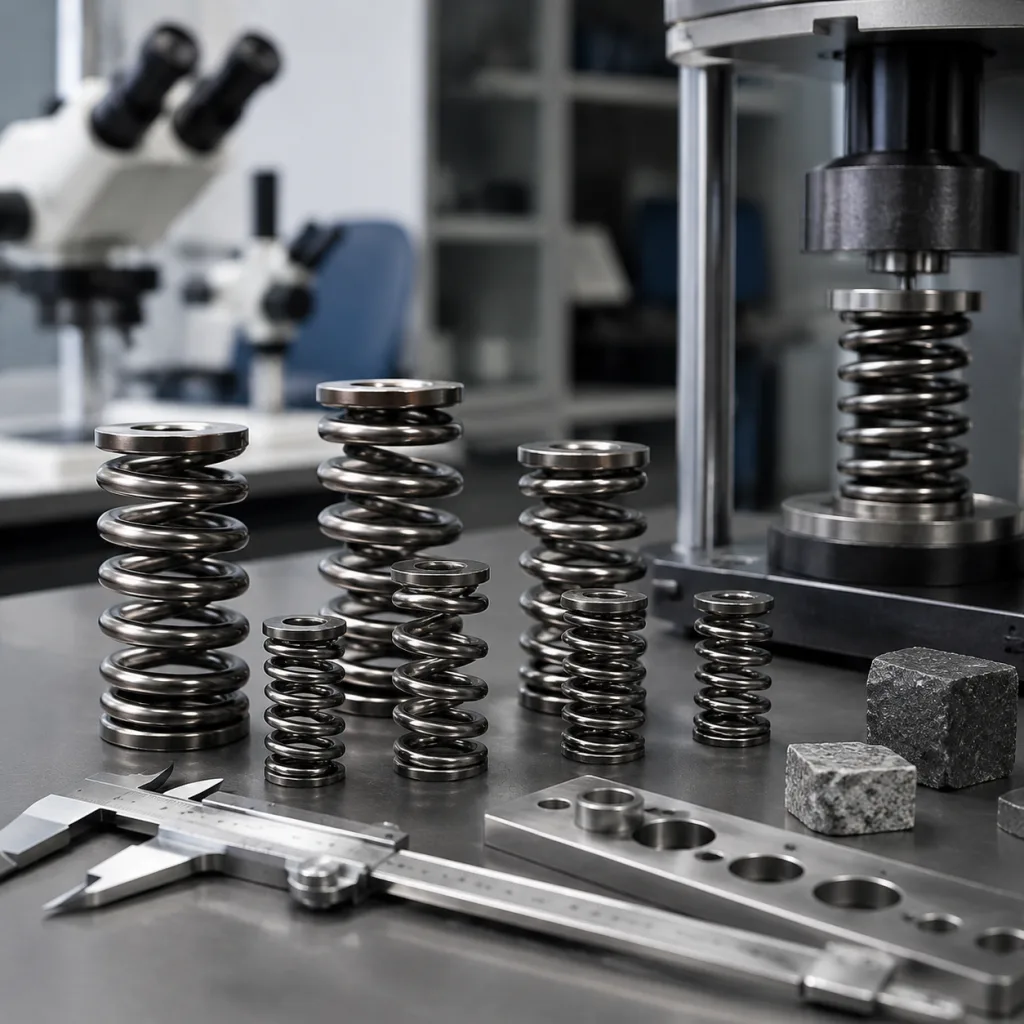
Validation should be agreed by application, volume, and destination market. For emissions-related components, the vehicle compliance framework may include regulations such as ECE R-83 in relevant markets. However, an aftermarket EGR cooler supplier should not claim vehicle manufacturer endorsement unless documented approval exists. Driventus does not claim approval by any vehicle manufacturer.
Build the programme around SKU behaviour
A Jeep-fitment EGR cooler range rarely consists of one neat high-volume reference. It usually combines fast movers, regional applications, older service parts, and slower long-tail items. Treating every SKU the same creates either stockouts or dead inventory.
A practical structure looks like this:
1. Segment the range. Separate high-volume references from trial items, regional demand, and development projects. 2. Run a pilot order. Use it to verify fitment, packaging, barcode data, carton strength, customs documents, and warehouse handling. 3. Lock the data. Confirm drawings, cross-references, accessories, labels, and carton marks before mass production. 4. Plan mixed-SKU production early. Material batches, packaging formats, and inspection requirements affect MOQ. 5. Move to call-offs only after evidence. Quarterly or annual schedules work best after the pilot confirms repeatability.
Commercial variables should be clear before a purchase order is issued:
MOQ: set by part number, tooling status, material batch, accessory kit, and packaging format.
Sample lead-time: shorter for existing references; longer for drawings, tooling, or special validation.
Mass-production lead-time: affected by order quantity, stainless-steel availability, packaging complexity, and inspection depth.
Tooling status: existing tooling supports faster launch; new tooling requires drawing confirmation, sample approval, and dimensional sign-off.
Forecast window: 3–6 months improves material planning, capacity scheduling, and price stability.
Packaging: neutral cartons, distributor labels, palletisation, barcode formats, and destination-language rules should be defined before production.
Buyers seeking China-based supply should ask whether the factory can support both catalogue supply and application-specific development. Driventus supports custom manufacturing for customers needing private drawings, controlled specifications, special packaging, or extended validation beyond standard aftermarket requirements.
Fitment is a specification, not a spreadsheet
Cross-reference data gets the discussion started. It does not finish the engineering work. Jeep applications may vary by engine code, model year range, emissions configuration, coolant port arrangement, sensor provision, bypass-valve layout, actuator type, and regional calibration. Two coolers can look similar on a screen and fail differently on the vehicle.
Treat fitment as a specification package. Before confirming a purchase order, check:
Vehicle platform, model year range, engine displacement, and fuel type.
Emissions level and regional market, where available.
Coolant inlet/outlet diameter, angle, and orientation.
Exhaust flange bolt pattern, sealing face, and gasket interface.
Presence or absence of bypass valve, actuator, vacuum connection, or sensor ports.
Mounting bracket position, heat-shield requirements, and clearance around adjacent components.
Supplied gasket, clamp, bolt, O-ring, or seal kit content.
Driventus manages fitment through application tables, technical drawings, sample comparison, inspection notes, and customer cross-reference files. When an OE-style reference is used, it is recorded only for identification and fitment matching, such as OE 06A… or OE 11251… formats where supplied by the buyer. We do not invent brand-owned part numbers and do not present aftermarket parts as genuine parts.
For broader sourcing around connected products, the engine components page can help buyers map EGR coolers alongside gaskets, water pumps, turbocharger components, coolant-system parts, and related service items.
Audit the line as if a claim has already happened
A useful factory audit should answer one practical question: if a field failure appears six months after shipment, can the supplier trace the part, explain the process history, and contain the problem? Certificates matter, but they are not enough if production records cannot be linked to a batch, gauges are not calibrated, or nonconforming parts are mixed back into stock.
Ask audit questions that follow the part from raw material to shipment:
Can the factory show current IATF 16949:2016 and ISO 9001:2015 documentation under the same legal entity as the exporter or manufacturer?
Are incoming materials linked to batch numbers, supplier certificates, inspection results, and storage controls?
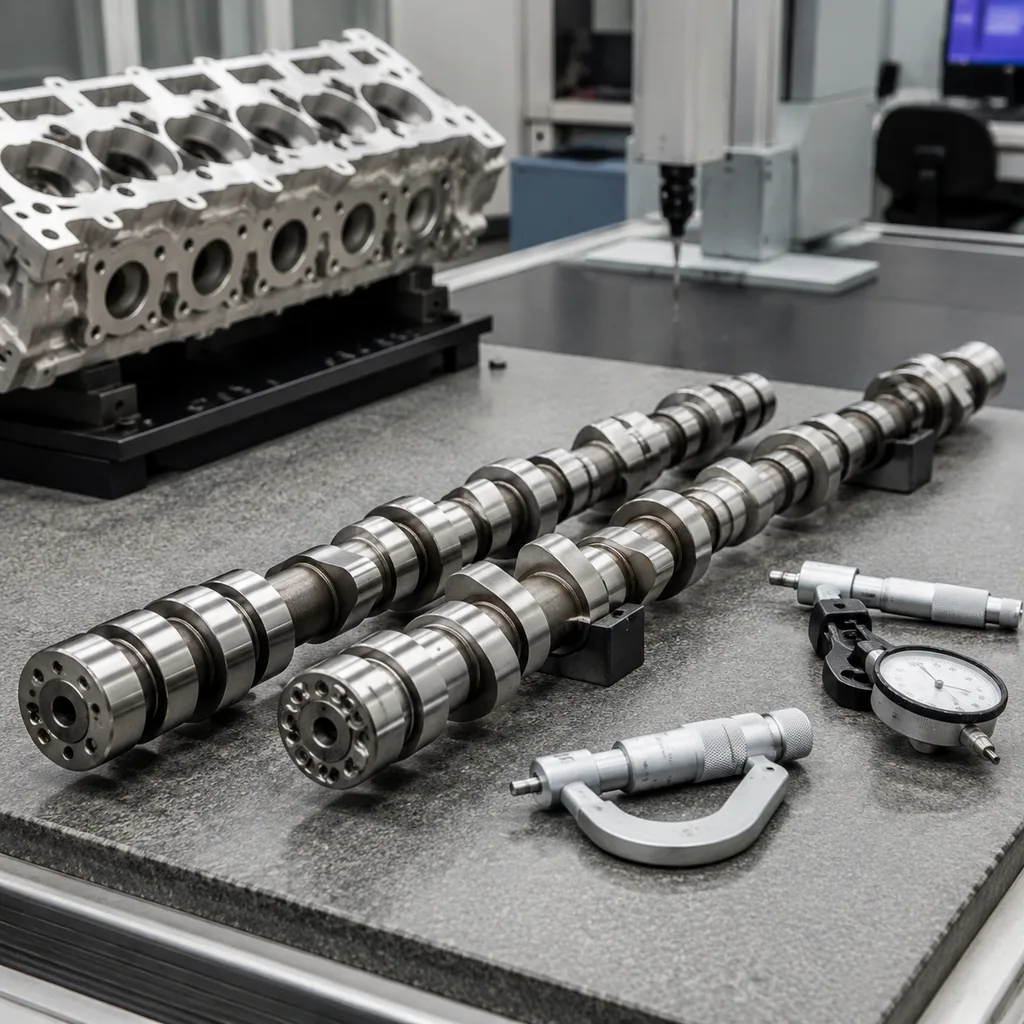
Are welders, brazing equipment, pressure-test rigs, CMM equipment, gauges, and fixtures covered by a calibration or maintenance plan?
Is every production lot linked to inspection records, pressure-test data, packing lists, and carton or pallet labels?
Can the factory segregate nonconforming parts, document corrective actions, and prevent mixed batches from reaching shipment?
Does the supplier support 8D reporting for repeated claims, installation feedback, or field failures?
Are labels, cartons, pallets, barcode formats, and shipping marks compliant with customer import and warehouse requirements?
Then test the answer. Pick one finished carton and ask the factory to trace it back to material, pressure test, inspection, packing list, and operator records. If the trail breaks, the warranty process will break too.
Driventus publishes an overview of its quality system, including certification-led process management and inspection controls. Buyers can request supporting documents during supplier qualification, including sample inspection reports, certificate copies, packaging specifications, and batch-level test records.
Scenario: consolidating Jeep-fitment supply with Driventus
Consider a distributor that wants to reduce scattered purchases from several sellers and build a controlled Jeep-fitment EGR cooler range. The team has target references, annual demand estimates, preferred carton labels, and several warranty complaints from previous supply. The immediate need is not just a quote. It is a cleaner sourcing path.
Driventus would typically support the programme in stages:
Application review: check cross-references, photos, drawings, vehicle notes, and accessory requirements before quotation.
Tooling and feasibility check: confirm existing-tooling coverage or identify new-project requirements.
Sample validation: supply parts for dimensional, material, packaging, and installation review.
Production control: apply batch pressure testing, inspection documentation, and controlled packing.
Export preparation: coordinate neutral or customer-specified packaging, carton marks, pallet plans, barcode rules, and shipping documents.
Claim handling: review photos, installation data, batch codes, and returned samples when required.
This scenario is where the phrase egr cooler jeep manufacturer china becomes only a starting point. Purchasing decisions should rest on process evidence, fitment control, validation discipline, and consistent export execution.
Driventus is based in Taizhou, Zhejiang, with manufacturing focused on engine and powertrain components. We support aftermarket distributors, wholesalers, OEM/Tier-1 purchasing teams, and multi-location repair chains. Driventus is an independent aftermarket manufacturer; brand names are referenced for fitment only. If your team is consolidating EGR cooler supply or adding Jeep-fitment coverage, you can request a quote with target part families, annual volume, destination market, audit requirements, and packaging specifications.
Frequently asked questions
Send target cross-references, photos or drawings if available, annual volume, destination country, packaging needs, and required accessories such as gaskets, clamps, bolts, or seals. Engine code, model year range, and emissions configuration help reduce fitment risk.
Yes. Driventus can support neutral packaging or customer-specified packaging for qualified B2B orders, subject to MOQ, artwork confirmation, carton specification, barcode rules, and destination-market labelling requirements.
No. Driventus does not claim vehicle manufacturer approval or endorsement. Driventus is an independent aftermarket manufacturer; brand names are referenced for fitment only.
Share your target references, forecast, destination market, packaging needs, and audit requirements so our team can confirm feasibility, MOQ, and lead-time. Contact Driventus at /contact.html