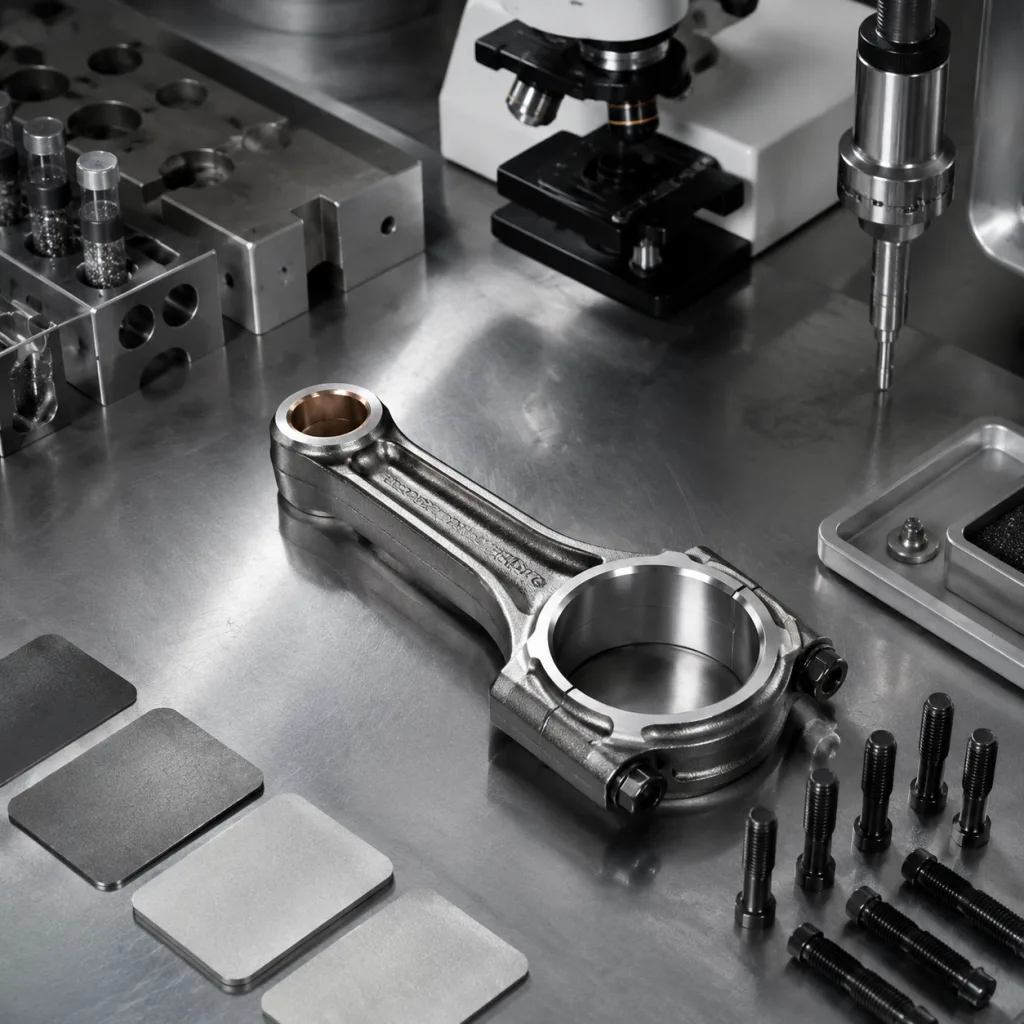
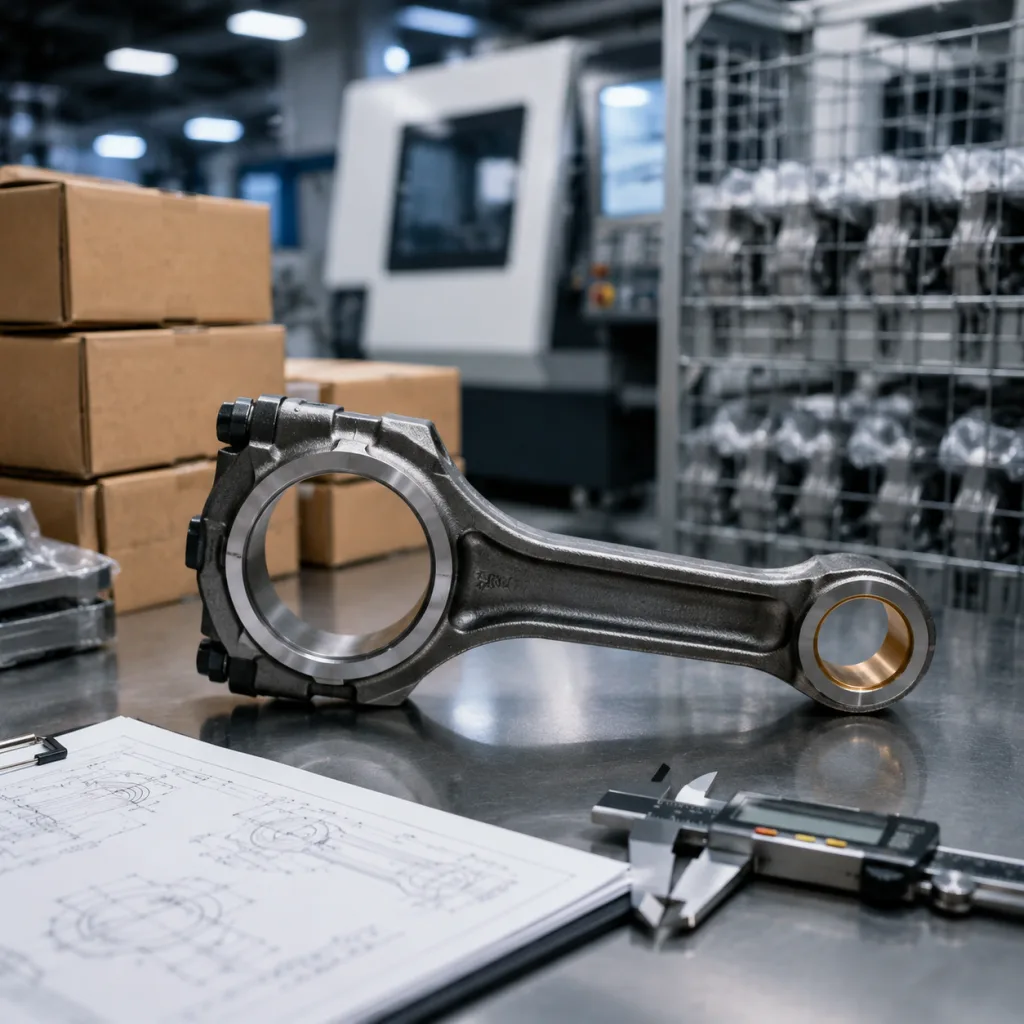
Sourcing a connecting rod for Honda Accord OE equivalent supply is not a catalogue-matching exercise. It is a risk-control decision: will this rod hold bearing geometry, pin alignment, bolt clamp load, and weight consistency across thousands of repairs, not just pass a visual comparison on a desk?
For distributors, engine rebuilders, and repair-chain procurement teams, the expensive failure is rarely the rod alone. It is the comeback: bearing noise, unstable oil pressure, imbalance, repeated labour, return freight, and warranty debate across several locations. A small error in big-end bore roundness, centre distance, small-end finish, cap alignment, or rod-bolt specification can create that outcome.
Driventus manufactures engine components in Taizhou, Zhejiang, for aftermarket and B2B replacement channels in more than 60 countries. This article sets out a practical sourcing framework: how to define OE-equivalent, which measurements matter, where suppliers typically fail, what validation evidence to request, and how to connect engineering approval with MOQ, pricing, lead time, packaging, and batch traceability. Driventus is an independent aftermarket manufacturer; Honda and Accord names are referenced for fitment identification only.
Define OE-Equivalent by Function, Not by Catalogue Appearance
OE-equivalent does not mean approved by, supplied to, or endorsed by a vehicle manufacturer. In B2B replacement sourcing, it means the component is engineered to match the functional geometry, material performance, mass control, assembly behaviour, and durability expectations required for the intended engine application.
For Honda Accord applications, the first decision is fitment scope. Do not start with a photo. Start with engine code, displacement, production year range, market, fuel type, and piston-pin configuration. Add any verified OE part-number cross-reference used in the buyer’s own system, using a generic format such as OE 13210… only where applicable. Rods from adjacent engine families may look almost identical while differing in crankpin size, small-end design, rod bolt length, cap design, or weight strategy.
A useful procurement file turns the application listing into measurable criteria:
Centre-to-centre length from crankpin bore to piston-pin bore, normally controlled to the drawing within about ±0.02 mm to ±0.05 mm depending on design
Big-end bore diameter after cap assembly and specified bolt torque, checked for size, taper, and out-of-round condition
Small-end bore diameter, pin clearance or interference requirement, and bushing material where fitted
Big-end width and small-end width, including side-clearance logic with the crankshaft and piston boss
Bearing locating tang position, chamfer direction, and oil-hole position where relevant
Rod bolt thread size, property class or grade, torque method, torque-plus-angle requirement, lubricant condition, and replacement policy
Weight target and permitted spread per matched set, commonly held tighter for four-cylinder engine sets than for loose service stock
Surface treatment, shot peening, stress relief, phosphate, or anti-corrosion oil process where specified
Marking, cap matching, laser code, batch number, and traceability requirements
This distinction prevents a common sourcing mistake: approving a rod because it is listed for an Accord generation while leaving the actual engineering boundaries undefined. A buyer should be able to state whether the quote is for loose rods, a matched set of four, rods with bolts included, rods with bushings finished to size, or rods supplied semi-finished for local honing.
Driventus publishes engine component coverage through our catalog, including replacement engine parts for import distributors and repair networks.
Failure Modes to Control Before They Reach Workshops
Connecting rods work under alternating tensile and compressive load while trying to keep the bearing housing stable at high speed. When geometry drifts, the complaint may not sound like “bad connecting rod.” It may arrive as bearing noise, piston slap, low oil-pressure concern, uneven wear, or vibration after an otherwise routine rebuild.
The most sensitive checks should be performed after final machining, cap matching, bolt tightening, and honing. Big-end roundness and cylindricity are critical because crankshaft oil film depends on stable bearing crush and predictable housing shape. In practical buyer specifications, the big-end bore is often checked at 0°, 45°, 90°, and 135° positions across at least two measuring depths. For high-volume programmes, buyers commonly request big-end roundness and taper controls in the 0.005 mm to 0.012 mm range where the design and machining route allow.
Small-end geometry also deserves attention. A press-fit pin, floating pin, or bronze-bushed design will each have different clearance, finish, and assembly risks. Pin-bore finish is commonly specified around Ra 0.2–0.8 µm depending on pin arrangement and bushing material.
Failure risk
Control point
Buyer verification
Piston deck inconsistency or compression variation
Centre distance
CMM or dedicated gauge report with tolerance stated
Bearing noise or oil-film instability
Big-end bore size
Bore gauge data at multiple angles after bolt torque
Local bearing overload
Big-end roundness and taper
Roundness trace or inspection summary, target agreed by drawing
Pin scuffing or slap
Small-end bore finish
Surface finish and diameter record, including bushing ID where fitted
Vibration after rebuild
Rod weight spread
Set weight report, total and end-to-end; typical matched-set spread agreed in grams
Housing distortion or cap mix-up
Cap alignment
Matched cap marking, fracture-split or machined-cap audit, and assembly record
</tr></thead><tbody> </tbody></table>The inspection plan should say which features are checked 100%, which are sampled, and which are verified during first-article approval. A practical control plan may require 100% visual inspection, cap-match confirmation, and go/no-go bore checks; 5-piece first-off inspection at each machining setup; and AQL-based final inspection for packed lots.
For production batches, Driventus typically uses fixture-based in-process inspection and final sampling plans agreed with the customer. For critical import programmes, buyers may request first-article inspection, PPAP-style documentation where relevant, and retained samples from each production lot for dispute resolution.
Spec Deep-Dive: Steel Route, Heat Treatment, Bolts, and Traceability
Material claims are easy to overstate. “OE quality” or “high strength” does not tell a buyer whether the rod will have the right fatigue resistance, toughness, thread integrity, or crack-control process. Replacement connecting rods for passenger-car petrol engines may be produced from forged steel, powdered metal, or other cast/forged process routes depending on the original design and load case.
For a credible connecting rod for Honda Accord OE equivalent programme, procurement teams should ask for documented controls in four areas.
1. Base material and manufacturing route
Confirm the material grade or chemical composition range, such as 40Cr, 42CrMo, C70S6, micro-alloyed steel, or the agreed equivalent for the application. Also confirm whether the rod is forged, powder metal, fracture-split, or a conventional machined-cap design. These routes are not interchangeable without engineering review.
2. Heat treatment and surface condition
Heat treatment should be controlled to a defined HRC or HB window, not a single nominal claim. Hardness alone is not proof of suitability. Excessive hardness can reduce toughness and raise crack sensitivity; insufficient heat treatment can reduce fatigue resistance. A useful approval file may include a hardness map or sample plan, for example 3 to 5 pieces per heat-treatment lot, plus destructive verification during new-part approval where the order volume justifies it.
Where specified, buyers should also confirm grain flow or microstructure, magnetic particle inspection or equivalent crack detection, and shot-peening coverage and intensity. Higher-risk programmes may require Almen value and coverage percentage records.
3. Rod bolts
Rod bolts are part of the joint system, not loose accessories. Confirm mechanical property, grade, tensile strength range, thread engagement, coating, torque method, torque-plus-angle requirement, lubricant condition, and replacement policy. If the inspection bore data was taken with a different bolt or torque condition than the workshop will use, the report is less useful.
4. Lot traceability
Records should link steel heat number, forging batch, heat-treatment batch, machining lot, inspection file, and packing lot. Without that chain, a future claim becomes a broad shipment dispute instead of a controlled batch investigation.
Driventus operates under IATF 16949:2016 and ISO 9001:2015 frameworks. Buyers can review how incoming material inspection, traceability, non-conforming product control, and corrective actions are managed through our quality system.
Choose the Right Validation Level for the Commercial Risk
Validation should not be identical for every order. A distributor adding low-volume catalogue coverage may need sample approval, material confirmation, and batch inspection. A repair-chain network installing the same rods every month should go deeper before national rollout. One fitment problem can spread through workshops quickly.
A practical approval sequence for a new SKU usually looks like this:
1. Confirm 2D drawing, reference sample, or buyer specification 2. Verify application scope and cross-reference logic 3. Produce prototype or trial-machined samples where required 4. Inspect 5 to 10 pieces for critical dimensions 5. Build a matched-set trial assembly 6. Obtain buyer sample sign-off 7. Run a pilot lot under agreed inspection controls 8. Review pilot feedback before mass production
Typical validation evidence includes dimensional first-article reports, hardness testing, tensile or material certification, surface-finish checks, bolt torque verification, weight matching, and fatigue testing based on the agreed duty cycle. Where the customer has an internal engineering specification, Driventus can build a control plan against that document under custom manufacturing.
Published management and compliance standards can support supplier screening. IATF 16949:2016 addresses automotive quality management, and ISO 9001:2015 addresses quality management systems. For European importers, material declarations may also need to consider REACH (EC) No 1907/2006 depending on the component, coating, packaging, and supply-chain disclosure requirements. These standards do not replace part-level validation. They show whether process controls exist behind it.
Suggested pre-shipment file
A practical pre-shipment file for replacement connecting rods should include:
1. Part drawing or approved reference sample record, with revision date and sign-off status 2. Dimensional inspection report for critical features, including bore size, centre distance, width, and weight 3. Material certificate and heat-treatment record linked to batch number 4. Hardness test data with method, location, and sample quantity 5. Rod weight report by set or batch, including total weight and, where required, big-end and small-end weight 6. Bolt specification and torque/assembly confirmation, including lubrication condition used during inspection 7. Packaging specification and corrosion-protection method, such as VCI bag, anti-rust oil, carton thickness, and pallet wrap 8. Batch number, production date, quantity, carton count, and traceability label format
Importer Scenario: When Fitment Data, Packaging, and Traceability Decide the Programme
Consider a typical importer: one Accord connecting rod SKU is intended for several markets, but the vehicles in those markets do not share the same engine mix. Some are regional imports. Some have replacement engines. Some catalogue systems group model years too broadly. If the buyer releases the line based only on model name and year range, returns are likely.
Fitment errors are one of the most avoidable causes of claims. For each SKU, buyers should maintain a fitment file covering engine code, displacement, model year range, piston-pin type, crankpin diameter family, bearing pairing, rod length family, and any supersession notes. If an OE part-number cross-reference is used, it should be recorded consistently, for example OE 13210… in internal interchange data. Brand names and model names should be used only for fitment identification, not to imply endorsement or genuine-part status.
The catalogue should also answer a workshop’s practical questions before the box is opened:
Is the item sold as one rod or one matched set of four?
Are bolts included, pre-fitted, packed separately, or excluded?
Are bushings fitted and finished to size?
Is the rod ready for installation after normal workshop checks, or is local honing required?
Does the set need to remain together because of weight matching?
Packaging then becomes part of quality control. A set for one engine should keep matched rods together, protect machined bores from corrosion, prevent cap mix-up, and show batch traceability on the outer carton. A typical export packing plan may use individual oiled VCI wrapping, separators to prevent metal-to-metal impact, an inner set box, 5-layer export carton, and palletised cartons with gross weight kept within the buyer’s warehouse limit.
Repair chains may also request QR-based traceability, private-label carton formats, installation notes, GS1-style barcode data, or pallet labelling aligned with warehouse systems.
Driventus can support catalogue review for importers sourcing multiple engine components, including pistons, rings, bearings, gaskets, crankshafts, and water pumps, so the connecting rod line aligns with related overhaul parts and reduces mismatch risk during engine rebuilds.
Buyer Q&A Before MOQ, Price, and Lead Time Are Locked
Before approving a connecting rod for Honda Accord OE equivalent programme, separate engineering approval from commercial approval. A low unit price does not offset warranty labour, vehicle downtime, diagnostic time, return freight, and customer dissatisfaction if the part is dimensionally unstable or incorrectly catalogued.
What should be confirmed before sampling?
Confirm exact application scope by engine code, market, and production range. Request critical dimensions and tolerance targets before price approval, not after. Check material route, heat treatment, hardness range, big-end bore data after bolt torque, small-end design, bushing condition, and pin-fit requirement.
What makes supplier comparisons more reliable?
Compare the same supply condition. One quote may include bolts, set weight matching, bushings, export corrosion protection, and private-label packing. Another may not. Confirm whether rods are supplied loose or in matched engine sets, what inspection level is included, and how batch records will be delivered.
Use this checklist during comparison:
Confirm rod bolt supply: included, pre-fitted, packed separately, or sold separately
Review weight-matching method for full engine sets and agree the maximum gram spread
Require batch traceability on component, carton, pallet label, invoice, and shipment paperwork
Check corrosion protection for sea freight and warehouse storage, typically 6 to 12 months depending on destination and packaging
Review IATF 16949:2016 or ISO 9001:2015 certification validity and audit scope
Agree on inspection method for first shipment and repeat orders, including retained sample quantity
Define claim handling, sample retention, 8D or corrective-action response time, and replacement-credit logic
How do MOQ and price usually move?
MOQ is usually lower when Driventus already has tooling, fixtures, and validated drawings for the application. It is higher when new forging dies, machining fixtures, gauges, or private packaging must be prepared. As a working planning range, stocked or active SKUs may be quoted from a few hundred pieces, while new or low-frequency applications may require 500–1,000 pieces or more to absorb setup cost.
Unit price is affected by steel grade, forging weight, machining time, bolt inclusion, bushing material, inspection level, packaging, and whether rods are supplied loose or weight-matched in engine sets.
What lead time should buyers plan around?
Lead time usually separates into sample development, approval, production, and shipping. Samples may require 2–6 weeks depending on tooling status. Mass production is often planned at 30–60 days after deposit and sample approval. Sea freight and customs add destination-specific time.
For distributors and repair networks, Driventus can provide samples, technical discussion, and quotation review. To discuss volume, packaging, or application coverage, request a quote.
Frequently asked questions
No. OE-equivalent means the replacement part is designed to match the required function, dimensions, material performance, and service fitment for the intended application. It does not mean the part is approved by or supplied through the vehicle manufacturer.
Request critical dimension reports, material and heat-treatment records, hardness data, rod weight data, bolt specifications, torque confirmation, packaging details, and batch traceability. For higher-volume programmes, add fatigue validation or customer-specific control-plan evidence.
Yes. Driventus can discuss private-label cartons, matched-set packaging, corrosion protection, barcode or QR traceability, and market-specific catalogue data as part of a B2B supply programme.
If you are evaluating Accord replacement connecting rods for distribution, service networks, or engine rebuild programmes, share your application list, target volumes, packaging needs, and inspection requirements with our team. Start a technical sourcing discussion at /contact.html