Connecting Rod for GMC Acadia Replacement Sourcing
A connecting rod for GMC Acadia replacement programs has to match the exact engine architecture—not just the vehicle name. Critical factors include bearing clearances, piston pin geometry, crankshaft journal interface, rod length, fastener preload, reciprocating weight, and fatigue strength. For importers, engine rebuilders, distributors, and repair-chain buyers, the sourcing risk is not limited to fitment. The part also needs to support consistent assembly, stable oil film formation, balanced engine operation, and repeatable quality across production batches. A sourcing file should define target dimensions, inspection method, sample quantity, commercial MOQ, replenishment lead time, packaging, and claim rules before the first purchase order. Driventus supplies connecting rods for aftermarket engine repair and remanufacturing programs, with production controls aligned to IATF 16949:2016 and ISO 9001:2015. This guide outlines what procurement teams should verify before approving a replacement connecting rod for GMC Acadia applications, including fitment data, dimensional matching, materials, validation testing, MOQ/price logic, packaging, and documentation. Driventus is an independent aftermarket manufacturer; vehicle brand names are used for fitment reference only.
Fitment Requirements for GMC Acadia Engine Repair
The GMC Acadia has been offered with different engine configurations depending on model year, generation, and market, including 4-cylinder and V6 gasoline engine families in some regions. Because of that, a replacement connecting rod should never be approved by vehicle model name alone. Buyers should verify the engine code or engine family, displacement, production year range, piston pin diameter, crankshaft journal diameter, bearing shell specification, and rod design before placing an order.
For B2B sourcing, the strongest approach is to maintain a fitment file that connects each SKU to its engine family, application range, reference dimensions, and OE-style reference data where available. If an OE part-number cross-reference is used, it should be treated as an identification aid, not as proof of vehicle manufacturer approval. Generic reference formats such as OE 06A… or OE 11251… should appear only when they are relevant to customer-provided reference data and supported by a technical comparison.
A practical replacement program should verify:
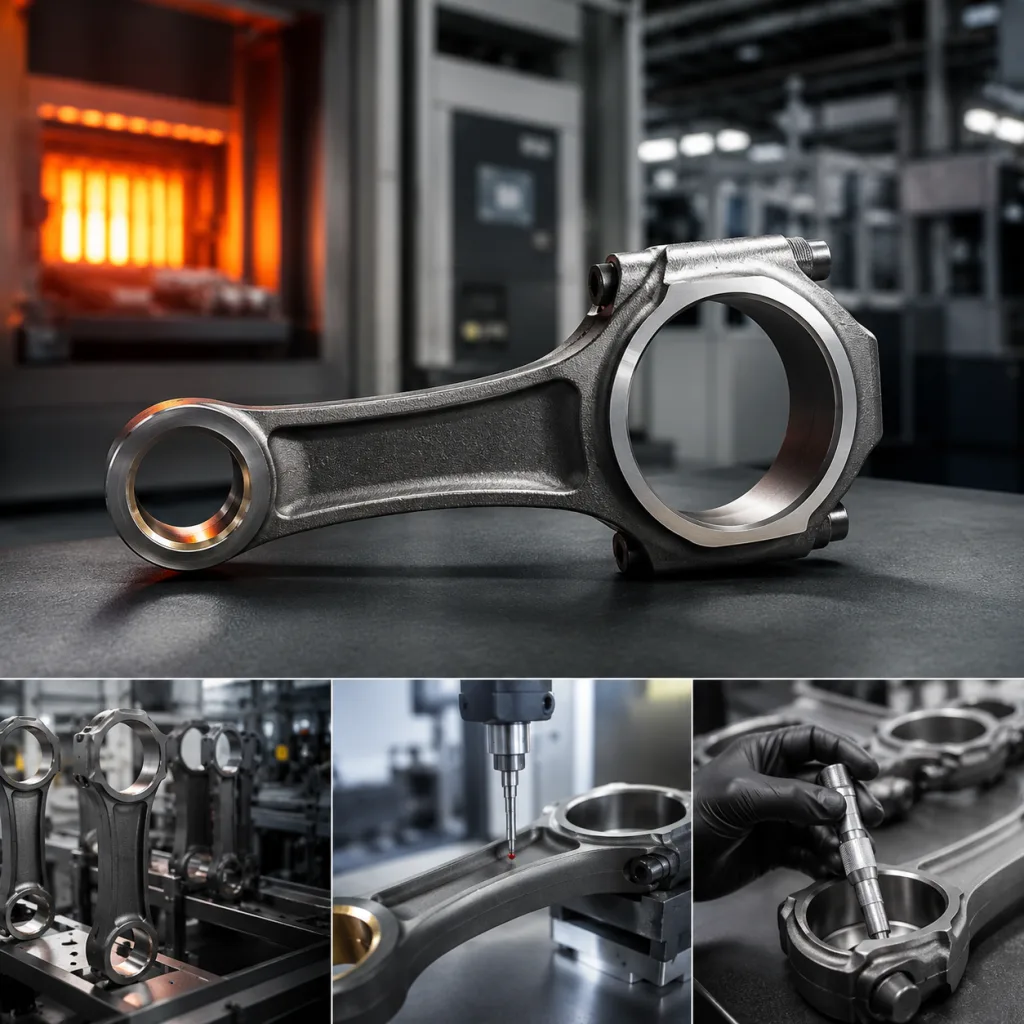
Centre-to-centre length from big-end bore to small-end bore, normally controlled within the drawing tolerance and checked on a calibrated fixture
Big-end bore diameter after cap assembly and tightening, with roundness and taper recorded rather than only a single diameter reading
Small-end pin bore diameter and bushing specification, if applicable, including oil-hole position and pin-fit class
Big-end width and side clearance target against the crankshaft cheek spacing
Rod bolt thread, length, grade, tightening method, torque-angle sequence, and whether bolts are reusable or torque-to-yield
Weight range and balancing method across sets, commonly quoted in gram bands for big-end, small-end, and total weight
Bearing tang position and cap orientation, including any asymmetric chamfer or oil-squirt clearance features
Cap parting method and cap-to-rod matching control, especially for fracture-split caps that must never be mixed
Surface finish at bearing and pin interfaces, typically specified by Ra value on the approved drawing
Compatibility with the intended piston, crankshaft, bearing set, cylinder block deck height, and compression target
This fitment discipline is especially important for distributors and repair chains that sell into multiple workshops. A rod that appears correct visually can still create oil-clearance, noise, or durability problems if the bore geometry, length, or fastener system is not matched to the engine build. For example, a small change in big-end bore size can reduce bearing crush, while a length deviation can affect piston deck clearance and compression balance. Driventus can support connecting rods as part of broader engine repair sourcing through our catalog and the engine component range at /products/engine-components.html.
Dimensional Match and OE-Equivalent Function
For replacement intent, dimensional accuracy is the first approval gate. Even small deviations can affect oil clearance, piston deck height, compression balance, cold-start noise, bearing life, or crankshaft loading. Procurement teams should request inspection data from pre-production samples and compare it with the mating piston, crankshaft, bearing shell, and fastener specification used in the rebuild program.
A connecting rod for GMC Acadia replacement use should be assessed as a system component, not as an isolated forging, casting, or powder-metal part. The big-end bore must remain round after the cap is tightened using the specified method. The small-end bore must maintain pin alignment under operating temperature and load. Rod bolt clamping force must be repeatable after the defined torque-angle or torque-only procedure, because cap movement can quickly damage the bearing interface.
Check point
Typical procurement requirement
Why it matters
Centre-to-centre length
Drawing-controlled; common sourcing targets are ±0.02–0.05 mm where the design allows
Maintains compression height and cylinder-to-cylinder balance
Big-end bore diameter
Measured after cap torque; record diameter at 0°, 90°, and both bore ends
Supports bearing crush and oil film stability
Big-end bore roundness/taper
Often controlled in the 0.005–0.015 mm range, subject to drawing
Reduces local bearing load and oil-film failure risk
Small-end bore finish
Matched to pin or bushing design; Ra target should be stated on the drawing
Helps reduce pin scuffing, seizure risk, and noise
Big-end width
Checked against crankshaft side-clearance target; do not quote by width alone
Prevents binding or excessive lateral movement
Weight grouping
Supplied in defined gram bands, such as ±1–3 g per set when required
Supports smoother engine operation after rebuild
Bolt preload consistency
Tested with the specified fastener method and lubricant condition
Reduces risk of cap shift and bearing damage
Traceability
Batch, heat, machining lot, and inspection records retained
Supports warranty analysis and containment action
</tr></thead><tbody> </tbody></table>Dimensional control should include both individual readings and process capability where the order volume justifies it. For high-volume programs, buyers may also define master samples, gauge requirements, sample retention, and requalification intervals after tooling or process changes. A typical first-article package may include 3–10 sample rods, full layout inspection, material certificate, hardness readings, and a signed deviation list if any non-critical dimension needs buyer approval.
Driventus replacement connecting rods are produced to customer drawings, approved sample specifications, or reverse-engineered dimensional data where legally permitted. We do not claim approval, authorization, or endorsement by any vehicle manufacturer.
Material, Heat Treatment, and Surface Control
Connecting rods for replacement engines are commonly manufactured from forged steel, powder metal, or other application-specific materials. The correct choice depends on the original design, production volume, load requirement, and target cost. For repair chains and remanufacturers, the priority is normally consistent OE-equivalent function rather than unnecessary design changes that may complicate balancing, assembly, or validation.
A robust sourcing specification should define material grade, heat treatment condition, hardness range, microstructure requirement, machining sequence, and final surface condition. Buyers should also state whether shot peening, machining after heat treatment, crack detection, or weight matching is mandatory. If the original connecting rod uses a fractured cap or a machined cap, the replacement design should preserve the required cap-location behavior and assembly procedure.
Key technical controls include:
Material certificate linked to the production batch, including heat number and chemical composition
Hardness testing after heat treatment, with the target range agreed before sampling rather than left to supplier standard
Microstructure or metallurgical review when specified, especially after a material or heat-treatment supplier change
Magnetic particle inspection or equivalent crack detection where required, with sampling rate or 100% inspection clearly stated
Big-end and small-end bore machining after stress-relieving where applicable to reduce distortion risk
Cap parting face control to prevent misalignment, fretting, or false seating during final torque
Rod bolt and thread inspection, including grade confirmation, thread gauge checks, and under-head seating condition where specified
Rust prevention suitable for 30–90 days of sea freight and warehouse exposure, or longer if the buyer requires seasonal stockholding
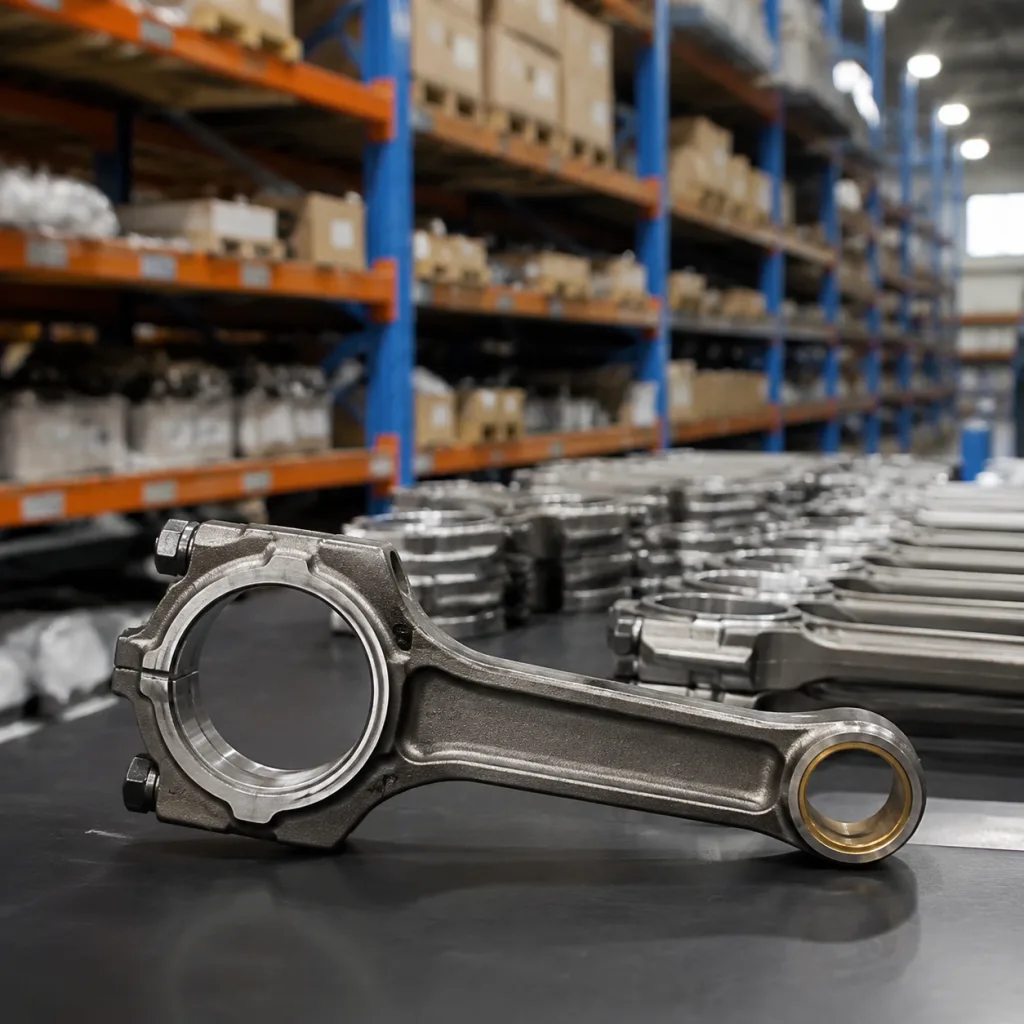
Packaging that prevents bore impact, cap mix-up, and mixed-set errors, using separators, VCI bags, oil paper, or molded trays as needed
Environmental and substance compliance may also apply. For EU-bound programs, importers often request declarations aligned with REACH (EC) No 1907/2006. Other markets may require additional packaging, labeling, or restricted-substance documentation. Export cartons should protect machined surfaces from corrosion, shock, dust, and humidity during ocean freight, inland transport, and extended warehouse storage.
Surface control deserves special attention because connecting rods are handled multiple times before installation. Protective oil, VCI packaging, separators, and set identification can prevent corrosion marks, nicks, and cap interchange errors that may otherwise appear only during engine assembly. Buyers should specify whether rods are packed as singles, 4-piece sets, 6-piece sets, or engine kits, because that decision affects balancing control, label logic, carton weight, and warranty traceability.
Validation Testing Before Purchase Approval
A replacement connecting rod should pass more than visual and dimensional checks. The approval plan should be proportionate to the risk, order volume, application severity, and warranty exposure. For a new SKU, buyers typically request initial sample inspection reports, material reports, hardness results, and test evidence from fatigue, tensile, or cyclic load validation where applicable.
Driventus manages production and inspection under a documented quality system aligned to IATF 16949:2016 and ISO 9001:2015. For powertrain components, this process structure matters because small changes in material, heat treatment, machining, or bolt tightening can affect long-term durability even when the part looks correct at incoming inspection.
A typical validation package may include:
Full dimensional inspection against drawing or approved sample, including gauge ID, calibration status, and actual readings
Material chemistry and mechanical property report linked to the heat number
Hardness and heat treatment verification, with readings taken at agreed locations
Bore geometry measurement before and after bolt tightening to detect cap movement or distortion
Bolt torque and clamp-load consistency evaluation using the specified oil, dry, or thread-locking condition
Fatigue or cyclic load testing based on customer requirement, especially for remanufactured-engine warranty programs
Surface defect inspection and cleanliness review for burrs, cracks, abrasive residue, and machining chips
Weight grouping report for matched sets, including total weight and, where required, big-end/small-end balance
Packaging drop, vibration, or corrosion-resistance review where long-distance export logistics are involved
Production Part Approval Process style documentation when required by the buyer, such as control plan, PFMEA, process flow, and PSW-style summary
Buyers should agree on the acceptance standard before samples are produced. That includes the number of samples, inspection method, tolerance source, measurement equipment, and whether destructive testing is needed. A practical approval sequence is: confirm application data, inspect reference samples, produce trial samples, complete dimensional and material validation, run assembly checks with the intended bearing and piston pin, approve packaging, then release a pilot order. For ongoing orders, the same logic should be converted into a control plan covering incoming material checks, in-process machining inspection, final audit frequency, and traceability retention.
Published vehicle emissions standards such as ECE R-83 regulate vehicle-level emissions performance, not individual connecting rod approval. However, stable engine rebuild quality helps maintain combustion consistency, oil control, compression balance, and durability after repair. Procurement teams should keep this distinction clear in technical files, catalog copy, and marketing claims.
Sourcing Options for Distributors and Repair Chains
Different buyers need different supply models. A national repair chain may need stable packed sets with rapid replenishment and clear workshop identification. An engine parts distributor may require mixed SKUs under one consolidated shipment. A remanufacturer may need rods supplied with matching pistons, bearings, crankshafts, gaskets, or other engine components to simplify line-side assembly.
Driventus is vertically integrated in Taizhou, Zhejiang, with production covering pistons, crankshafts, gaskets, water pumps, turbochargers, and related engine components. For a connecting rod for GMC Acadia replacement program, we can support standard aftermarket supply or custom manufacturing based on drawings, approved samples, target tolerances, inspection requirements, and packaging specifications.
Procurement teams should define the following before requesting pricing:
Annual forecast and first-order quantity, separated into launch order, safety stock, and monthly replenishment
Required model year and engine application range, including exclusions for engines that look similar but use different geometry
Engine code or engine family, where available, plus sample photos of rod, cap, bearing tang, and bolt head marking
Whether rods are purchased individually or as balanced sets, and whether the quote should include bolts, bushings, or packaging inserts
Required inspection report format and sampling level, such as 100% critical bore inspection or AQL-based final inspection
Private label, neutral label, or bulk industrial packaging, including barcode type and carton quantity
Destination market and compliance documentation, including REACH declarations where required
Incoterms, consolidation needs, and target lead time, such as EXW, FOB Ningbo/Shanghai, CIF, or DDP by agreement
Spare-parts catalog data, barcode format, and carton-marking rules
Expected warranty handling process and claim evidence requirements, including photos, mileage, engine build data, and failed-part return rules
MOQ and price should be read together, not separately. A small trial order may carry higher unit cost because setup, inspection, packaging artwork, and export documentation are spread across fewer pieces. For established tooling and neutral packaging, MOQs can often be lower than for a new custom rod requiring forging, fixtures, PPAP-style documentation, and fatigue testing. Lead time also depends on status: sample development is commonly longer than replenishment, while private-label packaging and consolidated engine kits add planning time. Buyers should ask suppliers to quote separately for sample cost, tooling or fixture cost if any, first mass-production MOQ, regular replenishment MOQ, and lead time after deposit or order confirmation.
Clear input data reduces sampling cycles and avoids disputes over fitment. It also allows suppliers to quote on the same technical basis, rather than competing only on unit price while using different assumptions for material, inspection, packaging, or documentation. For established SKUs, buyers can request a quote with application details, estimated annual volume, and any existing reference samples.
Buyer Checklist for Replacement Approval
Before releasing a purchase order, the buying team should complete a structured technical and commercial review. This is especially important when the part will be distributed across multiple repair locations, sold under a private label, or installed in remanufactured engines with warranty coverage.
Pre-order technical checklist
Confirm engine family, model year range, market application, and any excluded variants
Compare all critical dimensions against drawing or approved sample, including actual measurement values rather than pass/fail only
Validate big-end bore after cap tightening with specified bolts, lubricant condition, torque, and angle sequence
Confirm small-end bore or bushing specification against the piston pin, including clearance target and surface finish
Check rod weight grouping and set-matching method, including whether mixed production lots can be combined
Review material, heat treatment, hardness, crack inspection, and surface finish records
Confirm corrosion protection for the full logistics route, including expected days in transit and warehouse storage
Approve packaging to prevent cap mixing, bore damage, rust, and set separation
Retain batch traceability data for warranty handling, with carton label linked to production lot and inspection record
Define reapproval rules for tooling, process, material, heat treatment, bolt supplier, or packaging changes
Commercial and quality checklist
Confirm MOQ, sample quantity, lead time, and replenishment schedule for both launch and regular orders
Review audit documentation for IATF 16949:2016 and ISO 9001:2015 alignment
Define acceptable quality limit, critical-characteristic inspection rate, claim response timing, and containment process
Confirm REACH (EC) No 1907/2006 documentation if required for the EU
Agree on artwork, label language, barcode format, carton identification, and pallet requirements
Clarify Incoterms, shipment consolidation, payment terms, spare packaging needs, and whether pricing includes bolts or bushings
Keep fitment statements factual and avoid implying vehicle manufacturer endorsement
A well-controlled replacement program reduces installation issues, warranty returns, catalog corrections, and emergency air freight. It also gives import managers a clearer basis for comparing supplier quotations beyond unit price. When every supplier is measured against the same drawing, fitment scope, test package, MOQ, lead time, and packaging standard, purchasing decisions become easier to defend internally.
Frequently asked questions
No. Fitment depends on the engine family, model year, crank journal size, piston pin diameter, rod length, cap design, bolt system, and bearing specification. Buyers should confirm the exact engine application before ordering or approving samples.
Request dimensional reports with actual values, material certificates, heat treatment records, hardness results, traceability data, packaging specifications, and any agreed fatigue or load test evidence. For EU programs, REACH (EC) No 1907/2006 declarations may also be required.
No. Driventus is an independent aftermarket manufacturer; brand names are referenced for fitment only. We supply OE-equivalent replacement components and do not claim vehicle manufacturer approval, authorization, or endorsement.
If you are building a replacement connecting rod program for distributors, repair chains, or remanufacturing lines, share your application data, drawings, annual volume, MOQ target, packaging needs, or samples with our team. Start a technical sourcing discussion at /contact.html