Connecting Rod for Jaguar XE Aftermarket Replacement: OE Match
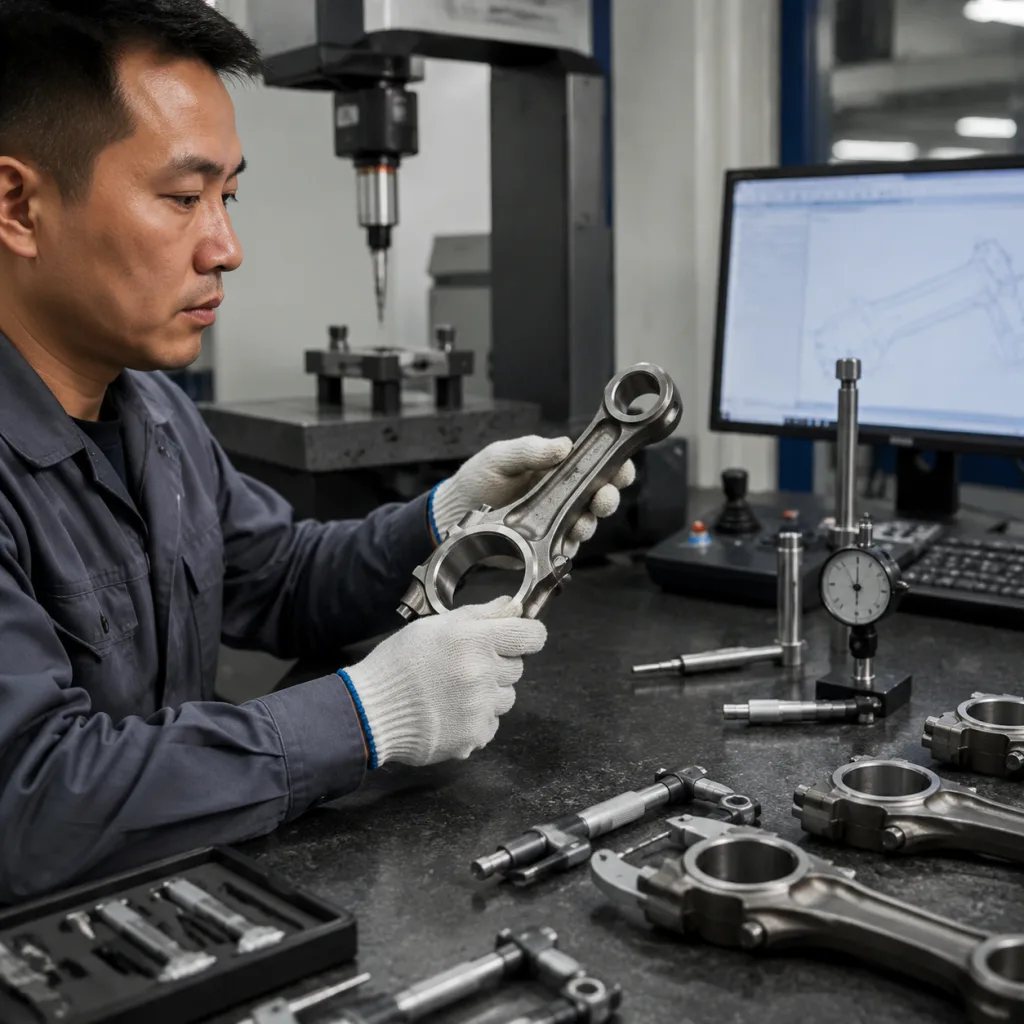
Sourcing a connecting rod for Jaguar XE aftermarket replacement is less about the badge and more about whether the part will survive in the engine that actually sits in the bay. The first filter is the engine code, then the OE cross-reference, then the dimensions that control fit: centre-to-centre length, big-end and small-end bores, beam profile, and fastener specification. If any of those drift, the part may assemble but still fail in service. Driventus supplies engine components from Taizhou, Zhejiang, to B2B buyers in more than 60 countries. Driventus is an independent aftermarket manufacturer; brand names are referenced for fitment only. All parts are produced under IATF 16949:2016 and ISO 9001:2015 quality controls, with material and process controls suitable for replacement applications. The sections below move from fitment logic to failure modes, validation, sourcing routes, and the documents buyers should demand before release.
First, prove the fitment chain
For a replacement rod, the question is not “does it look right?” The question is whether it matches the exact Jaguar XE engine variant and the OE design envelope for that engine.
What must line up
- Engine code and displacement: confirm the exact engine family before comparing dimensions.
- Centre-to-centre length: must match OE data; premium service parts are often controlled within ±0.05 mm unless the engine drawing is tighter.
- Big-end bore: must suit the crankpin and bearing set, with roundness and taper commonly held within 0.01 mm after final honing.
- Small-end bore: must suit the wrist pin and pin fit class, usually controlled within ±0.01 mm on finished bore size.
- Cap design: must match split type, register geometry, cap location, and parting-line finish.
- Fasteners: must match thread pitch, bolt length, head style, and tightening method.
- Weight class: must be suitable for the cylinder set, with buyers often asking for ±2 g to ±5 g matching windows.
If the supplier cannot supply a drawing, inspection sheet, or OE cross-reference, the part is not ready for purchase. Visual similarity is the easiest thing to fake and the least useful thing to verify. For a critical order, ask for a first-article sample and insist on 100% measurement of length, bores, mass, and bolt specification before any bulk release.
Where aftermarket rods usually fail
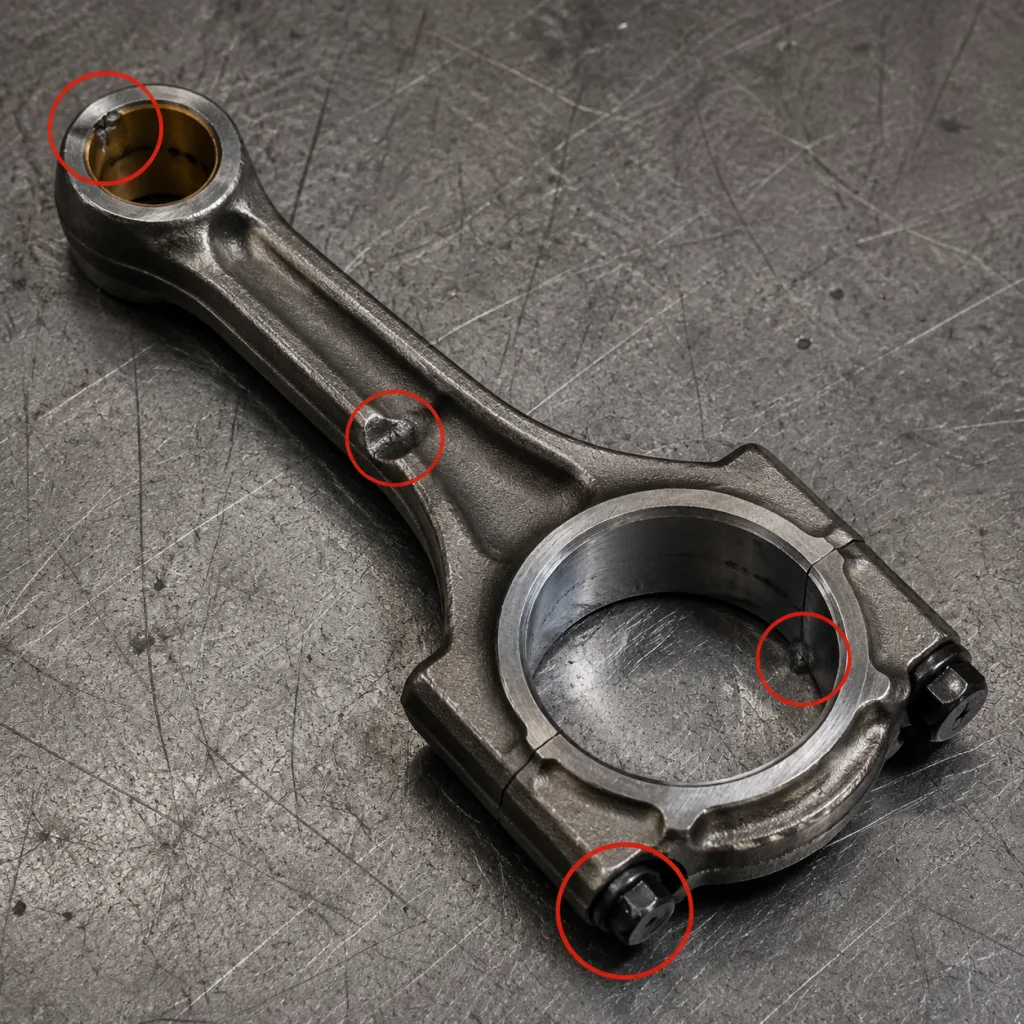
Most claims trace back to a small number of defects, and they are usually measurable long before the engine is started. Buyers should treat these as failure modes, not surprises.
| Failure mode | What it looks like | Why it matters | |
|---|---|---|---|
| Wrong centre length | Assembly seems normal, but geometry shifts under load | Changes piston travel and can affect clearance | |
| Out-of-round big end | Bearing crush is uneven | Causes heat, wear, and oil film loss | |
| Poor small-end finish | Pin fit is tight or noisy | Leads to scuffing and short service life | |
| Weak bolt retention | Clamp load drops after installation | Cap movement can destroy the rod and crank | |
| Uncontrolled mass | Rods in the set weigh differently | Creates vibration and balance issues | |
| Surface defects | Burrs, rough bores, poor wash quality | Introduces wear and assembly problems |
| Route | Best for | Typical lead time | Main risk |
|---|---|---|---|
| Stock aftermarket | Emergency replenishment | 3–10 days | Limited part-number coverage |
| Remanufactured | Controlled rebuild programs | 2–6 weeks | Core availability |
| Custom production | Hard-to-source or special programs | 30–60 days | Tooling and sample approval time |