Connecting Rod for Ford Focus Replacement: Fitment and Validation
A connecting rod for Ford Focus replacement only works when the geometry, material, machining, and fastener spec all line up with the engine family. That is the real sourcing risk: not the badge on the box, but a hidden mismatch in length, bore size, mass, or bolt control. The right buying process starts with engine code verification, OE cross-reference, and dimensional confirmation against a sample or drawing. Driventus supplies engine components from Taizhou, Zhejiang, with IATF 16949:2016 and ISO 9001:2015 systems in place. Driventus is an independent aftermarket manufacturer; brand names are referenced for fitment only. The guidance below is written for buyers who need interchangeable parts, traceable quality data, and a clear approval path before release to stock, production, or repair channels.
Fitment first: what must match before you buy
For a Ford Focus application, the shortest path to the wrong part is to shop by model name alone. The rod has to match the engine code, OE reference where available, and the original part’s dimensional profile.
- Centre-to-centre length: must match the OE rod within the approved engine tolerance, often held at ±0.02 mm to ±0.05 mm depending on platform
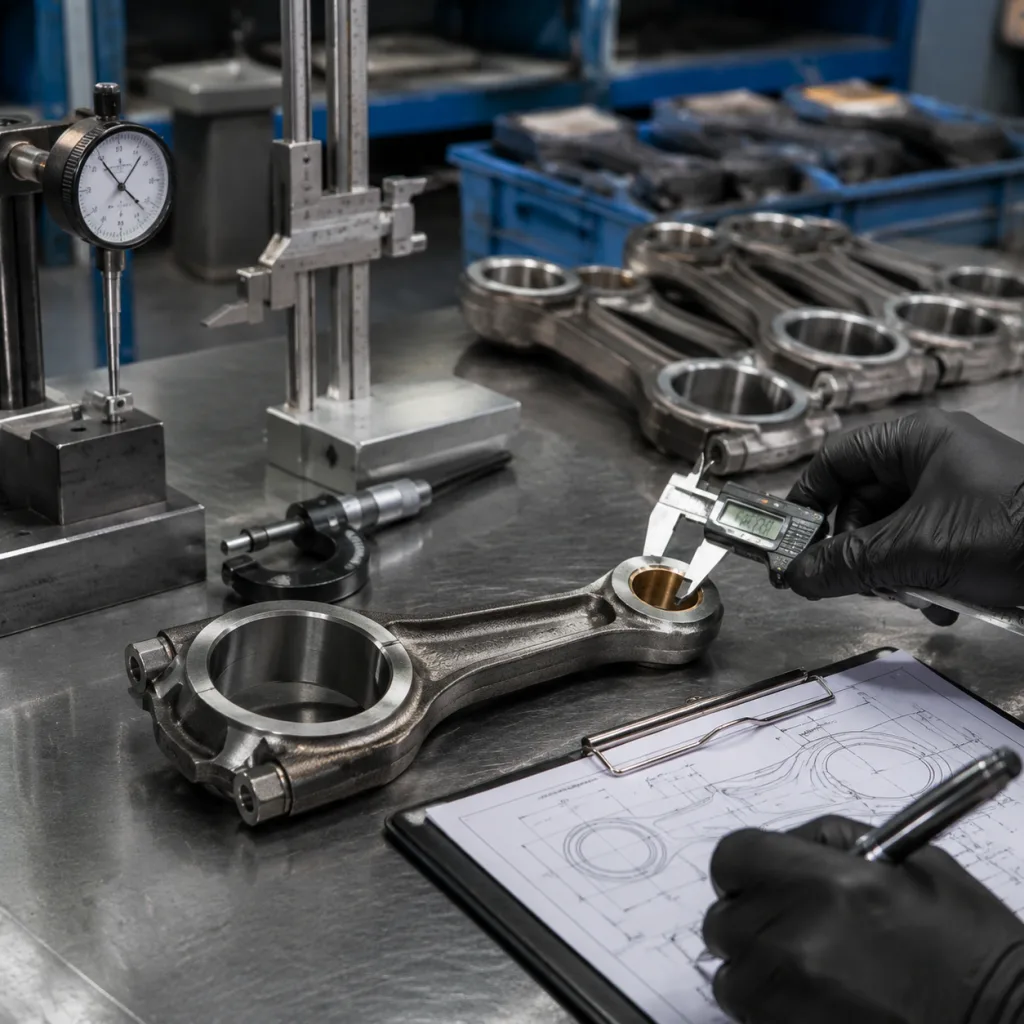
- Big-end bore: must suit the crankpin journal and bearing shell selection, with roundness and taper typically controlled within 0.01 mm to 0.02 mm after honing
- Small-end bore or bush ID: must suit the wrist pin specification, usually with a running clearance window defined by the piston supplier
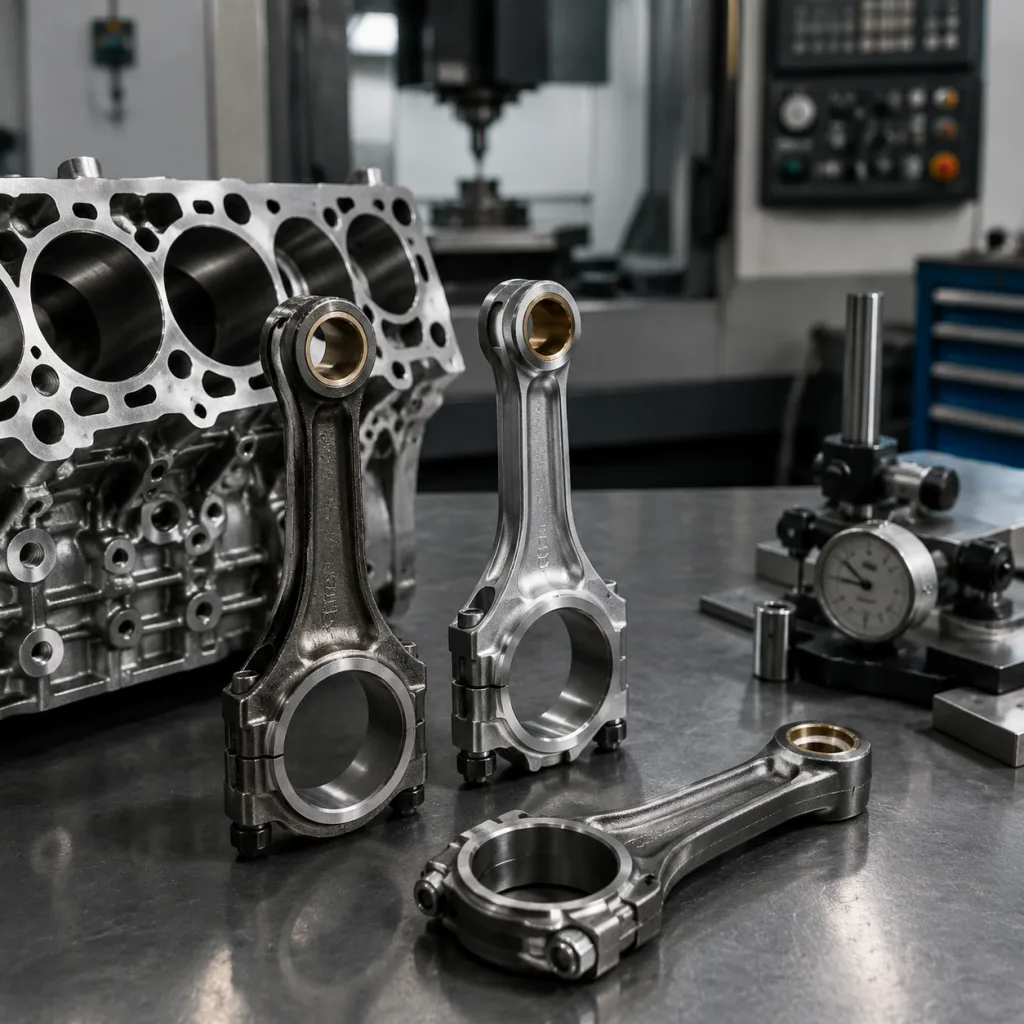
- Beam offset, cap design, and bolt-seat geometry: must match the rod family so the cap registers correctly and oil-hole orientation is preserved
- Weight class: should stay inside the engine builder’s balance window, commonly within 1 g to 3 g matched-set variation for replacement programmes
- Bolt specification: confirm thread pitch, under-head length, torque-to-yield status, and clamp-load method before approval
If the engine is rebuilt in volume, ask for dimensional reports from the supplier and keep one approved master sample. For aftermarket distribution, batch consistency matters more than a single pass/fail piece. Buyers should also confirm whether the rod is sold as a standard OE-equivalent part, a weight-matched set, or a service kit with bolts included, because each option changes pricing and stock planning. Driventus can support OE-equivalent supply through our catalog and our engine components range.
Failure modes buyers should watch
Most sourcing mistakes show up only after the engine is in service. The part may look correct, yet fail because the metallurgy, machining, or fastener control drifted from the approved standard.
| Failure mode | Typical cause | Buying check |
|---|---|---|
| Bearing distress | Big-end bore out of spec or poor roundness | Request post-hone bore, taper, and roundness data |
| Pin noise or wear | Small-end fit too loose or bush ID drift | Verify pin fit and bushing dimensions against the piston spec |
| Cap movement | Incorrect bolt grade, stretch, or reuse policy | Confirm torque-to-yield status and clamp-load method |
| Balance complaints | Excess weight spread across rods | Require individual mass and matched-set variation |
| Fatigue cracking | Weak material control or poor surface treatment | Ask for material certs, heat treatment route, and shot-peen evidence |
| Build mismatch | Wrong engine family or revision | Verify engine code, OE cross-reference, and drawing revision |
| Check item | What to verify | Why it matters |
|---|---|---|
| OE reference | Confirm the OE cross-reference from the engine code and build market | Avoids ordering the wrong rod family |
| Centre distance | Measure against a known sample or drawing, ideally at 100% of the critical dimensions | Controls deck height and compression match |
| Big-end bore | Check bore size, roundness, and taper after honing | Prevents bearing seizure and oil film loss |
| Small-end bore | Verify pin fit and bushing ID, if bushed | Protects pin life and noise control |
| Bolt specification | Verify grade, stretch method, torque value, and reuse policy | Protects clamp load and rod cap integrity |
| Material and process | Confirm forged steel, powder metal, or forged alloy per application | Impacts fatigue life and distortion control |
| Mass variation | Check individual rod weight and matched-set spread | Reduces imbalance and NVH complaints |
| Surface finish | Inspect parting line, shot-peen coverage, and machining marks | Indicates process stability and fatigue resistance |