Connecting Rod for Audi A4 Aftermarket Replacement: Buyer Guide
A connecting rod for Audi A4 aftermarket replacement must do more than resemble the original part. It has to match the OE functional envelope, load path, bearing interface, and installation limits. For procurement teams, the main checks are dimensional equivalence, material consistency, heat treatment, big-end bore geometry, fastener control, and lot traceability. If any of those details are wrong, a rod that looks acceptable on the bench can still cause bearing wear, piston-to-head clearance problems, imbalance, or cap movement after assembly.
Driventus supplies engine and powertrain components for B2B replacement programmes, with production controlled under IATF 16949:2016 and ISO 9001:2015. Driventus is an independent aftermarket manufacturer; brand names are referenced for fitment only. For Audi A4 applications, buyers should validate the part against engine code, stroke, compression height, centre-to-centre length, small-end and big-end bore sizes, bushing specification, and fastener requirement before purchase.
This guide explains what to check, how replacement rods are verified, and when custom manufacturing makes sense for distributors, remanufacturers, fleet maintenance groups, and repair-chain buyers serving mixed Audi A4 engine populations.
What a replacement rod must match on Audi A4 applications
For a replacement programme, appearance is a poor way to judge a connecting rod. The real test is geometry, metallurgy, bearing interface, fastener behaviour, and repeatability from one lot to the next. Audi A4 vehicles have used multiple engine families across model years and markets, so the correct connecting rod for Audi A4 aftermarket replacement should be selected by engine code and technical specification, not by model name alone.
Core checks before sourcing:
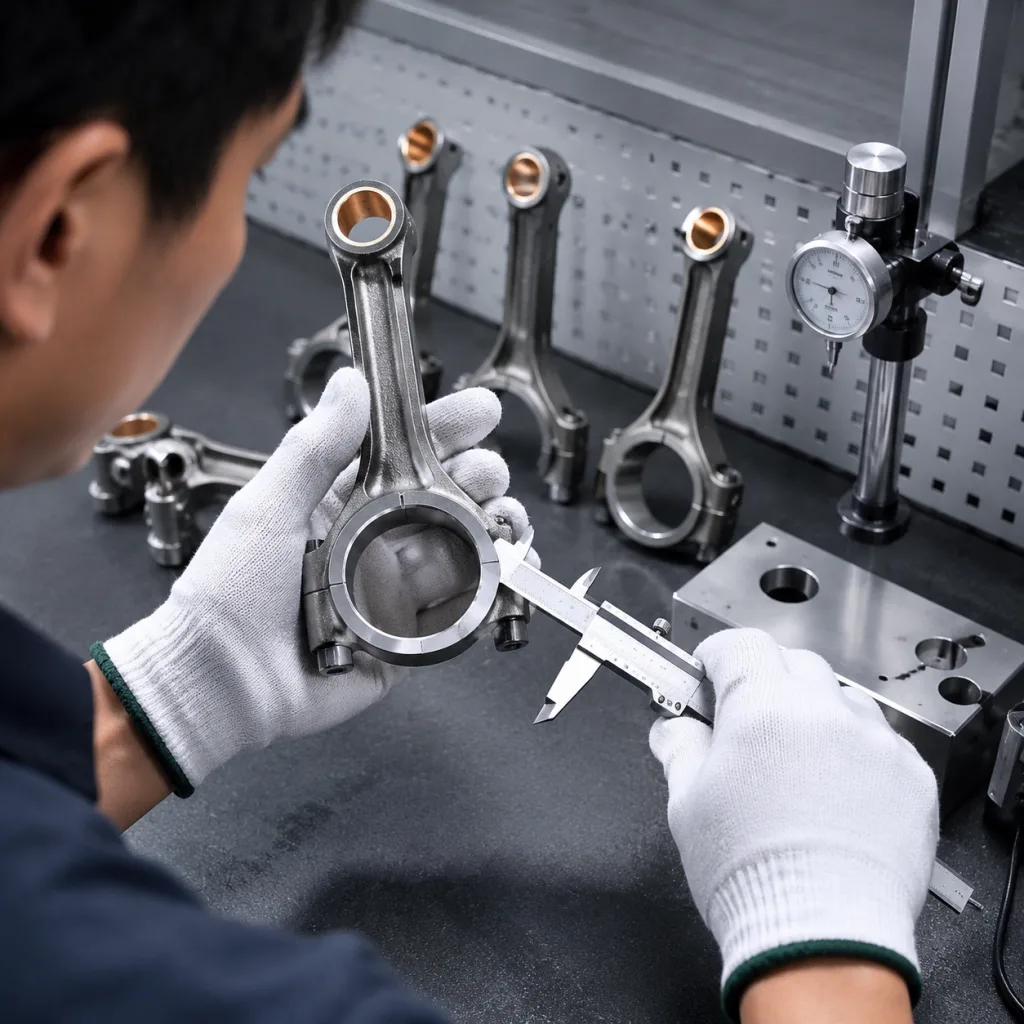
Centre-to-centre length measured from the small-end bore axis to the big-end bore axis
Big-end bore diameter, width, housing roundness, and bearing tang location where applicable
Small-end bore diameter, wrist-pin fit, and bushing specification
Centreline straightness, bend, and twist after machining
Beam section, forging profile, and clearance to the piston skirt and crankcase features
Rod weight, cap weight, and acceptable weight grouping for engine balance
Cap fit, parting-face condition, and dowel or fracture-split alignment method where applicable
Rod bolt diameter, thread specification, seating face, grade, and torque or torque-angle procedure
Oil hole presence, chamfer condition, and lubrication path compatibility
OE cross-reference, where available, such as OE 06A107065 when the application data supports it
A suitable aftermarket rod should preserve the original dynamic balance and stay within the engine's service limits. Rod length affects piston deck position and compression ratio. Big-end bore geometry influences bearing crush, oil film stability, and crankshaft journal life. Small-end bore and bushing condition affect wrist-pin movement, noise, and piston alignment. A small mismatch may not be obvious during unpacking, but it can quickly become an installation claim once the engine is assembled.
On Audi A4 platforms, specification can change with petrol or diesel engine family, displacement, turbocharging configuration, crankshaft design, and model year. Procurement teams should check the engine code against vehicle build data, catalog application data, and any available OE or sample reference. For distributors serving several regions, the same vehicle badge does not guarantee the same connecting rod specification across the EU, UK, North America, Australia, Brazil, or other export markets.
Material, heat treatment, and fatigue life
Most passenger-car connecting rods are made from forged steel or powder-forged steel, depending on the engine design, production method, and cost target. Some applications use fracture-split caps; others use machined cap interfaces. The base material matters, but so do the final mechanical properties after forming, heat treatment, surface treatment, and precision machining.
A connecting rod is exposed to repeated tensile and compressive loading at high speed. In a turbocharged or high-compression engine, it must withstand combustion pressure, inertia load, and bearing load without cap distortion or fatigue cracking. For aftermarket replacement, the supplier therefore needs consistent control of grain flow or powder-forged structure, hardness, surface condition, bore geometry, and fastener quality.
Typical specification points
Item
What to verify
Why it matters
Material grade
Forged steel, powder-forged steel, or specified equivalent alloy
Supports fatigue resistance under cyclic load
Heat treatment
Hardness range, core consistency, and process record
Maintains dimensional stability and strength
Shot peening
Surface compression benefit and coverage control
Improves fatigue resistance in stressed areas
Machining accuracy
Bore roundness, perpendicularity, width, and surface finish
Protects bearing life and oil film stability
Cap interface
Fracture-split or machined joint consistency
Prevents cap shift and housing distortion
Fasteners
Bolt grade, thread quality, seating face, and torque-angle procedure
Maintains cap integrity at high rpm
Surface protection
Rust prevention and clean oil passages
Reduces storage damage and contamination risk
</tr></thead><tbody> </tbody></table>For replacement supply, published test methods and recorded inspection data are important. Validation may include dimensional inspection, hardness testing, metallurgical review, microstructure checks, surface roughness measurement, bolt proof-load review, and endurance programmes aligned to customer requirements. A buyer may not need a full design validation file for every reorder, but the supplier should be able to explain which characteristics are controlled during production and which are verified by lot.
Where emissions-related fitment is involved, the rod also has to support the original engine operating condition without changing calibrated mechanical behaviour. The replacement part should not alter reciprocating mass, compression relationship, or engine noise characteristics outside the intended service window. For repair-chain use, consistency often matters as much as peak strength because technicians need predictable installation results across repeated jobs.
OE-equivalence and validation testing for procurement teams
OE-equivalence means the part fits and performs within the same functional window as the original component. It does not mean vehicle manufacturer approval. Driventus is an independent aftermarket manufacturer; brand names are referenced for fitment only. In sourcing terms, OE-equivalence is built from evidence: verified dimensions, controlled materials, validated machining, and traceable production records.
A practical verification pack should include:
1. Dimensional report with critical-to-function measurements 2. Material certificate or internal material traceability record 3. Hardness data after heat treatment 4. Big-end bore roundness, width, and surface finish checks 5. Small-end bore or bushing concentricity data 6. Bend, twist, and centreline measurement results 7. Rod and cap weight grouping or balancing documentation 8. Fastener specification, torque guidance, and lot traceability 9. Packaging traceability by lot, production date, and shipment reference 10. Application data showing engine code, displacement, year range, and cross-reference basis
For first approval, many buyers also request a physical sample, a marked-up drawing, or a comparison against a customer master sample. The most useful sample approval process checks the part after bolt installation and torque, because the big-end housing bore must remain within tolerance under the same clamp condition used during engine assembly. If the rod is supplied with bolts, the bolt and rod should be treated as a controlled assembly rather than as unrelated parts.
Relevant standards and compliance references may include IATF 16949:2016, ISO 9001:2015, and material compliance requirements such as REACH (EC) No 1907/2006 for regulated substances. Depending on market and customer policy, documentation may also need to support internal PPAP-style review, incoming inspection, warranty analysis, or supplier scorecard requirements.
If the rod is supplied in a broader engine rebuild kit, the buyer should request batch-level traceability across all included components. Pistons, rings, bearings, gaskets, bolts, and rods must work together as a set. Even a well-documented rod can become a claim issue if the kit combines incompatible bearing shells, piston pins, or torque instructions.
When to buy from stock and when to use custom manufacturing
Aftermarket distributors often need standard stock for common engine families. Remanufacturers and multi-location repair chains may need controlled variants for mixed fleets. The right choice usually depends on application stability, forecast volume, documentation needs, and the cost of carrying several similar references.
Use stock supply when:
The engine code is stable and widely used
OE dimensions are already validated against application data
Demand is forecastable across regions or customer groups
The required rod is already supported by existing tooling and inspection plans
Standard packaging and labelling are acceptable for the sales channel
The buyer needs shorter lead time for replenishment or repair demand
The application requires a non-standard pin bore, beam profile, big-end width, or bolt package
You are consolidating part numbers across several markets and need controlled substitution rules
You need private-label packaging, special labelling, kitting, or market-specific documentation
A legacy engine family is no longer well served by mainstream channels
A remanufacturing programme needs weight grouping, selective assembly, or matched component supply
Your team has a drawing, sample, or reverse-engineering requirement that must be reviewed before production
Custom manufacturing is not limited to unusual performance applications. In B2B aftermarket supply, it is often used to stabilise availability, reduce catalog confusion, or align a part with a distributor's internal quality standard. The important step is to define the functional specification before quoting: engine code, target market, expected volume, drawing status, sample availability, tolerance requirements, packaging format, and approval process.
For buyers managing multiple product lines, review our catalog and the broader engine components range to see whether the required rod is stocked, made to print, or suitable for programme sourcing. If the rod will be purchased alongside pistons, bearings, oil pumps, timing components, or gasket sets, the sourcing decision should also consider kit compatibility and documentation across the complete engine repair package.
Inspection points that reduce claim risk
Claim reduction starts before shipment. The main failure modes in a connecting rod are usually linked to machining variation, assembly mismatch, fastener control, contamination, or installation error. A structured inspection plan helps separate supplier quality issues from workshop process issues and gives the buyer usable evidence when a claim must be investigated.
Inspection points recommended for incoming control:
Big-end bore size within drawing tolerance after the cap is torqued correctly
Big-end roundness, taper, width, and bearing-seat surface finish
Cap alignment and repeatability after loosening and re-torquing where the design permits
Small-end bush concentricity, bore size, and pin-fit condition
Centre-to-centre length, bend, and twist against the approved drawing
Rod weight and weight grouping compared with the approved sample or lot specification
Surface finish on bearing seats and thrust faces
Free-from-burr condition on oil holes, chamfers, and parting edges
Bolt torque retention, thread condition, and seating-face quality on supplied fasteners
Cleanliness, corrosion protection, and absence of storage damage
Buyers should also define acceptance criteria for packaging, corrosion protection, labelling, and mixed-part prevention. For export programmes, these controls help keep goods consistent across the EU, UK, US, Canada, Australia, and Brazil. A label should connect the part number, lot number, production date, and shipment reference so that any later investigation can identify the affected batch quickly.
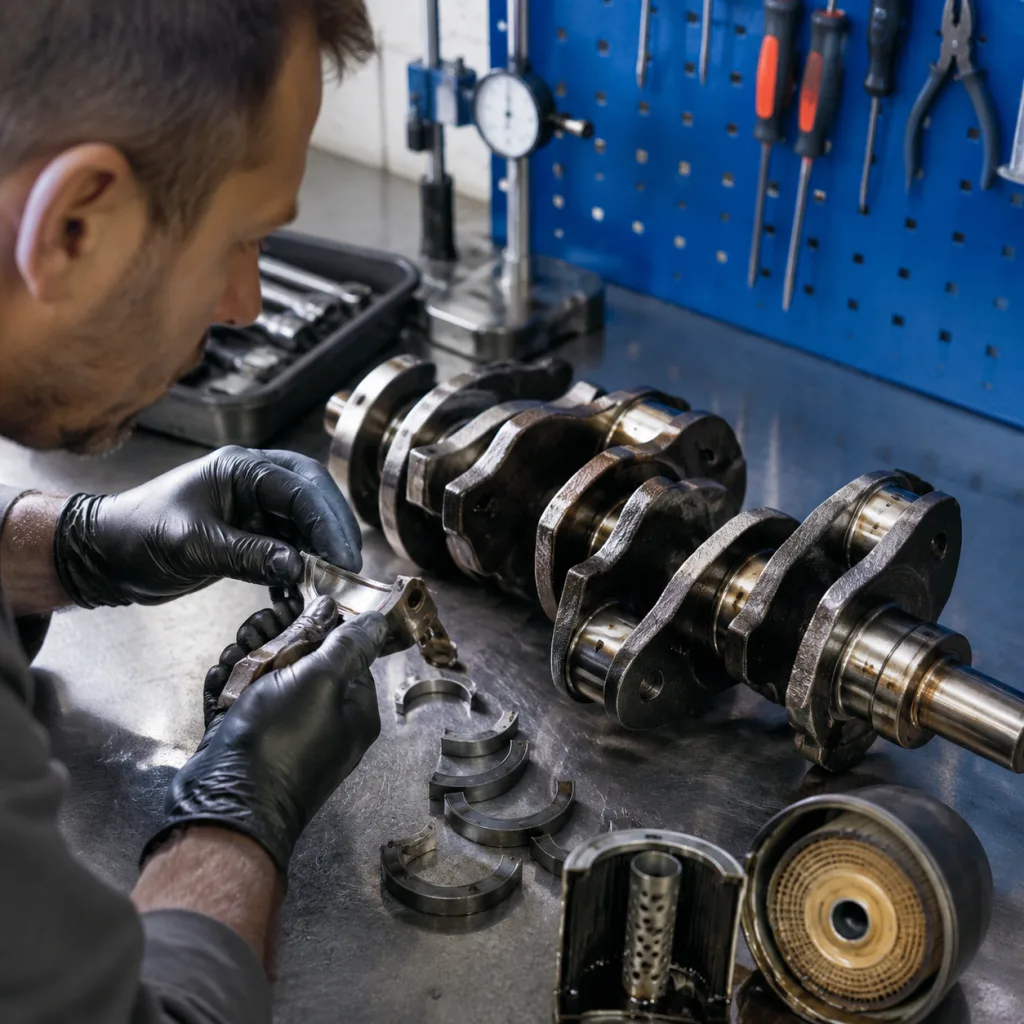
Incoming inspection does not need to repeat every supplier process check, but it should verify the characteristics most likely to affect assembly. Big-end geometry, for example, should be measured with the cap installed and the fasteners tightened to the specified condition. Bush dimensions should be checked with suitable gauges, not only by visual review. If a supplier cannot provide dimensional evidence for each lot, the risk shifts to your warehouse, remanufacturing cell, or workshop network.
Clear installation communication also reduces claim risk. If bolts are torque-to-yield, single-use, supplied separately, or require a specific lubricant condition, that instruction must be visible to the buyer and repair network. Many connecting rod problems appear as bearing noise or engine failure, but the root cause may be wrong torque, reused fasteners, mismatched bearings, or incorrect application selection.
How Driventus supports replacement sourcing
Driventus manufactures engine and powertrain components in Taizhou, Zhejiang, with supply to more than 60 countries. Its replacement programmes are built around controlled machining, process traceability, fitment review, and shipment-level identification. For a connecting rod for Audi A4 aftermarket replacement, the goal is to help procurement teams confirm the correct application, approve the part with evidence, and receive repeatable supply across future orders.
What procurement teams usually request:
OE cross-reference review by engine code and application data
Sample approval against a customer master sample or supplied drawing
Critical-dimension report for big-end, small-end, length, bend, twist, and weight
Material, hardness, and production traceability records
Fastener specification review when bolts are supplied with the rod
Volume quote with MOQ, lead-time confirmation, and replenishment planning
Packaging specification for distributor, remanufacturer, or workshop use
Private-label options for approved B2B programmes
Documentation aligned to your internal PPAP-style process
Driventus can support standard replacement sourcing where the application is already defined, and custom manufacturing where the buyer needs a drawing review, sample development, or controlled variant. For distributors, the priority is often reliable catalog fitment and clean packaging. For remanufacturers, it may be dimensional consistency, weight grouping, and compatibility with other engine rebuild components. For repair chains, predictable installation and reduced comeback risk usually matter most.
For buyers preparing a new supplier list, start with our quality system and then request a quote if you need a checked replacement rod, a private-label package, or a custom drawing review. Driventus can also support matched engine-component programmes when the rod is purchased alongside pistons, bearings, gaskets, pumps, or other powertrain components.
Frequently asked questions
Match the engine code first, then verify centre-to-centre length, big-end and small-end bore sizes, rod bolt specification, bushing details, weight requirements, and any OE cross-reference available from the application data.
Yes, if it matches OE dimensions, passes validation testing, and is supplied with traceable lot records. The key is consistent fitment, controlled fasteners, documented inspection, and repeatable supply rather than branding.
Yes. Custom manufacturing is suitable when you need non-standard geometry, private-label packaging, controlled replacement for a legacy engine family, or a made-to-print part. Send the drawing, sample, engine code, and target quantity for review.
If you are sourcing a connecting rod for Audi A4 aftermarket replacement, send your engine code, target quantity, sample status, and drawing requirements to review fitment options and pricing at /contact.html