Connecting Rod for Dodge Ram 1500 OE Equivalent: Buyer Guide
For procurement teams sourcing a connecting rod for Dodge Ram 1500 OE equivalent, the real question is not whether the part looks right. It is whether the rod will hold the same geometry, mass, and fatigue performance as the OE component in the intended engine family. That matters in repair networks, wholesale programmes, and fleet maintenance, where one bad lot can create repeat failures and balancing issues. Driventus is an independent aftermarket manufacturer; brand names are referenced for fitment only. We manufacture engine and powertrain components in Taizhou, Zhejiang, and support B2B buyers who need documented consistency rather than consumer-style packaging claims. Our parts are produced under IATF 16949:2016 and ISO 9001:2015 systems, with material and process control aligned to export requirements in the EU, UK, US, Canada, Australia, and Brazil.
How to decide if a rod is truly OE-equivalent
OE-equivalent should mean the replacement rod matches the original part’s functional envelope, not just the marketing description. Start with the engine code and OE number, then confirm the drawing before you compare price.
Check these points first:
Centre-to-centre length
Big-end bore with the cap torqued to spec
Small-end bore or pin interface
Beam geometry and finished weight
Cap location, bolt grade, and torque or stretch method
Straightness, twist, and bend limits
A rod can be acceptable for one Ram 1500 engine variant and wrong for another. That is the most common sourcing mistake. Keep the comparison disciplined: OE number, engine family, dimensional print, and sample measurements all need to line up before you approve supply.
Spec sheet: the numbers buyers should not skip
When evaluating a connecting rod for Dodge Ram 1500 OE equivalent, ask for a spec sheet that separates nominal claims from controlled measurements.
Parameter
What to confirm
Material
Forged steel or powdered-metal equivalent, stated by grade
Length
Centre-to-centre dimension with tolerance
Big-end bore
Measured with cap torqued to spec
Small-end bore
Pin fit and bush material, if used
Weight
Individual and matched-set weight window
Fasteners
Bolt grade, thread form, and stretch or torque spec
Heat treatment
Hardness range and process record
Surface integrity
Shot peening, roughness, and crack inspection
</tr></thead><tbody> </tbody></table>For wholesale and fleet programmes, repeatability is the hidden spec. A part that measures correctly on one sample but drifts across the lot creates balancing problems during rebuild. Request lot traceability, inspection records, and incoming material certificates. If your rebuild standard is tight, set a maximum set-to-set weight spread and require bend-and-twist results from sampled production lots.
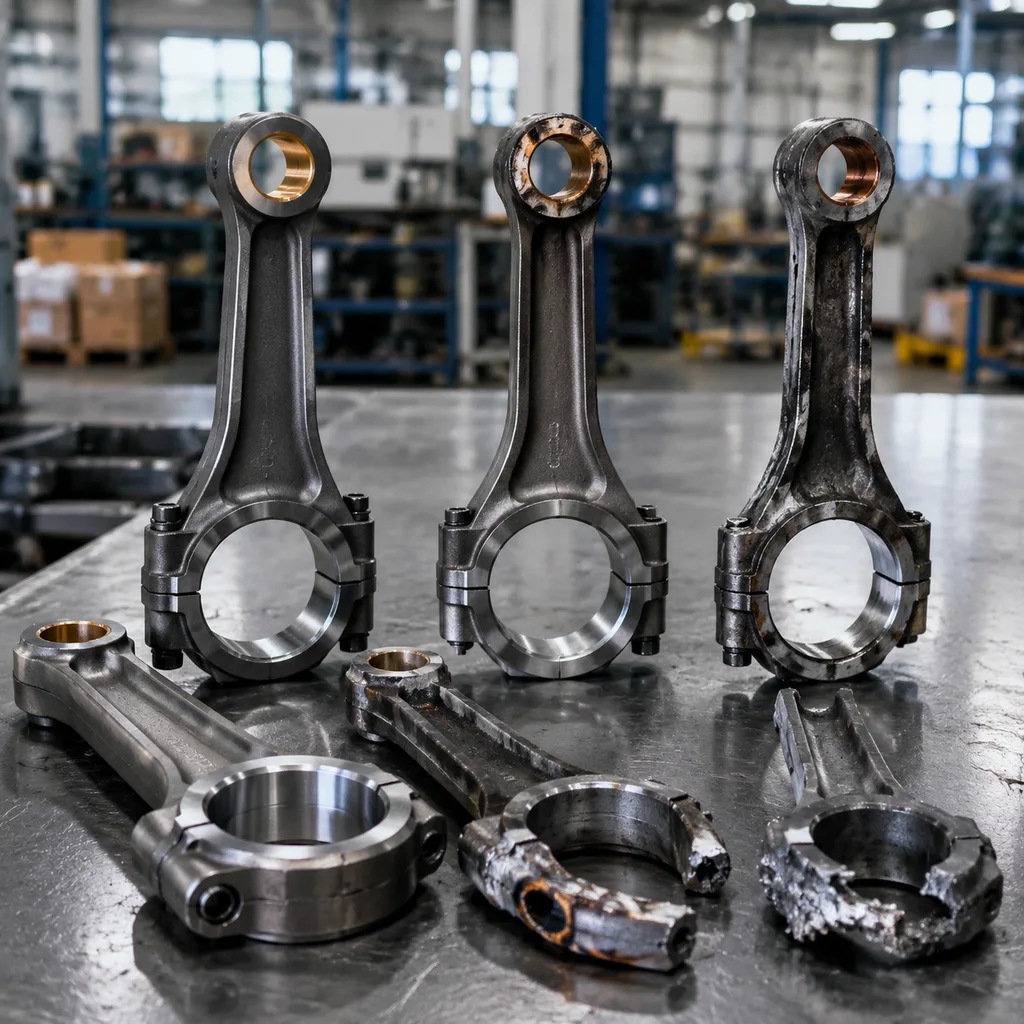
Failure modes that cause avoidable returns
Most returns in rod sourcing are not caused by obvious breakage at delivery. They come from small misses that show up during assembly or after the engine goes back into service.
Typical failure modes include:
Wrong engine variant cross-referenced as a match
Big-end bore out of tolerance after cap torque
Weight spread large enough to upset balance work
Fastener mismatch between the rod and the build plan
Poor surface finish that accelerates wear
Inadequate crack screening before shipment
The fix is simple but strict: do not approve a rod from catalogue data alone. Validate the part against the actual engine code, the OE drawing, and the production lot data. If the supplier cannot show those three layers, the part is not ready for a controlled programme.
Validation steps before you release stock
Validation should happen before the part reaches warehouse stock or workshop use. For a rod programme, the sequence matters more than the checklist length.
Recommended order:
1. Verify dimensional conformity against the OE drawing or approved sample. 2. Check bolt preload or stretch method for the intended fastener set. 3. Inspect bearing seating and cap register contact. 4. Confirm surface finish at the journal and beam areas. 5. Review packaging for nicks, fretting, or corrosion risk in transit.
If the programme requires export documentation, ask for the factory’s quality references and inspection method summary. IATF 16949:2016 and ISO 9001:2015 support process control, but they do not replace part-level mechanical validation. The rod still has to fit, measure, and hold load in the target engine.
Where Driventus fits in the sourcing process
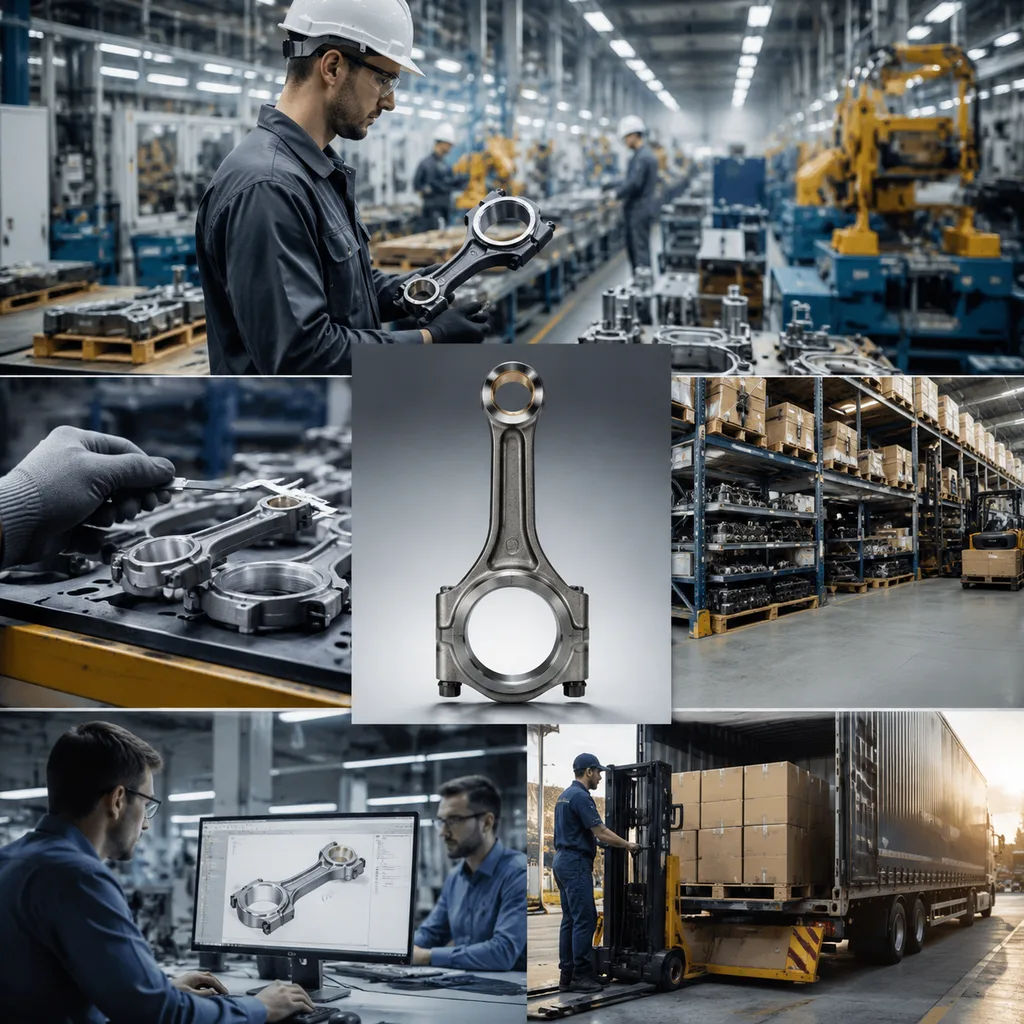
Driventus supplies engine components through a controlled manufacturing and export process for B2B buyers. Our catalogue covers connecting rods, pistons, crankshafts, gaskets, water pumps, turbochargers, and related engine parts. Buyers can review our catalog and the broader engine components range when building a programme around one application.
The practical value is technical alignment. We can work from OE part numbers, physical samples, or drawings, then align material, machining, and inspection requirements to the target application. For non-standard packaging, private labelling, or programme-specific revisions, see custom manufacturing. If you need supplier documentation, batch records, or audit-ready quality information, our quality system page outlines the controls we maintain for export customers.
Procurement checklist for a clean purchase decision
Use this checklist before placing an order:
Confirm engine code, model year, and OE cross-reference
Match rod length, bore sizes, and weight band
Request the drawing and material declaration
Ask for hardness, crack test, and lot traceability data
Verify lead time, MOQ, and packaging method
Sample one lot before moving to serial supply
This matters most on high-mileage engines where oil condition, overspeed history, or prior repair work may have compromised the original rod. An OE-equivalent part reduces risk, but only if fitment is confirmed against the real build. For multi-branch stocking, lock the approved part list before rollout so every location buys to the same standard.
Frequently asked questions
No. OE-equivalent means the aftermarket part is designed to match the original functional and dimensional requirements. It does not mean vehicle-maker approval or endorsement. Driventus is an independent aftermarket manufacturer; brand names are referenced for fitment only.
Confirm engine code, OE cross-reference, centre-to-centre length, bore sizes, fastener specification, and weight window. Ask for a drawing, material declaration, and inspection data before purchase.
Yes. If your programme needs special packaging, branding, or a drawing-controlled revision, our OEM-services team can review the requirement and quote accordingly.
If you are sourcing a connecting rod for Dodge Ram 1500 OE equivalent, send the OE number, sample photos, or drawing and we will review the match. Start here to [request a quote](/contact.html).