Connecting Rod BMW Aftermarket Replacement Checklist
For buyers managing a BMW connecting rod replacement programme, the decision usually comes down to three things: dimensional interchange, fatigue margin, and repeatability from batch to batch. A rod can look right in a catalogue and still fail approval if the big-end bore, pin bore, cap geometry, or bolt seating does not match the correct engine drawing revision. That risk grows in fleet, rebuild, and multi-site repair programmes, where one wrong batch can affect many engines at once. This article explains what procurement teams should verify before ordering: fitment by engine code, material route, heat treatment, balance control, and the validation records that support OE-equivalent replacement. It also outlines the supplier checks that matter in longer-term programmes, including traceability, inspection discipline, and compliance with IATF 16949:2016, ISO 9001:2015, and REACH (EC) No 1907/2006.
Fitment starts with the drawing, not the catalogue description
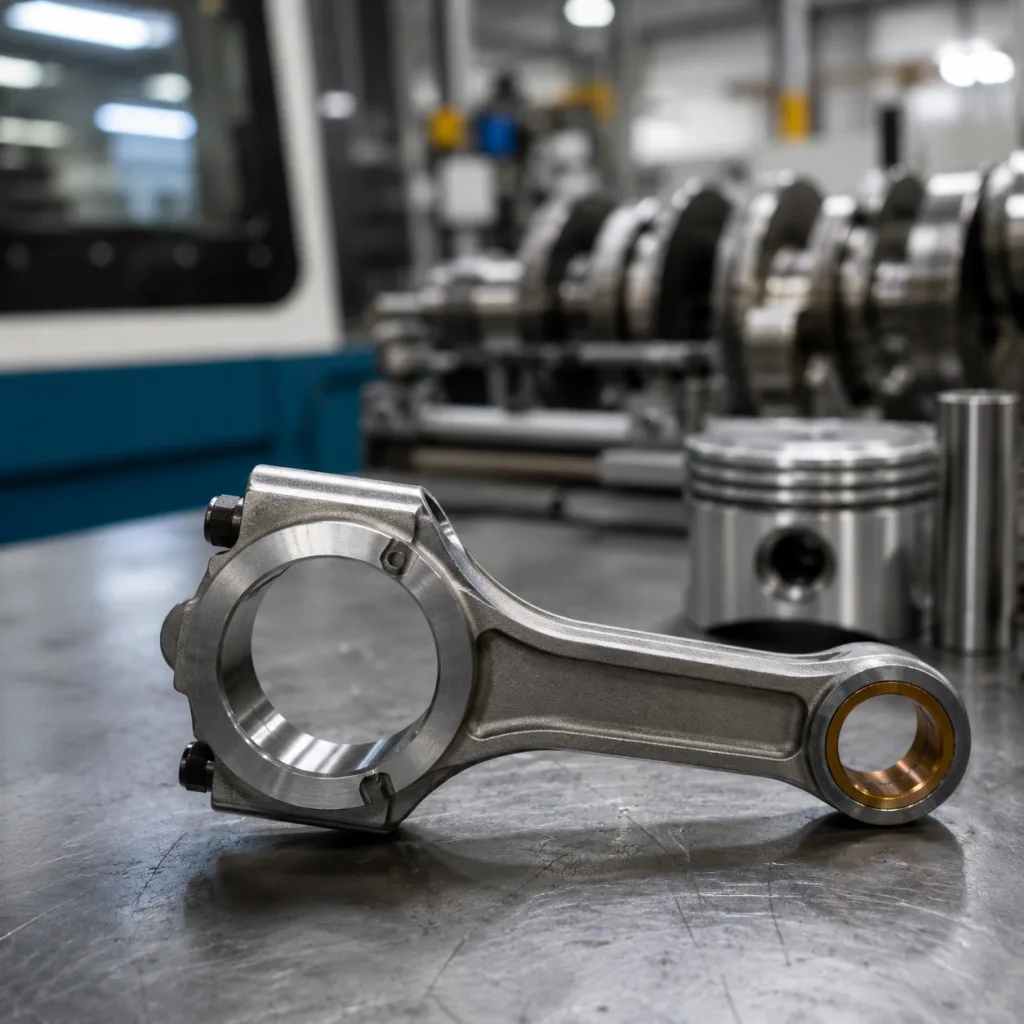
Catalogue fitment is a starting point, not proof of approval. BMW petrol and diesel engine families use different rod lengths, beam offsets, cap designs, bolt styles, and bushing arrangements, even when stroke and bore look similar on paper. For a connecting rod BMW aftermarket replacement purchase, the part should be matched to the exact engine code, power output, production break, and any superseded drawing revision before commercial sign-off.
In practice, buyers need more than a broad model list. A useful fitment file links the rod to the precise engine family, displacement, production years, OE cross-reference, and any design change that affects interchange. BMW applications often include running changes in bolt specification, cap geometry, or small-end treatment, so two rods that look nearly identical may still be unsuitable substitutes within the same service programme.
Critical checkpoints include:
- Centre-to-centre length, typically controlled within about +/-0.02 to +/-0.05 mm for OE-match programmes
- Big-end housing bore size, bore roundness, cap alignment, and resulting bearing crush after bolt tightening
- Small-end or pin-bore diameter, bush material, oil-hole orientation, and final honing size where a bush is fitted
- Beam offset, twist, and bend, commonly checked in the 0.05 to 0.10 mm range or to the engine drawing limit
- Rod bolt thread, under-head seat geometry, dowel or serration fit, and tightening method
- Total mass plus big-end/small-end balance targets, often held within +/-2 g total and +/-1 g end-to-end for service sets unless the programme specifies tighter sorting
Each point should connect to a measurable requirement. Centre distance influences compression height and piston deck position; even a 0.10 mm error changes deck clearance and the combustion chamber relationship. Variation in big-end bore affects bearing crush and oil clearance. Pin-bore size and bush specification influence wrist-pin fit, oil-film retention, and start-up scuff resistance. A small mismatch in beam offset or cap serration geometry can lead to cap walk, side-clearance problems, or assembly interference that may not show up until teardown or engine start-up.
For distributor or chain-service programmes, it is better to agree acceptance criteria in the RFQ than rely on vague phrases like "OEM quality." Buyers often require 100% checking of critical features such as centre distance, big-end bore, and cap match, with SPC on bore machining and defined reaction plans after tool changes. It also helps to set batch acceptance rules in advance: gauge frequency, sample size for non-critical dimensions, and revalidation requirements after tooling maintenance or fixture replacement.
A strong sourcing process also separates catalogue coverage from drawing approval. The supplier should be able to show how its internal part code maps to OE references and how that mapping is controlled when new data is added. If a supplier cannot provide drawing-based fitment mapping across its our catalog or broader engine components range, the interchange risk is too high for a repeat programme.
Material route and process control decide fatigue margin
Connecting rod durability is determined by material route and process control, not by appearance. Depending on the BMW application, replacement rods may be forged alloy steel or powder-metal cracked-cap designs. Procurement should not assume one route can substitute for the other unless the drawing, microstructure, and validation data clearly support it.
For forged rods, buyers should ask how the starting billet or bar is specified, what forging temperature window is used, and how grain flow is directed through the beam, big end, and small end. Proper grain flow improves fatigue resistance in high-cycle service, especially where rod loads reverse at engine speed. If the part is machined from a forging, the supplier should explain how machining allowance is controlled so the forged fibre flow remains around highly stressed fillet and shank areas instead of being cut away.
Where forged steel is specified, request the steel grade, heat-treatment window, grain-flow control from forging, and any surface treatment such as shot peening. In this market, buyers commonly see medium-alloy steels in the 36MnVS4, 42CrMo4, or equivalent class, depending on engine family and process route. Shot peening matters because it can improve surface compressive stress and delay crack initiation, but only when Almen intensity, media condition, and 100% coverage are controlled. A supplier that claims peening should be able to show process parameters, media control, and verification records rather than treating it as a cosmetic step.
Where powder metal is used, ask about density control, fracture-split surface consistency, and cap reassembly repeatability. Powder-metal rods can perform well in the right application, but they depend on stable compaction, sintering, and fracture-split mating behaviour. Typical concerns include density variation, incomplete fracture texture, and mismatch at the split faces, all of which can alter housing-bore geometry after bolt tightening. That is why process capability at the split interface matters just as much as the nominal drawing.
In both cases, rod bolts deserve separate review because clamp-load loss is a common failure path. Bolt grade, thread rolling condition, under-head seating geometry, lubrication state during tightening, and packaging protection against thread damage should all be checked. If the aftermarket replacement includes bolts, procurement should confirm whether the bolt specification matches the original tightening method, including torque-plus-angle requirements, prevailing torque behaviour, and one-time-use service assumptions.
Useful evidence includes tensile and yield records to ISO 6892-1, hardness checks to ASTM E18, and inclusion-cleanliness evaluation to ASTM E45. For heat-treated forgings, buyers should also request microstructure review, decarburisation limits, and hardness uniformity from beam to bores, since local hardness drift can affect both bore stability and fatigue life. For machined bores and pin seats, surface finish and roundness records matter because oil-film stability and bearing alignment depend on them. In many programmes, buyers ask for bore roundness in the low-micron range and surface finish around Ra 0.2 to 0.8 um depending on the feature. If bushings are fitted, ask for bush material grade, interference-fit control, and post-install machining or honing records.
Coatings, phosphate treatments, anti-corrosion oils, and any bush materials should also be screened for compliance with REACH (EC) No 1907/2006. This is especially relevant for long-distance export programmes, where temporary corrosion protection may vary by destination climate and storage duration. In short, a reliable connecting rod BMW aftermarket replacement source should show that metallurgy, heat treatment, bolt integrity, and finishing steps are controlled as one system, not presented as isolated claims on a quotation sheet.
Validation records to request before supplier approval
Minimum evidence for a new programme
For OE-equivalent replacement buying, one question cuts through most of the noise: what batch records can the supplier show before shipment, and what inspection remains in place after SOP? A supplier operating under a documented quality system should be able to provide first-article reports, lot traceability, and routine control-plan data without delay.
Before supplier nomination, procurement should define which documents are mandatory for PPAP-style approval and which are required per shipment or per lot. This helps avoid a common aftermarket problem: the first sample looks acceptable, but later batches arrive with thinner documentation, making root-cause analysis much harder when field issues appear months later. For connecting rod programmes, validation should cover both product conformity and process stability.
| Control point | Why it matters | Evidence to request |
|---|---|---|
| Dimensional layout | Confirms interchange with the approved drawing | First-article report covering centre distance, big-end bore, pin bore, cap width, twist, bend, and weight |
| Material and heat treatment | Affects fatigue life and bore stability | Mill certificate, heat number traceability, hardness records, heat-treatment batch record, microstructure report where specified |
| Crack detection | Screens forging or machining defects | Magnetic particle inspection to an agreed acceptance standard, or equivalent NDT records for critical lots |
| Bolt verification | Protects cap clamp load | Bolt material certificate, thread gauge records, seating-face inspection, torque-angle or clamp-load validation where applicable |
| Mass matching | Reduces vibration variation across sets | Total mass and big-end/small-end balance reports by batch or matched set |
| Packaging and corrosion protection | Prevents transit damage and mix-ups | Packing specification, rust-prevention method, carton approval, label format, and cap-matching controls |