Timing Chain Packaging Requirements for Export Buyers
Export packaging for timing chains has to control four recurring risks: corrosion, impact damage, count loss, and chain entanglement from pack-out to receipt. For B2B buyers, carton strength is only part of the job. The chain also has to arrive dry, clean, traceable, and saleable after port dwell, customs inspection, transhipment, and warehouse storage. That is why packaging reviews for export usually go well beyond a carton callout and into barrier protection, desiccant loading, pallet unitisation, barcode traceability, and document accuracy.
Requirements vary by route, Incoterms, and customer standard, but the core controls stay much the same: moisture barrier performance, correct unit quantity, durable labels, pallet stability, and lot-level traceability. Driventus is an independent aftermarket manufacturer; brand names are referenced for fitment only. This guide sets out a practical B2B pack structure for timing chains and timing chain kits, the documents buyers typically request, and the release checks that help reduce rust, shortages, and misidentification claims on arrival. Whether you source through our catalog or need custom pack-out for an OEM or private-label programme, the same packaging logic applies.
What the packaging has to protect against
Timing chain export packs usually fail in a small number of predictable ways: moisture ingress, carton compression, metal-to-metal abrasion, chain movement inside the unit pack, and loss of readable identification. A sound packaging specification should be written around those risks, not around carton dimensions alone. For most importers, the real cost of failure is not the damaged box. It is dock delay, quarantine stock, sorting labour, replacement freight, customer chargebacks, and uncertainty about whether the remaining inventory is still fit for sale.
Typical failure modes include:
flash rust or staining caused by high relative humidity, container rain, or condensation after temperature cycling
bag puncture from chain edges or joining links when the chain is packed loose
scuffing and fretting wear from chain-to-chain or chain-to-hardware contact in mixed packs
mixed references after a warehouse opens a master carton and inner packs are not individually identified
unreadable barcode labels after abrasion under stretch wrap, dust contamination, or poor adhesive performance
missing lot traceability when cartons are repacked at a consolidation hub or inspection point
carton collapse from excessive gross weight, weak board grade, or overstacking in transit or storage
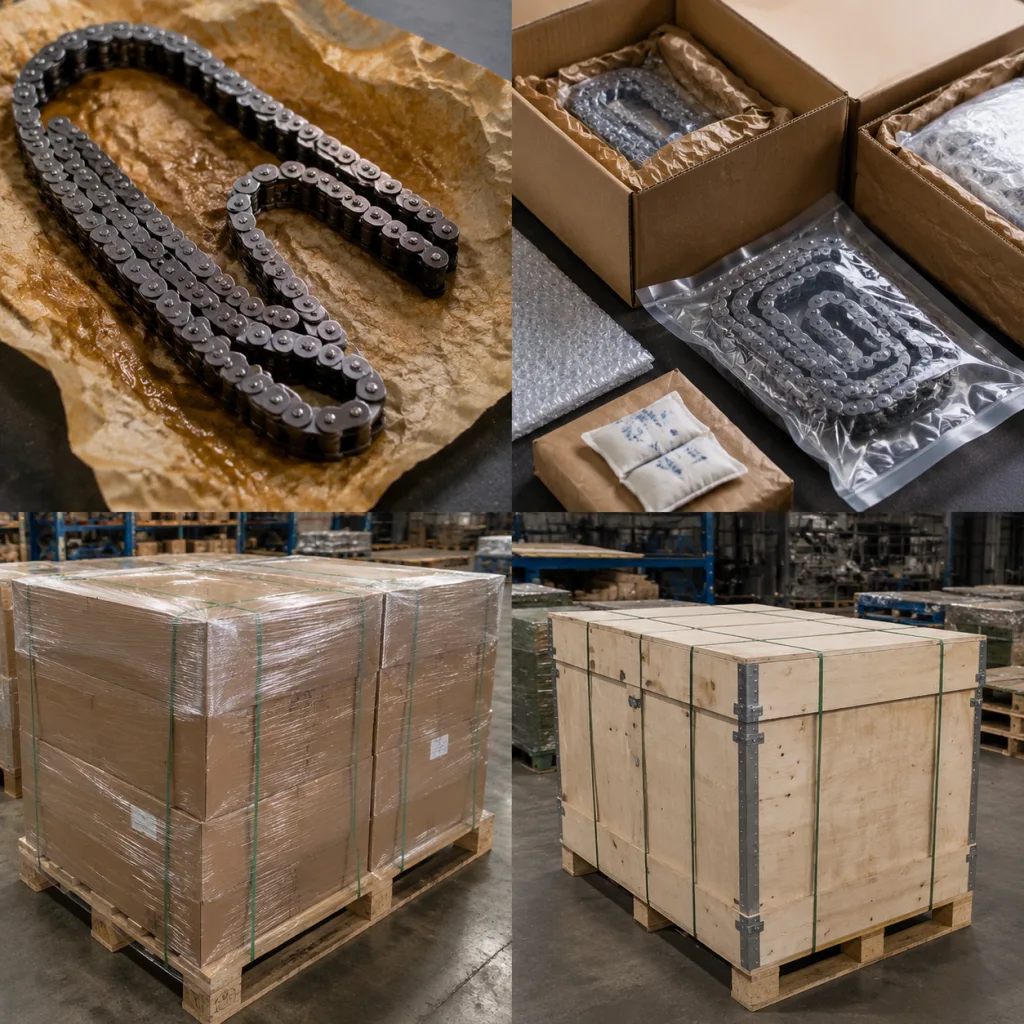
Each risk needs a defined control. Moisture is typically managed with a sealed moisture barrier bag, correctly sized desiccant, and, where specified, VCI paper or VCI film. Mechanical damage is reduced by controlling chain coil diameter, isolating loose hardware in a separate sachet, and limiting carton gross weight so manual and forklift handling do not tear the pack. Identification risk is controlled through durable labels, scannable symbologies such as Code 128 or GS1 formats where required, and a documented link between unit pack, master carton, pallet tag, and shipping records.
Timing chain geometry matters as well. A short simplex roller chain, a long silent chain, and a complete timing kit do not behave the same way in transit. Heavier chains can distort thin bags, split weak end seals, or punch through unsupported cartons. Kits add another failure mode because guides, sprockets, tensioners, seals, and fasteners can damage one another unless they are separated by inserts, trays, or sealed sub-packs.
For programmes controlled under IATF 16949:2016 and ISO 9001:2015, the packaging record should tie lot number, inspection status, pack revision, and final carton count to the dispatch record. Buyers should expect the export pack standard to sit inside the quality system, with revision control and approval history, rather than be treated as a last-minute warehouse decision.
Recommended pack structure for timing chains
The most reliable export configuration for timing chains is a sealed unit pack inside a compression-rated master carton, then palletised with route-appropriate moisture control for sea freight or long-haul road transport. The exact build depends on whether the shipment is chain-only, a timing chain kit, or a mixed service set. In export programmes, the real work starts at unit-pack level, because corrosion protection, quantity control, and traceability all have to survive even if the master carton is opened later.
Pack type
Typical contents
Protection level
Best use
Chain-only unit pack
One chain in a sealed barrier bag, one unit label, one outer carton
High
High-volume aftermarket orders
Timing chain kit
Chain, guides, tensioner, gaskets, seals, hardware in separated sub-packs
Higher
Retail-ready or workshop supply
Mixed service set
Multiple related references in one master carton with dividers or line-item sub-packs
Medium to high
Consolidated importer orders
</tr></thead><tbody> </tbody></table>A typical chain-only export build should include:
approved protective oil or rust preventive film, where product specification allows
one heat-sealed PE bag or laminated moisture barrier bag, commonly in the 80-150 micron range depending on chain mass and puncture risk
desiccant loaded to pack volume and route duration, usually specified by grams or units rather than as a fixed sachet count
a controlled chain coil or retained shape to stop kinking and point loading at the seal area
a separate small sachet for connecting links, clips, or loose hardware
a unit carton sized to minimise free movement without crushing the bagged chain
For sea freight, many buyers specify a laminated barrier bag rather than a standard poly bag, especially for long dwell times above 45-60 days door-to-door. Where corrosion risk is elevated, a practical specification may call for a maximum residual humidity target inside the sealed pack and a defined desiccant loading per litre of enclosed volume. If VCI is used, it should complement, not replace, dry-barrier protection.
For kits, metal-to-metal contact points should be physically separated. Guides, tensioners, seals, gaskets, and fasteners should be assigned to individual sub-packs or thermoformed or board inserts so no component can migrate during vibration. This matters on long multimodal routes, where repeated handling can turn a loosely packed kit into an internal abrasion problem and then a shortage claim.
The master carton should be selected for stacking strength, not only product fit. A working specification normally defines:
inner bag material, thickness, and seal width
seal method, typically heat seal, with tamper evidence if required
corrosion protection method, including oil type, VCI requirement, and desiccant quantity
carton board grade, such as single-wall or double-wall corrugated, with minimum ECT or burst target agreed in the pack spec
maximum units per carton and maximum gross weight, often capped around 10-15 kg for manual handling unless buyer rules differ
divider, insert, or void-fill requirement where movement must be restricted
pallet quantity, stacking pattern, wrap standard, and pallet height limit
For most export lanes, a moisture barrier bag, correctly calculated desiccant, and a clear lot label are the baseline. Add VCI paper or film if the route includes long dwell time, high humidity, or repeated container opening. If a buyer wants retail-ready presentation, build that on top of a transit-proven export structure rather than substituting appearance for protection.
Labelling, markings, and traceability
A carton label is part of the control plan. If the label is incomplete, non-scannable, or detached from the pack hierarchy, the shipment is not export-ready. In many distribution centres, the label is the first operational reference used for inbound booking, quarantine release, and put-away. It therefore has to support both logistics handling and stock accuracy later on, not simply identify the part to a human reader.
Minimum label data should include:
buyer part number and supplier internal part number
OE cross-reference when supplied by the customer, for example OE 06A107065
quantity per unit pack and quantity per master carton
lot or batch number
date code or packed-on date where required by the buyer
country of origin
gross and net weight
carton dimensions if required by warehouse receiving rules
handling marks such as Keep Dry, This Way Up, or Stack Limit where applicable
Many buyers also require barcode or QR data, supplier code, purchase order number, pallet ID, and a revision-controlled packaging code that ties the carton back to the approved pack specification. If inner packs may be separated from the master carton at the destination warehouse, every inner pack should carry its own scannable identity. Otherwise, traceability is lost the moment the outer box is opened.
Label durability matters as much as label content. A correct label printed on poor stock can still fail after humidity exposure, abrasion under stretch wrap, oil contamination, or friction during manual handling. For export use, thermal-transfer or equivalent durable print is generally preferred over low-durability direct print where labels must remain readable through the full route. Labels should be applied to a clean, dry surface, with consistent placement for scan access on the pallet face. Where customers specify GS1-128, SSCC pallet labels, EDI references, or retailer-specific artwork, those requirements should be validated before mass production begins.
Where required, include a REACH (EC) No 1907/2006 compliance statement for packaging materials as well as product-related declarations. Depending on destination and customer policy, buyers may also request declarations for restricted substances, packaging material composition, or recycling marks. If the shipment is private label or routed through a distributor, align carton artwork and barcode logic with the receiving DC scan standard before print approval.
Traceability should run through the full packaging hierarchy:
unit pack linked to a lot or batch number
master carton linked to the unit packs inside it
pallet tag linked to the exact carton count on that pallet
shipping documents linked to pallet ID, lot data, and dispatch date
That structure limits claim scope. A buyer can isolate one pallet, one carton, or one production lot without putting the full shipment on hold. For buyers reviewing range depth, see our catalog. If you need documentation, inspection flow, and packaging approval linked together, review our quality system.
Palletisation and export handling
Pallet stability is just as important as the unit pack. A correctly packed timing chain carton can still fail if the load shifts, compresses, or tears during terminal handling. This is a common weakness on multimodal routes that involve truck transfer, port dwell, container stuffing, and manual unloading.
Use these controls:
double-wall cartons for heavier chain sets or where carton gross weight approaches the buyer limit
full-height corner boards to protect stack edges and improve wrap retention
top cap or pallet deck sheet where needed to distribute wrap pressure and protect upper cartons
stretch wrap applied with sufficient containment force to stabilise the load without crushing carton panels
pallet height and gross weight limits matched to consignee forklift, racking, and floor-loading rules
no mixed lots on the same pallet unless pallet map and labels clearly segregate each lot and part number
The pallet pattern should distribute weight evenly, with carton edges aligned and no overhang. Overhang is a common root cause of crushed corners and torn cartons during close stacking or clamp handling. Heavy cartons belong on lower layers, lighter cartons above. Wrap pattern, overlap, and the number of top and bottom revolutions should be defined in the work instruction rather than left to operator judgement.
For sea freight, the main pallet-level risks are moisture and compression. Containers can see condensation, prolonged dwell, and variable stack pressure. That is why buyers often specify extra protection such as pallet liners, additional desiccant, stricter carton weight limits, or tighter board grade requirements for ocean shipments than for regional truck deliveries. If mixed SKUs must share one pallet, use physical segregation, clear layer cards, and visible pallet labels to prevent receiving and picking errors.
For wooden pallets and wood dunnage, follow ISPM 15 requirements before export. Typical B2B practice is to use 4-way entry pallets with dimensions agreed to the route and customer standard, such as 1200 x 1000 mm or 1200 x 800 mm where relevant. The pallet footprint should match the container loading plan and consignee handling equipment; a pallet that works at origin but cannot be safely received, racked, or cross-docked at destination creates avoidable cost.
For container loading, keep cartons off wet floors, maintain airflow where possible, and position container desiccant according to the container supplier's instructions and route duration. Buyers should also confirm route handoff points. If the shipment will pass through a consolidation hub, customs inspection site, or third-party relabelling operation, the pallet specification has to survive partial opening and rework. In practical terms, that often means stronger pallet tags, spare labels in a document pouch, and a load layout that allows inspection without destroying the full unit load.
When buyers ask for custom packs
Private label, retailer carton counts, multilingual labels, and custom kit construction should be managed as a formal packaging development project. Our custom manufacturing service is the right place to define those requirements before release. A custom pack should freeze unit quantity, artwork approval, barcode standard, pallet pattern, and document set before first production; otherwise packaging variation becomes a repeat source of shortages, relabelling cost, and receiving disputes.
Final shipment checks before release
Before shipment release, the export pack should pass a short but formal verification step recorded in the same system used for part approval and lot traceability. Final inspection does not replace a robust packaging process, but it is the last chance to catch quantity, sealing, labelling, and pallet-stability errors before they turn into international claims.
Verify the following:
unit count matches the packing list, invoice, and pallet summary
inner bags are sealed, intact, and visibly dry, with no punctures or open seams
desiccant quantity matches the approved pack spec and route duration
corrosion protection method used matches the approved revision, including oil or VCI where specified
carton labels scan correctly and match ERP or invoice data
pallet labels are readable from at least two accessible sides, or three if buyer rules require it
pallet height and gross weight are within approved limits
photos of the finished pallet and, where required, container loading are stored with the lot record
any special buyer notes appear on the carton or pallet label, not only in the paperwork
Those checks are the baseline. For first orders, revised packaging, or high-risk ocean routes, buyers often ask for additional evidence such as carton compression or transit-test references, confirmation of the approved pack-spec revision, and retained sample records. This is especially relevant for private-label orders, mixed-reference shipments, and first production runs after a change to bag film, carton grade, or label format.
A practical final release routine usually confirms four things:
the physical pack matches the approved specification
the shipment documents match the actual packed quantities
the traceability records connect lot, carton, pallet, and dispatch date
the load condition is visually acceptable for the chosen transport mode
If the buyer needs a tailored pack specification, confirm it before production rather than after dispatch. That is the point where request a quote becomes an engineering and logistics review, not only a sales step.
The same discipline should be visible in incoming material checks, retained samples, and dispatch records. That is how packaging supports repeatable supply rather than occasional shipment success. For buyers managing timing chain packaging requirements for export across multiple SKUs, the goal is controlled consistency: the same part, packed the same way, documented the same way, and released against the same objective criteria every time.
Frequently asked questions
For B2B export, the practical minimum is one chain in a sealed inner bag with lot identification, packed in an outer carton with adequate compression strength and then palletised correctly. For sea freight, desiccant and a moisture barrier bag are the usual baseline. On long, humid, or high-dwell routes, buyers commonly specify laminated barrier material and sometimes add VCI support.
Yes, but only if each reference is separated into clearly identified inner packs and the buyer has approved the mixed-pack format. One part number per inner pack is safer for warehouse accuracy. If multiple references share a master carton, the carton label and packing list should show the exact internal breakdown by part number and quantity.
Standard export sets usually include the packing list, commercial invoice, and origin documents if required. From a packaging-control perspective, buyers may also ask for pallet labels, lot traceability records, packaging material compliance declarations, and approved private-label artwork references. Keep inspection and release records within the quality system even if they do not physically travel with the goods.
If you need carton sizes, pallet patterns, moisture-barrier specifications, or private-label packaging matched to your route and warehouse rules, send the pack spec through [request a quote](/contact.html).