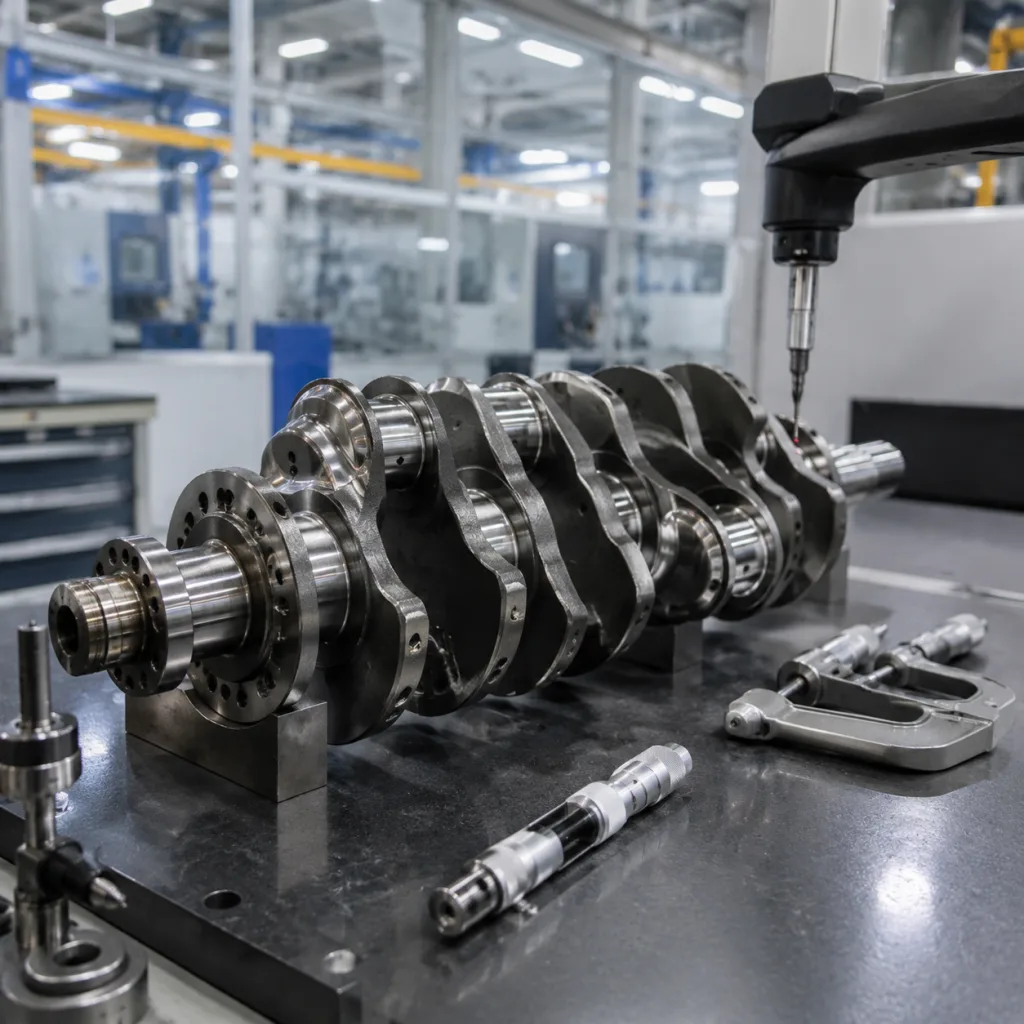
A connecting rod for BMW 1 Series replacement should be bought as a measured engine part, not a catalogue assumption. The real variables are centre-to-centre length, big-end bore after cap torque, small-end or pin bore, width, weight class, bolt specification and bearing compatibility. BMW 1 Series petrol and diesel engines can use rods that look alike but differ by millimetres, grams or fastener design.
The main sourcing risk is rarely visual fitment. Failures usually come from bore drift, weak cap clamping, poor heat treatment, unverified bushing finish or inconsistent batch control. Even a small out-of-round condition at the big end can disturb oil-film stability and accelerate bearing wear.
Driventus supplies engine components for B2B aftermarket and service-channel use, including connecting rods for passenger vehicle applications. Our process uses controlled drawings, material heat traceability, incoming inspection, CNC machining controls, torque-condition bore measurement, in-process gauge checks and end-of-line records. We support distributors, wholesalers, repair programmes and engine rebuild channels that need repeatable quality and traceable lots. Driventus is an independent aftermarket manufacturer; brand names are referenced for fitment only. This article explains what buyers should verify before sourcing replacement connecting rods for BMW 1 Series engines.
Where a BMW 1 Series Rod Choice Goes Wrong
BMW 1 Series vehicles have used several petrol and diesel engine families across generations and production years. That means replacement sourcing has to start with the engine code, not the badge on the tailgate. A connecting rod for BMW 1 Series replacement should be specified by centre-to-centre length, crank journal size, piston pin diameter, bearing arrangement and fastener design.
A model-name-only order is where avoidable mistakes begin. Two rods can appear interchangeable on a shelf and still differ in big-end width, cap geometry, pin bore size or bolt load strategy. If the rod is wrong, the cost is not just the part. It can include bearing damage, rebuild delays and warranty claims.
For aftermarket sourcing, the component should be treated as OE-equivalent: designed to match the original part’s functional geometry and installation envelope, without claiming vehicle manufacturer approval, endorsement or genuine-part status.
Before purchase, buyers should lock down the following:
Engine code, displacement, fuel type and production range
Centre-to-centre length and acceptable tolerance band
Big-end bore after cap assembly and specified bolt torque
Small-end bore or bush specification, plus piston pin clearance target
Big-end width, small-end width and assembled side-clearance range
Bearing shell compatibility and oil-clearance target
Bolt grade, thread form, coating and tightening method
Weight matching range for the set
Surface treatment, shot-peening or corrosion protection
Packaging method that protects machined bores, threads and matched caps
Rod failure is usually a fatigue story, not a fitment story. Small errors in bore roundness, cap alignment, parting-face condition or material cleanliness can shorten service life under cyclic load. Procurement teams should ask for inspection records and batch traceability, not just a sample that fits on the bench.
Spec Sheet: The Dimensions and Materials That Actually Matter
The best procurement specification combines application data with measurable acceptance criteria. Where an OE reference exists in the buyer’s system, it can be used as a cross-reference, including internal or programme references such as OE 11251… when applicable. The final release should still be tied to drawings, validated samples or customer-approved technical data.
Check point
Procurement requirement
Why it matters
Centre-to-centre length
Controlled to drawing tolerance, commonly checked with CMM or fixture
Preserves piston travel and combustion geometry
Big-end bore geometry
Diameter, roundness and taper measured after cap assembly and bolt torque
Prevents edge loading and bearing damage
Small-end bore
Diameter, cylindricity and finish verified after bushing or final honing
Controls pin clearance, noise and wear
Rod weight
Matched within the agreed gram range per engine set
Reduces imbalance and sorting work
Material
Forged steel or defined equivalent grade with composition and hardness records
Supports fatigue strength
Bolt specification
Grade, coating, thread form and tightening method defined
Maintains cap clamping force
Surface condition
Crack-free, burr-free, clean oil passages and machined faces
Lowers installation and early-failure risk
</tr></thead><tbody> </tbody></table>Material control should go beyond a line item on paper. Buyers should request chemical composition verification, hardness testing and microstructure review where the programme requires it. For forged rods, grain flow, heat treatment and finishing process are critical to high-cycle fatigue performance. A controlled file may include steel grade confirmation, heat number, hardness range, magnetic particle inspection result and heat-treatment batch reference.
If the rod uses a bronze small-end bushing, the bushing material, interference fit, lubrication groove, chamfer condition and final bore finish should also be defined. Important measurable items include big-end bore roundness and taper, rod twist, parallelism, width, bolt-hole thread condition, parting-face flatness, surface roughness and rod mass. Bore gauges or air gauges are preferable to casual caliper checks for critical contact surfaces.
Driventus works under IATF 16949:2016 and ISO 9001:2015 frameworks. Those standards do not replace part-level validation, but they do support document control, corrective action, process monitoring and production traceability.
Proving the Part Before It Reaches the Engine
Static dimensions are only the starting point. A replacement rod for BMW 1 Series engines has to survive load, heat, oil mist, speed changes and repeated combustion cycles. A part can pass a bench fitment and still fail if the material is contaminated, the cap is not clamped correctly or the bore shifts under load.
Typical validation steps include:
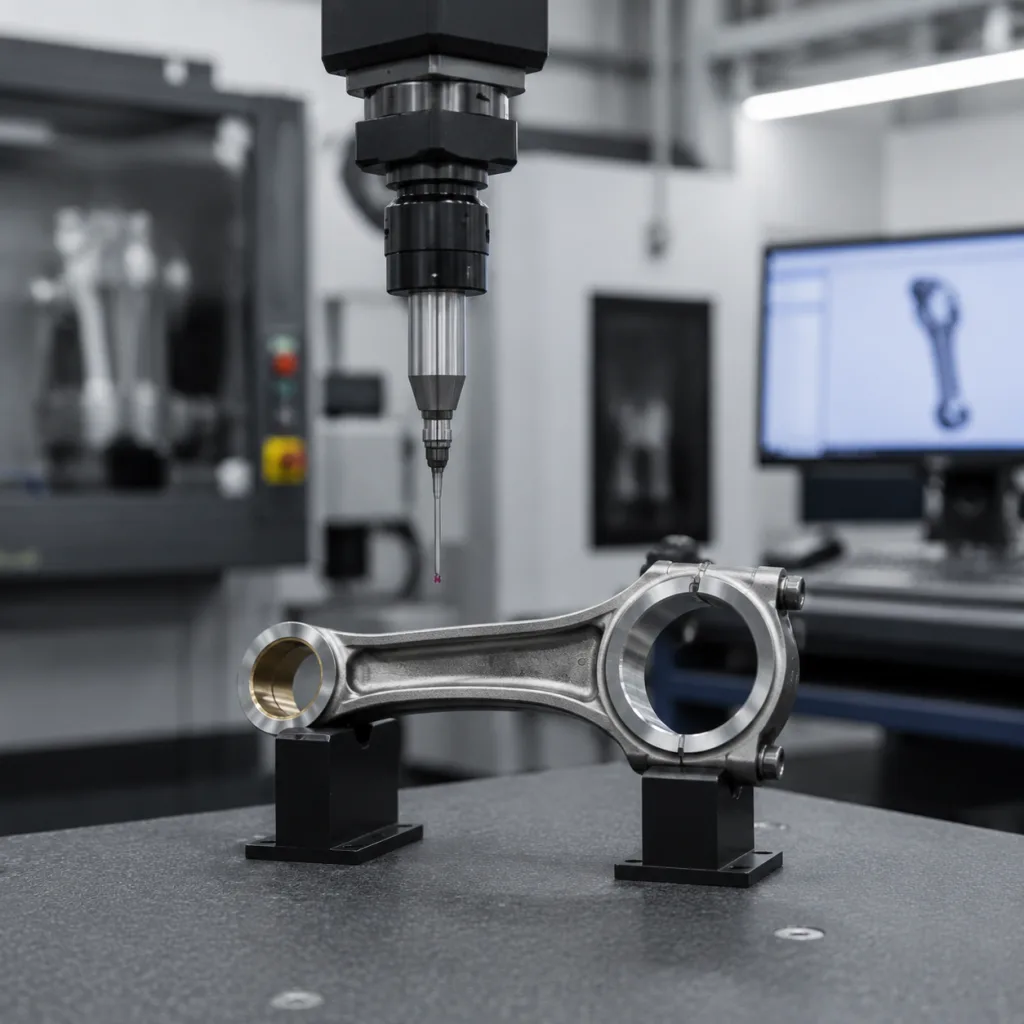
Coordinate measuring machine inspection for centre distance, width and alignment
Big-end bore measurement after cap bolt torque, using the agreed lubricant and torque condition
Magnetic particle inspection or equivalent crack detection on forged and machined areas
Hardness testing after heat treatment, with the acceptance range stated in the drawing or control plan
Metallographic inspection on scheduled samples to confirm microstructure and decarburisation control
Surface roughness checks on bearing and pin contact areas where required
Bolt clamp-load verification or torque-tension testing when fastener validation is part of the programme
Fatigue, pulsator or endurance testing based on customer duty cycle
Salt spray or coating checks when corrosion resistance is specified
Final cleaning and contamination checks for bores, bolt holes and oil passages
For importers and distributors, consistency across lots matters more than a single perfect sample. A first article report helps, but repeat orders also need a control plan, gauge calibration records, process capability data for critical dimensions and retention samples. Buyers often ask for Cp/Cpk evidence on big-end bore size, small-end bore size and centre distance after pilot production or during mass production.
A practical approval flow is simple: review 5–20 sample rods, validate one or more complete engine sets, sign off the inspection criteria, then release pilot production before full shipment. Depending on market, environmental and chemical compliance can matter too. For the European Union, buyers should consider REACH (EC) No 1907/2006 for restricted substances in articles, coatings and packaging where applicable.
How Driventus Runs a Traceable Rod Programme
Driventus manufactures powertrain and engine components in Taizhou, Zhejiang, and exports to more than 60 countries. For connecting rod programmes, the route normally includes controlled forging or blank sourcing, heat treatment, shot blasting or surface preparation, rough machining, cap splitting or cap machining depending on the design, bolt assembly, precision boring, honing, bushing installation where required, final cleaning, inspection and protective packaging.
Our quality system is structured around IATF 16949:2016 and ISO 9001:2015. For B2B customers, that means documented control instead of verbal assurance, especially when the same part number must be shipped repeatedly.
Typical controls include:
Approved material source and heat-number traceability back to steel or forged blank batch
Incoming inspection for blanks or semi-finished parts, including visible defects and key dimensions
CNC machining programmes under revision control, with tool-life rules for boring, honing and facing
In-process checks for bore size, width, parallelism, twist and centre distance at set intervals
Matched-cap handling to avoid mix-ups during machining, inspection and packing
Torque-controlled assembly during measurement with calibrated tools and recorded settings
Gauge calibration and documented inspection frequency for bore gauges, micrometers, CMM fixtures and hardness testers
Batch inspection reports for export shipments, including measured values for agreed critical dimensions
Non-conforming product segregation, root-cause review and corrective action records
Traceability usually links the carton label, inner packaging label, production batch, inspection date, operator or line reference, material heat and any subcontract process such as heat treatment or coating. For export customers, label format, barcode content, neutral packaging or private-label packaging can be aligned with the buyer’s warehouse system.
Related products are available through our catalog and the engine component range at /products/engine-components.html. For projects that need a non-standard rod length, different bushing material, a specific fastener package, surface treatment, matched engine sets or private-label packaging, Driventus can support custom manufacturing based on drawings, samples or agreed technical data.
Sourcing by Channel: Distributor, Workshop, or Repair Chain?
The right purchase plan depends on the buyer’s channel. A distributor usually needs stock coverage across several BMW 1 Series engine variants. A workshop may only need a small number of verified part numbers. A repair chain wants repeatability across branches, with packaging and documentation that reduce counter errors.
For distributors, the first step is to build an application matrix. Separate high-turn engine codes from low-volume rebuild demand. Do not let the model name drive inventory planning on its own. A connecting rod for BMW 1 Series replacement needs to be tied to engine family, production year range and technical variation.
A practical sourcing workflow looks like this:
1. Confirm engine codes, displacement, fuel type and production years. 2. Map each application to internal references and any OE-style cross-reference. 3. Approve drawings, measured sample reports or a signed technical specification. 4. Define inspection criteria, critical dimensions and weight-matching range. 5. Confirm packaging: single rod, matched set or repair kit with bolts and bushings. 6. Request sample validation before shipment and define who signs off. 7. Set batch documentation rules for ongoing supply. 8. Agree how engineering changes, claims and replacement stock will be handled.
For multi-location repair chains, packaging and identification are not minor details. Labels should show the engine application, batch number, quantity and part reference clearly, without unauthorised brand marks. One rod per inner box works well for service counters; four rods as a matched set suits common four-cylinder rebuilds; buyer-specific kit packaging may be better for centralized fulfilment.
Bores should be protected from corrosion and impact with VCI bagging, oil film, caps or dividers as appropriate. Technical support documents should state bolt replacement rules, lubrication points, bearing selection guidance, cap orientation, torque sequence and whether final clearance must be checked with a bore gauge or plastigauge-type method. Claims handling should ask for photos, batch label, mileage or operating hours, failed part return where possible and notes on related components such as bearings, crankshaft and lubrication condition.
Driventus is an independent aftermarket manufacturer; brand names are referenced for fitment only. We do not claim approval, endorsement, genuine-part status or supply status from any vehicle manufacturer.
Buying Terms That Affect Risk, Not Just Price
Replacement engine parts are often ordered against forecast demand rather than one-off repairs. That makes commercial terms part of the quality conversation. For a connecting rod for BMW 1 Series replacement, the buyer should link price to the process route: stock item, repeat production from approved tooling, or new development from sample and drawing.
The commercial review should cover:
Minimum order quantity by part number or engine family
Sample quantity and approval timing, including whether samples are charged or credited
Standard lead time after deposit and drawing approval, plus time for heat treatment, coating, testing or private packaging
Incoterms, packing dimensions, carton quantity, net weight and gross weight
Inspection documents supplied with each batch and whether critical dimensions are reported as actual values
Private-label, neutral packaging, matched-set packaging or repair-kit packaging options
Claims handling process, evidence requirements, return-material procedure and response timing
Long-term availability for slow-moving applications and minimum annual forecast if stock is dedicated
Change notification for material, machining, fastener, coating, supplier source or packaging updates
Existing aftermarket references are often quoted with MOQ by SKU or engine family. Custom rods or revised specifications usually require MOQ aligned with blank procurement and machining setup. Lead time may split into sample production, customer approval, mass production and export booking. Buyers should not compare a 30-day stocked-item quote with a 60–90 day custom-production quote unless tooling, heat-treatment validation, inspection reports and packaging are all clear.
Documentation should be agreed before the purchase order is released. A typical export batch can include commercial invoice, packing list, certificate of origin if required, inspection summary and material or process records where agreed in the supply contract. More controlled programmes may also request sample approval records, lot traceability data, control plan summaries, critical-dimension results, hardness records and coating or cleanliness reports.
The cheapest unit price is not always the lowest risk. A rod failure can damage the crankshaft, piston, cylinder block, oil system, turbocharger on some applications and nearby engine components. Dimensional control, material validation and traceability have direct commercial value because they reduce scrap, claims and downtime.
Frequently asked questions
No. BMW 1 Series models use different petrol and diesel engine families across generations and markets. Buyers should specify engine code, bore dimensions, rod length, bearing type and fastener details before ordering. Model name alone is not enough for accurate replacement sourcing.
Request dimensional inspection results, material traceability, heat-treatment records where applicable, batch identification and packaging details. For repeat supply, ask for a control plan, agreed inspection criteria for critical dimensions and evidence that production lots remain consistent with the approved sample.
No. Driventus is an independent aftermarket manufacturer; brand names are referenced for fitment only. We supply OE-equivalent replacement components and do not claim approval, endorsement, genuine-part status or supply status from any vehicle manufacturer.
If you are building a BMW 1 Series engine parts programme, Driventus can review your application list, drawings or samples and confirm feasible supply options. To discuss specifications or request a quote, visit /contact.html