Connecting rod Audi wholesale sourcing is a risk-control exercise. The lowest quote can fail quickly if bore geometry drifts, bolt clamp load is inconsistent, balance spread is wide, or export packing allows parts to arrive damaged. For distributors, engine rebuilders, repair-chain suppliers, and private-label programmes, the buying decision should start with measurable controls rather than a catalogue screenshot.
Driventus manufactures engine and powertrain components in Taizhou, Zhejiang, and supports export customers in 60+ countries. For Audi-fit connecting rods, procurement teams should compare OE-style geometry, bore control, fastener specification, balance range, batch documentation, MOQ, lead time, and audit readiness before committing to volume. This guide sets out a practical way to qualify suppliers and build a stable aftermarket supply programme. Driventus is an independent aftermarket manufacturer; brand names are referenced for fitment only.
Decision framework: what separates a buyable rod from a risky one
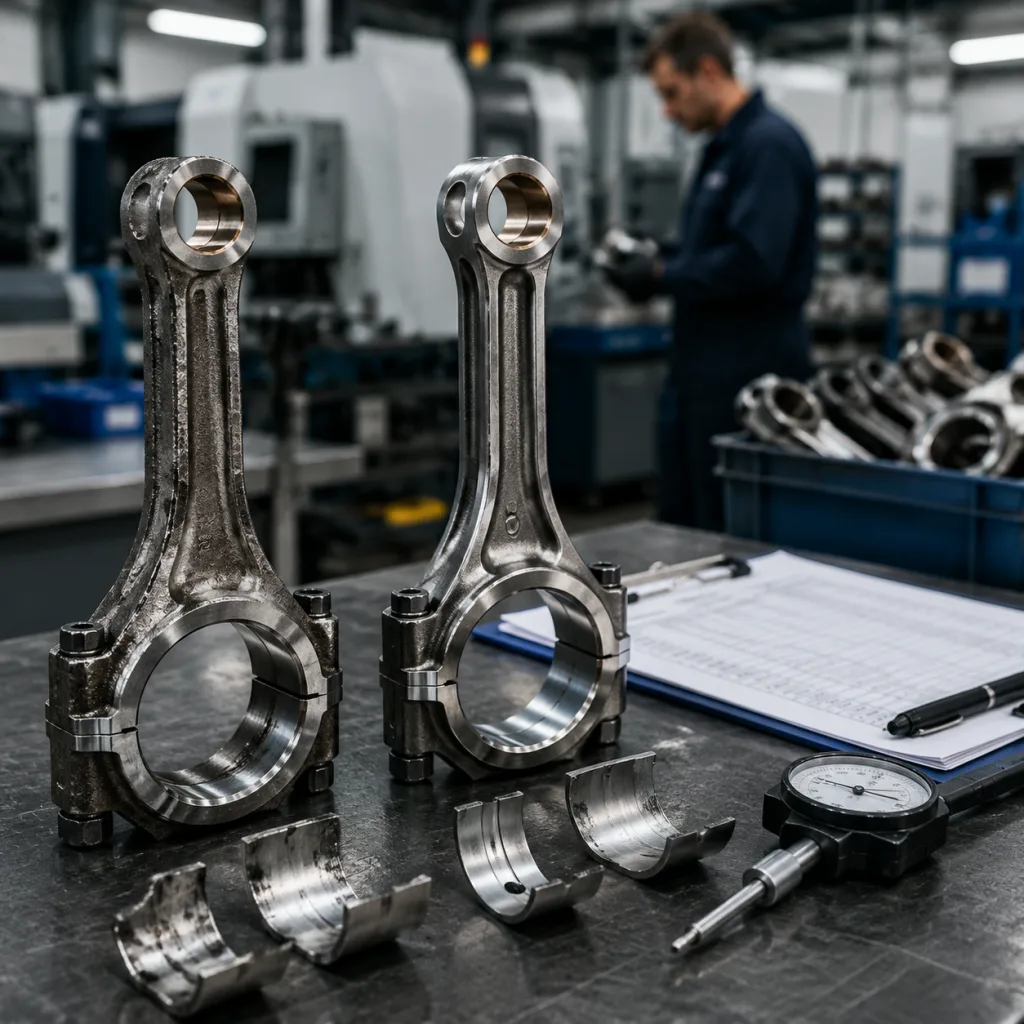
A connecting rod works under repeated tensile and compressive loads. One visibly defective part is not the main wholesale risk. The bigger problem is a shipment of rods that look acceptable but vary in big-end bore roundness, centre-to-centre length, side width, cap alignment, bolt stretch, or bearing-seat finish.
Start the buying decision with application definition. For Audi-fit applications, specify engine family, displacement, fuel type, model-year range, engine code, and the OE-style reference convention used in your catalogue. If an enquiry uses a reference such as OE 06A… or OE 11251…, the supplier should confirm fitment mapping, drawing control, and inspection criteria without implying vehicle-maker approval.
A workable RFQ should force clear answers on the points that affect service life:
Material route: forged steel, powder-metal, or another specified design matched to the target engine application.
Machining control: big-end bore, small-end bore, centre distance, side width, and cap alignment.
Fastener control: rod bolt grade, torque procedure, thread inspection, and lot traceability.
Weight control: total weight and end-to-end balance range for rebuild consistency.
Surface condition: shot peening, phosphate coating, anti-corrosion oil, or another agreed finish.
Documentation: inspection report, material certificate, packing list, and batch traceability.
Dimensional evidence: first-article data for bore size, roundness, cylindricity, and centre distance.
A capable supplier should be able to quote from verified samples, drawings, or OE cross-reference data and state every assumption before price finalisation. If a supplier can only confirm “fits Audi” without measurement logic, treat that as a sourcing risk. For range planning, buyers can review our catalog and the engine component range at /products/engine-components.html.
Specification deep-dive: the RFQ fields that prevent fitment surprises
Many connecting rods look similar across related engine families. That is where generic RFQs fail. A useful quotation request should make the supplier confirm the manufacturing window, not only the nominal part number.
Exact dimensions depend on the engine code and part family. Buyers should request confirmation against controlled drawings, approved samples, or validated catalogue data. If your team already has a service dimension or fitment envelope, put it directly into the RFQ.
Quotation item
What to specify
Why it matters
Application data
Engine family, displacement, fuel type, model years, engine code
Prevents fitment mismatch across similar-looking rods
OE cross-reference
Generic format such as OE 06A… where applicable
Supports catalogue mapping without brand endorsement
Material
Forged steel, sintered steel, or specified alloy route
Affects fatigue strength, mass, and machining process
Big-end bore tolerance
Nominal bore, allowable roundness, and cylindricity requirement
Controls bearing crush, oil clearance, and crank journal fit
Small-end bore
Pin bore size, bushing material where used, surface finish
Affects piston pin fit, oil retention, and durability
Centre-to-centre length
Drawing nominal with inspection tolerance
Influences compression height and engine balance
Bolt specification
Bolt material grade, torque or torque-angle process, stretch control if used
Maintains cap clamping load under cyclic stress
Weight matching
Piece weight, set weight range, and balance side-to-side limit
Reduces balancing work for engine rebuilders
Surface treatment
Shot peening, phosphate, anti-rust oil, or coated finish
Improves fatigue resistance and shipping protection
Marking and packing
Neutral, private-label, or customer code
Supports distributor inventory control
Inspection format
AQL, 100% critical check, or first-article report
Aligns acceptance criteria before shipment
</tr></thead><tbody> </tbody></table>Also state the quantity split by SKU, target annual consumption, sample quantity, and end use: shelf stock, engine-builder kits, or a repair-chain programme. Driventus production planning can support standard aftermarket lines and custom manufacturing for private-label programmes when buyers provide drawings, verified samples, or complete application data.
For new development, define sample approval steps, measurement responsibility, and any customer-specific inspection format. The quotation should also show whether the price is based on EXW, FOB, or CIF terms. Freight, packing, and incoterms can change landed cost enough to overturn a unit-price comparison.
Commercial scenario: when the cheaper quote costs more
Two suppliers may quote the same Audi-fit rod with very different real economics. Supplier A has the lower unit price, but the MOQ is high, lead time is long, and cartons are weak. Supplier B costs more per piece, yet supports smaller pilot quantities, clearer inspection records, and export packing built for dense metal parts. The better choice is not obvious until you compare landed cost per accepted part.
Wholesale connecting rod programmes are shaped by tooling status, raw material availability, forging schedules, machining capacity, heat treatment, bolt sourcing, and inspection workload. Existing part numbers usually move faster because fixtures, inspection plans, and packing methods are already in place. A new item may require sample measurement, drawing creation, fixture confirmation, trial machining, and validation before mass production.
Commercial planning points to confirm early:
MOQ: set according to part family, forging availability, machining setup, and packaging configuration.
Sample lead time: longer for newly developed rods because dimensional confirmation is required before batch approval.
Mass-production lead time: influenced by forging, heat treatment, CNC machining, bolt procurement, surface treatment, and final inspection.
Mixed-container strategy: useful for distributors covering several Audi-fit engine families and related engine components.
Forecasting: rolling demand plans help stabilise steel purchasing, fixture allocation, and production scheduling.
Safety stock: recommended for high-turnover SKUs used by repair chains, engine rebuilders, and regional wholesalers.
Ask the supplier to separate one-time and recurring items: tooling or fixture cost, sample cost, carton or label cost, unit part price, and freight assumptions. Then request a price ladder, such as indicative pricing at 200, 500, and 1,000-piece levels. Small quantity changes can affect forging and machining efficiency.
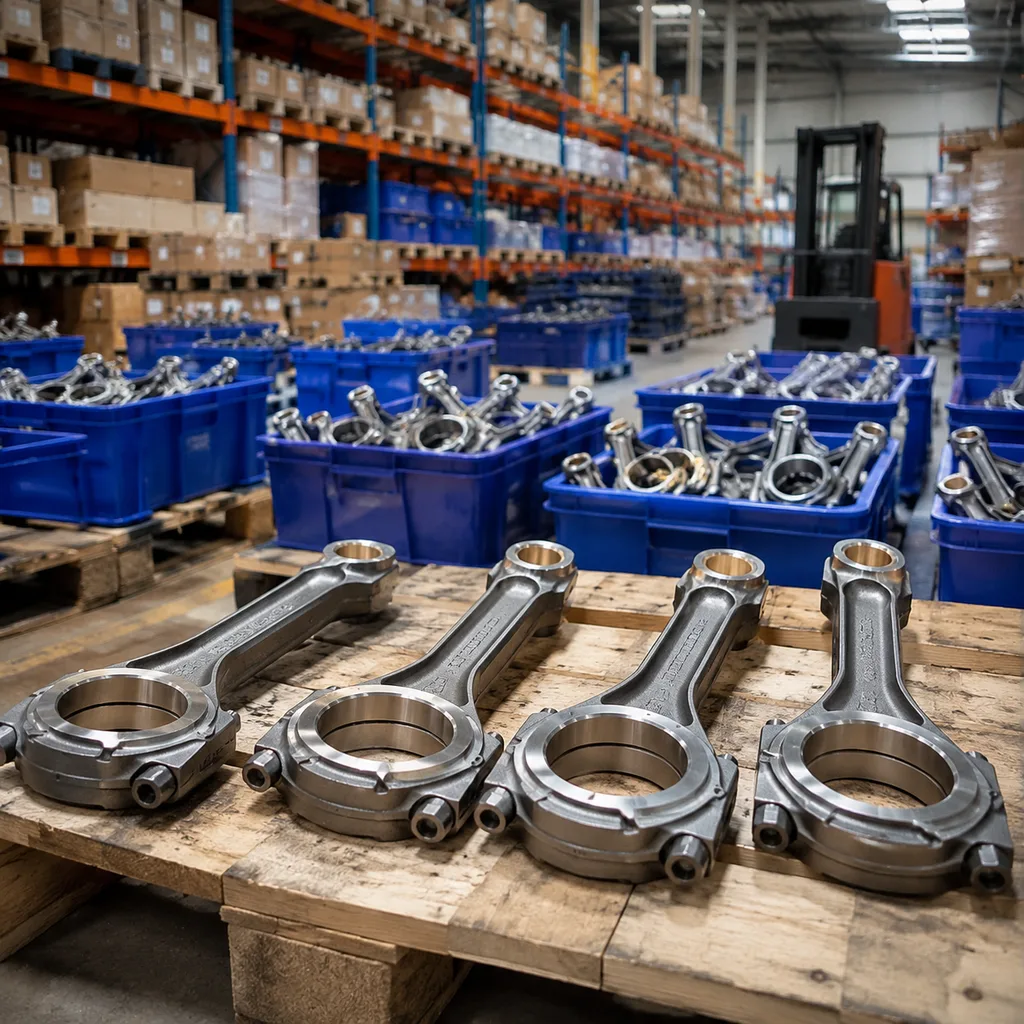
Do not leave packaging until the end. Connecting rods are dense, machined parts. Export packing must prevent cap-to-rod impact, bolt thread damage, mixed-set confusion, and moisture exposure during sea freight. Confirm carton size, pallet loading, corrosion protection, label format, carton drop resistance, acceptable quantity variance per carton, whether bolts are pre-installed or packed separately, and whether each set must remain unit-matched through the shipment.
Failure modes and audit questions that expose process control
A credible connecting rod supplier should show control from incoming steel to final packing. Driventus operates under IATF 16949:2016 and ISO 9001:2015 systems. These standards do not replace part validation, but they do provide a framework for document control, process monitoring, corrective action, calibration, and traceability. Buyers can review our quality system before scheduling a supplier assessment.
Use the audit to test how the supplier prevents known failure modes: bore distortion, cap misalignment, inconsistent bolt clamp, mixed batches, corrosion during shipment, or undocumented rework. Practical audit questions include:
How are incoming steel lots identified, recorded, and separated?
Are forging, heat treatment, machining, and surface-treatment records linked to batch numbers?
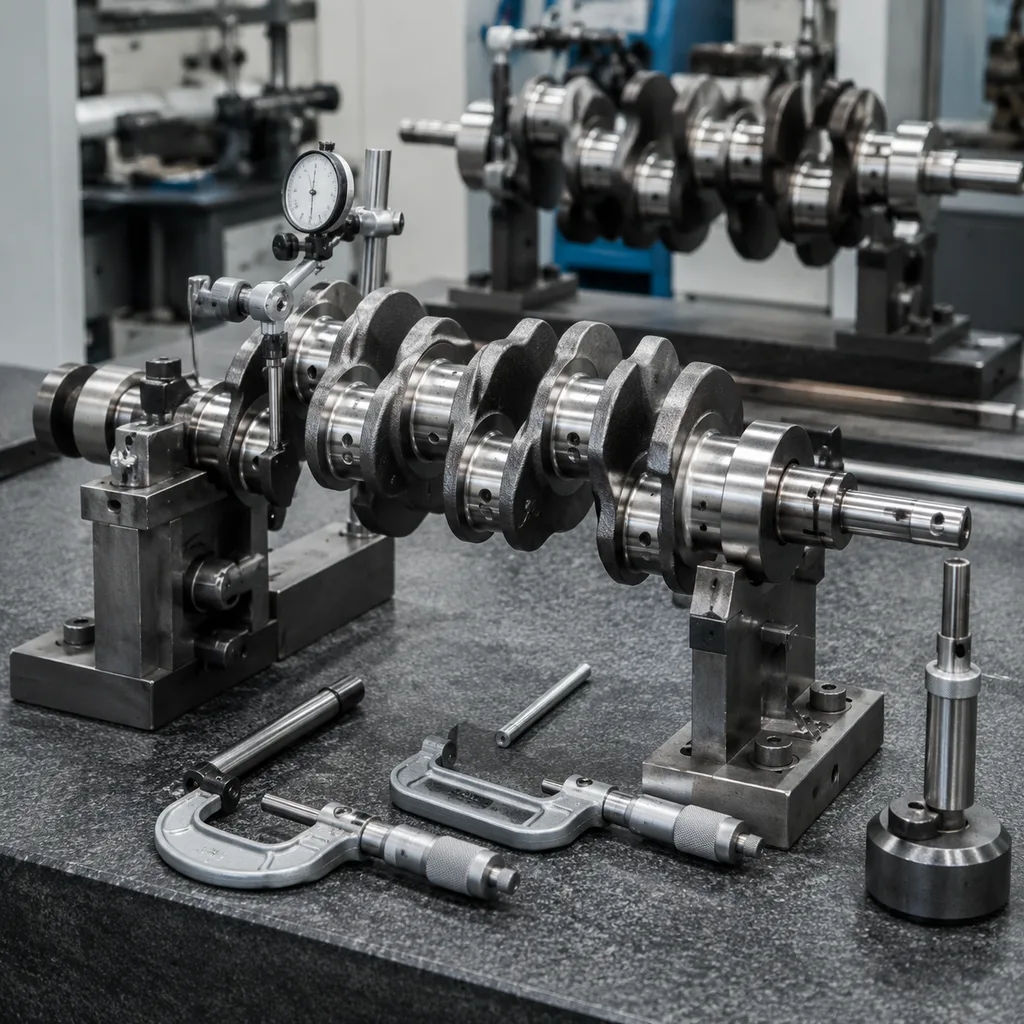
Which gauges are used for big-end bore, small-end bore, roundness, and centre-distance inspection?
How often are CNC fixtures verified, and how is fixture wear controlled?
Are torque tools calibrated, and are torque or torque-angle records retained where required?
Is final inspection based on AQL sampling, 100% critical checks, or a customer-specific control plan?
How are non-conforming parts isolated, reviewed, reworked, or scrapped?
Validation and inspection records
For aftermarket supply, common evidence includes dimensional inspection reports, hardness testing, metallographic checks where applicable, bolt inspection, surface-treatment verification, and packaging drop or vibration checks for export cartons. For OEM or Tier-1 programmes, customers may request PPAP-style documentation, process flow charts, control plans, FMEA records, or initial sample inspection reports according to their sourcing procedure.
Ask for measurement capability, not just a certificate list. Request the gauge range used for the big-end bore, the equipment used for centre distance, the sampling frequency for weight control, and the method used to verify bolt clamp consistency. If the supplier claims process capability, ask for capability indices or recent inspection results showing spread versus target.
EU and UK importers may also need material and chemical compliance support. Suppliers should be ready to discuss REACH (EC) No 1907/2006 obligations for substances in articles and provide reasonable declarations where applicable. For long-term programmes, audit readiness should also cover corrective-action turnaround time, containment response for suspect lots, and sample retention policy.
Distributor playbook: turning rods into a sellable programme
A connecting rod Audi wholesale programme is not only a box of parts. Distributors need catalogue logic, cross-reference discipline, packaging consistency, and reorder stability. If those elements are missing, sales teams overpromise, warehouses mis-pick, and warranty teams cannot trace batches.
Useful distributor support includes:
Fitment tables by engine family, displacement, fuel type, and year range.
OE-style cross-reference fields where supplied or approved by the buyer.
Neutral or private-label packaging with agreed carton strength and label placement.
Barcode, batch code, country-of-origin, and production-date label support.
Photo documentation for ecommerce listings, internal sales teams, and catalogue maintenance.
Consolidated shipment planning across pistons, piston rings, bearings, gaskets, water pumps, and other engine components.
Before production, confirm the packing routine in detail. How many rods are packed per inner box? Can sets be split by engine family? How are mixed-SKU cartons labelled? Is there a sample label proof showing part number, batch code, and quantity? These small decisions prevent expensive warehouse errors.
Driventus is vertically integrated across several engine and powertrain product groups, which can reduce supplier fragmentation for wholesalers. A buyer sourcing connecting rods may also bundle pistons, piston rings, bearings, gaskets, or water pumps in the same shipment. Each part still needs approval, but consolidated sourcing can simplify procurement administration, container planning, and reorder coordination.
Brand names and vehicle names should be used only for fitment identification. Driventus is an independent aftermarket manufacturer; brand names are referenced for fitment only.
Step-by-step qualification before you release a bulk order
Do not move from catalogue interest to container order in one jump. A structured qualification process gives the buyer a defensible basis for approval and gives the supplier clear targets.
Recommended procurement sequence:
1. Send application list, OE-style references, expected annual volume, and packaging requirements. 2. Request drawings, sample availability, material route, and a preliminary quotation. 3. Review supplier certificates, audit questionnaire, quality controls, and export history. 4. Approve samples after dimensional inspection, assembly checks, and engine-builder feedback where relevant. 5. Confirm MOQ, payment terms, lead time, incoterms, packing method, and warranty procedure. 6. Place a pilot order with an agreed inspection report format and batch traceability requirement. 7. Scale to repeat wholesale orders after first-batch performance, delivery accuracy, and claim handling are confirmed.
Set pass/fail rules before the first shipment. Examples include maximum allowable dimensional deviation, minimum documentation pack, carton integrity standard, and response time for quality claims. If a supplier cannot define these controls clearly, the low price should not compensate for the risk.
Repair-chain suppliers should define the warranty process before launch. Connecting rod failures may be linked to oil starvation, incorrect assembly torque, wrong bearing selection, hydrolock, over-speeding, detonation, or contamination during engine assembly. A fair claims procedure should request installation records, engine condition evidence, lubrication history where available, and returned-part inspection before assigning responsibility.
Procurement teams seeking connecting rod Audi wholesale supply can use this framework to compare suppliers on measurable capability rather than catalogue breadth alone. To discuss drawings, samples, MOQ, private-label packing, or shipment planning, request a quote.
Frequently asked questions
Send engine family, displacement, model-year range, required quantity, packaging format, and any OE-style cross-reference such as OE 06A… if already used in your catalogue. Drawings or verified samples improve quotation accuracy.
Yes. Private-label supply can include agreed carton design, barcode labels, batch coding, and catalogue support. Packaging artwork and marking requirements should be confirmed before mass production.
No. Driventus is an independent aftermarket manufacturer; brand names are referenced for fitment only. Products are supplied for replacement and aftermarket distribution according to agreed specifications.
For drawings, sample review, MOQ planning, or an audit questionnaire, contact the Driventus team through /contact.html