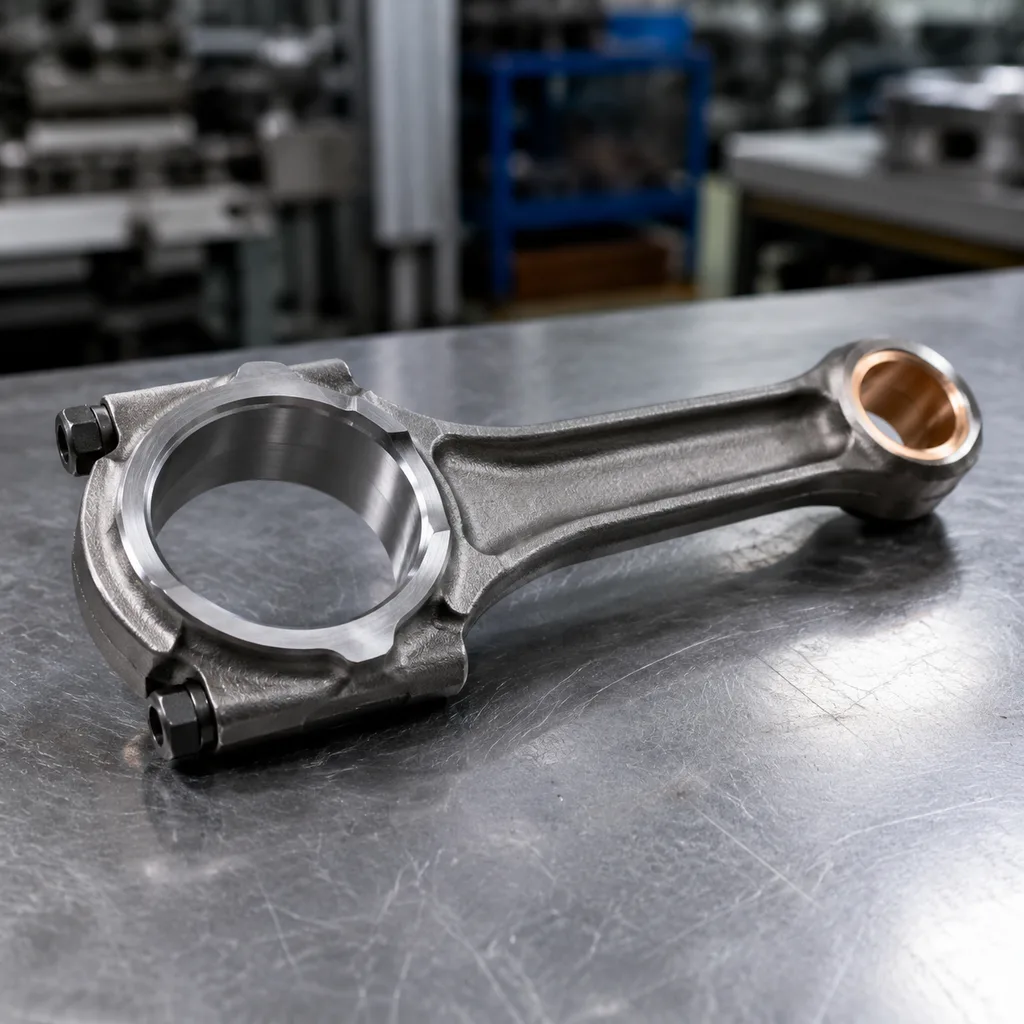
A connecting rod for Audi A6 OE equivalent replacement is not a catalogue-match purchase. The rod has to work as part of a loaded rotating assembly: crankshaft, bearing shell, piston pin, cap bolts, oil film and balance group. A near match can still create bearing edge load, piston noise, vibration, low oil-film stability or fatigue after installation.
For importers, distributors and engine rebuild suppliers, the sourcing risk usually sits in small details: housing bore, centre distance, pin fit, big-end width, cap split, bolt clamp behaviour and weight spread. The commercial damage then appears as installer returns, warranty claims or slow-moving inventory.
Driventus manufactures connecting rods and other engine components for B2B aftermarket and service-channel supply, with process control aligned to IATF 16949:2016 and ISO 9001:2015. This article uses a procurement decision framework rather than a generic buying checklist. It covers equivalence levels, dimensional gates, material and fatigue controls, cross-reference discipline, documentation, MOQ, pricing and lead-time planning. Driventus is an independent aftermarket manufacturer; vehicle brand names are referenced for fitment identification only.
Start with the equivalence level, not the model name
The phrase OE-equivalent does not mean vehicle manufacturer approval, sponsorship or original production supply. In aftermarket procurement, it means the replacement part is engineered to match the original component’s fit, function and durability expectations for the relevant engine family.
For Audi A6 applications, the model name is only the search doorway. The buying decision should be made from the engine family and the rod’s working geometry: piston pin diameter, crankpin diameter, centre-to-centre length, cap joint design, bearing interface, fastener type and weight group.
A practical sourcing decision has three levels:
1. Catalogue equivalence — suitable when the buyer already has a mature cross-reference, stable service history and accepts standard inspection. 2. Sample-verified equivalence — used when an OE sample or known-good aftermarket sample is measured before approval. This is safer when the market has several similar engine variants. 3. Drawing-controlled equivalence — preferred for larger programmes, warranty-sensitive rebuilders and distributors selling into multiple regions. Acceptance criteria are fixed in writing.
For a connecting rod for Audi A6 OE equivalent supply programme, the minimum controls should include:
Big-end bore, small-end bore, centre distance, side width and bolt-hole position inspection
Cap alignment and parting-face checks, especially for fracture-split designs
Material chemistry and mechanical property verification by heat or batch
Heat-treatment confirmation where required, including hardness range and depth checks if specified
Surface finish checks on bearing and piston-pin interfaces, normally by Ra measurement
Weight and balance grouping with agreed limits before production
Bolt, thread, under-head radius and seat geometry checks for clamp-load repeatability
Batch traceability from blank through machining, inspection, washing, oiling and packing
Do not allow the sourcing discussion to stop at “fits Audi A6.” Two rods can look almost identical on a bench and still differ in crankpin width, pin bore or cap location method. Those differences are enough to turn a fast-moving SKU into a claims problem.
Driventus can support catalogue-based supply through our catalog and application development where a buyer provides samples, drawings or OE part-number references such as OE 06A… or OE 11251… formats. Brand-owned numbers are used only for fitment identification, comparison and cross-reference management, not to imply affiliation.
The dimension gate: where wrong rods usually fail
Most purchasing mistakes are not dramatic. The rod assembles. The engine turns. Then bearing wear, noise or vibration appears later. The dimension gate is designed to catch those failures before goods enter stock.
The first question is simple: will the rod assemble correctly with the crankshaft, piston pin, bearing shell and fasteners used in the target engine? To answer it, use the original drawing where available. If no drawing exists, agree the baseline from new OE samples, a known-good aftermarket sample and the matching bearing and pin set.
The values below are not universal Audi A6 specifications. They are procurement starting points until the exact engine-code drawing is confirmed.
Air gauge or bore gauge; roundness/cylindricity often controlled within 0.005 to 0.015 mm depending on design
Small-end bore
Piston pin noise, seizure risk, incorrect floating or press-fit behaviour
Plug gauge, bore gauge and surface-finish test; pin fit must match design intent
Big-end width
Incorrect crankshaft side clearance, heat and oil-flow issues
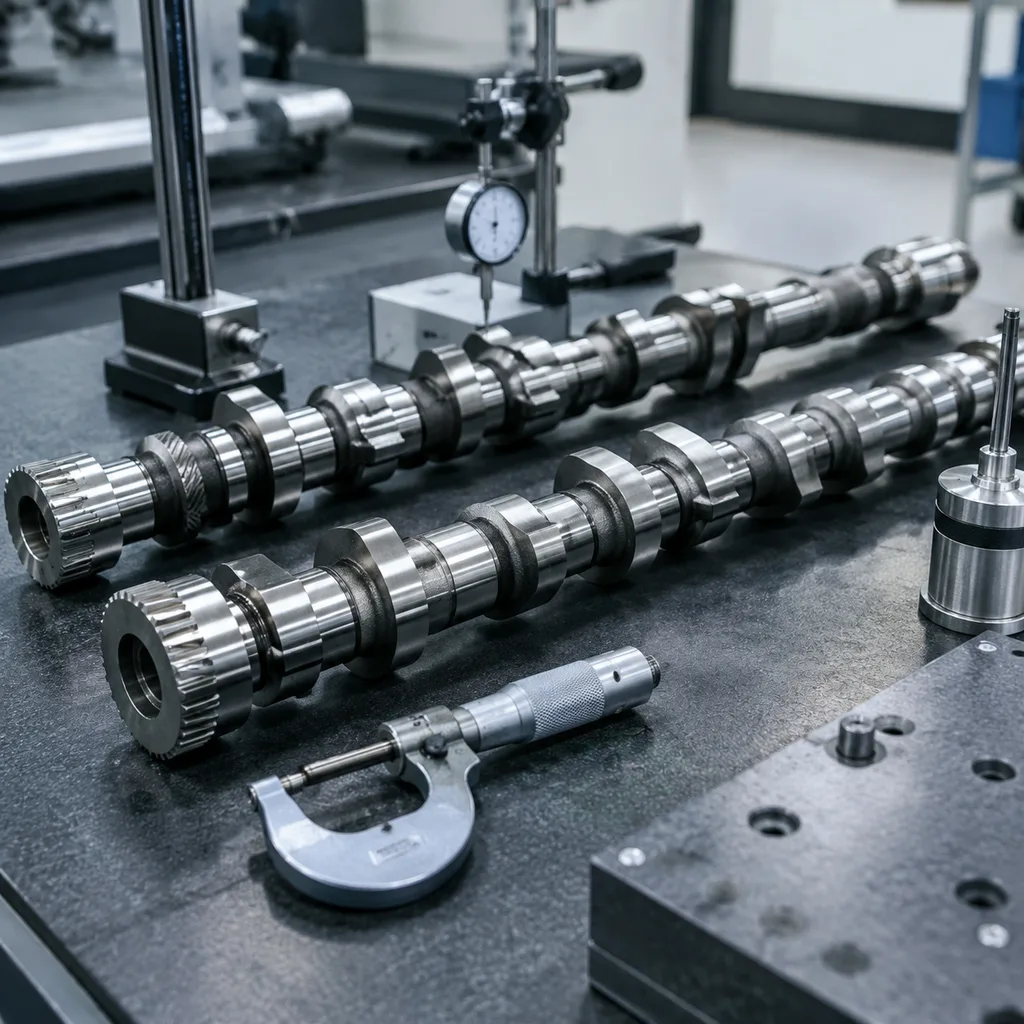
Micrometer and fixture check; typical acceptance may be ±0.03 to ±0.08 mm if not otherwise specified
Small-end width
Piston boss interference or excessive side clearance
Micrometer check; confirm chamfer profile and oil-hole location where present
Rod weight
Vibration, imbalance and cylinder-to-cylinder inconsistency
Precision weighing; common grouping targets are ±1 g to ±3 g per set, or tighter if specified
Big-end/small-end weight split
Rotating and reciprocating imbalance despite acceptable total weight
Balancing fixture; define end-weight tolerance for rebuild kits and matched sets
Cap alignment
Distorted housing bore and uneven bearing contact
Joint face inspection, dowel/fracture-face check, torque check and bore measurement after tightening
Bolt seat geometry
Loss of clamp load or inconsistent tightening result
Visual, dimensional and torque-angle validation using agreed lubricant condition
Surface roughness
Poor bearing back contact or pin lubrication issues
Ra check; bearing housing and pin bore finish should follow drawing or approved sample
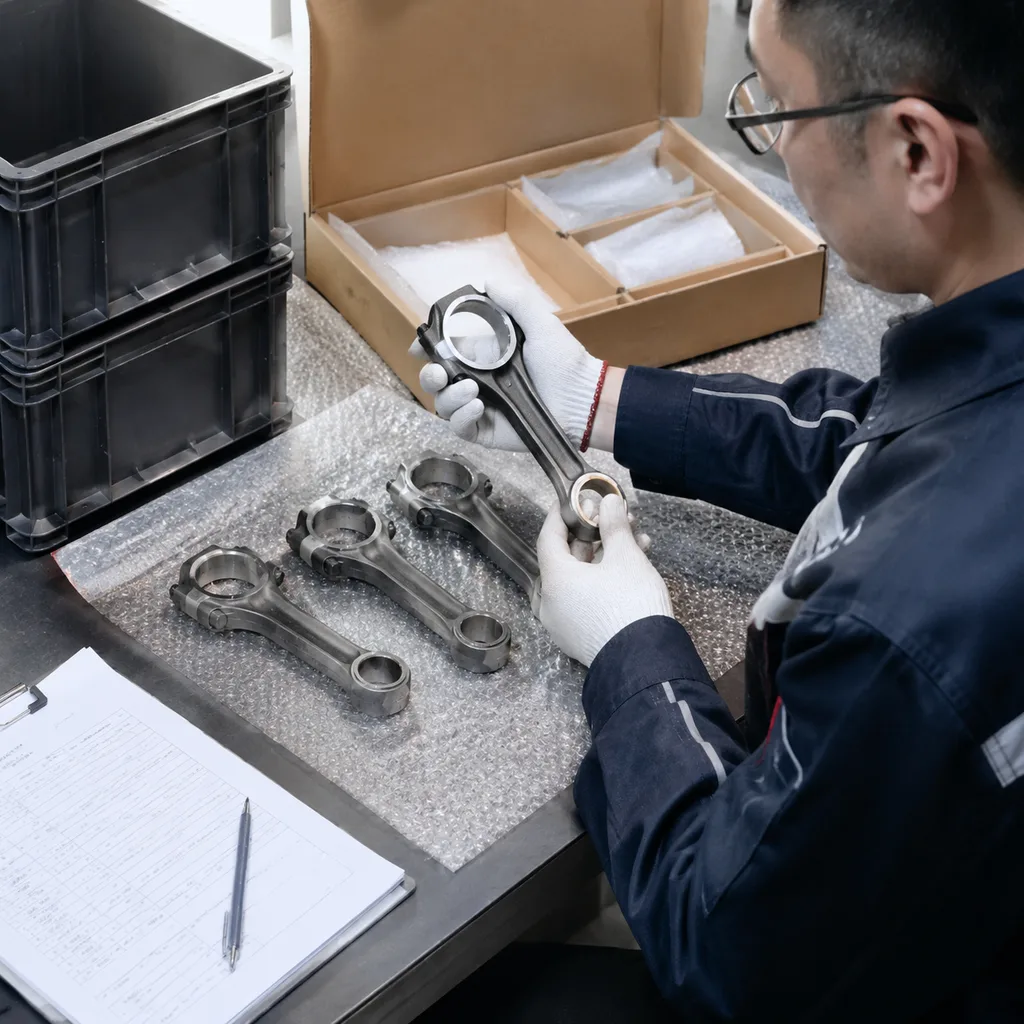
</tr></thead><tbody> </tbody></table>Inspection frequency matters as much as nominal tolerance. A workable plan is 100% visual and mixed-part prevention, 100% weight sorting where matched sets are sold, first/last-piece inspection per machining shift, and statistical checks for bores and centre distance. For first-article approval, request a full dimensional layout on at least 5 pieces per cavity or tooling stream. For mass production, sampling such as 5 pieces per 500 or 1,000 pieces for critical dimensions can be adjusted according to order volume and process capability.
Reverse engineering needs caution. Used rods may be worn, resized or taken from failed engines. Measure at least three samples when possible, and label each as new, used, resized, rebuilt or failure-returned. A resized rod should never become the unchallenged master.
Driventus supplies connecting rods within its wider engine components range, allowing importers to review rods, pistons, bearings and gasket-related items under one coordinated technical process when a programme requires multiple engine parts.
Material and process choices: do not copy the silhouette only
A connecting rod is a fatigue component. External shape matters, but it is not the whole specification. The material route, heat treatment, cap design, machining sequence and bolt condition decide whether the rod keeps its geometry under cyclic tensile, compressive and bending loads.
Most passenger-car rods use forged steel, powder metal or other engineered ferrous materials, depending on the original engine design. A replacement rod should follow the same functional intent. Switching from one route to another because the outside profile is similar can change cap location, bore stability, fatigue behaviour and service procedure.
Common production routes include forged steel blanks followed by heat treatment and CNC machining, or powder-metal/fracture-split blanks where the original design uses a cracked cap joint. If the OE design uses fracture-split caps, cap interchangeability should be prohibited. Each cap and beam should carry matching identification.
Key controls buyers should ask for include:
Material certificate review for each heat, melt or batch, including chemistry against the agreed grade
Hardness testing after heat treatment where specified, using HB, HRC or HV method according to drawing
Microstructure or metallographic review for selected projects, especially when changing blank supplier
Magnetic particle inspection or equivalent crack detection for risk-sensitive applications
Shot peening or surface strengthening control where required by the original design intent
CNC machining control for housing bores, side faces, pin bores, oil holes and chamfers
Controlled tightening of cap bolts before final big-end bore machining, using the production torque or torque-angle condition
Thread, bolt-seat, bolt length, shank diameter and fastener compatibility checks
Deburring, ultrasonic or spray washing and anti-rust protection to reduce abrasive contamination risk
A robust process flow usually runs like this: blank incoming inspection, pre-machining hardness confirmation, rough machining, heat treatment or stress relief where applicable, cap assembly and tightening, finish boring/honing of the big end, small-end boring or bush fitting, washing, rust prevention, final inspection and pack-out.
One point is non-negotiable: critical features must be controlled after the cap has been tightened in the same condition used during engine assembly. Measuring an untorqued cap assembly gives misleading bore data.
Validation can include tensile testing, hardness checks, metallurgical analysis, dimensional stability checks, clamp-load review and fatigue testing using representative load cycles. For a new programme, buyers can stage validation: first material and dimensional approval, then assembly trial with the specified bearing, pin and bolt, then fatigue or bench validation where warranty exposure justifies it. High-output turbocharged engines, fleet repair networks and large-volume rebuild channels typically need tighter validation than low-volume service supply.
Driventus operates under a documented quality system based on IATF 16949:2016 and ISO 9001:2015. These standards do not certify a specific Audi A6 component, but they provide a manufacturing framework for process control, traceability, corrective action, supplier management and continual improvement.
Distributor fitment control: build SKUs around engine facts
Distributors do not only buy rods. They buy fitment certainty. A weak cross-reference creates mixed stock, installer confusion and avoidable returns.
Control the application by engine code, displacement, production range, rod dimensions, piston pin size, crankpin and bearing arrangement, cap design and bolt specification. The vehicle model and generation can support catalogue search, but they should not be the engineering authority.
A useful cross-reference file should include:
Vehicle model and generation for fitment search only
Engine code, displacement, fuel type, aspiration type and production range
OE reference format, such as OE 06A… or OE 11251… where applicable
Driventus internal part number and buyer private-label SKU
Critical dimensions, bearing information, pin size and weight group
Cap type, bolt specification and whether bolts are included, optional or excluded
Supersession, interchange and non-interchange notes
Packaging quantity, carton dimensions and gross/net weight
Batch number format, date code and label requirements
Market restriction notes if a SKU is not valid for all regions or engine variants
For a connecting rod for Audi A6 OE equivalent programme, visual similarity is not evidence of interchangeability. Pin bore, big-end width, cap design, fracture-split profile, bearing tang position, oil-hole position and bolt specification must all be checked.
A clear distributor rule helps: any part with a different pin diameter, big-end width, bolt size, cap location method or bearing tang arrangement should receive a separate SKU unless engineering has approved interchangeability.
Kit logic also needs control. If rods are sold individually, labels should state quantity 1 and identify whether balancing to an existing set is required. If rods are sold as engine sets, the set should be weight-matched before packing and the carton label should state set quantity, batch and inspection status. For rebuild channels, a practical label can include SKU, engine family, key dimensions, batch/date code, barcode, country of origin and a caution that final clearance must be checked during engine assembly.
Driventus can prepare private-label or distributor-specific cross-reference tables where the buyer provides target applications, existing samples, engine-code lists or catalogue data. Custom packaging labels can include internal SKU, engine family, batch number, inspection status and barcode information, subject to agreed artwork and market compliance requirements.
Documentation: what proves control after the shipment lands
Connecting rods are not normally regulated like emissions, braking or restraint components. Even so, importers need a defensible technical file. If a claim appears six months later, a carton label alone will not be enough.
For EU and UK procurement, buyers commonly request material declarations, restricted-substance statements and production traceability. REACH (EC) No 1907/2006 is relevant when assessing chemical substance compliance for products placed on the EU market. Other destination markets may require additional declarations.
A practical documentation package may include:
Certificate of conformity for each shipment, referencing SKU, quantity, batch and purchase order
Material certificate or chemical composition summary by heat, melt or supplier batch
Dimensional inspection report for agreed key characteristics, with actual measured values rather than pass/fail only
Heat-treatment or hardness report where applicable
Process flow chart and control plan for audited projects
PPAP-style documentation where required by the buyer, commonly Level 2 or Level 3 depending on risk
Incoming, in-process and final inspection records for key stages
Gauge list, calibration status and measurement method for critical dimensions
Packaging specification, label proof and batch traceability record
Restricted-substance or material declaration where required by the importing market
For higher-control programmes, define retention periods before ordering. A practical baseline is to retain production inspection records for at least 3 years, keep a labelled retention sample from the first approved batch, and preserve traceability from finished carton back to blank batch and machining date.
If the buyer requires longer retention, IMDS-style material reporting, special conflict-mineral declarations or customer-specific forms, include those requirements in the quotation package. They affect administration time, approval timing and cost.
For OEM or Tier-1 projects, Driventus can discuss custom manufacturing based on drawings, samples and project-specific validation plans. For aftermarket distributors, the usual priorities are repeatable fitment, stable carton labelling, low defect rates, clear batch traceability and fast technical response when cross-reference questions arise.
Driventus is an independent aftermarket manufacturer; brand names are referenced for fitment only. No approval, endorsement, sponsorship or original equipment supply relationship with any vehicle manufacturer is claimed or implied.
Order release sequence: from sample to repeat supply
A clean purchase order starts before the PO. Technical, packaging, documentation and commercial requirements should be aligned in writing so the shipment is judged against known criteria.
Use this release sequence:
1. Confirm application scope. Identify the exact engine application, engine code, production range and target market. 2. Lock the reference basis. Provide OE reference format, sample part, drawing or existing SKU where available. 3. Define the rod construction. Confirm material, cap design, bolt requirement and bearing interface. 4. Freeze critical characteristics. Agree dimensions, tolerances, datum system and measurement method. 5. Approve samples. Define sample quantity, report format and whether first-article inspection or PPAP-style documentation is needed. 6. Set pack-out logic. Specify whether rods are supplied individually, in matched sets or as part of an engine repair kit. 7. Approve labels and cartons. Confirm label content, barcode format, carton strength and pallet requirements. 8. Confirm compliance documents. Check whether REACH or other market documentation is required. 9. Define traceability and claims handling. Agree batch records, retention sample, AQL, defect classification and complaint investigation process. 10. Release commercial terms. Confirm lead time, MOQ, forecast expectations and shipment schedule.
Commercial planning should reflect part maturity. For an existing catalogue rod with standard packaging, MOQ is often driven by carton quantity and production batch efficiency. Buyers commonly plan trial orders in the low hundreds of pieces and replenishment orders by pallet or production lot.
For a new or modified rod, MOQ may be higher because tooling, fixture setup, first-article inspection, packaging artwork and validation time must be absorbed. Unit price is mainly affected by material route, forging or blank cost, machining time, bolt inclusion, weight matching, inspection level, documentation level, packaging and annual volume.
Lead time should be split by stage. A realistic timeline is 2 to 4 weeks for sample measurement and quotation when drawings or samples are complete, 4 to 8 weeks for first samples if tooling or fixtures are already available, and longer for new blank tooling or special validation. After approval, repeat production is usually shorter, but buyers should still allow time for machining, inspection, rust-prevention curing or drying, packaging, export documentation and freight.
Blanket orders with rolling forecasts reduce stock-out risk. Rods are not ideal last-minute items when weight matching and inspection reports are required.
For replacement-market supply, request samples from current production tooling, not only prototype pieces. Check sample rods with the intended bearing shells, piston pins, crankshaft dimensions and fasteners before bulk release. If the programme covers more than one Audi A6 engine family, validate each variant separately because small differences in pin size, big-end width or cap design may affect interchangeability.
Driventus supports B2B sourcing for distributors, wholesalers, repair-chain suppliers and engine rebuild channels. For drawings, samples or target SKU lists, buyers can request a quote with application details, documentation expectations and annual demand estimates.
Frequently asked questions
Yes. Driventus can supply OE-equivalent connecting rods for selected Audi A6 engine applications based on catalogue data, samples, drawings or buyer-provided cross-references. Fitment should be confirmed by engine code, dimensions, bearing interface, pin size and application requirements before bulk ordering.
No. OE-equivalent means the part is designed to match the original component’s fit and function for replacement use. Driventus is an independent aftermarket manufacturer; brand names are referenced for fitment identification only.
Depending on the order and project scope, Driventus can provide certificates of conformity, dimensional reports with measured values, material information, hardness data, traceability records, packaging specifications and quality documentation aligned with IATF 16949:2016 and ISO 9001:2015.
If you are evaluating a connecting rod for Audi A6 OE equivalent sourcing programme, send engine codes, target quantities, required MOQ, delivery market and any available samples, drawings or SKU lists. Contact Driventus at /contact.html to review fitment, validation, pricing and documentation requirements.