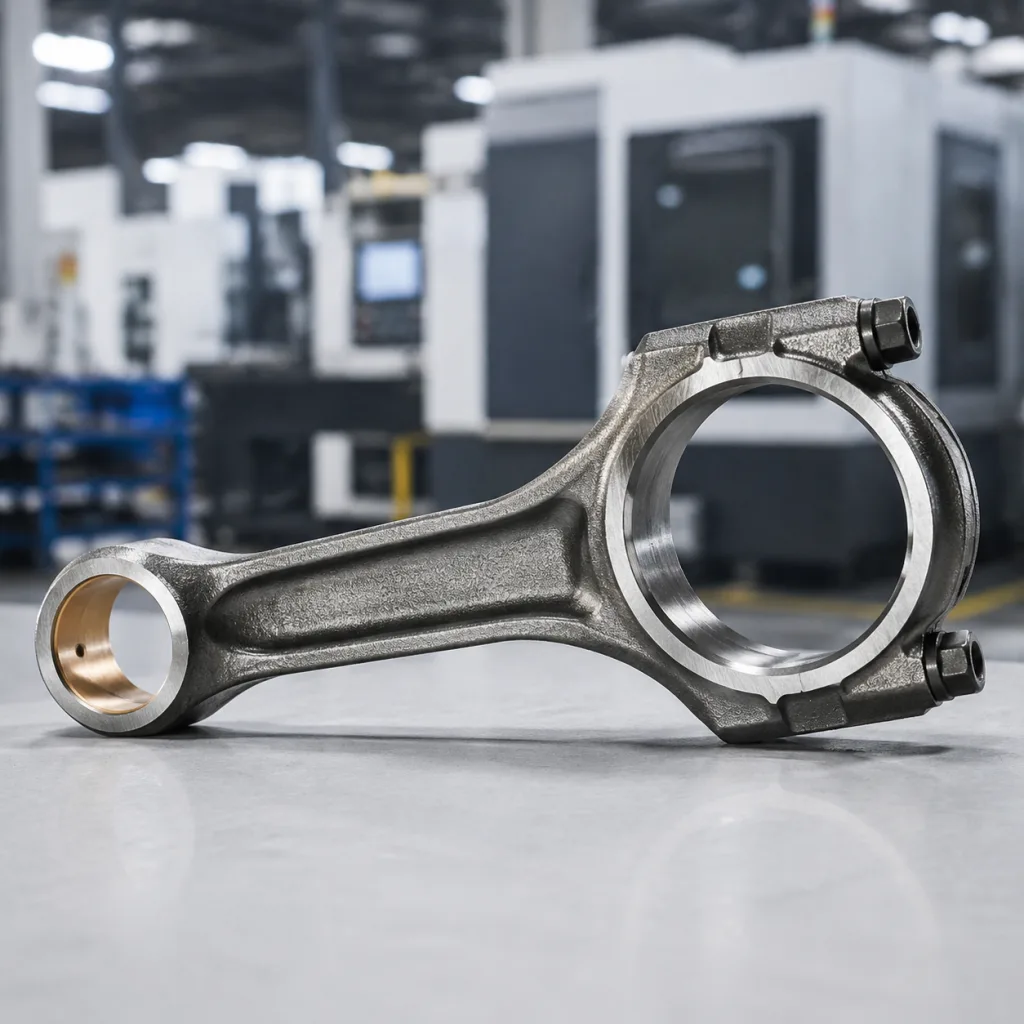
Connecting Rod for Audi A6 Aftermarket Replacement
A connecting rod for Audi A6 aftermarket replacement is not a model-name purchase. It is an engine-code decision. Before quoting, buyers need the centre-to-centre length, crankpin journal diameter, bearing width, piston-pin diameter, big-end bore after bolt tightening, small-end bushing condition, rod-bolt clamp method, and total plus end-to-end weight ranges used for engine balance.
A rod that is “close enough” can still install. That is the problem. The failure may appear later as bearing distress, piston slap, vibration, oil-film collapse, cap fretting, or fatigue cracking. For distributors, repair chains, and sourcing engineers, the target is controlled equivalence: correct fitment, repeatable material, stable machining, verified inspection, and traceable batches.
This guide turns the sourcing process into practical decisions: how to confirm fitment, where aftermarket rods fail, what dimensions matter, how to review metallurgy, when validation testing is necessary, and what documentation should block or release an order. Driventus is an independent aftermarket manufacturer; vehicle brand names and OE references are used only to identify fitment.
Start With the Engine Code, Not the Audi A6 Badge
Audi A6 applications include multiple petrol and diesel engine families, including inline-four, V6, and selected performance variants. One catalogue line cannot safely cover them all. The buyer’s first gate is fitment scope: engine code, displacement, production year range, fuel type, piston-pin size, crankpin diameter, bearing width, centre-to-centre rod length, big-end width, small-end style, bolt design, and cap-splitting method.
Catalogue matching usually comes from sample inspection, engine-code tables, customer fitment files, and OE part-number cross-references where available. If an OE reference is used, it should appear exactly as supplied in the sourcing file, for example OE 06A107065. It should not be presented as an approval, endorsement, or genuine-part claim. Driventus does not claim approval or endorsement by any vehicle manufacturer.
Total weight plus big-end and small-end balance, commonly held within a buyer-agreed 1–3 g set window
Surface condition at parting faces, fillet radii, machined bores, and shot-peened areas where specified
For RFQ screening, send one physical sample or controlled drawing, target engine codes, expected annual volume, service packaging format, and destination market. If the programme covers more than one Audi A6 engine family, assign each rod its own part number, inspection file, and fitment approval record. Do not group different rods under one broad model description.
Where Replacement Rod Programmes Usually Go Wrong
Most warranty risk starts with geometry, not appearance. A rod can look clean, carry the right catalogue label, and still damage an engine if the big-end bore, small-end bore, bend, twist, side width, cap register, bolt seat, or mass distribution is unstable. Buyers should request a control plan and lot-level inspection report, not just a drawing or catalogue description.
Failure mode
Procurement control
Why it matters
Wrong compression height or piston travel
Centre-to-centre length held to ±0.02 mm to ±0.04 mm, depending on drawing
Prevents compression imbalance and piston-to-head risk
Bearing oil-film loss
Big-end bore roundness ≤0.005 mm after cap assembly and final torque
Protects bearing crush and oil-film stability
Loose or tight bearing housing
Big-end bore size checked by 100% or AQL-based bore-gauge inspection
Reduces bearing spin, heat, and seizure risk
Pin knock or pin seizure
Small-end bore and bushing clearance checked in 0.005 mm increments where required
Controls pin movement and wear
Piston side loading
Bend and twist typically ≤0.03 mm per 100 mm unless drawing differs
Limits bore wear and skirt scuffing
Incorrect crank side clearance
Big-end width controlled to the crank journal target
Maintains oil flow and lateral movement control
Vibration after rebuild
Total and end weights sorted to an agreed set window
Keeps cylinder sets balanced
Cap movement under load
Bolt stretch or torque-angle response verified on sample bolts
Maintains clamp load around the crankpin
Poor bearing or pin seating
Bore surface roughness defined on drawing, often ≤0.4 µm Ra for honed bores
Supports stable bearing seating and pin motion
</tr></thead><tbody> </tbody></table>Inspection order matters. The big-end bore must be measured after the cap is assembled with the specified bolts and tightening procedure, because clamp load can move bore shape by several microns. A useful report shows torque or torque-angle setting, gauge ID, calibration date, measurement temperature, and at least two measuring planes at 90 degrees. For fracture-split rods, caps must remain marked and non-interchangeable through machining, cleaning, inspection, and packing.
Weight matching also needs precise language. Total rod weight may not be enough when a buyer requires big-end and small-end balance windows. A common service programme uses a full engine set sorted within 2 g total weight and within 1–2 g at each end, but the final tolerance should follow the engine specification or buyer-approved master sample.
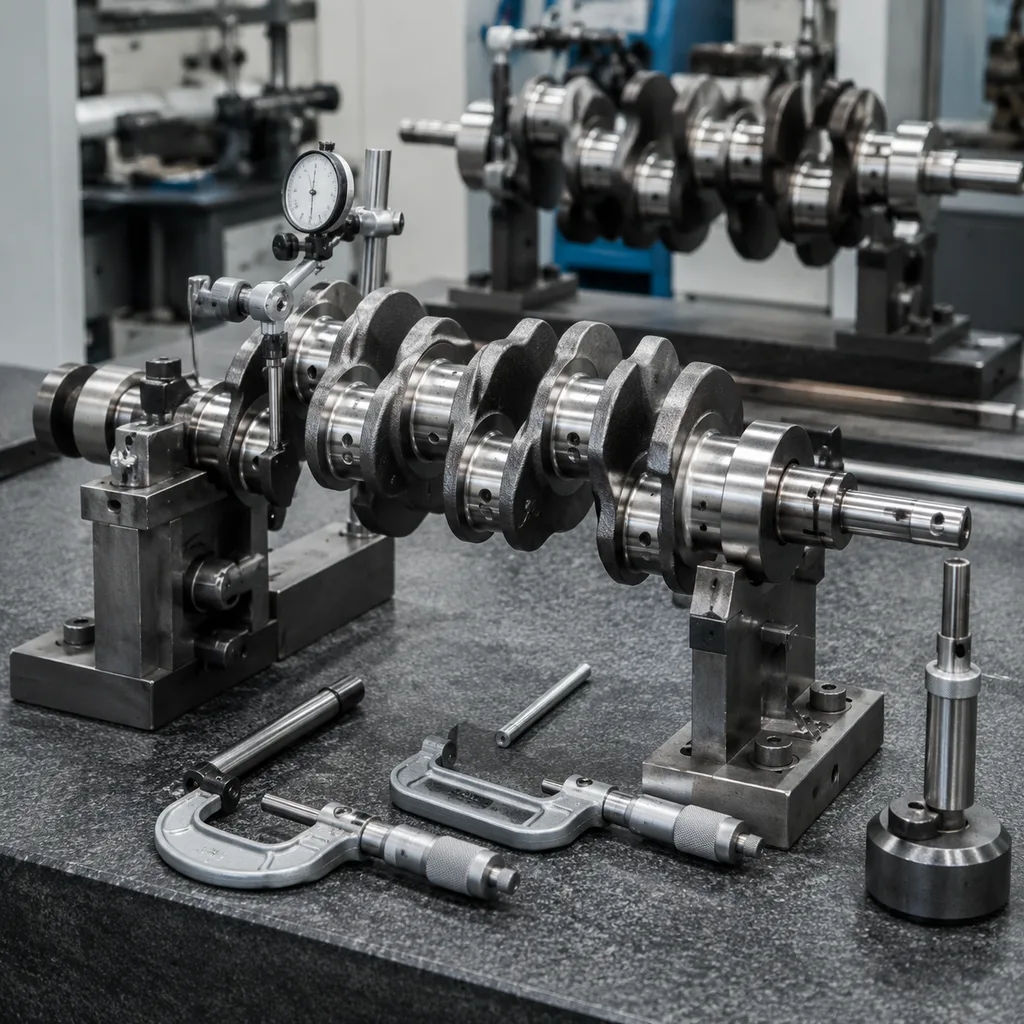
Driventus production control can include CNC machining, cap assembly, precision boring, honing, CMM inspection, hardness checks, magnetic particle inspection, and sample destructive testing depending on the part family and order specification. For multi-location repair chains, rods are commonly supplied as matched sets so installers do not have to sort mixed-weight assemblies on site.
Material Route: Forged, Powdered Metal, or Fracture-Split?
Material selection is not a generic upgrade choice. Aftermarket connecting rods for Audi A6 repair programmes may use forged steel, powdered metal, or another route depending on the original engine design. The replacement must meet the intended engine’s strength, stiffness, fatigue, machining, and cap-alignment requirements. Substituting a forged design for a powdered-metal fracture-split rod, or the reverse, should happen only after fitment, cap alignment, bolt load, and validation testing are confirmed.
For forged steel rods, ask for material-grade confirmation, heat-treatment records, hardness range, and evidence that grain flow and forging quality are controlled. Typical steel-rod programmes may specify alloy steel such as 40Cr, 42CrMo, or an equivalent grade agreed by drawing, with heat treatment controlled to a defined hardness band such as HRC 28–36 or another buyer-approved range. The exact grade and hardness must match the approved engineering file. Too soft, and the bore can lose stability. Too hard, and fatigue margin or machining consistency may suffer.
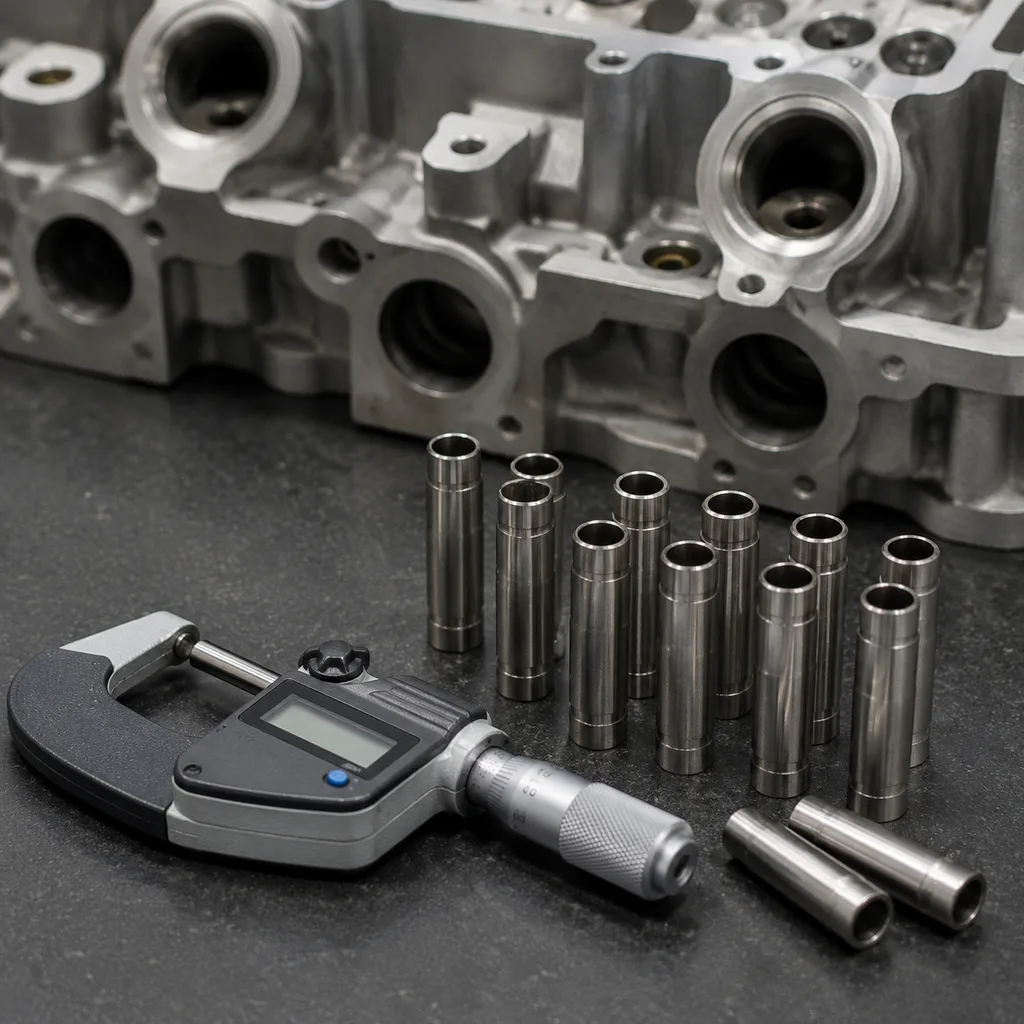
For powdered-metal or fracture-split designs, the cap face becomes the critical feature. Caps are not interchangeable. The audit should verify crack-split fixture control, cap pairing, bolt tightening sequence, and rejection rules for damaged fracture faces. For bushed small ends, define the bushing material, oil-hole geometry, surface finish, chamfer, and press-fit retention. Also define whether the bushing is supplied semi-finished, final-honed, or matched to a specified piston-pin clearance.
A serious supplier file should include:
Material certificate for each heat or batch, with chemical composition and heat number
Heat-treatment report with furnace batch, cycle record, quench or temper data, and hardness results
Forging, powder-metal, or machining route with critical-process controls
Surface treatment, shot-peening intensity, and coverage specification where applicable
Rod-bolt specification, supplier source, tensile class, coating, and tightening recommendation
Traceability code linking parts to raw material, heat treatment, machining lot, and inspection lot
Inspection data for critical dimensions, hardness, bore geometry, and mass sorting
Packaging method preventing bore damage, cap mix-up, impact marks, and corrosion
Rod bolts need their own review because they create the clamp load that keeps the cap stable around the crankpin. Confirm bolt grade, thread quality, seating condition, tightening method, and whether the bolts are reusable or single-use under the agreed service procedure. If torque-to-yield bolts are used, the service instruction and packaging label should state the single-use rule clearly.
Quality management should align with IATF 16949:2016 and ISO 9001:2015. For EU and UK distribution, material and surface-treatment declarations may also need review against REACH (EC) No 1907/2006 where applicable to the supplied article and packaging.
Validation Levels: Match the Test Plan to the Risk
Validation should prove that the rod holds geometry and fatigue resistance under the load conditions expected in the target engine. Not every connecting rod for Audi A6 aftermarket replacement needs the same test plan. A low-volume service programme may rely on sample inspection, installation trial, hardness checks, magnetic particle inspection, and dimensional recheck. A higher-risk private-label programme should add fatigue testing, bolt-clamp validation, and PPAP-style documentation.
A practical validation plan usually includes dimensional first-article inspection, bolt clamp-load verification, hardness testing, metallographic review, magnetic particle inspection, and fatigue testing on representative samples. Useful sample logic is to inspect 5–10 pieces for first article, run 20–50 pieces for a pilot lot, and hold mass-production release until installation feedback, bore stability, and packaging performance are reviewed. If the rod ships as part of an engine rebuild kit, verify compatibility with pistons, bearings, pins, and crankshaft journals as a system.
Replacement validation checklist
Confirm fitment by engine code, not vehicle model only
Inspect the sample against the drawing or approved master sample, including CMM and bore-gauge data
Assemble rod and cap with the specified bolt procedure before bore measurement
Check bearing seating, crush, tang location, and cap alignment
Verify piston-pin movement at operating clearance after bushing oil-hole inspection
Check side clearance on a representative crankshaft journal or controlled fixture
Confirm total weight plus big-end and small-end weight range across a full engine set
Perform magnetic particle inspection after heat treatment and machining where specified
Recheck big-end bore after bolt tightening, loosening, and retightening to detect cap movement
Record batch traceability and inspection results before shipment
Installation feedback is part of validation, not an afterthought. A pilot order is safer than an immediate full rollout because it can expose installer handling, bearing selection, lubrication practice, storage conditions, or packaging problems before larger stocking orders are placed. Define the number of workshop installations, mileage or operating-hour feedback where available, returned-part review rules, and the decision gate before repeat purchase orders.
For repeat programmes, retain reference samples from the approved lot and from each major production batch. If a complaint appears later, the retained sample allows comparison of bore size, hardness, weight, bolt condition, surface finish, and cap fit against the parts originally approved.
Supplier Audit Questions That Separate Price From Cost
A cheap rod is not cheap if it arrives without matched-set sorting, hardness evidence, bore reports, or change-control obligations. Evaluate a replacement rod programme like any other critical engine component: process capability, traceability, repeatability, and corrective-action control. Price differences often reflect real differences in machining capability, heat-treatment verification, rod-bolt sourcing, inspection frequency, packaging strength, and batch documentation.
During an audit, review the quality system, process flow, gauge calibration records, nonconforming-material procedure, and lot traceability. Check how the factory controls outsourced operations such as forging, heat treatment, surface treatment, bushing supply, and bolt manufacturing. Ask for the latest calibration list for bore gauges, micrometers, CMM fixtures, hardness testers, torque tools, and weighing scales used on the rod programme.
Use these questions before placing an order:
What is the MOQ by engine family: 100–300 pieces for stocked catalogue rods, or 500–1,000 pieces for private-label or new-tooling programmes?
What is the sample lead time: 15–30 days when tooling exists, or 45–75 days when fixture or tooling work is required?
What is the pilot-lot lead time after sample approval, and does mass production require 45–60 days depending on batch size and material availability?
Does the price include rod only, rod with bolts, bushed small end, matched sets, individual retail box, or bulk workshop packaging?
Are matched sets available for 4-cylinder, V6, or other engine-set configurations?
Which documents ship with each lot: inspection report, material certificate, heat-treatment record, and retained-sample record?
What change-control approval is required for material, tooling, bolts, bushing source, heat treatment, honing, or packaging?
Can export documentation support EU, UK, US, Canada, Australia, Brazil, or the buyer’s target market?
How are warranty claims handled, including photo evidence, installation data, returned-part analysis, and evidence-retention period?
Change control should be written into the purchase order. A supplier should not alter material source, heat-treatment route, bolt specification, machining fixture, honing process, bushing supplier, cleaning process, corrosion protection, or packaging method without buyer approval. Any of those changes can affect fitment, durability, or installation consistency.
Purchase orders should reference the approved drawing revision, sample approval date, packaging specification, inspection level, and required documents for shipment release. Driventus manufactures engine and powertrain components in Taizhou, Zhejiang, and exports to more than 60 countries, supporting aftermarket distributors, OEM and Tier-1 supply projects, and multi-location repair chains with catalogue items and drawing-based production.
Order Release Scenario: From RFQ to Packed Carton
The final risk is often logistics. Connecting rods can corrode, pick up bore nicks, lose cap pairing, or suffer impact damage during transport. Packaging should hold each rod separately, protect machined faces, keep caps paired with their rods, and stop movement inside the carton. For ocean freight, define anti-corrosion protection and humidity control according to route, transit time, destination climate, and warehouse conditions. A typical export setup uses a VCI bag or anti-rust oil, separator tray or foam support, inner carton protection, and a master carton weight suitable for warehouse handling.
The release file for a connecting rod for Audi A6 aftermarket replacement should include the approved drawing or sample reference, fitment list, inspection report, material certificate, heat-treatment record, bolt specification, packaging specification, and carton label format. Labels should identify part number, quantity, batch code, country of origin, production date or lot code, customer reference, and set number where matched sets are supplied. They should not imply vehicle-manufacturer approval.
Think of the order as a gated sequence:
1. RFQ with engine code, sample or drawing, target annual volume, market, packaging, and document requirements 2. Supplier feasibility review covering material route, tooling, MOQ, price tier, and lead time 3. Sample production with first-article inspection and bolt-tightening data 4. Buyer approval, installation trial, and pilot order release 5. Pilot-lot report with dimensional data, material certificate, heat-treatment record, and packaging photos 6. Mass-production purchase order tied to drawing revision, approved sample, inspection level, and change-control terms
For importers, lot-to-lot consistency matters more than a clean first shipment. If the second batch uses a different bolt, heat-treatment source, bushing material, honing stone, or anti-rust method, the programme risk resets. Require shipment release only after document review, photo confirmation of labels and packaging, and confirmation that the inspection lot matches the packed goods.
Buyers can review standard engine-component availability through our catalog or discuss drawing-based development through custom manufacturing. For live sourcing projects, provide the engine code, sample photos, requested annual volume, destination market, packaging requirements, target MOQ, expected price tier, and any OE cross-reference already in the customer file when you request a quote.
Frequently asked questions
Confirm by engine code, displacement, production year, crankpin size, piston-pin diameter, bearing width, centre-to-centre length, big-end width, small-end style, bolt design, and rod material route. Vehicle model alone is not enough because Audi A6 applications use different engine families.
Yes. For repair-chain and distributor programmes, matched sets can be supplied within an agreed weight range, often 1–3 g depending on the application and buyer requirement, with lot-level inspection records and packaging that keeps each set identified during storage and shipment.
Request drawing or sample approval, material certificate, heat-treatment record, hardness data, critical-dimension inspection report, rod-bolt specification, tightening recommendation, traceability code, packaging specification, and quality-system evidence aligned with IATF 16949:2016 and ISO 9001:2015.
For a controlled connecting rod sourcing review, share the engine code, sample data, annual volume, destination market, target MOQ, price tier, lead-time requirement, and packaging requirements. Driventus can review fitment and production options at /contact.html