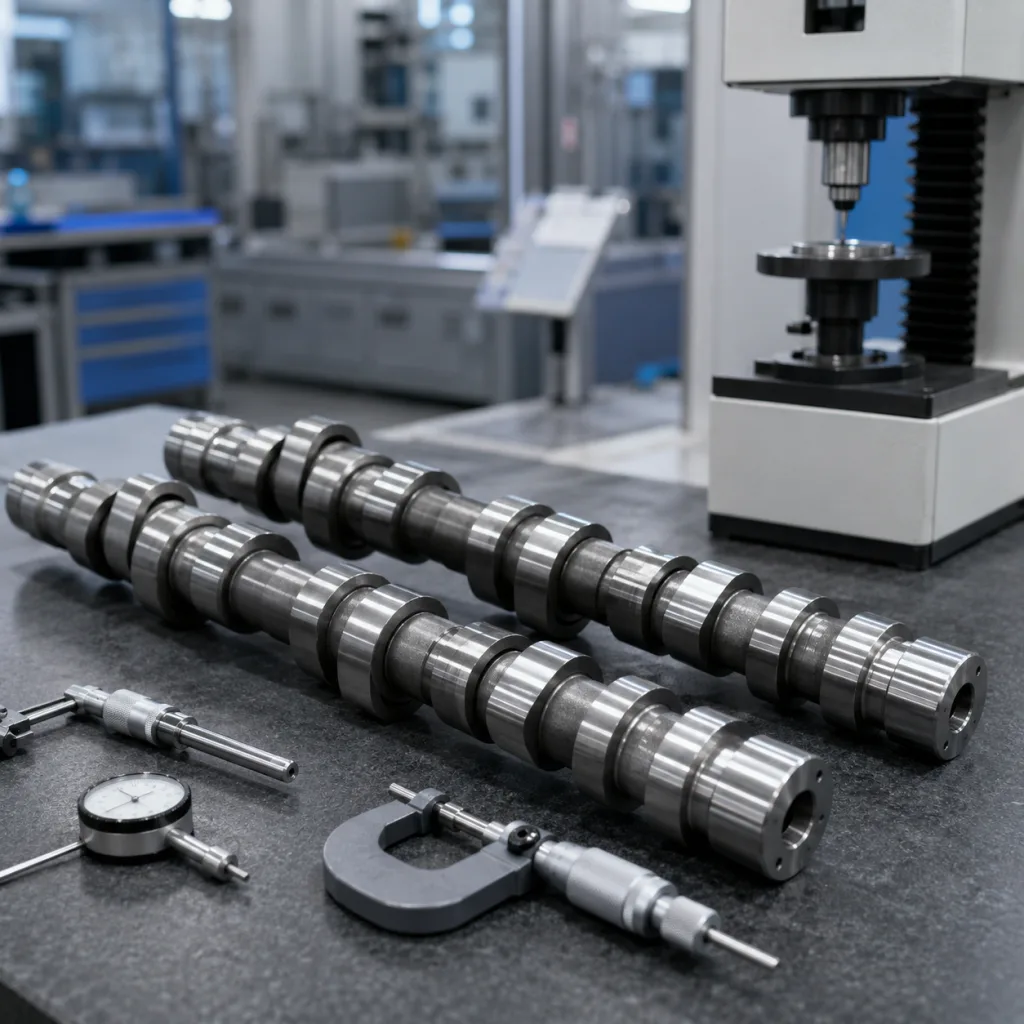
Camshaft for Nissan Altima Aftermarket Replacement
A camshaft for Nissan Altima aftermarket replacement is typically sourced for engine repair programmes, warranty-return investigations, distributor range expansion, or repair-chain stocking. For procurement teams, the decision goes beyond vehicle compatibility. The supplier must control lobe geometry, journal sizing, heat treatment, oil-passage cleanliness, packaging protection, and batch traceability across repeat shipments.
Altima applications vary by engine generation, production year, and market. Buyers should confirm engine code, intake or exhaust position, valve-train layout, sensor trigger design, and any variable valve timing interface before quotation. This guide explains how Driventus supports aftermarket distributors, repair-chain buyers, and engine component wholesalers with replacement camshaft sourcing. Driventus is an independent aftermarket manufacturer; brand names are referenced for fitment identification only.
Replacement fitment starts with engine identification
Altima camshafts are not interchangeable across all engines or positions. A sourcing file should identify the engine family, production year range, intake or exhaust requirement, variable valve timing arrangement, sensor trigger pattern, and market-specific emissions configuration. Capturing this information before quotation helps ensure that samples, drawings, inspection plans, and packaging labels reflect the actual repair demand.
A practical fitment file normally includes:
Vehicle model and production year range
Engine displacement and engine code, where available
Intake, exhaust, or matched camshaft set requirement
Valve-train type and follower interface
Cam phaser, sprocket, or timing-interface details
Camshaft position sensor trigger design
Packaging label format and customer part-number mapping
Driventus can support sourcing from catalogue references, customer drawings, or sample-based reverse engineering. Buyers can review related coverage in our catalog, including products listed under engine components. Fitment references are used only to identify replacement applications and do not imply vehicle manufacturer approval.
OE-equivalence criteria procurement teams should specify
For a camshaft for Nissan Altima aftermarket replacement, OE-equivalence should be defined by measurable characteristics rather than catalogue wording alone. Critical-to-function features include journal diameter, cam lobe lift, base-circle diameter, lobe separation, end-face geometry, oil-feed passage condition, thrust surface width, and timing-interface position.
Attribute
Procurement check
Typical acceptance method
Journal diameter and roundness
Supports oil film control and bearing clearance
Micrometer, roundness gauge, control chart
Lobe lift and profile
Controls valve opening and closing events
Cam profile measurement, master sample comparison
Surface hardness
Supports wear resistance at lobes and journals
Hardness testing after heat treatment
Runout and straightness
Helps reduce valve-train noise and uneven wear
V-block and dial indicator inspection
Timing reference position
Aligns valve timing and cam sensor signal
Fixture inspection against approved sample
Oil passage cleanliness
Reduces assembly contamination risk
Visual check, air flow, cleaning validation
</tr></thead><tbody> </tbody></table>Procurement teams should avoid relying only on outer dimensions. Two camshafts may look similar but differ in trigger wheel position, oil-feed routing, thrust-face design, or phaser interface. For distributors supplying professional repair channels, these differences can lead to installation delays and avoidable returns. A controlled replacement programme should combine dimensional inspection, functional fitment checks, approved reference samples, and batch documentation.
Materials, heat treatment, and machining controls
Camshaft material selection depends on application load, valve-train design, original construction, and production economics. Replacement camshafts are commonly produced from cast iron, chilled cast iron, or forged steel, depending on the required wear characteristics and the design being matched. Driventus aligns the production route with the target application instead of substituting material for convenience.
Key manufacturing controls include:
Controlled casting or forging source approval
CNC turning and grinding of journals, lobes, and end features
Heat-treatment process control for lobe and journal wear surfaces
Surface roughness checks on bearing journals and thrust faces
Deburring of oil holes, keyways, slots, and sensor features
Anti-corrosion oiling or VCI packaging before export
For B2B programmes, production stability matters as much as first-sample approval. A first article can meet dimensional targets while later batches drift if grinding wheels, fixtures, heat-treatment parameters, or cleaning procedures are not controlled. Driventus uses documented process controls under IATF 16949:2016 and ISO 9001:2015. Our quality system explains the wider approach to inspection, traceability, and corrective action management.
Where customer markets require chemical or material declarations, procurement files can also reference REACH (EC) No 1907/2006 obligations. For engine internal components, this is normally handled through material declarations, coating information, and packaging material review rather than vehicle-level emissions approval.
Validation checks before bulk ordering
A validated replacement camshaft programme should progress from application confirmation to sample approval and then to batch-level release. Procurement teams should request evidence that the part has been checked for dimensional match, assembly compatibility, and repeatable production control.
Recommended validation sequence:
1. Confirm application data and target reference sample. 2. Review drawings or create measurement records from sample parts. 3. Produce pre-production samples using the intended process route. 4. Check journal sizes, lobe profile, timing reference, runout, hardness, and surface finish. 5. Perform trial assembly or fitment evaluation when the buyer can provide an engine, cylinder head, or validated fixture. 6. Approve packaging, labels, carton strength, and palletisation. 7. Release production with defined AQL, traceability, and inspection records.
For multi-location repair chains, the feedback loop should include installer observations such as abnormal noise, oil pressure concerns, sensor faults, and timing-system compatibility. For distributors, return codes should separate catalogue mismatch from manufacturing defect. This distinction helps category managers improve application coverage without misclassifying root cause.
Driventus can provide standard replacement production or custom manufacturing for buyers that need a private-label range, revised packaging, a dedicated inspection plan, or an application-specific dimensional report.
Packaging, labelling, and import documentation
Camshafts are long, machined components with finished journals, lobes, thrust faces, and timing features. Export packaging must protect against corrosion, impact damage, bending risk, and label loss during inland transport, warehousing, and container movement. A useful packaging specification should define single-part protection, master carton quantity, gross weight, pallet height, barcode format, customer SKU display, and country-of-origin marking.
For aftermarket importers, the commercial file normally includes:
Proforma invoice and packing list
Country-of-origin information
HS code confirmation by the importer or customs broker
Batch number and production date coding
Customer SKU and cross-reference label data
Inspection report, if required by the purchase order
Material declaration or compliance statement where applicable
Driventus exports from Taizhou, Zhejiang to distributors, wholesalers, OEM/Tier-1 support channels, and repair-chain supply programmes in more than 60 countries. Lead time depends on whether the camshaft is in regular production, sample-based, or newly tooled. For repeat aftermarket demand, buyers often combine camshafts with related powertrain components such as gaskets, water pumps, crankshafts, pistons, and other engine parts to improve container utilisation and purchasing efficiency.
How to reduce returns in replacement programmes
Camshaft returns usually originate from three areas: incorrect application data, installation-related damage, or manufacturing nonconformance. Procurement teams can reduce risk by building tighter controls into the sourcing process before the first purchase order and by keeping return analysis connected to the original fitment file.
Useful controls include:
Application notes that distinguish intake and exhaust positions
Engine-code and production-year filters in the buyer catalogue
Clear photos or diagrams of sensor trigger and timing end features
Protective packaging that prevents lobe, journal, and end-face impact
Batch traceability linked to carton labels and inspection records
Return analysis forms that capture vehicle data and fault description
A camshaft for Nissan Altima aftermarket replacement should also be evaluated with related components in mind. Worn followers, blocked oil passages, incorrect lubricant, damaged timing chains, weak tensioners, or reused torque-to-yield fasteners can cause premature failure even when the camshaft is dimensionally correct. A distributor warranty policy should therefore request installation context, not only photos of the returned part.
Driventus supports this process with sample comparison, dimensional reporting, production traceability, and packaging review. The objective is consistent replacement performance across repeat orders, not a one-time sample that cannot be reproduced.
Frequently asked questions
Yes, subject to application confirmation. Buyers should specify engine family, production year range, intake or exhaust position, timing interface, and any sample or drawing reference before quotation.
No. Driventus is an independent aftermarket manufacturer; brand names are referenced for fitment identification only. We do not claim approval, endorsement, or authorisation by any vehicle manufacturer.
Typical documents include inspection reports, batch traceability records, packing lists, invoices, and relevant material or compliance statements. Requirements should be agreed during quotation.
If you are building a replacement camshaft sourcing programme, share the application data, target quantity, and documentation requirements with our team. You can [request a quote](/contact.html).