A clutch kit Vauxhall replacement programme fails fastest when it is treated as a simple catalogue match. For aftermarket distributors, repair-chain buyers and import managers, the expensive problems are usually hidden in the interfaces: spline geometry, release bearing travel, CSC port position, pressure plate clamp load, flywheel compatibility and packaging protection during export. Once the gearbox has to come out again, labour often costs more than the kit. By then, installation marks, heat spots or contamination can make responsibility hard to prove.
This article sets out how Driventus approaches Vauxhall and Opel-aligned clutch kit sourcing for professional aftermarket programmes. It is not a generic buying checklist. It focuses on the decisions that prevent wrong-part supply, premature noise, slip, judder, hydraulic leakage, transit damage and unclear warranty disputes. Driventus is an independent aftermarket manufacturer; vehicle and brand names are used only to identify fitment. The goal is simple: specify kits that install correctly, engage predictably and can be supported with evidence if a field issue occurs.
Decision Gate 1: Prove the Vehicle Application Before You Price the Kit
Start with the application, not the part photo. Vauxhall clutch applications often overlap with Opel platforms, but a model name and engine size are not enough for purchasing control. Engine code, transmission code, production date, flywheel type and release actuation can all change the correct kit. A petrol hatchback, diesel estate and light commercial van may sit on related platforms yet need different torque capacity, cover height, damper design or bearing geometry.
Before releasing an RFQ for a clutch kit vauxhall replacement range, lock down the application sheet. It should cover:
Vehicle platform and model-year range, preferably with month/year production cut-offs
Engine displacement, fuel type and engine code; include power output where one engine code has more than one calibration
Gearbox family and input shaft spline count, for example 14, 17, 20 or 24 teeth depending on the application
Clutch disc outside diameter, thickness and hub offset; common passenger-car diameters often sit around 200–240 mm, while van applications may be larger
Pressure plate bolt pattern, dowel position, cover height and diaphragm finger position
Concentric slave cylinder or external release bearing type, including hydraulic connector shape and mounting-face geometry
Single-mass flywheel or dual-mass flywheel compatibility, including whether the kit is for OE-style DMF service or a conversion system
OE part-number cross-reference format where available, used only when it matches verified buyer data
This matters most when distributors merge Vauxhall, Opel and broader European references into one aftermarket catalogue. Adjacent applications can look identical in catalogue images but differ by a few millimetres of release travel, a hydraulic port angle or a damper spring layout. Those small differences become returns.
A useful application sheet includes buyer SKU, supplier SKU, OE references, vehicle notes, exclusion notes and supersession history. Catalogue teams then have a way to control early/late variants instead of relying on memory or supplier descriptions.
For RFQ preparation, send annual forecast, first-order quantity by SKU, target market, packaging type and mandatory cross-reference format. Pricing is usually cleaner when the first order covers a stable core range rather than many small trial quantities. Low-volume SKUs may require higher unit prices, tooling review or consolidation with repeat production. Driventus maintains application records in our catalog and supports fitment validation for buyers consolidating regional references. No vehicle manufacturer approval or endorsement is implied.
Where “Looks the Same” Fails: Dimensional and Interface Checks
A clutch kit must fit the original installation envelope. Close is not enough. Small dimensional errors can create release noise, incomplete disengagement, pedal vibration, accelerated lining wear, hydraulic leakage or early bearing failure. For B2B replacement programmes, controlled measurements are more valuable than a broad claim of compatibility.
Cover height, bolt circle, diaphragm finger position
Cover height within ±0.30–0.50 mm; bolt-hole position per drawing
Release travel error, bolt interference
Release bearing or CSC
Stroke, mounting face, hydraulic port position
Mounting face and port location per approved sample/drawing
Leakage, noise, non-release
Alignment tool
Pilot diameter and spline approximation
Functional fit with pilot and disc hub
Installation damage, disc misalignment
Fasteners where included
Grade, thread, coating, locking method
Grade and coating as specified; torque test by batch
Clamp loss, corrosion, service rework
</tr></thead><tbody> </tbody></table>\*Final tolerances should follow the approved drawing, OE sample, application requirement and agreed inspection plan.
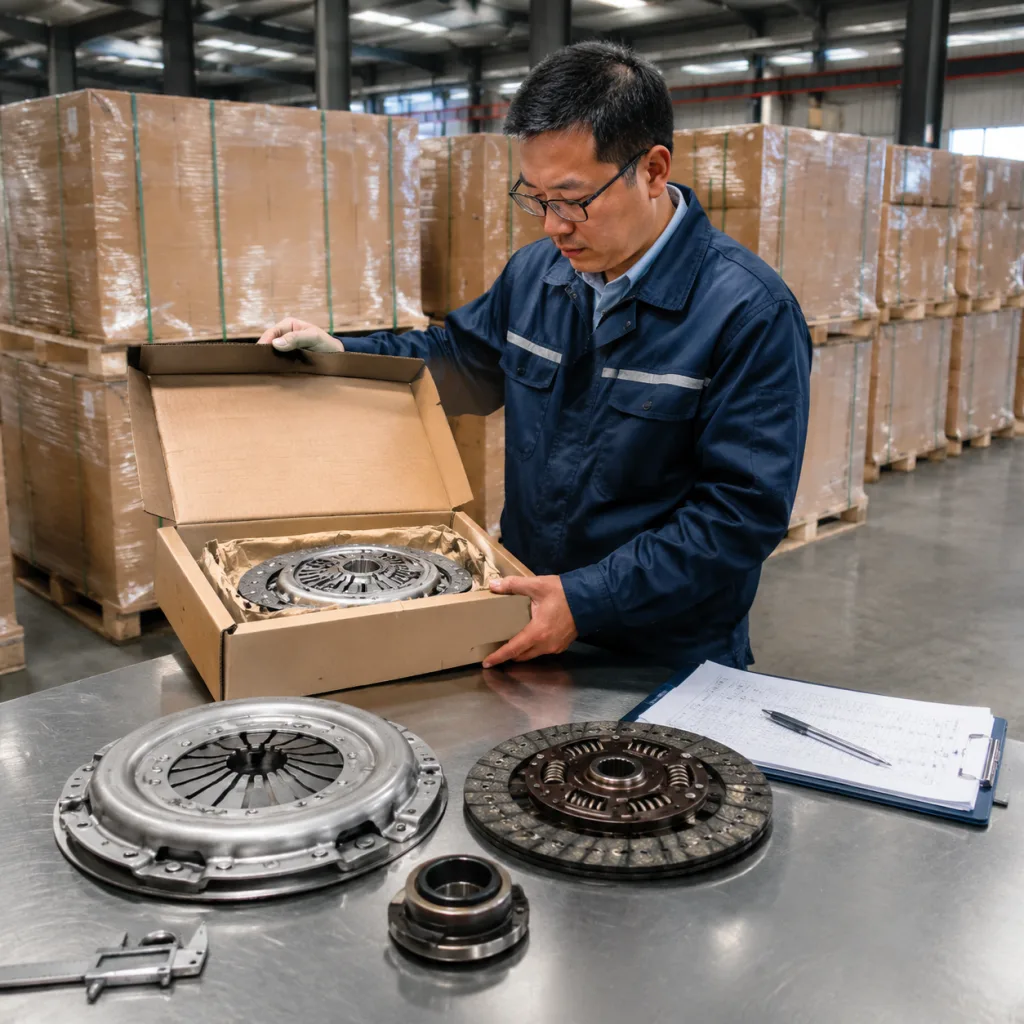
Inspection normally uses digital callipers, micrometers, height gauges, spline plug gauges, runout fixtures, spring-load testers and controlled torque assembly. For higher-risk SKUs, agree the batch inspection plan before the purchase order is released. Waiting until the first shipment arrives turns quality control into damage control.
A practical route is first-article approval for each new reference, then AQL-based inspection for production lots. Keep 100% checks for safety-critical interfaces, hydraulic sealing surfaces or dimensions already linked to claims.
The kit also has to match the surrounding system. A kit designed for a dual-mass flywheel may not behave correctly on a single-mass conversion unless the disc damping and clamp load are specified for that arrangement. A release bearing can look visually close but have a different face profile, fork contact width, travel range or hydraulic connection.
For CSC units, confirm bore, stroke, bleed-port orientation, seal material compatibility with the specified brake fluid and packaging protection for ports. For custom references, Driventus can review samples, drawings and buyer fitment data through custom manufacturing. The best sample set includes a new OE or verified aftermarket kit, the removed part if a claim is involved, gearbox/flywheel photos, and the buyer’s intended label and application data.
Spec Deep-Dive: Friction, Clamp Load and the Feel of the Pedal
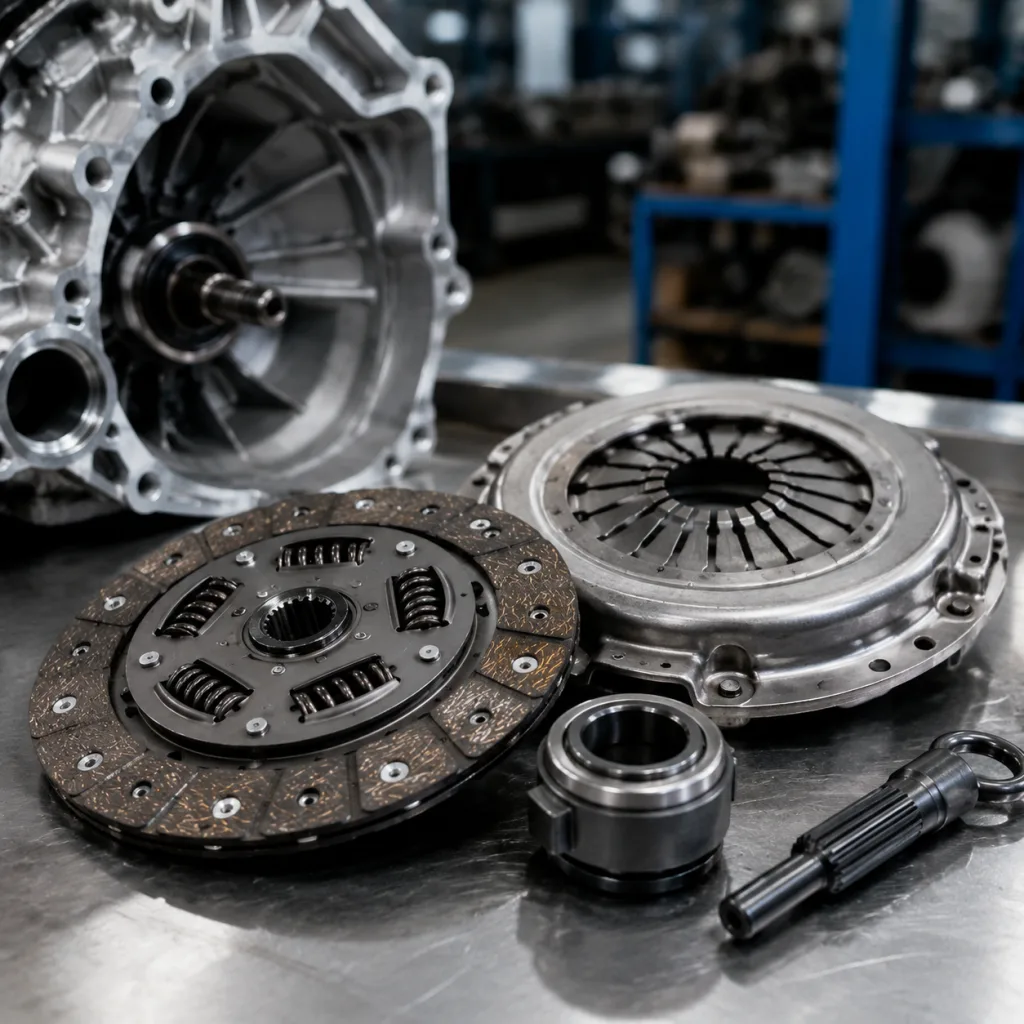
Technicians see the friction disc first, but the vehicle feels the whole system. Disc facing, torsional damper, pressure plate, diaphragm spring and release mechanism must work as one matched assembly. A clutch kit vauxhall replacement programme should therefore be validated for torque holding capacity, engagement feel, pedal behaviour and thermal stability, not just dimensions.
Key validation areas include:
Static clamp load measurement after assembly, recorded by cover type and production batch
Disc facing thickness and rivet depth control; rivet head depth is normally specified to protect wear margin
Burst speed testing for rotating components, usually above maximum engine speed with an agreed safety factor
Torsional damper spring function, preload and free angle checks
Pressure plate lift and parallelism measurement across the working stroke
Runout and balance checks where required by the application; disc lateral runout is often controlled around 0.50–0.80 mm depending on design
Hot-spot inspection after thermal cycling and controlled slip tests
Noise, vibration and harshness screening on applicable rigs, especially for diesel and light commercial references
Salt-spray or coating checks for exposed steel components where required by the buyer, such as 48–96 hours for basic corrosion screening or higher if specified
Formulation is application-specific. A small petrol vehicle may need smooth engagement, low pedal effort and low noise. A diesel van may need a higher torque margin and better thermal resistance under load. The pressure plate also has to hold torque without overloading the release system or making the pedal unacceptable.
Ask for the design torque margin against engine output and intended use. Do not rely only on catalogue interchange.
Manufacturing discipline is just as important as the headline specification. Facing material should be mixed, pressed, cured and finished under controlled parameters. Disc assemblies should be riveted to defined pressure, checked for parallelism and inspected for contamination before packing. Pressure plates should have diaphragm spring characteristics checked, cover assemblies balanced where required, and machined surfaces protected immediately after final inspection.
Batch records should connect the disc facing lot, spring lot, cover production lot and final kit packing lot. That traceability becomes critical when a claim pattern needs investigation.
Friction material should comply with chemical controls in the target market, including REACH (EC) No 1907/2006 for the European Union where relevant. If buyers require restricted-substance declarations, asbestos-free statements, copper or heavy-metal limits, or market-specific material documents, confirm them at quotation stage. After production is too late.
Importer Control File: What Certification Does—and Does Not—Prove
Factory certification is useful, but it is not part approval. It shows that a management system exists. It does not prove that every clutch kit reference fits every Vauxhall or Opel variant in your catalogue. Treat certification as the foundation, then build a product-specific sourcing file on top.
Driventus operates under IATF 16949:2016 and ISO 9001:2015, with production controls covering incoming material inspection, process monitoring, final inspection and traceability.
A practical importer file should include:
Supplier certificate copies and validity dates
Control plan summary for the product family, including special characteristics
Critical-dimension inspection report with drawing/sample reference and measuring equipment used
Material or friction formulation declaration where applicable
Packaging drop-test or transit-protection evidence for export lanes
Batch traceability format and label examples, including date code and production lot logic
Warranty assessment process and return-part requirements
Approved sample status or reference sample retention for key SKUs
Change-control requirement for formulation, bearing source, CSC seal supplier, coating, carton and label changes
For distributors selling into the EU, UK, US, Canada, Australia or Brazil, documentation should also support customs classification, country-of-origin declarations and customer-specific labelling. Multi-location repair chains may need barcode labels, installation notes and consistent carton dimensions to reduce branch-level handling errors.
Barcode data should be frozen before carton printing. Common mistakes are basic but costly: missing check digits, conflicting private-label SKUs, poor print contrast, labels that lift in humidity, or barcodes that fail after stretch-wrapping.
Change control needs to be explicit. If the friction formulation, bearing supplier, fastener coating, carton structure or label format changes, the buyer may need advance notice and updated documentation. For private-label programmes, put the route in the purchase agreement: sample submission, comparison report, buyer sign-off and effective production date. This protects the distributor that owns the customer relationship and has to answer field questions quickly.
Commercially, prices depend on bill of materials, order quantity, packaging format, testing level and forecast stability. A neutral-packed repeat order with stable carton artwork will not carry the same lead-time profile as a private-label launch needing new artwork, barcode approval and pre-shipment inspection. Driventus shares relevant process documentation through its quality system review process, subject to commercial and confidentiality requirements.
Scenario Planning: Packaging, MOQ and Lead Time in a Real Replacement Programme
Imagine the kit leaves the factory correctly built, then arrives with a bent diaphragm finger, a bruised release bearing or a contaminated friction facing. The installer does not see the full history. The buyer just sees a claim. That is why packaging is part of the product specification, not an afterthought.
Clutch kits are vulnerable to impact, humidity and contamination during sea freight, inland transport and warehouse handling. Packaging should stop movement inside the carton and protect machined faces from corrosion during storage.
For import programmes, specify:
Individual kit carton with internal dividers, formed pulp, foam or corrugated supports to prevent metal-to-metal contact
Rust-preventive oil, VCI paper or sealed protection for machined steel surfaces, selected for the expected storage period
Bearing cap, port plug or sealed bag protection where applicable, especially for CSC hydraulic ports
Clear part number, batch number, quantity, country-of-origin and application label
Pallet pattern suitable for container loading and warehouse picking; keep heavy kits low and avoid overhang
Outer carton strength matched to export transport conditions, with edge-crush/burst strength agreed for the lane
Neutral or customer-branded packaging, as agreed
Barcode, language and installation-note requirements where needed
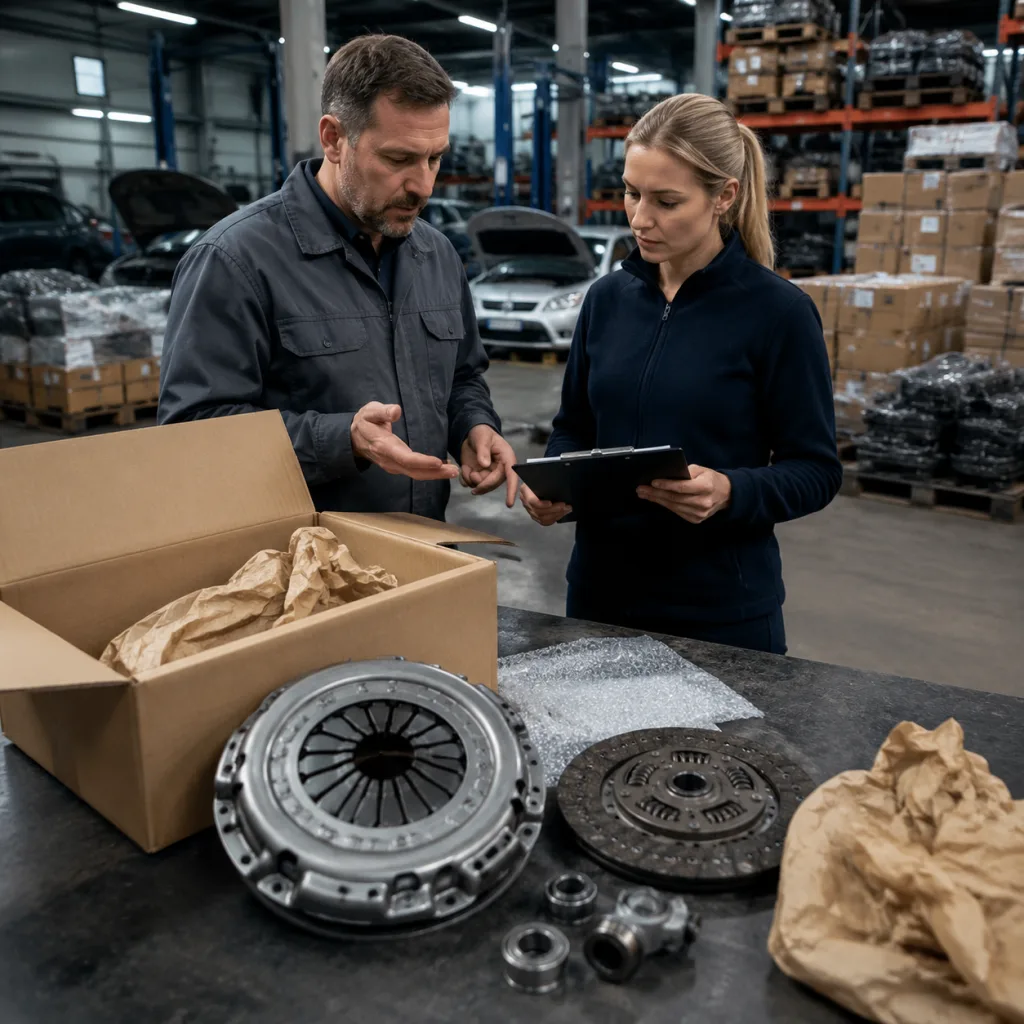
Poor packaging creates failures before the part reaches the workshop. A contaminated lining or damaged diaphragm finger may pass a quick receiving check but fail after installation. Inbound inspection should therefore include random carton opening, component seating checks, corrosion checks, bearing rotation checks and label verification against the purchase order.
For a first mixed container, open several cartons per SKU. Once the supplier proves stable packing quality, reduce the frequency.
Lead time is shaped by SKU count, packaging type, order quantity and forecast stability. Separate three dates in planning: sample lead time, mass-production lead time and vessel or road transit time. New private-label references usually need extra time for artwork confirmation, sample approval, carton production and final inspection. Add buffer for fitment questions and label corrections before the schedule is locked.
MOQ is usually driven by component batch size, carton printing, bearing or CSC sourcing and pallet efficiency. Buyers can reduce cost by grouping SKUs with common pressure plates or bearings, using neutral cartons for slow movers, and providing a rolling forecast instead of urgent spot orders. For private-label programmes, approve artwork, carton testing and barcode format before production scheduling. Otherwise, the finished kit waits for the box.
Warranty Q&A: How to Separate Product Faults from Field Damage
Why are clutch kit claims hard to judge? Because wear, installation technique, driving conditions and related component condition all influence performance. A new kit can be damaged by a worn flywheel, incorrect alignment, excess grease, hydraulic faults or release fork wear. Product validation matters, but so do installation rules and evidence collection.
What should workshops check before installation?
Confirm flywheel condition; heat cracks, excessive runout or deep scoring can damage a new clutch. If flywheel runout exceeds the vehicle service limit, the clutch kit should not be blamed for judder.
Replace the release bearing or concentric slave cylinder when specified as part of the kit; reusing a worn bearing can cause noise or uneven diaphragm wear.
Check the gearbox input shaft and lubricate only at approved contact points; excess grease can migrate onto the facing.
Use the correct alignment tool and torque sequence; pressure plate bolts should be tightened progressively in a star pattern to avoid cover distortion.
Keep the friction surfaces clean. Grease, oil or hydraulic fluid can create slip, judder or hot spots.
Check the hydraulic system, cable adjustment or release fork condition where applicable.
Record vehicle mileage, technician observations, flywheel condition, installation date and removed-part condition for claims.
What evidence supports a fair technical decision? A useful return includes the complete kit, original carton label, vehicle data, installation mileage, failure mileage and workshop notes. Photographs help, but they rarely replace the physical part.
Claim review may consider lining condition, heat marks, diaphragm finger wear pattern, bearing witness marks, spline condition, rivet contact, broken damper springs and signs of contamination. A supplier should be able to distinguish manufacturing defects from application mismatch, installation damage and system-related failures.
How should buyers monitor claim trends? Track claims by failure mode and SKU, not just total count. One noisy bearing report may be a workshop issue. Repeated reports on the same application, batch or branch can indicate catalogue error, packaging damage or process drift. Monthly claim-rate review by parts sold gives a better view than claim count alone. Many professional buyers set an alert level, for example a rising claim rate above 0.5–1.0% on a mature SKU, to trigger review before the issue spreads.
Driventus supports batch traceability, retained samples for selected production runs and structured claim review for B2B customers. If your purchasing team is building a clutch kit vauxhall replacement range, share the application list, forecast, target market, MOQ expectations, target price band and packaging requirements when you request a quote.
Frequently asked questions
Verify engine code, gearbox type, production date, flywheel type, disc diameter, spline count and release system. Model name alone is not enough because similar Vauxhall and Opel applications can use different pressure plates, friction discs or release bearings.
Yes. Driventus can supply neutral packaging or customer-specified packaging subject to artwork, order quantity and labelling requirements. Export carton strength, batch traceability, barcode format and pallet configuration should be confirmed before production.
No. OE-equivalent refers to dimensional, material and functional alignment with the intended replacement application. Driventus is an independent aftermarket manufacturer; brand names are referenced for fitment only.
For fitment review, sample evaluation or a quotation on clutch kit references, contact the Driventus export team. Start with your application list, target market, packaging requirements, MOQ expectation, annual forecast and target lead time at /contact.html