Clutch Kit Supplier: Sourcing Guide for B2B Buyers
A clutch kit supplier has to do more than ship parts. B2B buyers need consistent fitment, documented quality control, export-ready packing, and lead times they can plan around. For distributors, wholesalers, repair chains, and OE or Tier-1 programmes, the buying decision usually comes down to dimensional accuracy, friction material selection, diaphragm spring load, and batch traceability. Driventus is an independent aftermarket manufacturer; brand names are referenced for fitment only. We produce engine and powertrain components in Taizhou, Zhejiang, and export to more than 60 countries under IATF 16949:2016 and ISO 9001:2015 systems. This article explains what procurement teams should verify before placing orders, how to compare suppliers, and which documents help reduce landed-cost risk. If you are sourcing by OE reference, the supplier should support cross-checks against OE numbers and application data without implying vehicle-maker approval.
How to judge a clutch kit supplier
The fastest way to separate a capable clutch kit supplier from a generic source is to check whether they can prove fitment, repeatability, and shipment control at the same time. If any one of those is vague, the quote is not ready for procurement.
Start with these checks
- Exact vehicle and transmission application
- Disc diameter, hub spline, and lining thickness
- Cover height, clamp load, and release bearing type
- Batch traceability and lot-marking practice
- Export packaging and moisture protection
- Certificate scope and inspection records
A good RFQ should name the vehicle, engine, gearbox code, OE reference if available, and the full kit contents. That level of detail matters because two kits that look identical can fail differently once installed. A 220 mm package is not interchangeable with a 240 mm package, and a spline mismatch will stop the job before the vehicle leaves the bay.
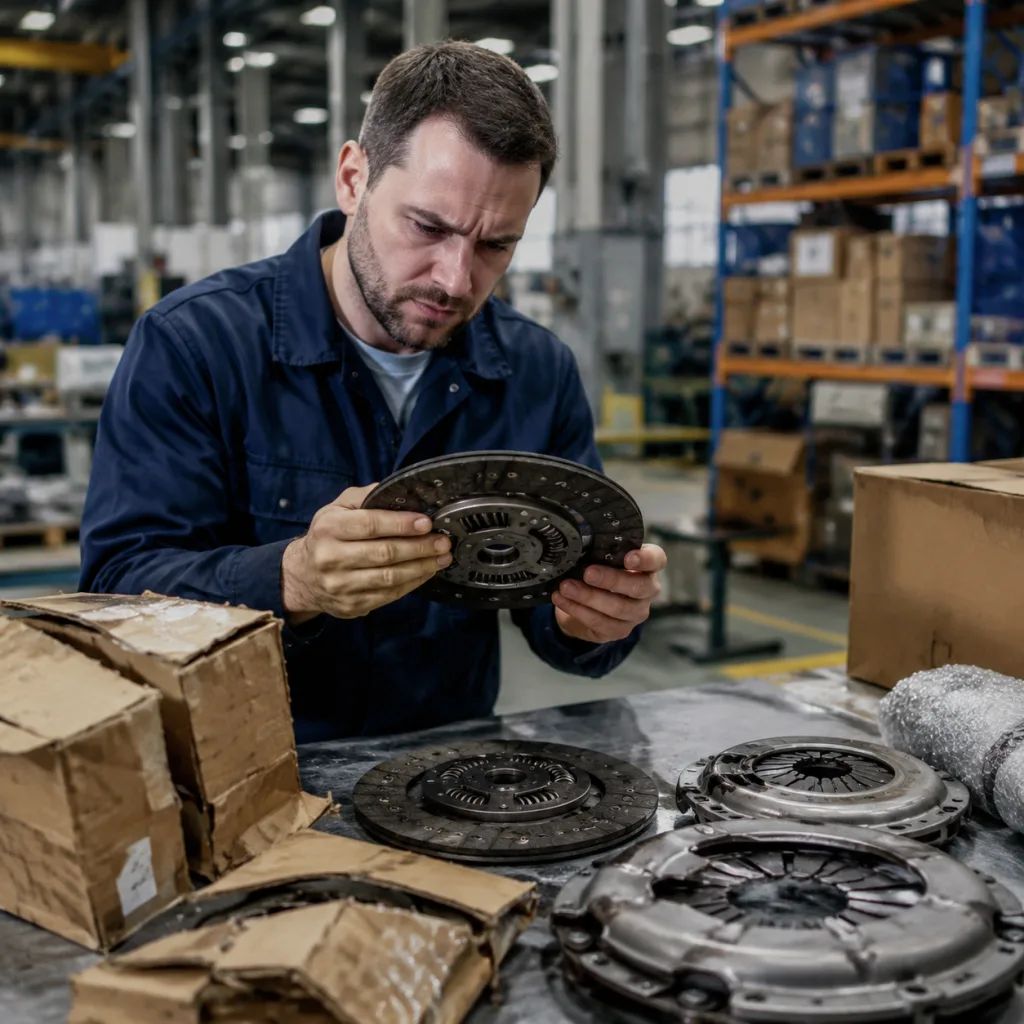
Ask for written tolerance data, not just catalog claims. Disc runout, facing thickness variation, cover-to-flywheel installed height, and bearing geometry should all be documented. If the supplier only says it "fits many models," treat that as a warning sign. Strong suppliers tie each part number to a defined application list and revision history.
Specification details that affect fit and life
Clutch assemblies fail in predictable ways when a key dimension drifts. That is why procurement teams should review the actual spec stack instead of stopping at the part number.
| Specification | What it influences | Why buyers care |
|---|---|---|
| Disc outer diameter | Torque capacity and packaging | Prevents wrong-size substitution |
| Hub spline count | Transmission engagement | Avoids installation failure |
| Friction lining thickness | Wear life and pedal feel | Impacts durability claims |
| Cover height | Clamp setup and release travel | Controls installation accuracy |
| Clamp-load data | Holding power under load | Helps compare equivalent kits |
| Bearing contact geometry | Noise and smooth release | Reduces comebacks |
| Area | Better supplier | Riskier supplier |
|---|---|---|
| Application control | Ties parts to specific vehicle and gearbox codes | Uses broad model-fit language |
| Quality evidence | Shares inspection records and certificate scope | Relies on marketing claims |
| Traceability | Marks cartons, packs, and lots clearly | Cannot isolate production batches |
| Lead time | States sample and production timing separately | Gives one vague delivery promise |
| Packaging | Defines carton, pallet, and moisture protection | Treats packaging as an afterthought |
| Claim handling | Has containment and corrective-action flow | Defers every issue to sales |